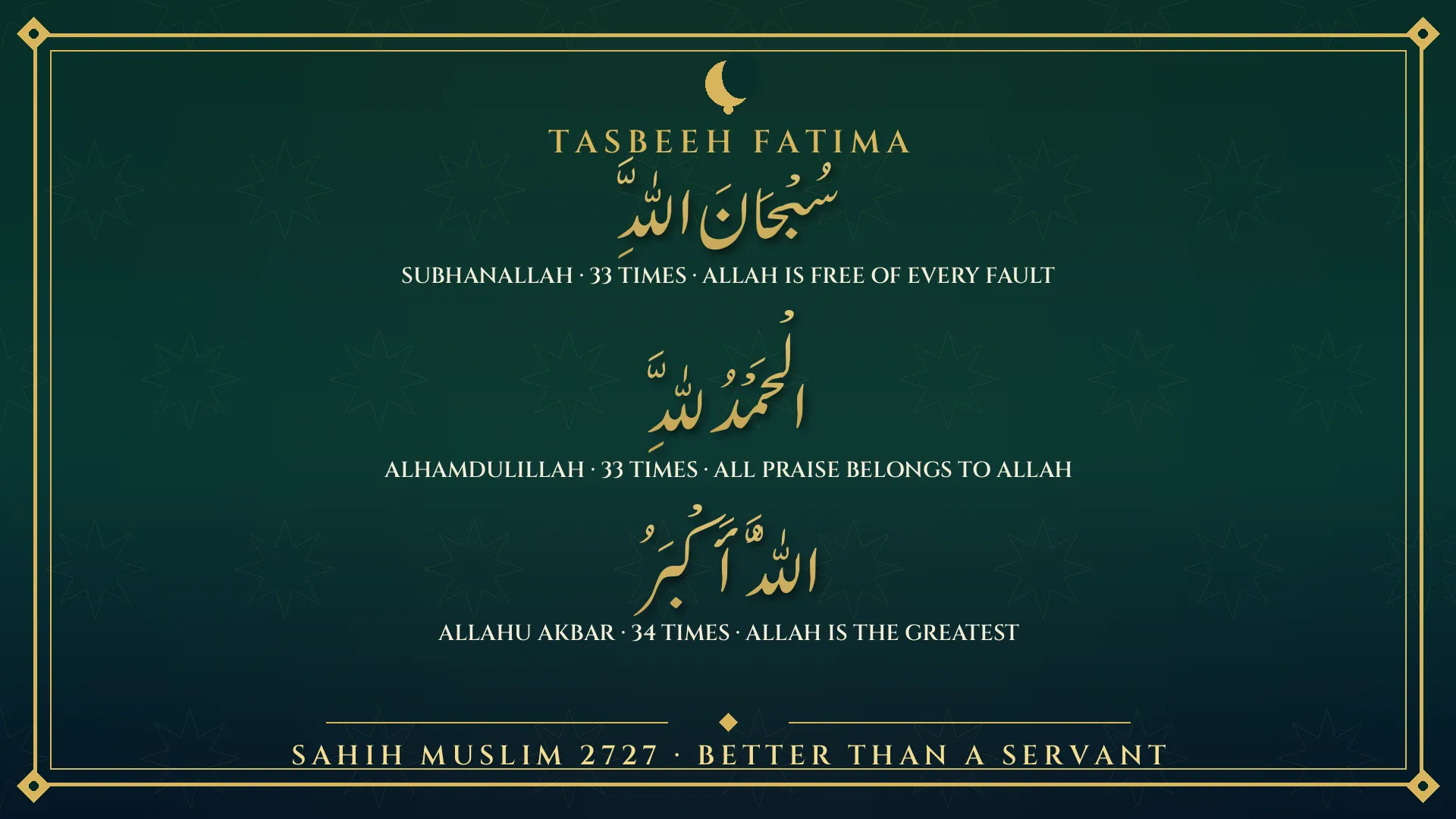
Tired at night? The Prophet ﷺ taught his daughter a 100-count dhikr instead of a servant
Table of Contents
- Quick Answer
- What Is Tasbeeh Fatima?
- The Night Fatima Asked for a Servant
- How Many Times? The Counts, Narration by Narration
- What Do the Three Phrases Mean?
- The Better-Than-a-Servant Reset: Your Start-Tonight Plan
- What Are the Benefits — and What the Hadith Actually Promises
- Tasbeeh Fatima in a Western Day
- Common Mistakes and Misconceptions
- FAQ
- Next Step
Quick Answer
- Tasbeeh Fatima is the dhikr (remembrance of Allah) the Prophet ﷺ taught his daughter Fatima (RA) and Ali (RA) at bedtime: SubhanAllah 33 times, Alhamdulillah 33 times, Allahu Akbar 34 times — 100 in total (Sahih Muslim 2727a).
- The same three phrases are also read after every obligatory prayer, with counts of 33, 33, 34 (Sahih Muslim 596a) or 33 of each completed to 100 with La ilaha illallah… (Sahih Muslim 597a).
- He ﷺ called it “better for you than a servant.” Slowly and with attention, it takes about three to four minutes.
Your hands are sore, the kitchen is finally quiet, and the day has taken everything you had. That is the exact moment this dhikr was given — to a young mother whose hands were blistered from grinding grain.
Tasbeeh Fatima is a set of 100 short phrases of remembrance — 33 times SubhanAllah, 33 times Alhamdulillah, and 34 times Allahu Akbar — taught by the Prophet Muhammad ﷺ to his daughter Fatima (RA) when she asked him for a servant, and described by him as better than what she asked for.
What Is Tasbeeh Fatima?
Tasbeeh Fatima is named after Fatima (RA), the daughter of the Prophet ﷺ, because he taught it to her and her husband Ali (RA) at home, in bed. Tasbeeh means glorifying Allah by saying SubhanAllah. The name covers all three phrases: Tasbih, Tahmid (Alhamdulillah), and Takbir (Allahu Akbar).
It sits inside a wider Quranic habit. Allah commands:
يَـٰٓأَيُّهَا ٱلَّذِينَ ءَامَنُوا۟ ٱذْكُرُوا۟ ٱللَّهَ ذِكْرًا كَثِيرًا ٤١ وَسَبِّحُوهُ بُكْرَةً وَأَصِيلًا ٤٢
Ya ayyuhalladhina amanu-dhkuru-llaha dhikran kathira. Wa sabbihuhu bukratan wa asila.
“O believers! Always remember Allah often, and glorify Him morning and evening.” (Surah Al-Ahzab 33:41-42, The Clear Quran)
Urdu (Jalandhari, checked via the Quran.com API for both ayahs):
“اے اہلِ ایمان! خدا کا بہت ذکر کیا کرو، اور صبح و شام اس کی پاکی بیان کرتے رہو۔”
This is why the same phrases run through the morning and evening azkar: the Quran sets the rhythm; the Sunnah gives it words and counts.
The Night Fatima Asked for a Servant
Fatima’s hands had blisters from turning the hand-mill. When captives were brought to Madinah, she went to her father ﷺ to ask for a servant. He was not home, so she left her request with Aisha (RA). That night he came to the couple’s house, sat between them in bed, and said:
أَلَا أُعَلِّمُكُمَا خَيْرًا مِمَّا سَأَلْتُمَا؟ إِذَا أَخَذْتُمَا مَضَاجِعَكُمَا أَنْ تُكَبِّرَا اللَّهَ أَرْبَعًا وَثَلَاثِينَ، وَتُسَبِّحَاهُ ثَلَاثًا وَثَلَاثِينَ، وَتَحْمَدَاهُ ثَلَاثًا وَثَلَاثِينَ، فَهُوَ خَيْرٌ لَكُمَا مِنْ خَادِمٍ
“May I not direct you to something better than what you have asked for? When you go to your bed, you should recite Takbir (Allahu Akbar) thirty-four times, Tasbih (SubhanAllah) thirty-three times, and Tahmid (Alhamdulillah) thirty-three times, and that is better for you than a servant.” (Sahih Muslim 2727a; the same story is in Sahih al-Bukhari 6318)
Ali (RA) said he never abandoned it after that — not even on the night of the battle of Siffin (Sahih al-Bukhari 5362, checked on Sunnah.com for this package).
How Many Times? The Counts, Narration by Narration
The counts depend on the moment, and the honest answer keeps the narrations separate instead of blending them. At bedtime, Allahu Akbar is 34. After prayer, two authentic forms exist side by side, and a believer may follow either.
| When | SubhanAllah | Alhamdulillah | Allahu Akbar | Completion | Source |
| Before sleep (Tasbeeh Fatima proper) | 33 | 33 | 34 | — | Sahih Muslim 2727a |
| After every obligatory prayer | 33 | 33 | 34 | — | Sahih Muslim 596a |
| After every obligatory prayer | 33 | 33 | 33 | La ilaha illallah wahdahu la sharika lah, lahul-mulku wa lahul-hamdu wa huwa ‘ala kulli shay’in qadir (once) | Sahih Muslim 597a |
One honest note: Sahih al-Bukhari 6318 narrates the story with 33 of each phrase, and Ibn Sirin adds that SubhanAllah is 34. The widely taught form, and Muslim’s narration, is 33, 33, 34 — any authentically narrated form is the Sunnah. For the words around these counts, see the dua after salah guide.
What Do the Three Phrases Mean?
Each phrase does different work. SubhanAllah clears away every wrong idea about Allah. Alhamdulillah fills the heart with thanks. Allahu Akbar shrinks every problem to its real size.
| Arabic | Transliteration | English | Urdu | Hindi |
| سُبْحَانَ اللَّهِ | SubhanAllah | Allah is free of every fault and defect | اللہ ہر عیب اور کمی سے پاک ہے | अल्लाह हर ऐब और कमी से पाक है |
| الْحَمْدُ لِلَّهِ | Alhamdulillah | All praise belongs to Allah alone | تمام تعریفیں اللہ ہی کے لیے ہیں | तमाम तारीफ़ अल्लाह ही के लिए है |
| اللَّهُ أَكْبَرُ | Allahu Akbar | Allah is Greater than everything | اللہ سب سے بڑا ہے | अल्लाह सबसे बड़ा है |
Word by word: Subhana means “glory and freedom from all defect”; Al-hamdu, “all praise and thanks”; li-llah, “belongs to Allah”; Akbar, “the Greatest.” The order teaches: purity, gratitude, greatness. It is the same movement as Fallahu Khairun Hafizan — hand the burden over, then rest. Allah, free of all need, is Ya Ghaniyu, the Self-Sufficient: we need Him for everything.
The Better-Than-a-Servant Reset: Your Start-Tonight Plan
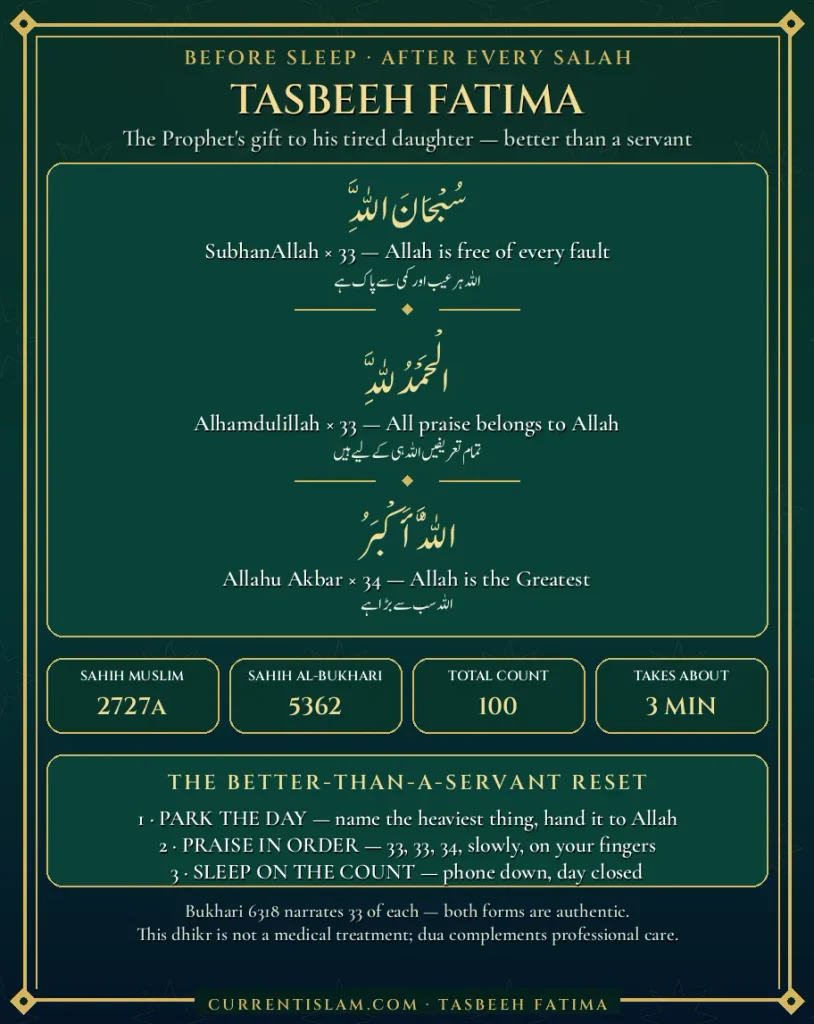
The framework is the Better-Than-a-Servant Reset: three steps, once a night, in bed, phone already down.
Step 1 — Park the day (30 seconds). Name the day’s heaviest thing silently and leave it with Allah. This is tawakkul (trust in Allah), the handing-over taught in Hasbunallahu wa ni’mal wakeel.
Step 2 — Praise in order (about 3 minutes). SubhanAllah 33, Alhamdulillah 33, Allahu Akbar 34. Count on your fingers or on a tasbeeh (prayer beads); fingers need no charging and no light. Speak slowly enough to hear the meaning.
Step 3 — Sleep on the count. When the count ends, stop. No scrolling back into the day. Let your last waking words be about Allah, inside the wider dua before sleeping routine.
Start tonight: do the full count, slowly — it is shorter than one social media scroll. If illness truly prevents it, say what you can and build up.
Save this — the 100-Count Night Card:
- ☐ Lights low, phone face down
- ☐ One heavy thing named and handed to Allah
- ☐ SubhanAllah × 33 — He is free of all defect
- ☐ Alhamdulillah × 33 — all praise is His
- ☐ Allahu Akbar × 34 — He is greater than today
- ☐ Sleep. Tracker: Night 1 ☐ 2 ☐ 3 ☐ 4 ☐ 5 ☐ 6 ☐ 7 ☐ 8 ☐ 9 ☐ 10 ☐ 11 ☐ 12 ☐ 13 ☐ 14 ☐ 15 ☐
Tasbeeh Fatima: The Better-Than-A-Servant Reset
What Are the Benefits — and What the Hadith Actually Promises
The hadith makes two promises; this article will not add a third. After prayer, the one who keeps these counts “will never be caused disappointment” (Sahih Muslim 596a). With the completion to 100, sins are forgiven “even if they are as abundant as the foam of the sea” (Sahih Muslim 597a). At bedtime, the promise is Fatima’s: better than a servant.
Many people also find that a fixed three-minute ending settles the heart before sleep. That is a hope, not a hadith promise, and this dhikr is not a treatment for insomnia, anxiety, or any medical condition. If poor sleep or low mood persists, see a doctor or qualified counsellor; dua walks alongside professional care, never in its place. Pair it with the morning words of SubhanAllahi wa bihamdihi, and the day is bookended by remembrance.
Tasbeeh Fatima in a Western Day
After Fajr at home, the counts take three quiet minutes while the kettle boils. After Maghrib in a prayer room at work or university, they are the pause between job and evening. As the only Muslim in the room, this dhikr asks for no space or equipment.
Small anchors keep it alive: the bedtime count pairs with locking the front door, the after-Isha count with the drive home. A tiny habit like the Sheesha Dekhne Ki Dua works the same way — one fixed moment, one remembrance, daily. And when a worry feels like it rules you, Allahu Akbar answers: Allah is greater — Ya Kaharo, the One nothing overpowers.
Common Mistakes and Misconceptions
Racing the count. A hundred phrases in forty seconds teaches the fingers, not the heart. Slow down; presence is the point.
Merging the narrations. The foam-of-the-sea promise belongs to the 33-33-33-plus-completion form (Muslim 597a), not to every form. Keep the reports straight.
Confusing it with Salatul Tasbih. Salatul Tasbih is a separate four-rak’ah prayer with 300 repetitions inside it — different practice, different evidence.
Treating it as a sleep cure. He ﷺ called it better than a servant; he did not promise it would do the housework. Its gift is strength and nearness, not magic.
Quitting after a missed night. Ali (RA) kept it even on the night of a battle. The habit is built by returning.
Tasbeeh Fatima: The Complete 33-33-34 Bedtime & After Salah Dhikr Guide (PDF)
FAQ
What is Tasbeeh Fatima in simple words?
Tasbeeh Fatima is a 100-count bedtime remembrance the Prophet ﷺ taught his daughter Fatima (RA): SubhanAllah 33 times, Alhamdulillah 33 times, and Allahu Akbar 34 times. He called it better than a servant, and it is also read after daily prayers (Sahih Muslim 2727a).
How many times should I recite each phrase?
At bedtime, say SubhanAllah 33 times, Alhamdulillah 33 times, and Allahu Akbar 34 times, making 100 in total. After prayer, the same 33, 33, 34 counts are narrated in one report, and another authentic form uses 33 of each plus one completion line after the ninety-nine (Sahih Muslim 596a, 597a).
Is Tasbeeh Fatima for after salah or before sleeping?
Both are authentically reported, and they are two settings for the same three phrases. The teaching to Fatima and Ali was specifically for bedtime. Separate narrations place the counts after every obligatory prayer. Many Muslims do both: after each prayer, and again in bed.
What does “better than a servant” actually mean?
Fatima (RA) asked for a servant to ease exhausting housework, and the Prophet ﷺ gave her this dhikr instead, calling it better for her. Scholars explain that its strength, reward, and nearness to Allah serve a person more lastingly than hired help would.
How long does Tasbeeh Fatima take to read?
At a calm, unhurried pace, the full 100 counts take roughly three to four minutes. Rushed, they can be finished in about a minute, but speed works against the purpose. Ali (RA) kept this dhikr nightly for years; it is a small, sustainable habit.
Can I count on my fingers instead of a tasbeeh?
Yes. Counting on the fingers is established from the Sunnah, and a tasbeeh (string of beads) is also widely used as a counting aid. Choose whichever helps you keep count with presence. What matters is the remembrance itself, not the tool in your hand.
What if I fall asleep before finishing the count?
Do not worry, and do not punish yourself with guilt. Say the count when you get into bed rather than after you are already drifting off, and simply return the next night. A habit rebuilt gently lasts longer than one carried by guilt and fear.
Is Tasbeeh Fatima the same as Salatul Tasbih?
No. Tasbeeh Fatima is a short dhikr of three phrases, read in bed or after prayer in about three minutes. Salatul Tasbih is a separate prayer of four rak’ahs containing 300 repetitions, with its own hadith discussion. They share a root word, not a method.
Next Step
- Start tonight: use the 100-Count Night Card above for 15 nights.
- Complete the picture after prayer: Dua After Salah — full adhkar guide
- Build the full bedtime routine: Raat Ko Sone Ki Dua
- Also at night, the Names: Surah Hashr Last 3 Ayat
- Go wider: 99 Names of Allah (Asma-ul-Husna)
Last reviewed: 1 November 2026 · Author: Shahab Khan · Reviewed by: Atif khan
