Quick Answer
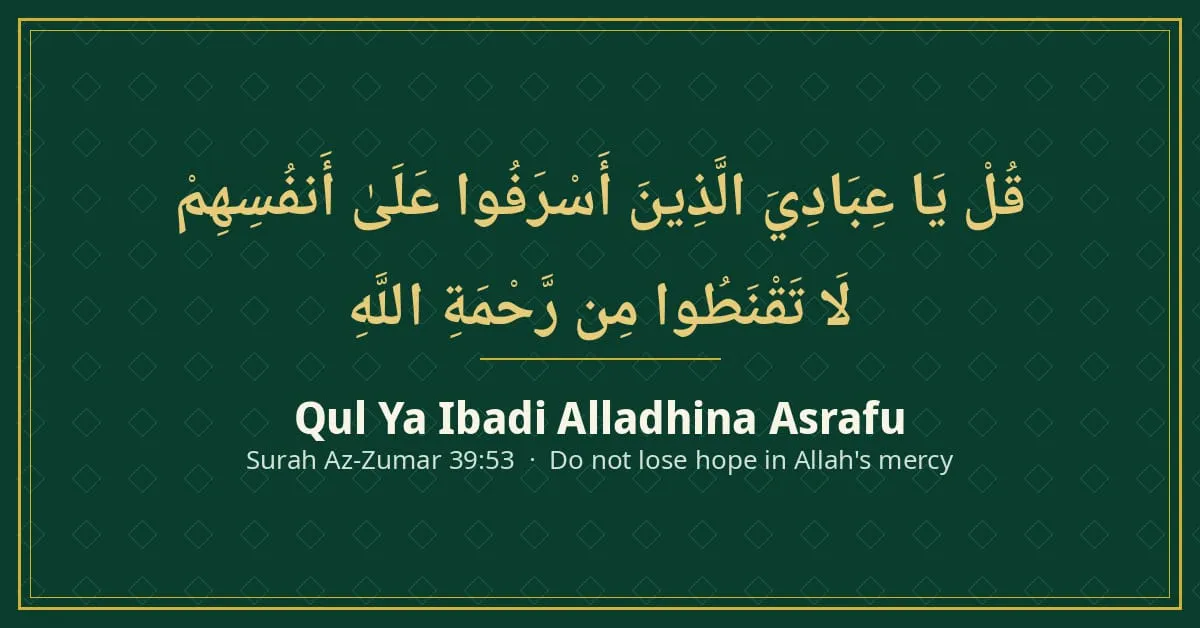
- Qul ya ibadi alladhina asrafu is the opening of Surah Az-Zumar, verse 53. It means: Say, O My servants who have gone too far against themselves, do not lose hope in the mercy of Allah.
- The verse is in Juz 24. It promises that Allah forgives all sins for the person who turns back to Him in repentance.
- There is no fixed wazifa count for this verse in the Quran or Sunnah. Read it once with meaning, seek forgiveness, and change one act today.
Contents
- What does Qul Ya Ibadi Alladhina mean?
- The verse: Arabic, transliteration, English, Urdu, and Hindi
- In which para is Surah Az-Zumar 39:53?
- Why does Allah still call sinners “My servants”?
- When people asked if they could be forgiven
- Is there a wazifa for this verse?
- How do I return today? The Return Loop
- What does this verse change at work, school, and home?
- What mistakes do people make with this verse?
- Frequently asked questions
The message you deleted three times
You typed it, then deleted it. The apology. The prayer you meant to say after Fajr, the dawn prayer, and then did not say. The same sin came back, and the shame felt heavier than the sin. You told yourself you had used up your chances.
That thought is the problem this verse answers. It answers with a name. Allah still calls you His servant. The verse was sent for people who had gone further than you think you have gone. Hope here is a door, and the next verse tells you to walk through it.
What does Qul Ya Ibadi Alladhina mean?
Qul ya ibadi alladhina asrafu means: Say, O My servants who have exceeded the limits against their souls. Allah tells Prophet Muhammad ﷺ to speak to people who have wronged themselves by sin, and to tell them not to lose hope in His mercy.
The first word, Qul, means “Say.” Allah does not say, “O you righteous people.” He says, “O My servants,” to people who have gone too far. Asrafu comes from israf, which means excess, going beyond limits. The harm is described as against themselves. Sin does not reduce Allah. It wounds the person who commits it. The verse ends with names of Allah: Al-Ghafur, the All-Forgiving, and Ar-Rahim, the Most Merciful.
The verse: Arabic, transliteration, English, Urdu, and Hindi
Read the Arabic slowly, even if you read one word at a time. Then read the meaning in your own language.
Arabic:
قُلْ يَا عِبَادِيَ الَّذِينَ أَسْرَفُوا عَلَىٰ أَنفُسِهِمْ لَا تَقْنَطُوا مِن رَّحْمَةِ اللَّهِ ۚ إِنَّ اللَّهَ يَغْفِرُ الذُّنُوبَ جَمِيعًا ۚ إِنَّهُ هُوَ الْغَفُورُ الرَّحِيمُ
Transliteration:
Qul ya ‘ibadi alladhina asrafu ‘ala anfusihim la taqnatu min rahmati Allahi inna Allaha yaghfiru adh-dhunuba jami’an innahu huwa al-Ghafuru ar-Rahim.
English, from Dr. Mustafa Khattab, The Clear Quran:
“Say, ˹O Prophet, that Allah says,˺ “O My servants who have exceeded the limits against their souls! Do not lose hope in Allah’s mercy, for Allah certainly forgives all sins. He is indeed the All-Forgiving, Most Merciful.” (Surah Az-Zumar 39:53)
Urdu, from Fateh Muhammad Jalandhari:
(اے پیغمبر میری طرف سے لوگوں کو) کہہ دو کہ اے میرے بندو جنہوں نے اپنی جانوں پر زیادتی کی ہے خدا کی رحمت سے ناامید نہ ہونا۔ خدا تو سب گناہوں کو بخش دیتا ہے۔ (اور) وہ تو بخشنے والا مہربان ہے
Hindi, from Maulana Azizul Haque al-Umari:
कह दो, “ऐ मेरे बन्दो, जिन्होंने अपने आप पर ज्यादती की है, अल्लाह की दयालुता से निराश न हो। निस्संदेह अल्लाह सारे ही गुनाहों का क्षमा कर देता है। निश्चय ही वह बड़ा क्षमाशील, अत्यन्त दयावान है।”
| Arabic (عربي) | Transliteration | Meaning (English) |
|---|---|---|
| قُلْ | Qul | Say |
| يَا عِبَادِيَ | Ya ‘ibadi | O My servants |
| الَّذِينَ | Alladhina | Those who |
| أَسْرَفُوا | Asrafu | Have gone beyond limits |
| عَلَىٰ أَنفُسِهِمْ | ‘Ala anfusihim | Against themselves |
| لَا تَقْنَطُوا | La taqnatu | Do not lose hope |
| مِن رَّحْمَةِ اللَّهِ | Min rahmati Allahi | In the mercy of Allah |
| إِنَّ اللَّهَ يَغْفِرُ | Inna Allaha yaghfiru | Indeed, Allah forgives |
| الذُّنُوبَ جَمِيعًا | Adh-dhunuba jami’an | All sins |
| إِنَّهُ هُوَ الْغَفُورُ الرَّحِيمُ | Innahu huwa al-Ghafuru ar-Rahim | Indeed, He is the All-Forgiving, Most Merciful |
The word jami’an, meaning “all,” leaves no small print. The promise covers every sin, and the next step is repentance.
In which para is Surah Az-Zumar 39:53?
Surah Az-Zumar 39:53 is in Juz 24, also called Para 24, on page 464 of the standard Madinah mushaf, the printed copy of the Quran. Az-Zumar is the 39th surah, it has 75 verses, and it is a Makki surah, revealed in Makkah.
Open Juz 24 and read verses 53 to 55. Verse 53 gives hope. Verse 54 gives the action. Verse 55 warns against delay. Read them as one passage, not as one line on its own.
Why does Allah still call sinners “My servants”?
Allah still calls sinners “My servants” because belonging comes before behavior in this verse. The name is given first, and the fault is named second. A person who has sinned is not cast out of the address. He is spoken to inside it.
That order matters for a new Muslim, for a born Muslim returning to practice, and for a person sent this link by a friend. You do not have to become perfect before you turn back. Hope here is tied to action. A person who hopes in Allah’s mercy stops hiding, speaks honestly in dua, a supplication, a direct request to Allah, and takes one step he can keep.
When people asked if they could be forgiven
People who had committed many killings and many acts of unlawful sexual relations came to Prophet Muhammad ﷺ and asked whether there was any way to wipe out what they had done. Sahih al-Bukhari 4810 records their question and the answer that came down.
Ibn Kathir, in his tafsir, a scholarly explanation of the Quran, records that this verse is a call to all sinners to repent and turn to Allah. He explains that Allah will forgive all the sins of those who repent, no matter what or how many their sins are. He also makes the limit plain: the verse cannot be read as forgiveness without repentance, because associating partners with Allah, called shirk, is forgiven only for the one who repents from it.
The verse that follows gives the order. From Dr. Mustafa Khattab, The Clear Quran, Surah Az-Zumar 39:54: “Turn to your Lord ˹in repentance˺, and ˹fully˺ submit to Him before the punishment reaches you, ˹for˺ then you will not be helped.” Hope, then return. Return, then submission. The door is wide open, and it is open now.
A hadith qudsi, a report relaying Allah’s words through Prophet Muhammad ﷺ, carries the same promise. Jami’ at-Tirmidhi 3540, graded Hasan by Darussalam, reports Anas ibn Malik as saying he heard the Messenger of Allah ﷺ say that Allah said: “O son of Adam! Verily as long as you called upon Me and hoped in Me, I forgave you, despite whatever may have occurred from you, and I did not mind. O son of Adam! Were your sins to reach the clouds of the sky, then you sought forgiveness from Me, I would forgive you, and I would not mind.” Allah is near and answers dua, as Surah Al-Baqarah 2:186 teaches.
Is there a wazifa for this verse?
There is no fixed wazifa, no set number of repetitions, for Surah Az-Zumar 39:53 in the Quran or in an authentic hadith verified for this article. A wazifa is a set routine of recitation, often with a fixed count. No count was found in the sources checked.
That honesty protects you. If a post promises a job, a marriage, or a visa after a set number of readings, that promise is not in the verse. The verse promises forgiveness for the person who repents. Read it once, slowly, with meaning. Say Astaghfirullah, meaning “I seek the forgiveness of Allah,” from the heart. Then change one act.
How do I return today? The Return Loop
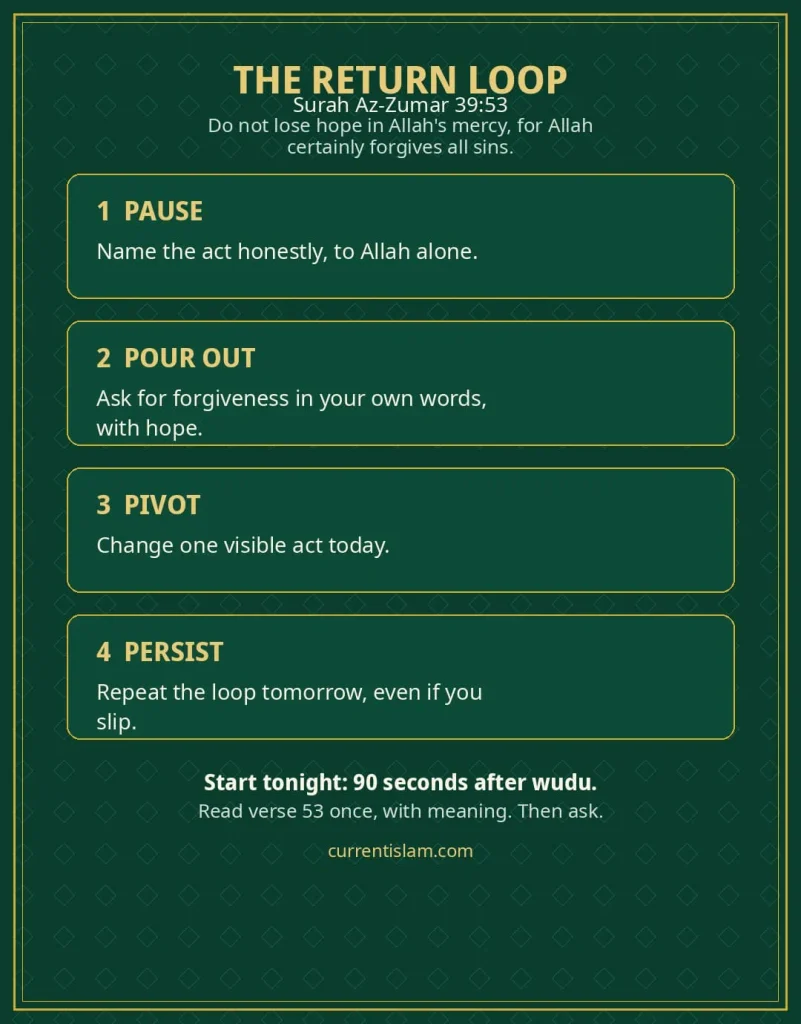
You return in four steps: Pause, Pour out, Pivot, Persist. That loop is called the Return Loop. It is made to be used under stress, in 90 seconds, tonight, after Fajr, before sleep, or on the commute, wherever you are.
Pause means stop and name the act honestly, without excuses. Say what you did, in plain words, to Allah alone. Pour out means ask in your own words, with hope, not with a bargain. Pivot means change one visible act today. If the sin lives on your phone, remove the trigger. If prayer was missed, pray the next prayer on time. Persist means stay with the loop tomorrow. A return is a small, kept habit, not one strong night.
Start tonight. After wudu, the ritual washing before prayer, say the dua after wudu, and read verse 53 once with meaning. Make one short dua in your own language, name one change for tomorrow, and go to sleep with the loop closed.
Attach the loop to prayer or wudu, so it survives a busy day. When you learn how to make dua with sincerity, the asking becomes steadier.
Finish with Tasbeeh Fatima after prayer, the short remembrance of 33, 33, and 34 phrases, as a quiet anchor before sleep.
Save this: The Return Loop checklist
- Pause: Name the act honestly, to Allah alone.
- Pour out: Ask for forgiveness in your own words, with hope.
- Pivot: Change one visible act today.
- Persist: Repeat the loop tomorrow, even if you slip.
- If you slip, start the loop again. A slip is not proof that return failed.
What does this verse change at work, school, and home?
This verse changes the story you tell yourself after a mistake, at work, at school, and at home. It replaces a fixed identity, “I am a bad person,” with a next step: own the act, fix what can be fixed, and return to Allah.
At work, you do not carry a failed project or a sharp word as your identity. Apologize where a person was hurt, fix what you can, and return to Allah. Tawakkul, reliance on Allah, means you do your part and leave the outcome with Him. At school, a low grade or a friendship that went wrong does not end your story. Sabr, patience that stays active, means you keep studying and asking for help, while you trust Allah with the result. If panic rises, say a short dua for a racing heart, breathe slowly, and speak to a trusted adult or a clinician if distress keeps coming back. Dua complements professional care and never replaces it.
At home, a harsh message can be followed by a real apology. A parent who missed prayers for years can start with the next prayer. A person who is the only Muslim in the room can read the verse on a phone after Fajr, before sleep, or on the commute. Allah knows what is in the chest, even when no one else sees the struggle, as Surah Al-Mulk 67:13 teaches. Guilt that leads you back to Allah is useful. Guilt that keeps you away is not from this verse.
What mistakes do people make with this verse?
Three mistakes turn hope into harm: using mercy as a license to keep sinning, turning despair into an identity, and waiting for a perfect feeling before repenting. Each one misreads the verse, and each one has a clear fix in this passage.
The first mistake is using mercy as a license. A person reads “Allah forgives all sins” and keeps sinning on purpose, planning to repent later. Ibn Kathir warns against this: hope in mercy while inviting Allah’s anger on purpose is foolishness, not faith. The second mistake is turning despair into an identity. A person says, “I am too far gone,” and stops praying. That sentence contradicts the verse, which was addressed to people who had gone too far.
The third mistake is waiting for a perfect feeling. A person waits to feel clean before praying, or waits for a sign before repenting. Repentance starts with an act, not a feeling: stop, ask, change one thing. The feeling often follows the act. If anxiety or low mood makes daily life hard, seek professional help alongside dua. The complete Islamic guide to overcoming modern anxiety with faith treats both sides of that line with care, and it is worth reading beside this verse.
| What despair says | What Surah Az-Zumar 39:53 says |
|---|---|
| You have gone too far. | Allah still calls you “My servant.” |
| Your sins are too many. | Allah forgives all sins for the one who repents. |
| You must feel perfect first. | Turn back now, then submit, before delay closes the door. |
| Hiding is safer than asking. | Call, hope, and ask. Allah is near. |
| One slip ends the return. | Return again. The loop is made to be repeated. |
Frequently asked questions
What is the full Arabic of Qul Ya Ibadi Alladhina?
The full verse is Surah Az-Zumar 39:53, in Juz 24. It opens with Qul ya ibadi alladhina asrafu ala anfusihim and ends with the names Al-Ghafur and Ar-Rahim. Read the Arabic, transliteration, and translation together in the verse block above, slowly, before you move on.
In which para is Surah Az-Zumar 39:53?
Surah Az-Zumar 39:53 is in Juz 24, also called Para 24, on page 464 of the standard Madinah mushaf. Az-Zumar is the 39th surah, has 75 verses, and is a Makki surah. Read verses 53 to 55 together for the full passage.
Does Allah forgive all sins, including major sins?
Yes, for the person who repents and turns back to Allah. Ibn Kathir explains that this verse calls all sinners to repent, and Allah forgives all sins of those who repent. Shirk is forgiven when a person repents from it in life. Forgiveness is not promised without repentance.
Is there a wazifa or a fixed count for this verse?
No fixed count was verified in the Quran or in an authentic hadith for this verse. Read it once with meaning, seek forgiveness, and change one act. Do not trust a post that promises a worldly result for a set number of readings. The verse promises forgiveness for return.
Can a new Muslim, or a Muslim returning after years away, use this verse?
Yes. The verse addresses people who have exceeded limits against themselves, not only lifelong worshippers. Start with the next prayer, read the verse with meaning, and ask in your own words. You do not need to be perfect first. Return is the first step.
What should I do right now, tonight, after a sin?
Pause and name the act honestly to Allah alone. Ask for forgiveness in your own words, with hope. Change one visible act today, such as removing a trigger or praying the next prayer on time. Then repeat the Return Loop tomorrow, even if you slip again.
Does this verse mean I can keep sinning and repent later?
No. The next verse orders an immediate return and submission before help is cut off. Using mercy as a plan to delay repentance contradicts the passage. Hope is strength to stop now, not permission to continue. Repent today, while the door is open.
Next steps
- Read the forgiveness dua before death for a short prayer that asks Allah for pardon in life and mercy at death.
- In Ramadan, read the forgiveness dua for the second ten days and increase in seeking forgiveness.
