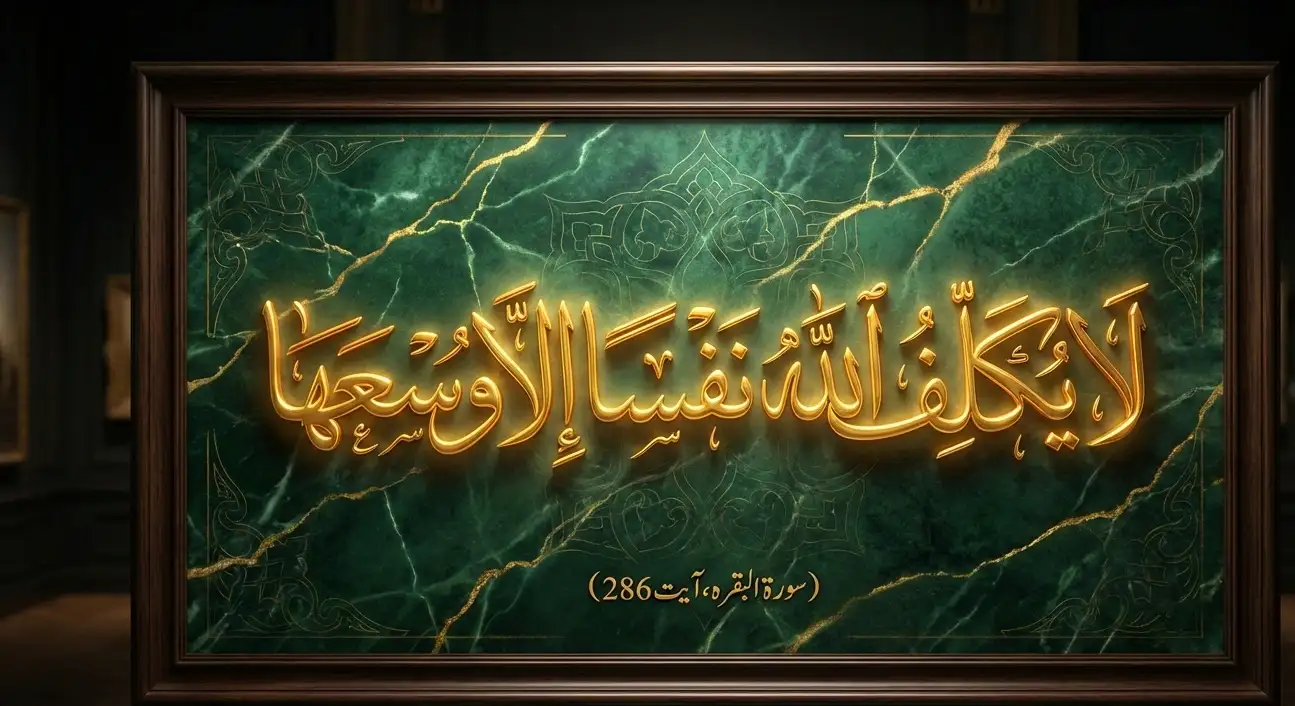
Have you ever felt that life is asking too much of you — emotionally, spiritually, mentally — and wondered if you are failing Allah? Here’s the heart-steadying truth the Qur’an speaks directly to anxious hearts: Allah already knows your limit… and He never crosses it.
This single verse has healed generations struggling with guilt, burnout, depression, and fear — and today, it speaks louder than ever.
What Does La Yukallifullāhu Nafsān Illā Wus‘ahā Mean?
Direct Answer
“La yukallifullāhu nafsān illā wus‘ahā” means Allah does not obligate any soul beyond its capacity, teaching that every test, command, and hardship is divinely measured, mercifully limited, and matched to a person’s real ability — even when they feel overwhelmed.
📖 The Qur’anic Source (Surah Al-Baqarah, Ayat 286)
🕋 Arabic
لَا يُكَلِّفُ ٱللَّهُ نَفْسًا إِلَّا وُسْعَهَا
🔤 Transliteration
Lā yukallifullāhu nafsan illā wus‘ahā
🇬🇧 English (Saheeh International)
“Allah does not burden a soul beyond that it can bear.”
🇵🇰 اردو (فتح محمد جالندھری)
“اللہ کسی شخص پر اس کی طاقت سے زیادہ بوجھ نہیں ڈالتا۔”
Why This Verse Is the Foundation of Islamic Mental Peace
Direct Answer (Voice Search Block — 42 words):
This verse is the Qur’anic foundation of emotional balance in Islam, confirming that Allah’s commands and life trials are never cruel or random, but tailored to human limits, removing despair, self-hatred, and the fear that one is spiritually “not enough.”
Think of it this way: Islam does not demand perfection — it demands sincerity within your capacity.
Benefits of This Verse
This verse is not just a line to remember. It quietly reshapes how a believer sees Allah, faith, and their own struggles.
It lifts unnecessary guilt.
When you are trying but still falling short, this verse reminds you that Allah sees effort, not perfection.
It calms an anxious heart.
Feeling overwhelmed does not mean you are weak in faith. Allah already knows the weight you are carrying.
It acknowledges mental and emotional limits.
Islam does not ignore exhaustion, anxiety, or emotional pain. Your capacity includes your mental state.
It protects from burnout in worship.
Faith is meant to be lived for a lifetime, not rushed until it breaks you.
It strengthens trust in Allah.
Every test comes measured, never random, never cruel.
It keeps hope alive during long trials.
If the road feels heavy, it is only because Allah knows you can walk it — one step at a time.
It builds a mercy-based relationship with Allah.
This verse gently moves the heart away from fear and toward balance, compassion, and quiet confidence.
Allah Does Not Burden a Soul Beyond What It Can Bea (PDF)
Classical Tafsir: What Scholars Really Meant by “Capacity”
Direct Answer (Voice Search Block — 48 words):
Classical scholars explained “wus‘ahā” as encompassing physical strength, emotional endurance, mental ability, and situational limits, meaning Allah accounts for exhaustion, trauma, ignorance, and weakness, and never judges a servant by an unrealistic or imagined standard.
📚 Scholarly Evidence
- Ibn Kathir رحمه الله writes that this verse proves Allah’s mercy, removing hardship from religious obligation.
- Imam Al-Ghazali links this principle to inner peace, stating that guilt beyond ability is a whisper, not guidance.
- Imam Nawawi affirms that incapacity suspends accountability, not faith.
➡️ Your struggle does not cancel your iman.
Mental Health & Anxiety Through This Verse
Direct Answer (Voice Search Block — 44 words):
For anxiety and mental distress, this verse reassures that emotional overload is not sinful, missed acts due to mental exhaustion are excused, and Allah evaluates effort, not outcomes, offering relief to believers facing burnout, depression, panic, or spiritual paralysis.
🧠 The Spiritual Habit Loop
Trigger: Anxiety, guilt, “I’m failing Allah”
Response: Remember the verse
Reframe: This pain exists because Allah knows I can carry it — not because He wants to break me
Result: Calm replaces panic, hope replaces self-blame
Is This Verse an Excuse to Avoid Responsibility?
Direct Answer (Voice Search Block — 41 words):
No, this verse does not remove responsibility; it defines it correctly, teaching that effort within capacity is rewarded, while negligence without excuse remains blameworthy, creating a balanced path between self-compassion and accountability.
Islam rejects two extremes:
- Crushing yourself beyond capacity ❌
- Abandoning effort entirely ❌
The verse teaches measured faith.
How the Prophet ﷺ Lived This Verse
Direct Answer (Voice Search Block — 43 words):
The Prophet Muhammad ﷺ embodied this verse by choosing ease, shortening prayers when needed, excusing weakness, and teaching that Allah loves consistent small deeds, proving that mercy and sustainability are central to true Sunnah.
📖 Hadith Evidence
“Do what you can, for Allah does not tire until you tire.”
— (Bukhari & Muslim)
This is “La yukallifullāhu nafsān illā wus‘ahā” in action.
Why This Verse Appears at the END of Surah Al-Baqarah
Direct Answer (Voice Search Block — 40 words):
Allah placed this verse at the end of Surah Al-Baqarah to seal divine law with mercy, ensuring believers leave the longest surah not overwhelmed, but reassured that all commands rest within human capacity.
Law without mercy crushes.
Mercy without law confuses.
Islam unites both.
Final Reflection (Heart-Level Close)
Some days, faith feels light.
Other days, it feels heavy.
On both days, this verse remains true.
Allah is not waiting for you to break.
He is watching you try — within your capacity — and that is already enough.
Questions People Ask:
Yes. Every test is uniquely measured to a person’s capacity, background, and inner strength.
Feeling broken does not mean you are beyond capacity — it means you are human, and Allah sees what others cannot.
Yes. Classical fiqh recognizes diminished accountability due to mental incapacity.
If anxiety prevents ability, Allah’s mercy applies. Intention still carries reward.
Recite this verse while breathing deeply. Acknowledge that your current feeling of being “overwhelmed” is a temporary emotion, but the Divine Truth is that you are designed to handle this moment. Allah does not make mistakes in His “load-bearing” calculations.
These verses are a gift from beneath the Throne (Arsh). They provide spiritual protection, forgiveness for unintentional errors, and a psychological “reset” that reminds the believer they are under the guardianship of a Merciful Protector (Mawla).
Yes. Scholars suggest reciting the final section of Surah Al-Baqarah before sleep to calm the heart and secure the soul against the whispers of inadequacy and fear that often strike at night.
