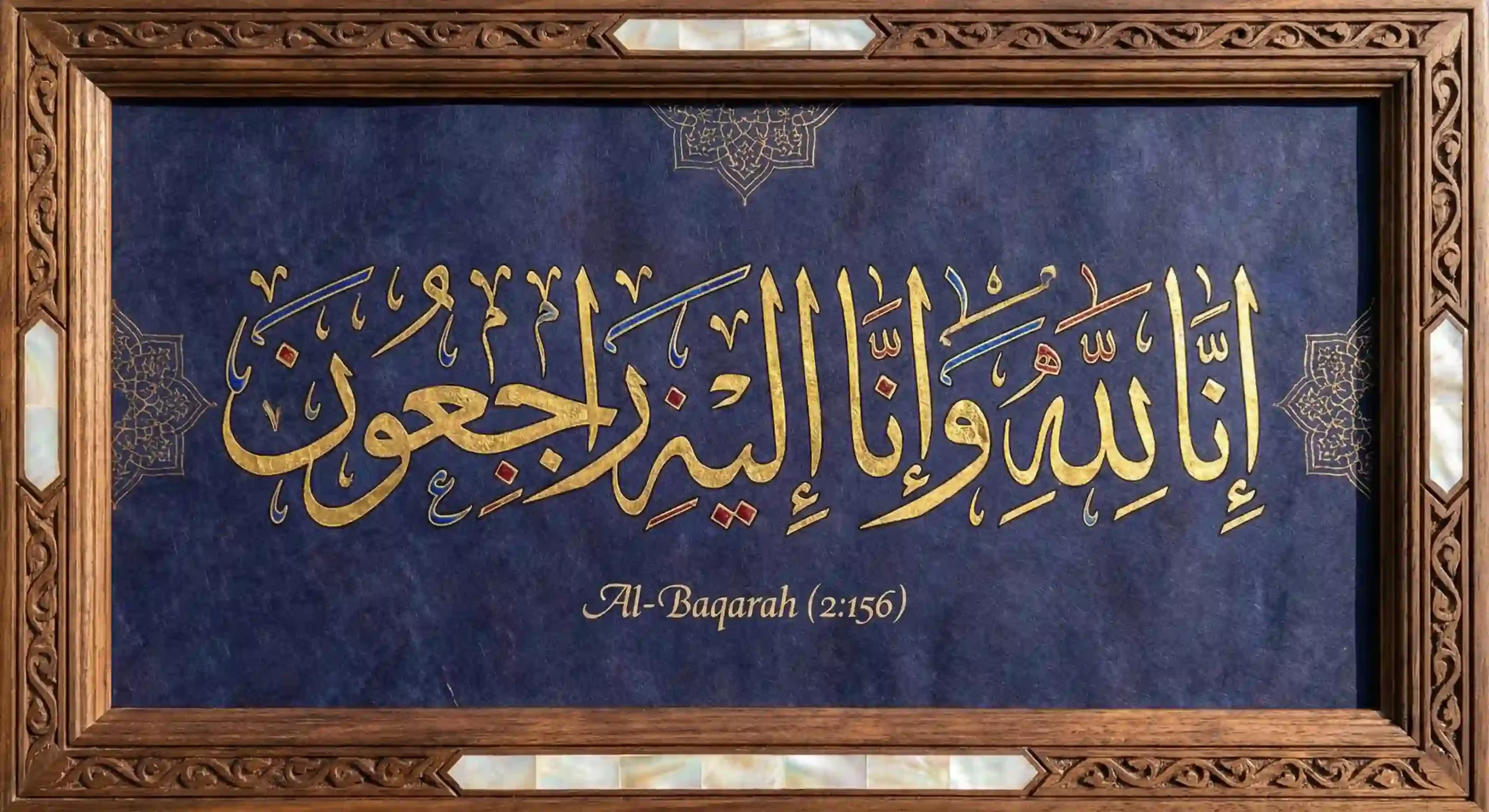
Have you ever felt the ground beneath you crumble after a sudden phone call? Or perhaps you’ve felt that sharp, stinging frustration when a simple plan falls apart? In those split seconds of shock, the human heart desperately searches for an anchor.
For 1.9 billion people, that anchor is a single, powerful sentence. It isn’t just a phrase for funerals; it is a spiritual reflex that rewires how we process pain.
What Does Inna Lillahi wa Inna Ilayhi Raji’un Mean?
Inna lillahi wa inna ilayhi raji’un is a Quranic phrase known as Istirja, meaning “Indeed, to Allah we belong and to Him we shall return.” Muslims recite it during times of loss, bad news, or minor inconveniences to express patience, surrender to God’s will, and acknowledge that all blessings are temporary loans from the Creator.
The Linguistic Breakdown
To truly understand the weight of this phrase, we must look at it word-for-word.
| Arabic | Transliteration | English Meaning |
| إِنَّا | Inna | Indeed, we / Verily, we |
| لِلَّهِ | Li-llahi | Belong to Allah (We are for Him) |
| وَإِنَّا | Wa Inna | And indeed, we |
| إِلَيْهِ | Ilayhi | To Him (Towards Him) |
| رَاجِعُونَ | Raji’un | Will return (are returning) |
The Source: Surah Al-Baqarah (2:156)
This phrase is the divine response taught in the Quran (Surah Al-Baqarah, verse 156) for the “Patient Ones” (As-Sabireen). It serves as a direct command from Allah to stabilize the heart immediately after a calamity strikes, promising God’s blessings and mercy in return.
Here is the verse that defines the believer’s reaction to tragedy:
Arabic:
الَّذِينَ إِذَا أَصَابَتْهُم مُّصِيبَةٌ قَالُوا إِنَّا لِلَّهِ وَإِنَّا إِلَيْهِ رَاجِعُونَ
Transliteration:
Allatheena itha asabathum museebatun qaloo inna lillahi wa inna ilayhi raji’un.
English (Saheeh International):
“Who, when disaster strikes them, say, ‘Indeed we belong to Allah, and indeed to Him we will return.'”
Urdu (Fateh Muhammad Jalandhari):
“وہ کہ جب ان پر کوئی مصیبت پڑتی ہے تو کہتے ہیں: بے شک ہم اللہ ہی کا مال ہیں اور اسی کی طرف لوٹ کر جانے والے ہیں۔”
When Should You Recite It? (The “Broken Shoelace” Rule)
While commonly recited upon hearing of a death, the Prophet Muhammad (peace be upon him) taught that Istirja should be said for any misfortune, regardless of size. This includes minor frustrations like a lamp going out, a stumble, or losing a personal item, as these are all considered tests of patience.
Many of us reserve this phrase for the graveyard, but that limits its power.
Think of it this way: The Prophet (PBUH) once instructed that if a person’s shoelace breaks, they should say Inna lillahi wa inna ilayhi raji’un. Why? Because it trains the brain to recognize that control is an illusion. Whether it’s a broken shoelace or a broken heart, the source of relief is the same.
Common situations to recite:
- Hearing news of a death (Muslim or non-Muslim).
- Losing money or a job.
- Physical pain or illness.
- Minor inconveniences (traffic, breaking a glass, tripping).
The Power of the “Umm Salama” Dua
The Sunnah recommends adding a specific supplication immediately after the Istirja: “Allahumma’jurni fi musibati wa akhlif li khayran minha.” This prayer, meaning “O Allah, reward me in my affliction and replace it with something better,” is famous for bringing immense blessings, as seen in the story of Umm Salama.
The Story of Replacement
When Umm Salama’s husband (Abu Salama) passed away, she was devastated. He was the best of men in her eyes. Yet, she followed the Prophet’s advice and recited this dua, even though she wondered, “Who could possibly be better than Abu Salama?”
Allah answered her prayer by granting her marriage to the Prophet Muhammad (PBUH) himself—the best of all creation.
The Full Wazifa:
Arabic:
إِنَّا لِلَّهِ وَإِنَّا إِلَيْهِ رَاجِعُونَ، اللَّهُمَّ أْجُرْنِي فِي مُصِيبَتِي وَأَخْلِفْ لِي خَيْرًا مِنْهَا
Transliteration:
Inna lillahi wa inna ilayhi raji’un. Allahumma-jurni fi musibati wa akhlif li khayran minha.
Translation:
“Indeed we belong to Allah, and indeed to Him we will return. O Allah, reward me in my affliction and replace it for me with something better.”
Transforming Grief with Surah Al-Baqarah (2:156) (PDF)
The Spiritual Resilience Framework (2026)
We live in an era of high anxiety and the obsession with “manifesting” control. The concept of Istirja offers a counter-intuitive psychological release valve.
The “Owner vs. Manager” Mindset:
Anxiety often comes from acting like the Owner of your life—fretting over outcomes you cannot force.
Istirja reminds you that you are merely the Manager.
- The Owner: Allah (He decides when the “lease” on your health, wealth, or loved ones expires).
- The Manager: You (You care for them while you have them).
When you say “To Allah we belong,” you are handing the heavy burden of ownership back to the Owner. You are admitting, “This was never mine to keep forever.” This shift releases the tension of grief and replaces it with the peace of submission.
The Reward: Bayt al-Hamd (The House of Praise)
According to Tirmidhi, parents who praise Allah and say Inna lillahi wa inna ilayhi raji’un after the death of a child are granted a specific reward: Allah commands the angels to build a house for them in Paradise and name it “Bayt al-Hamd,” or the House of Praise.
This highlights that Istirja is not just a statement of fact; it is a transaction. You give Allah your patience during the shock, and He gives you a permanent home in Jannah.
People Also Ask:
In-na (Stress the ‘n’)
Lil-la-hi (Soft ‘h’ at the end)
Wa In-na
Ilay-hi
Ra-ji-oon (The ‘oon’ sounds like ‘moon’).
No, it is not haram. The Prophet Muhammad (PBUH) shed tears when his son Ibrahim died. Tears are a sign of mercy in the heart. What is prohibited is wailing, screaming, or questioning Allah’s decree. Istirja is the verbal check that keeps grief within the boundaries of faith.
Yes. The phrase acknowledges that all souls belong to Allah and return to Him for judgment. While we cannot pray for the forgiveness (Maghfirah) of those who died in disbelief, reciting Istirja is simply stating a truth about the reality of life and death.
There is no single fixed sunnah reply, but it is good etiquette to respond with a dua for the bereaved, such as:
“May Allah increase your reward and grant you patience.”
(In Urdu): Allah apko sabr-e-jameel ata farmaye.
