Did your last meal feel like just “eating”… or an act of worship?
Have you ever finished a whole meal without thanking Allah once? The Prophet ﷺ taught a simple, three‑step pattern: say Bismillah wa ‘ala barakatillah before eating, say small dhikr while eating, and say Al‑hamdulillah after eating. This is what “khana khane ki dua” really means in Islam: turning every mouthful into gratitude and barakah, not just a ritual. For parents and busy professionals, this Sunnah meal framework can become a powerful daily habit that shapes hearts more than just stomachs.
The 3‑Step Sunnah Meal: Start, During, End
Before and after eating food, the Prophet ﷺ gave very clear etiquette that Muslims still follow today. This pattern is not just about words; it is about awareness, discipline, and gratitude. Let’s break it into three parts: start (before eating), during (dua while eating), and end (after eating). Each step will include the Arabic text, transliteration, a simple English meaning, and a Urdu translation so this page can serve as a multilingual resource hub for your family.
1. Start: Dua Before Eating (Khana Khane Ki Dua – Bismillah wa ‘ala barakatillah)
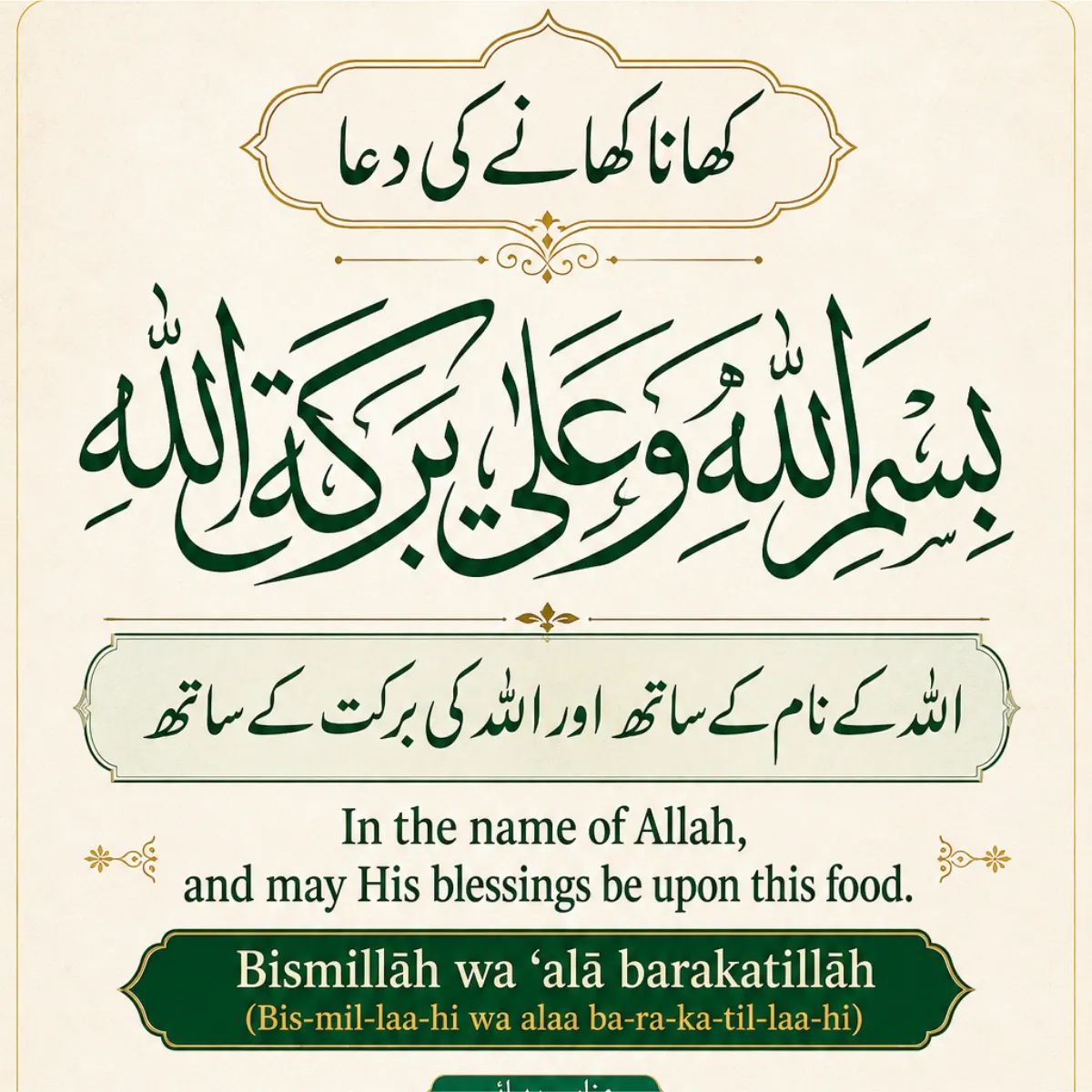
Before you take your first bite, say Bismillah wa ‘ala barakatillah in the name of Allah, and may His blessings be upon this food. This short dua is one of the most common khana khane ki duain used by parents and families. It keeps the table connected to barakah and reminds everyone that Allah is the real giver of food.
Your main khana khane ki dua
Arabic:
بِسْمِ اللَّهِ وَعَلَى بَرَكَةِ اللَّهِ
Transliteration:
Bismillāh wa ‘alā barakatillāh
English (Saheeh‑style paraphrase):
“In the name of Allah, and may His blessings be upon this food.”
Urdu (Fateh Muhammad Jalandhari style):
“اللہ کے نام کے ساتھ اور اللہ کی برکت کے ساتھ”
How to use this in daily life
- Parents and kids:
- Before every meal, as a family, say “Bismillah wa ‘ala barakatillah” together.
- You can add: “O Allah, bless this food and make it easy for us.”
- If you forget at the beginning:
- Say: Bismillahi awwalahu wa akhirahu (“In the name of Allah, at its beginning and its end”).
This dua is not mentioned in a single classical hadith with this exact wording, but it is built on two strong Sunnah principles:
- Saying Bismillah before eating (supported in Sunan Abi Dawud, Tirmidhi).
- Asking for barakah (blessings) in your food, which is a common Sunnah supplication.
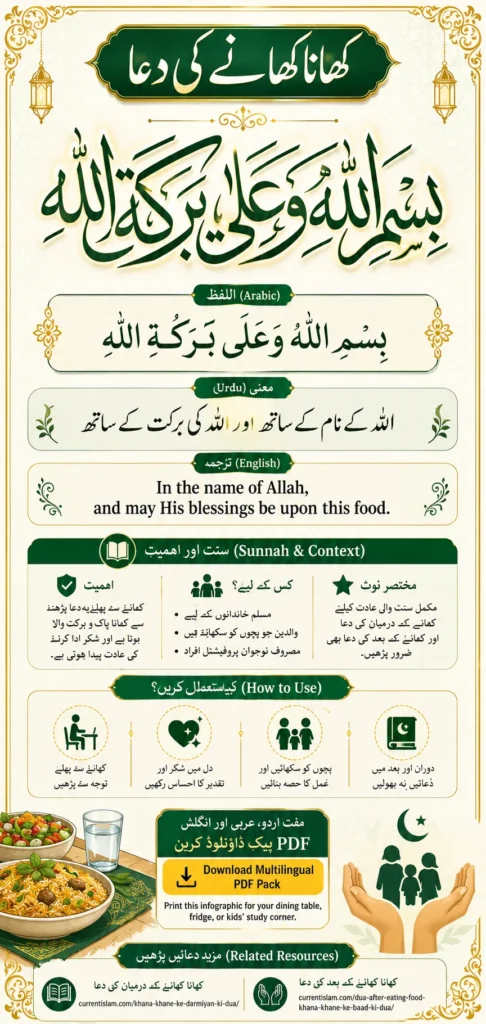
Teach your family the beautiful Sunnah of beginning meals with the name of Allah.
بِسْمِ اللَّهِ وَعَلَى بَرَكَةِ اللَّهِ
This educational Islamic infographic includes:
✔ Arabic dua
✔ Urdu meaning
✔ English translation
✔ Sunnah benefits
✔ Guidance for parents & kids
Perfect for your dining area, madrassah, classroom, or Islamic study corner.
#IslamicInfographic #KhanaKhaneKiDua #MuslimFamily #IslamicReminder #DuaBeforeEating #IslamicPoster #SunnahLifestyle
2. During: Dua While Eating (Khana Khane ke Darmiyan ki Dua – Bismillahi awwalahu wa ākhirahu)
While you are eating, slow down, chew properly, and say Bismillahi awwalahu wa ākhirah once or twice. This is part of khana khane ke darmiyan ki dua: asking Allah to bless your food at the beginning and the end of the meal. It turns your table into a quiet circle of gratitude and helps you stay present while eating.
Make this your khana khane ke darmiyan ki dua
Arabic:
بِسْمِ اللَّهِ أَوَّلَهُ وَآخِرَهُ
Transliteration:
Bismillahi awwalahu wa ākhirahu
English (Saheeh‑style paraphrase):
“In the name of Allah, at its beginning and its end.”
Urdu (Fateh Muhammad Jalandhari style):
“اللہ کے نام کے ساتھ اس کے شروع اور آخر میں”
How to use this in practice
- Use this as your main “dua while eating” for khana khane ke darmiyan ki dua.
- Parents can teach kids:
- “If you forgot Bismillah at the start, say Bismillahi awwalahu wa ākhirahu now.”
- “Say this once in the middle of your meal to bring Allah’s barakah.”
- Busy professionals can say it silently once they realize they started eating without dua.
For families who want to go deeper, our detailed guide on khana khane ke darmiyan ki dua explains more on the etiquette, recommended dhikr, and simple teaching tips for children.
3. End: Dua After Eating Food (Khana Khane ke Baad ki Dua)
Before you stand up from the table, say a short dua of gratitude. The most famous khana khane ke baad ki dua thanks Allah for feeding and giving drink, and for making us Muslims. This simple act turns your meal into an act of worship and closes your eating time with humility and praise.
The main dua after eating
Arabic:
الْحَمْدُ لِلَّهِ الَّذِي أَطْعَمَنَا وَسَقَانَا وَجَعَلَنَا مِنَ الْمُسْلِمِينَ
Transliteration:
Al‑hamdu lillāhi alladhī at‘amanā wa saqānā wa ja‘alanā min al‑muslimīn
English (Saheeh International style):
“All praise is due to Allah, who has fed us, given us drink, and made us among the Muslims.”
Urdu (Fateh Muhammad Jalandhari style):
“سب تعریفیں اس اللہ کے لیے ہیں جس نے ہمیں کھلایا اور پلایا، اور ہمیں مسلمانوں میں سے بنایا۔”
This dua is supported by hadith in Sunan Abi Dawud and Tirmidhi, where the Prophet ﷺ emphasized saying Al‑hamdulillah after eating and encouraged not leaving the table without thanking Allah.
You can read more detailed explanations and multiple variations of khana khane ke baad ki dua in our dedicated article on dua after eating food – khana khane ke baad ki dua.
Why Saying Khana Ki Dua Is Not Just a “Ritual”
Saying bismillah wa ‘ala barakatillah before eating and Al‑hamdulillah after eating is not an empty ritual; it is a declaration that Allah is the real giver of your food. This practice protects your meal from Shaytan, increases barakah, and trains your heart to be grateful. For busy professionals and parents, it becomes a tiny but powerful daily checkpoint with your Creator.
Quranic tafseer: Blessings and gratitude
The Prophet’s teachings on gratitude for food are deeply connected to several Quranic themes. Two key verses help us understand the deeper meaning of “khana khane ki dua.”
1. Surah al‑Nahl (16:114)
- Arabic:وَكُلُوا مِمَّا رَزَقَكُمُ اللَّهُ وَلَا تَتَّبِعُوا خُطَوَاتِ الشَّيْطَانِ إِنَّهُ لَكُمْ عَدُوٌّ مُّبِينٌ
- Meaning: Allah provides lawful food, and we are commanded to eat it and be grateful, not wasteful.
- Connection to khana ki dua: Saying Bismillah wa ‘ala barakatillah and Al‑hamdulillah is the simplest way to turn your eating into obedience instead of carelessness.
2. Surah al‑Mulk (67:23)
- Arabic & meaning: The verse reminds us that Allah is the one who gave us life, food, and drink.
- Relevance: Every time you recite khana khane ki dua, you are verbally confirming this Qur’anic truth: your sustenance comes from Allah, not just your efforts.
Classical scholars like Ibn Kathir and Imam Nawawi consistently link gratitude in food with obedience, barakah, and protection from sin. Modern scholars also connect this to mindful‑eating: when you thank Allah, you are less likely to overeat or waste.
Mindful Eating x Sunnah (Practical Guides for Parents & Professionals)
Mindful eating in Islam means eating slowly, with presence, and remembering Allah before, during, and after the meal. This simple habit reduces over‑eating, sharpens focus, and turns your table into a small circle of dhikr. For parents and busy professionals, it is one of the easiest “digital‑friendly” Islamic habits to build.
For practicing parents (teaching kids these duain)
- Create a “dua‑time on the table” routine:
- Say Bismillah wa ‘ala barakatillah together before starting the meal.
- After finishing, say Al‑hamdulillah or the full khana khane ke baad ki dua together.
- Make it visual:
- Use a small printable card with Arabic + transliteration + Urdu + English.
- Hang it near the dining table or fridge.
- Game‑ify it for kids:
- “Who can remember Bismillah wa ‘ala barakatillah first?”
- “Who can say Al‑hamdulillah with a smile after eating?”
For young professionals (busy, distracted, digital‑friendly habits)
- Set a phone reminder:
- Title: “Remember Bismillah wa ‘ala barakatillah + Al‑hamdulillah.”
- Trigger: 10 minutes before lunch/dinner.
- The 5‑second meal reset:
- Before you open your takeout box, pause, touch your heart, and say Bismillah wa ‘ala barakatillah.
- Before you stand up, say Al‑hamdulillah silently.
- Use the “mindful‑eating reminders” from our multilingual PDF pack (Urdu + English + Arabic) to print and stick to your desk or laptop.
People Also Ask:
Your main khana khane ki dua before eating is: “Bismillāh wa ‘alā barakatillāh” (“In the name of Allah, and may His blessings be upon this food”). After eating, use the well‑known khana khane ke baad ki dua: Al‑hamdu lillāhi alladhī at‘amanā wa saqānā wa ja‘alanā min al‑muslimīn.
It is a recommended Sunnah, not wajib. It brings great barakah and gratitude, but you are not sinful for missing it. The important point is to make Bismillah wa ‘ala barakatillah and Al‑hamdulillah regular habits.
Turn it into a family game. Say Bismillah wa ‘ala barakatillah together before eating, like a team chant. After the meal, say Al‑hamdulillah with a smile. Use colorful charts or stickers for every day they remember.
It usually means saying short dhikr such as Al‑hamdulillah or Subhanallah while eating. There is no single long fixed dua, but the idea is to remember Allah in the middle of your meal by eating slowly and with gratitude.
Saying Bismillah before eating and Al‑hamdulillah after eating are well‑supported in Sunan Abi Dawud and Tirmidhi. The exact wording “bismillah wa ‘ala barakatillah” is a blessed, easy‑to‑teach phrase built on these Sunan, while the khana khane ke baad ki dua is a classical Sunnah dua mentioned by scholars.
Multilingual Resource Hub: Download Your PDF Pack
Next Steps for You
Here’s what you can do after reading this:
- If you are a parent: Tonight, start dinner with “Bismillah wa ‘ala barakatillah” as a family.
- If you are a busy professional: Set a simple phone reminder for Bismillah wa ‘ala barakatillah and Al‑hamdulillah before and after your next meal.
By following this Sunnah meal framework, you are not just “saying a dua”; you are training your family and your own heart in the art of gratitude, one meal at a time.
Khana khane ki dua, khana khane ke darmiyan ki dua, and mindful‑eating prompts for families.
