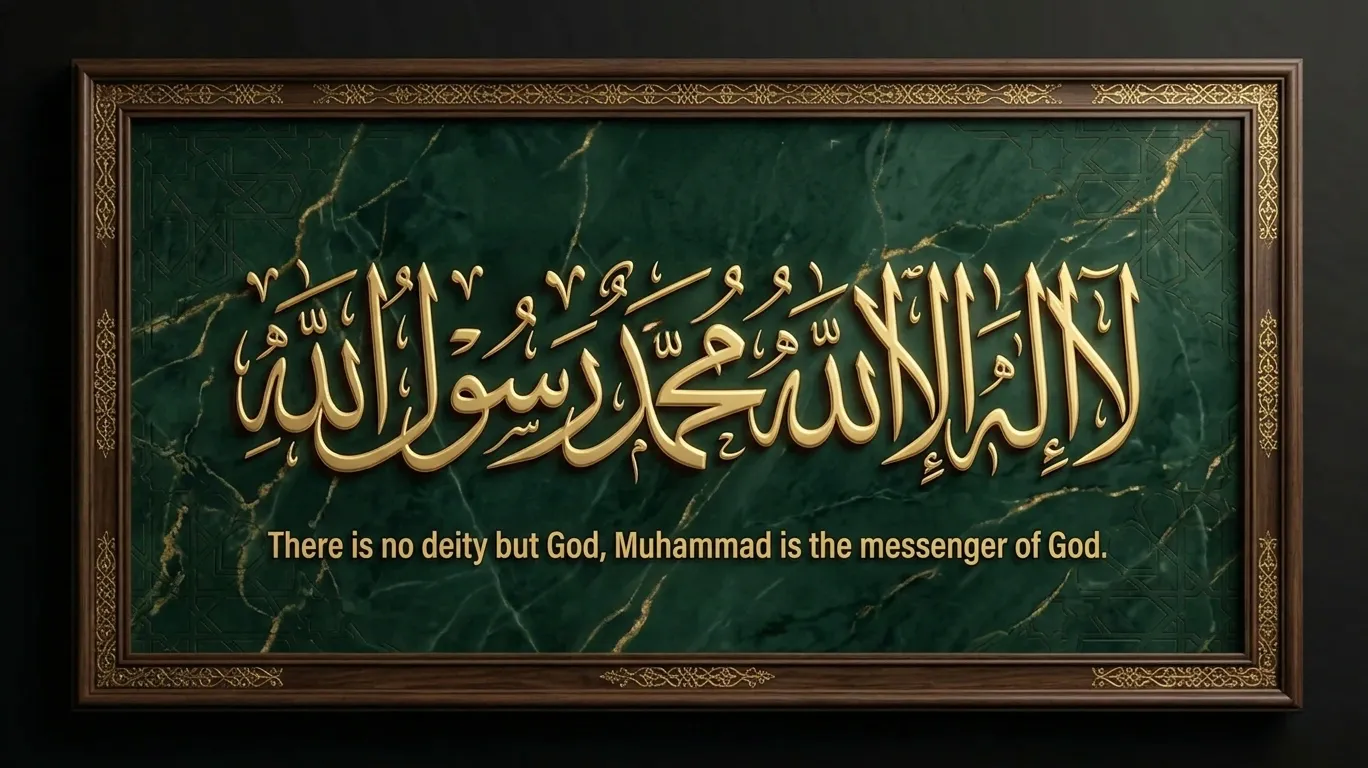
What if one sentence could change not only your beliefs, but the way you breathe, pray, hope, and return to Allah in every season of life? For every Muslim, and for many people searching for truth, la ilaha illallah muhammadur rasulullah is not just a phrase on the tongue; it is the doorway to Islam, the foundation of iman, and the sentence that gives life its true direction.
What it means?
La ilaha illallah muhammadur rasulullah is the Shahada, the declaration of faith in Islam. It means that no one deserves worship except Allah, and that Muhammad is the Messenger of Allah. This statement is the first pillar of Islam and the root of a Muslim’s faith and identity.
When a person says it with sincerity, knowledge, and conviction, they are not merely repeating sacred words. They are accepting Allah’s exclusive right to be worshipped and accepting the Prophet Muhammad ﷺ as the final messenger whose guidance must be followed.
La Ilaha Illallah Muhammadur Rasulullah
| Arabic | لَا إِلَٰهَ إِلَّا ٱللَّٰهُ مُحَمَّدٌ رَسُولُ ٱللَّٰهِ |
| Transliteration | Laa ilaaha ill-Allahu Muhammadur-Rasoolullahi |
| English (Saheeh International) | There is no deity worthy of worship except Allah; Muhammad is the Messenger of Allah. |
| Urdu (Fateh Muhammad Jalandhari) | اللہ کے سوا کوئی معبود نہیں، محمد اللہ کے رسول ہیں۔ |
Word-by-word meaning
The phrase becomes even more powerful when you understand each part clearly. Every word carries creed, submission, and purpose.
| Word | Arabic | Transliteration | English | Urdu |
|---|---|---|---|---|
| La | لا | La | No / There is no | نہیں |
| ilaha | إله | ilaha | god / deity worthy of worship | معبود |
| illa | إلا | illa | except | مگر |
| Allah | الله | Allah | Allah | اللہ |
| Muhammadur | محمد | Muhammadur | Muhammad | محمد |
| Rasulullah | رسول الله | Rasulullah | Messenger of Allah | اللہ کے رسول |
So the full meaning is: There is no deity worthy of worship except Allah, and Muhammad is the Messenger of Allah.
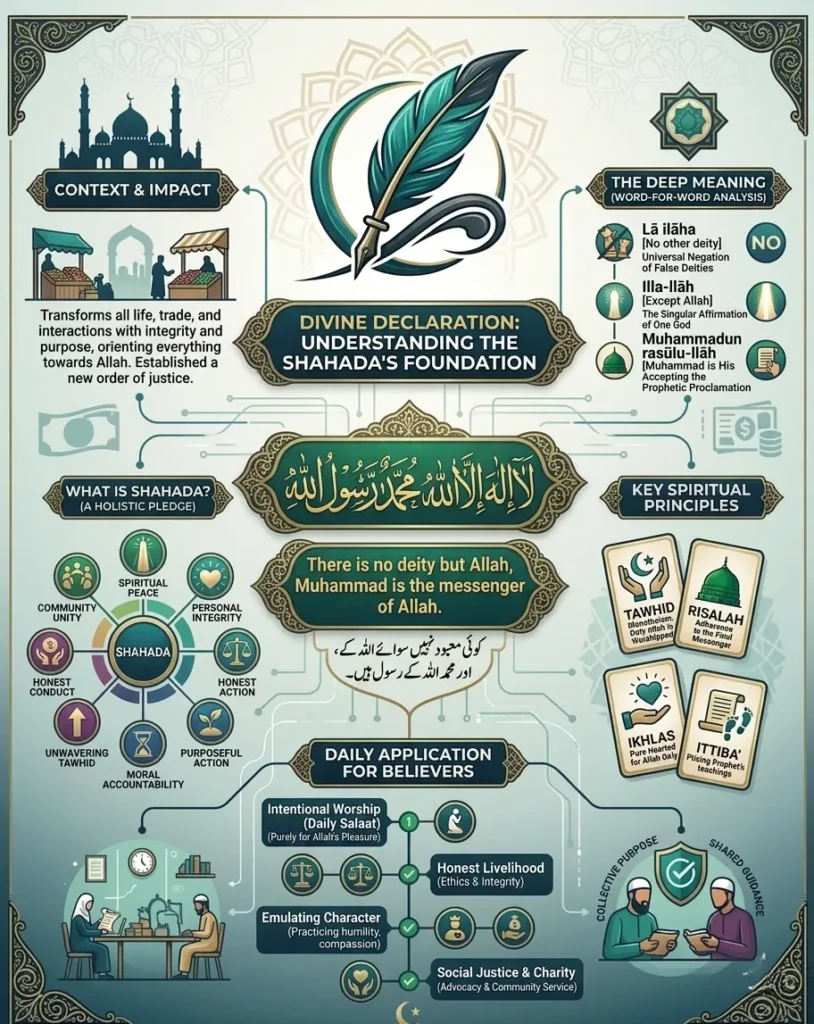
Complete Declaration (Kalima Shahadat)
| Arabic | أَشْهَدُ أَنْ لَا إِلَٰهَ إِلَّا ٱللَّٰهُ وَأَشْهَدُ أَنَّ مُحَمَّدًا رَسُولُ ٱللَّٰهِ |
| Transliteration | Ash-hadu an laa ilaaha ill-Allahu wa ash-hadu anna Muhammadan Rasoolullahi |
| English (Saheeh International) | I bear witness that there is no deity worthy of worship except Allah, and I bear witness that Muhammad is the Messenger of Allah. |
| Urdu (Fateh Muhammad Jalandhari) | میں گواہی دیتا ہوں کہ اللہ کے سوا کوئی معبود نہیں اور میں گواہی دیتا ہوں کہ محمد اللہ کے رسول ہیں۔ |
Second Kalima (Extended Form with Prophetic Servitude)
| Arabic | أَشْهَدُ أَنْ لَا إِلَٰهَ إِلَّا ٱللَّٰهُ وَحْدَهُ لَا شَرِيكَ لَهُ وَأَشْهَدُ أَنَّ مُحَمَّدًا عَبْدُهُ وَرَسُولُهُ |
| Transliteration | Ash-hadu an laa ilaaha ill-Allahu wahdahu laa shareeka lahu wa ash-hadu anna Muhammadan ‘abduhu wa Rasooluhu |
| English (Saheeh International) | I bear witness that there is no deity worthy of worship except Allah, alone without any partner, and I bear witness that Muhammad is His servant and His Messenger. |
| Urdu (Fateh Muhammad Jalandhari) | میں گواہی دیتا ہوں کہ اللہ کے سوا کوئی معبود نہیں، وہ اکیلا ہے اس کا کوئی شریک نہیں، اور میں گواہی دیتا ہوں کہ محمد اس کے بندے اور اس کے رسول ہیں۔ |
The basic form is the core testimony, while the complete declaration with Ashhadu (“I bear witness”) is what Muslims recite formally when entering Islam or during the Adhan and daily prayers.
Why this is the foundation
La ilaha illallah muhammadur rasulullah is called the foundation of iman and Islam because all belief and worship rest upon it. If Tawhid is missing, the whole structure of religious life collapses, because prayer, fasting, charity, and Hajj only have meaning when built on correct belief in Allah and acceptance of His Messenger.
This is also why it can rightly be described as the first path of iman and Islam. Islam begins outwardly with this testimony, and iman grows inwardly through understanding it, loving it, and living by its demands every day.
The first pillar of Islam
The Shahada is recognized as the first pillar of Islam. It is the entry point into the Muslim faith, and from it all other pillars follow in order and meaning.
A person may perform visible acts, but the heart of the matter is this declaration. It establishes who your Lord is, what your life is for, and whose message you trust above every other voice.
Is it in the Quran?
The exact full formula of the Shahada, as commonly recited, is established through the Sunnah, while the central phrase la ilaha illallah appears repeatedly in the Quran. The Quran strongly affirms Allah’s oneness, and the Prophet’s messengership is affirmed in many verses as well.
One of the clearest verses is Surah Muhammad 47:19, which directly states la ilaha illa Allah. Another foundational verse is Surah Taha 20:14, where Allah commands worship based on His exclusive divinity.
Quranic reference
1: Surah Muhammad 47:19
This verse is one of the strongest Quranic proofs for the phrase la ilaha illa Allah. It links knowledge of Allah’s oneness with repentance and conscious faith.
Arabic:
فَاعْلَمْ أَنَّهُ لَا إِلَٰهَ إِلَّا اللَّهُ وَاسْتَغْفِرْ لِذَنبِكَ وَلِلْمُؤْمِنِينَ وَالْمُؤْمِنَاتِ
Transliteration:
Fa’lam annahu la ilaha illa Allahu wastaghfir lithanbika walilmu’mineena walmu’minati
English (Saheeh International):
“So know, [O Muhammad], that there is no deity except Allah and ask forgiveness for your sin and for the believing men and believing women.”
Urdu (Fateh Muhammad Jalandhari):
“پس جان لو کہ اللہ کے سوا کوئی معبود نہیں اور اپنے گناہ کی بخشش مانگو اور مومن مردوں اور مومن عورتوں کے لیے بھی۔”
Quranic reference
2:Surah Taha 20:14
This verse shows that Allah’s oneness is not only a belief to hold, but a call to worship and remembrance. It ties creed directly to prayer and obedience.
Arabic:
إِنَّنِي أَنَا اللَّهُ لَا إِلَٰهَ إِلَّا أَنَا فَاعْبُدْنِي وَأَقِمِ الصَّلَاةَ لِذِكْرِي
Transliteration:
Innani ana Allahu la ilaha illa ana fa’budni wa aqimi assalata lidhikri
English (Saheeh International):
“Indeed, I am Allah. There is no deity except Me, so worship Me and establish prayer for My remembrance.”
Urdu (Fateh Muhammad Jalandhari):
“بے شک میں ہی اللہ ہوں، میرے سوا کوئی معبود نہیں، سو میری عبادت کرو اور میری یاد کے لیے نماز قائم کرو۔”
From where does this phrase come?
The belief behind this phrase comes directly from the Quran and the Sunnah. The wording la ilaha illa Allah is Quranic, while the testified form joining Allah’s oneness with Muhammad’s messengership is taught through prophetic guidance and the broader Islamic tradition.
This is why scholars explain that the Shahada is not a slogan created by culture. It is a revealed creed rooted in divine scripture and prophetic teaching, and it remains the universal key to entering Islam.
Hadith about its importance
The Prophet ﷺ taught that this testimony is the greatest dividing line between belief and disbelief, salvation and loss. Authentic hadith literature repeatedly shows that sincere testimony to Allah’s oneness and the Prophet’s messengership carries immense reward and forgiveness.
One narration states that whoever dies bearing witness truthfully from the heart that there is no god but Allah and that Muhammad is His Messenger will find Allah forgiving toward him. Another narration explains that whoever says it sincerely seeking Allah’s pleasure will be protected from the Fire.
Hadith on forgiveness
This hadith shows that the Shahada is not empty speech. When it comes from truthful faith, it becomes a means of Allah’s mercy.
Arabic:
مَا مِنْ أَحَدٍ يَمُوتُ يَشْهَدُ أَنْ لاَ إِلَهَ إِلاَّ اللَّهُ وَأَنَّ مُحَمَّدًا رَسُولُ اللَّهِ صِدْقًا مِنْ قَلْبِهِ إِلاَّ تَجَاوَزَ اللَّهُ عَنْهُ
Transliteration:
Ma min ahadin yamutu yashhadu an la ilaha illallahu wa anna Muhammadan rasulullah sidqan min qalbihi illa tajawwazallahu anhu
English:
“There is no one who dies bearing witness that there is no god but Allah and that Muhammad is the Messenger of Allah, truthfully from his heart, except that Allah will pardon him.”
Urdu:
“جو شخص سچے دل سے اس بات کی گواہی دیتے ہوئے مرے کہ اللہ کے سوا کوئی معبود نہیں اور محمد اللہ کے رسول ہیں، اللہ اسے معاف فرما دے گا۔”
Hadith on sincerity
This teaching makes the heart of the issue very clear. The benefit is tied not only to pronunciation, but to sincerity, truthfulness, and submission.
The Prophet ﷺ taught that whoever says la ilaha illallah sincerely, seeking Allah’s pleasure, will be kept away from Hellfire. That is why scholars always explain the phrase with its conditions, not as a mere formula to repeat without faith or obedience.
Tafseer and scholarly depth
Classical scholarship explains that la ilaha illallah is not just a statement of God’s existence. It is a complete rejection of all false worship and a complete affirmation that worship, reliance, fear, hope, and ultimate love belong only to Allah.
Ibn Kathir’s tafsir repeatedly connects verses of Tawhid with exclusive worship and the rejection of shirk. In the wider scholarly tradition, this phrase is treated as the summary of prophetic mission itself: calling humanity away from created things and back to the Creator alone.
What Ibn Kathir helps us see
Ibn Kathir highlights how central this declaration is in the prophetic call. Even in narrations surrounding Abu Talib, the plea to say la ilaha illa Allah shows that this word is tied to salvation, identity, and one’s final standing before Allah.
Here’s why this matters for you: the Shahada is not only what a new Muslim says once. It is what every Muslim must keep renewing in understanding, action, and sincerity for life.
Benefits of reciting it
The benefits of saying la ilaha illallah are immense when it is spoken with belief, sincerity, and remembrance. The hadith literature links it with forgiveness, protection from punishment, accepted supplication, and spiritual purification.
This is why righteous Muslims have always kept their tongues moist with dhikr. But the greatest benefit is not simply reward in numbers; it is that the heart becomes anchored in Tawhid and less enslaved to fear, ego, and worldly pressure.
Benefits mentioned in Islamic teachings
- It renews Tawhid in the heart and keeps belief clear.
- It brings forgiveness when spoken truthfully and sincerely.
- It is a cause of salvation and distance from Hellfire.
- It strengthens dhikr and makes the heart more connected to Allah.
- It reminds the believer that no created thing deserves absolute dependence or worship.
Wazifa and how many times
There is no single universally binding number in the primary sources that every Muslim must recite daily for this phrase. The Sunnah emphasizes abundant remembrance, sincerity, and consistency more than turning dhikr into a mechanical count without understanding.
Some later devotional traditions mention specific counts, including larger spiritual routines, but these should be handled carefully and never placed above authentic prophetic guidance. The safest method is to recite it regularly, with reflection, presence of heart, and love of Allah.
A balanced daily practice
If you want a practical routine, begin small and remain consistent. That approach is more transforming than dramatic counts that do not change the heart.
- After Fajr: 33 times with reflection on Tawhid.
- During travel or walking: repeat it softly as daily dhikr.
- Before sleep: recite it while making tawbah and dua.
- In stress or fear: return to it as a sentence of grounding and surrender.
And here’s the part most people miss: a sincere single recitation with a wakeful heart is better than thousands uttered heedlessly, even if large counts appear in later devotional culture.
Urdu translation
In simple Urdu, la ilaha illallah means:
اللہ کے سوا کوئی معبود نہیں
And Muhammadur Rasulullah means:
🚀🚀🚀
A fuller Urdu rendering of the complete phrase is:
اللہ کے سوا کوئی معبود نہیں، محمد اللہ کے رسول ہیں.
This translation is simple, but the depth behind it includes worship, obedience, love, and complete surrender to divine guidance.
Why it matters now
In 2026, many Muslims live in a world of distraction, noise, identity pressure, and spiritual fatigue. That makes the Shahada even more urgent, because it restores clarity: Who is your Lord? What deserves your worship? Which voice deserves your loyalty above trends, algorithms, and public pressure?
This is where the “Digital Sunnah” mindset becomes useful. A believer can turn ordinary moments into acts of remembrance by linking the Shahada to daily habits like waking up, commuting, waiting, and preparing to sleep, so the creed moves from the page into real life.
The spiritual habit loop
A simple modern framework can help readers live the Shahada, not just study it. Attach the phrase to repeated moments in your day until Tawhid becomes your reflex.
- Unlock your phone, then say it once before opening apps.
- Sit in traffic, then repeat it instead of scrolling mindlessly.
- Feel anxiety rising, then return to it as an anchor.
- End the day with it, asking Allah to keep your heart firm on faith.
Related spiritual reading
When readers engage with Allah’s words more deeply, they often also want to learn about sacred Quranic formulas and protective spiritual readings. A relevant companion topic is Lohe Qurani, especially for readers interested in Quranic inscriptions and the spiritual significance of selected verses.
And when the article discusses dua, intercession, and devotional life, a natural internal bridge is Dua e Tawassul, which can be presented as further reading for those exploring broader traditions of supplication and spiritual attachment.
People also ask:
It means that only Allah deserves worship. No person, object, power, saint, desire, or worldly system has the right to receive the devotion that belongs only to Allah.
Yes, the phrase appears in the Quran in multiple places, including Surah Muhammad 47:19 and verses affirming Allah’s sole divinity such as Surah Taha 20:14.
The Quran repeatedly affirms that Muhammad is Allah’s Messenger, including well-known verses such as “Muhammadur Rasulullah” in Surah Al-Fath 48:29, even if the full Shahada formula is known through the broader revealed tradition.
There is no single fixed number required for every Muslim. The better path is frequent, sincere, reflective remembrance rather than chasing a number without understanding.
Its benefits include renewing faith, gaining forgiveness, protecting the heart from heedlessness, and drawing a person nearer to Allah through remembrance and sincerity.
Because it is the entry point into Islam and the root from which true iman grows. A person begins with this testimony, then deepens into prayer, obedience, repentance, and inner certainty.
A final prayerful reminder
This phrase is not only for the lips of a new Muslim, the walls of a mosque, or the calligraphy of a frame. It is for your fear, your hope, your repentance, your daily habits, and your final breath before meeting Allah.
If this article strengthened your heart even a little, make a dua request below and ask Allah to renew la ilaha illallah muhammadur rasulullah in your soul with truth, firmness, and acceptance.
