What Does Surah Taha Ayat 39 Mean?
Surah Taha Ayat 39 is Allah’s direct message to Prophet Musa (AS), revealing how He protected him as a baby. Allah told Musa’s mother to place him in a chest and cast him into the Nile River. Despite the danger, Allah promised: “I cast love upon you from Me, and you will be raised under My Eye.” This verse teaches unwavering trust in Allah during impossible situations and shows how He can turn enemies into protectors.
The Story Behind This Verse: Why It Matters Today
Why This Ancient Verse Speaks to Modern Hearts
Imagine your child’s life hanging in the balance. A mother’s heart breaks as she faces an impossible choice: watch your baby be killed or trust Allah with a command that seems dangerous. That’s exactly what happened to Musa’s (AS) mother over 1,400 years ago.
This isn’t just history—it’s a living lesson for anyone facing anxiety, relationship struggles, or situations where you must trust Allah against all logic.
Here’s why this matters: When you feel trapped with no way out, Surah Taha Ayat 39 reminds you that Allah’s plan is far greater than your understanding. What looks like danger might be the beginning of your miracle.
Full Arabic Text with Transliteration
Arabic Text
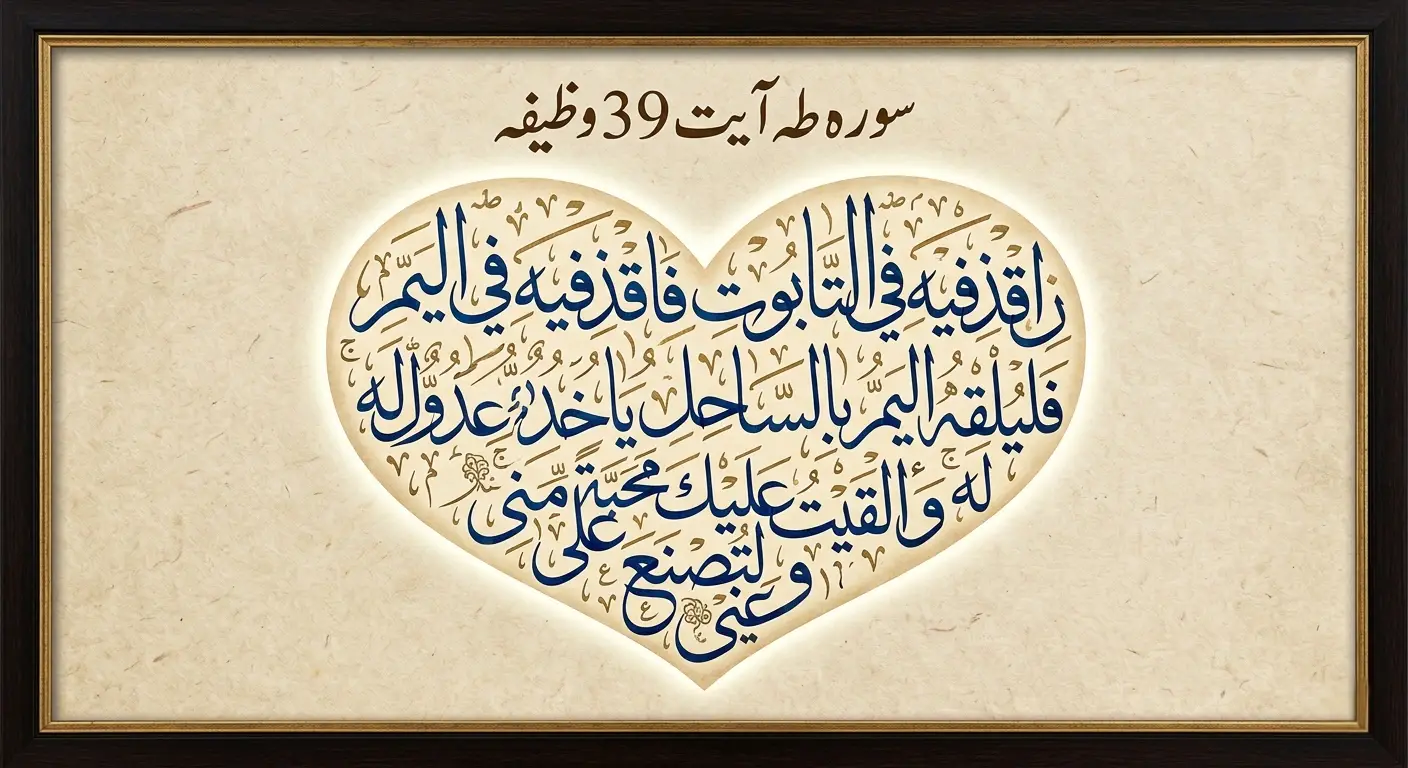
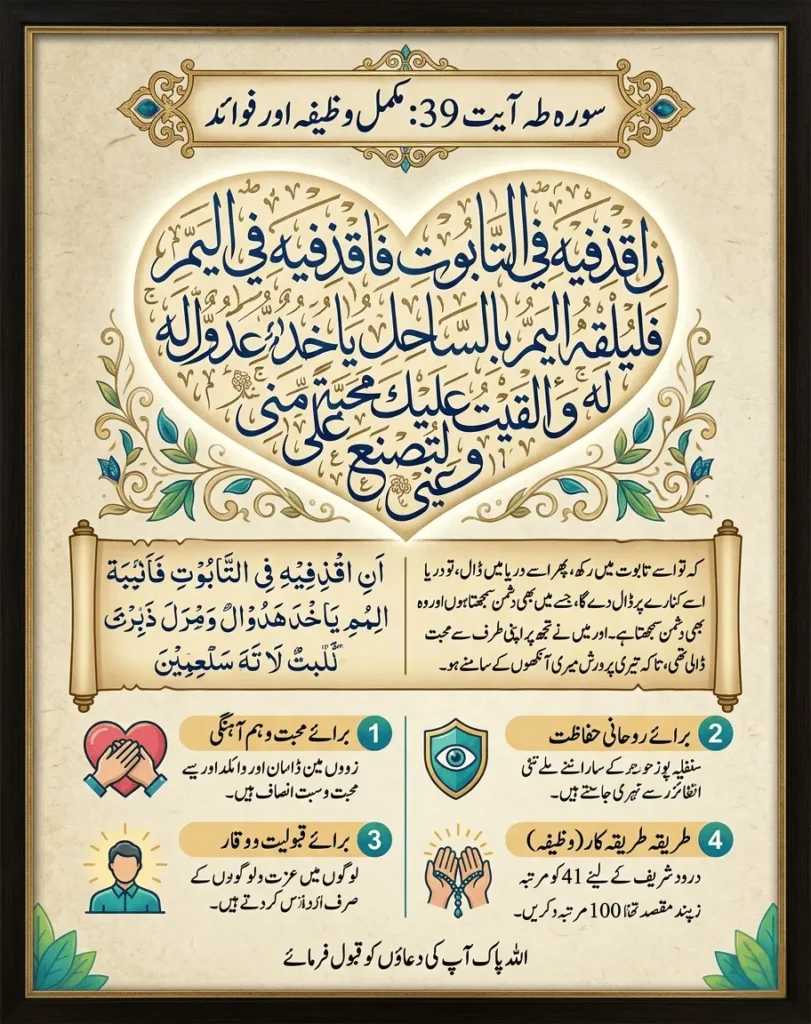
أَنِ اقْذِفِيهِ فِي التَّابُوتِ فَاقْذِفِيهِ فِي الْيَمِّ فَلْيُلْقِهِ الْيَمُّ بِالسَّاحِلِ يَأْخُذْهُ عَدُوٌّ لِّي وَعَدُوٌّ لَّهُۥ ۚ وَأَلْقَيْتُ عَلَيْكَ مَحَبَّةًۭ مِّنِّى وَلِتُصْنَعَ عَلَىٰ عَيْنِىٓ
Roman Transliteration (Easy to Read)
“Ani iq’dheefeehi fi t-taabooti faq’dheefeehi fi l-yammi fal-yulqi-hi l-yammu bi-s-saa-heeli ya’khudh-hu ‘aduwwun lee wa ‘aduwwun lahu, wa al-qaytu ‘alaika mahabbatan minnee wa li-tusna’a ‘alaa ‘aynee.”
Word-by-word breakdown:
| Arabic | Transliteration | Meaning |
|---|---|---|
| أَنِ | Ani | Saying |
| اقْذِفِيهِ | iq’dheefeehi | Cast him |
| فِي التَّابُوتِ | fi t-taabooti | in the chest/ark |
| فَاقْذِفِيهِ | faq’dheefeehi | then cast it |
| فِي الْيَمِّ | fi l-yammi | in the river |
| فَلْيُلْقِهِ | fal-yulqi-hi | then let it cast him |
| الْيَمُّ | l-yammu | the river |
| بِالسَّاحِلِ | bi-s-saa-heeli | on the bank |
| يَأْخُذْهُ | ya’khudh-hu | he will take him |
| عَدُوٌّ لِّي | ‘aduwwun lee | an enemy to Me |
| وَعَدُوٌّ لَّهُ | wa ‘aduwwun lahu | and an enemy to him |
| وَأَلْقَيْتُ | wa al-qaytu | And I cast/bestowed |
| عَلَيْكَ مَحَبَّةً | ‘alaika mahabbatan | upon you love |
| مِّنِّى | minnee | from Me |
| وَلِتُصْنَعَ | wa li-tusna’a | and that you may be reared |
| عَلَىٰ عَيْنِى | ‘alaa ‘aynee | under My Eye |
Sahih International (Most Widely Used)
“[Saying], ‘Cast him into the chest and cast it into the river, and the river will throw it onto the bank; there will take him an enemy to Me and an enemy to him.’ And I bestowed upon you love from Me that you would be brought up under My eye.”
Urdu Translation (اردو ترجمہ)
“کہہ رہا ہوں کہ اس بچے کو صندوق میں رکھ کر دریا میں ڈال دو، پھر دریا اسے کنارے پر پھینک دے گا، وہاں اسے کوئی اٹھائے گا جو میرا دشمن ہے اور اس کا دشمن ہے۔ اور میں نے تم پر اپنی طرف سے محبت ڈال دی ہے تاکہ تم میری نگہداشت میں پرورش پاؤ۔”
Key Urdu phrases:
- “محبت ڈال دی” = I cast love upon you
- “میری نگہداشت میں” = Under My protection/care
- “صندوق” = Chest/ark
Hindi Translation (हिंदी अनुवाद)
“(कहा) कि उसे संदूक में डालो, फिर उसे नदी में डाल दो, तो नदी उसे तट पर फेंक देगी, वहाँ उसे एक ऐसा दुश्मन ले जाएगा जो मेरा दुश्मन है और उसका दुश्मन है। और मैंने तुम पर अपनी ओर से प्यार डाल दिया है ताकि तुम मेरी देखभाल में पले-बढ़े।”
Key Hindi phrases:
- “प्यार डाल दिया” = I cast love upon you
- “मेरी देखभाल में” = Under My care
- “संदूक” = Chest/box
Tafseer: What Classical Scholars Say
Ibn Kathir’s Explanation
Ibn Kathir (رحمہ اللہ) explains that this verse reveals Allah’s special favor on Musa (AS). When Allah said “I cast love upon you from Me,” He meant:
“I made every person who saw Musa love him, including Pharaoh’s household. When Pharaoh’s wife Asiya found baby Musa, she immediately loved him and pleaded with Pharaoh: ‘Do not kill him! He may benefit us or we may adopt him as a son.’ This was divine love from Allah.”
Key insight: Musa grew up in the very house of his enemy (Pharaoh), yet Allah’s protection kept him safe. This shows how Allah can use apparent enemies to fulfill His wisdom.
Tafsir Al-Jalalayn’s Perspective
Al-Jalalayn states:
“And I bestowed upon you love from Me—meaning, I instilled love for you in the hearts of people, especially Pharaoh’s family. ‘That you may be reared under My Eye’ means under My direct protection and watchful care, not leaving you to creation’s care.”
The miracle in three blessings:
- Divine command through inspiration to Musa’s mother
- Divine love cast upon Musa in people’s hearts
- Divine protection under Allah’s direct Eye
3 Key Lessons from This Verse
1. Trust Allah Even When It Feels Dangerous
Musa’s mother faced what seemed like a death sentence: “Put your baby in a river.” Human logic says this is madness. But her tawakkul (trust in Allah) saved her son.
Modern application: When you’re facing impossible choices—relationship problems, job loss, health issues—remember that Allah’s commands sometimes seem illogical but lead to miracles.
2. Allah Can Turn Enemies Into Protectors
Pharaoh was “an enemy to Me and an enemy to him,” yet Allah used Pharaoh’s palace to raise and protect Musa.
This becomes important when you look at… your own life. The person who hurt you, the situation that seemed hopeless—Allah can transform it into something good. His wisdom exceeds human understanding.
3. Divine Love Is Real and Accessible
When Allah says “I cast love upon you from Me,” it means Allah can make you beloved to others. This isn’t manipulation—it’s a spiritual favor.
Why this matters today: Many people search for “wazifa for love” because they want halal ways to gain respect, reconciliation, or attraction. This verse shows that true love comes from Allah, not magic or superstition.
Authentic Wazifa Guidance: What’s Real vs. Unverified
The Search Reality
Thousands of people search monthly for:
- “Surah Taha Ayat 39 wazifa for love”
- “Surah Taha Ayat 39 wazifa for husband”
- “Wa alqaitu alaika mahabbatan minni wazifa”
What Islam Actually Says
Important clarification: There is no authentic hadith that specifically prescribes reciting Surah Taha Ayat 39 a certain number of times for love or marriage. Many viral wazifa videos on social media make claims without scholarly backing.
However, the authentic spiritual practice is:
✅ Reciting this ayat to remember Allah’s love and protection
✅ Making dua (supplication) after recitation, asking Allah for halal love and marriage
✅ Trusting in Allah’s timing, like Musa’s mother did
✅ Reciting with sincerity (ikhlas) for Allah’s pleasure, not control over others
How to Recite with Blessing (Adab/Etiquette)
If you want to recite this ayat for spiritual benefit:
- Make wudu (ablution) for purity
- Recite with understanding—know what the words mean
- Recite 11 or 21 times daily after Fajr or Maghrib (customary, not mandatory)
- Make sincere dua after recitation:
- “Ya Allah, just as You cast love upon Musa from You, cast love in the hearts of those who can benefit me halal”
- “Ya Allah, protect me under Your Eye like You protected Musa”
- Have patience (sabr)—results come from Allah’s will, not mechanical recitation
Warning: Avoid anyone claiming this wazifa will “force” someone to love you. Islam teaches halal intentions, free will, and trust in Allah’s wisdom—not coercion or manipulation.
Surah Taha Ayat 39 & “Wa Alqaitu Alaika Mahabbatan Minni Wazifa” — Complete Guide
Surah Taha Ayat 39 reveals Allah’s divine love and protection for Prophet Musa (AS). Key elements: Arabic text, Urdu/English translation, word-by-word meaning, Ibn Kathir tafseer, authentic wazifa guidance (no guaranteed claims), trust in Allah (tawakkul), and practical application for love, marriage, and protection. Recite with sincerity, not superstition. “Wa alqaitu alaika mahabbatan minni” means Allah cast love upon Musa from Himself — a divine favor believers can seek through halal dua.
Surah Taha Ayat 39 reveals Allah’s divine love and protection for Prophet Musa (AS). Key elements: Arabic text, Urdu/English translation, word-by-word meaning, Ibn Kathir tafseer, authentic wazifa guidance (no guaranteed claims), trust in Allah (tawakkul), and practical application for love, marriage, and protection. Recite with sincerity, not superstition. “Wa alqaitu alaika mahabbatan minni” means Allah cast love upon Musa from Himself — a divine favor believers can seek through halal dua.
Complete Wazifa Guide: “Wa Alqaitu Alaika Mahabbatan Minni”
⚠️ Authenticity Warning (Read First)
Bottom line: The ayat itself is authentic, but specific wazifa methods found online are NOT from hadith. You can recite with sincere intention, but avoid superstition.
The Authentic Wazifa Method (Permissible & Safe)
Step-by-Step Procedure
text📿 Best Time: After Fajr or Maghrib prayer (or any quiet time)
📿 Duration: 11, 14, or 40 consecutive days (customary, not mandatory)
📿 Intention: Sincere (ikhlas) for Allah's pleasure, NOT manipulation| Step | Action | Count | Authenticity |
|---|---|---|---|
| 1 | Make fresh wudu (ablution) | — | ✅ Sunnah |
| 2 | Recite Durood Shareef (Islamic blessings on Prophet ﷺ) | 11 times | ✅ Sunnah (highly rewarding) |
| 3 | Recite Surah Taha Ayat 39 (full verse) | 11–41 times | ✅ Quran (authentic) |
| 4 | Recite “Ya Wadood” (Allah’s Name of Love) | 100–300 times | ✅ Authentic (99 Names of Allah) |
| 5 | Make sincere dua in your own words | Free | ✅ Sunnah |
| 6 | Recite Durood Shareef again | 11 times | ✅ Sunnah |
| 7 | Trust in Allah’s will + have patience (sabr) | — | ✅ Core Islamic belief |
Hadith References About Musa (AS) and Trust in Allah
Hadith on Consistency in Good Deeds
The Prophet Muhammad (ﷺ) said:
“Take on only as much as you can do of good deeds, for the best of deeds is that which is done consistently, even if it is little.”
— Sunan Ibn Majah 4240
Connection to Surah Taha 39: Just as Musa’s mother showed consistent trust in Allah, our spiritual practice should be sustainable and sincere, not intense but short-lived.
Story of Musa’s Mother’s Inspiration
While there’s no hadith explicitly detailing Musa’s mother’s story, the Quran itself is the primary source. Allah says in Surah Al-Qasas (28:7):
“And We inspired to the mother of Moses, ‘Suckle him; but when you fear for him, cast him into the river and do not fear and do not grieve. Indeed, We will return him to you and will make him [one] of the messengers.'”
This confirms the divine inspiration (wahy) she received, just like in Surah Taha 39.
Practical Applications for Daily Life
When You’re Anxious About Relationships
Like Musa’s mother: You can’t control outcomes, only your trust in Allah. Recite this ayat while making dua for:
- Halal marriage
- Reconciliation with family
- Respect in relationships
- Protection from harm
When You Feel Trapped
The miracle pattern: Musa’s story shows that the most dangerous moment was the beginning of his salvation. Your current crisis might be Allah’s setup for your breakthrough.
When You Want Allah’s Love in Your Life
Spiritual practice: Recite this ayat while reflecting on:
- Allah’s love for you (not just your love for Him)
- How Allah protects you when you’re unaware
- How Allah can make you beloved to others through His mercy
Surah Taha ayat 39 PDF
People Also Ask:
There’s no authentic hadith specifying a number. Common practice among pious Muslims is 11, 21, or 41 times daily after Fajr or Maghrib. The key is sincerity and consistency, not just quantity.
This ayat teaches trust in Allah’s protection. If you’re seeking reconciliation, recite it with dua for halal resolution, patience, and Allah’s will. Avoid superstition—results come from Allah, not mechanical recitation.
No specific Sahih Bukhari hadith directly mentions Surah Taha 39. The story of Musa’s mother appears in Quran (Surah Al-Qasas 28:7) and is explained by classical tafseer scholars like Ibn Kathir.
It means “I cast love upon you from Me”—Allah’s divine favor making someone beloved. This is Allah’s power, not a magic formula. Use it for halal intentions: respect, reconciliation, or attracting a righteous spouse through Allah’s will.
Yes. The verse mentions Allah protecting Musa from Pharaoh (an enemy). Many Muslims recite it seeking Allah’s protection from harm, evil eye, or enemies. Pair it with dua for safety and trust in Allah’s plan.
Benefits of Reciting Surah Taha Ayat 39
Continue Your Islamic Learning Journey
Ready to go deeper? Explore these related articles:
→ Read the complete tafseer of Surah Taha to understand the full context of Prophet Musa’s story
🚀🚀🚀
→ Learn the morning dua after waking up to start your day with Allah’s protection, just like Musa was under His Eye
🚀🚀🚀
→ Explore Ayat for protection to discover more Quranic verses that shield you from harm and anxiety
Final Thought: Trust Allah Like Musa’s Mother Did
Surah Taha Ayat 39 isn’t just ancient history. It’s a living promise that Allah’s love, protection, and wisdom surround those who trust Him.
When you feel trapped, remember:
- Musa’s mother cast her baby into the river and Allah saved him
- Pharaoh was an enemy and Allah used him to protect Musa
- Allah cast love from Himself upon Musa
Your turn: What’s your “river moment”? What situation seems impossible? Trust Allah. His plan is greater than your fear.
May Allah grant us the wisdom to trust Him like Musa’s mother, the love that comes from His mercy, and the protection under His watches Eye. Ameen.
