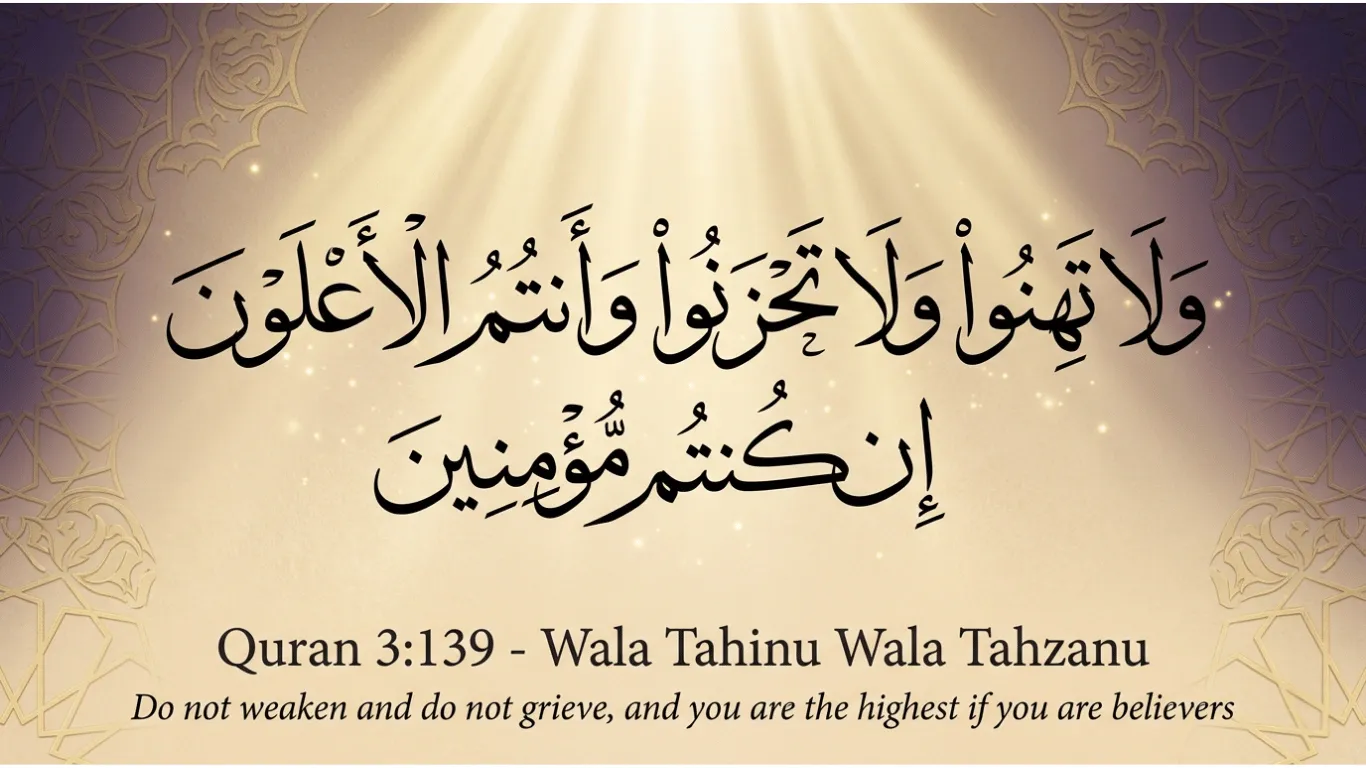
What does “wala tahinu wala tahzanu” mean? It means “So do not weaken and do not grieve” from Quran 3:139 (Surah Ali ‘Imran). Allah gave TWO separate commands addressing physical/spiritual weakness AND emotional grief—teaching us that true resilience requires both strength AND hope.
When Grief Makes You Feel Weak
You’re sitting in your room. The notification from the hospital came three days ago. Your phone hasn’t stopped buzzing with messages from relatives asking “how are you holding up?” But you can’t answer. Because the truth is—you’re not holding up. You’re breaking. You feel weak in your body, empty in your heart, and somewhere deep down, you’re starting to wonder: Does Allah even see me right now?
Here’s what most articles about this verse miss: Allah didn’t give one command. He gave TWO. And understanding why changes everything about how you approach grief.
What Is the Complete Meaning of Wala Tahinu Wala Tahzanu?
“Wala tahinu wala tahzanu” translates to: “So do not weaken and do not grieve.” This is Quran 3:139 from Surah Ali ‘Imran, revealed after the Battle of Uhud to Comfort Muslims who experienced devastating loss.
Full Arabic Text with Complete Transliteration
Arabic:
وَلَا تَهِنُوا وَلَا تَحْزَنُوا وَأَنتُمُ الْأَعْلَوْنَ إِن كُنتُم مُّؤْمِنِينَ
Transliteration:Walā tahinū walā tahzanū wa-antumul-aʿlawna in kuntum muʾminīn
English Translation:“So do not weaken and do not grieve, and you will be superior if you are [true] believers”
Urdu Translation:
“اور کمزوری نہ کرو اور غم میں نہ پڑو، اور tum highest (derajat) par hain agar tum musalman ho”
Hindi Translation:
“اور ताक़त न моहरो और दुख न पड़ो, और tum sabse ऊँचे हो अगर tum musalman ho”
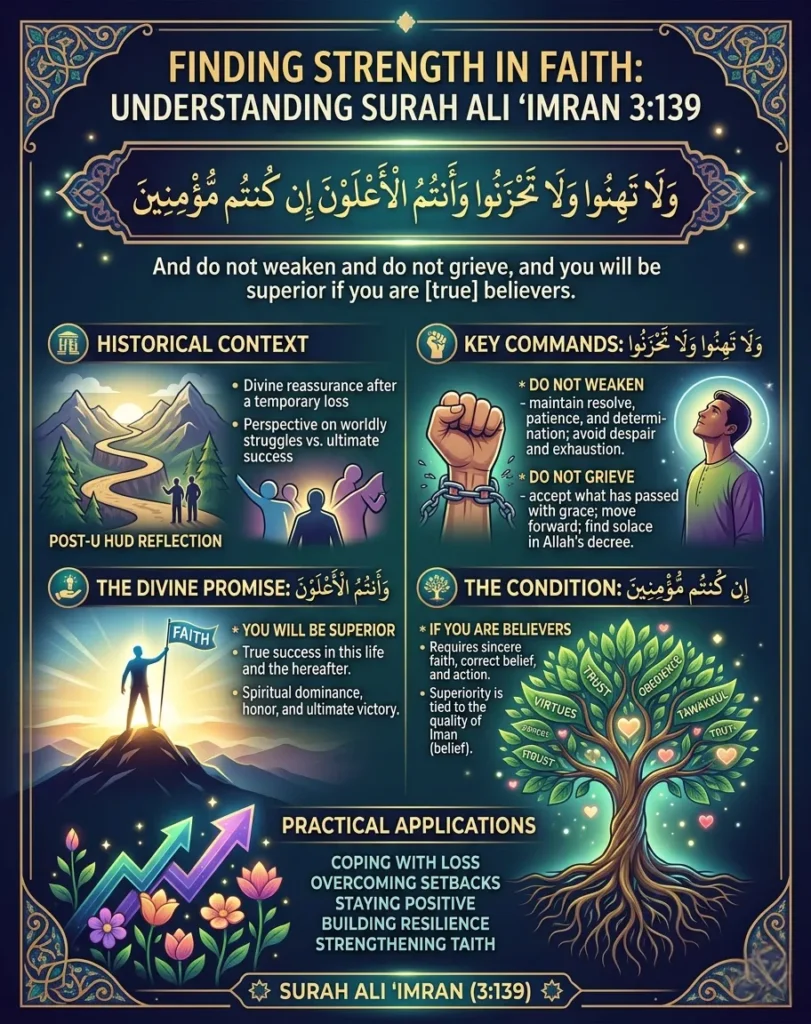
Word-by-Word Breakdown: Why Two Commands?
Allah commanded Muslims to stop TWO different things: weakness (tahinū) AND grief (tahzanū). These address separate human vulnerabilities—physical/spiritual strength AND emotional/psychological state.
Linguistic Analysis Table
| Arabic Word | Root | Literal Meaning | Manifestation | Modern Example |
|---|---|---|---|---|
| تَهِنُوا (Tahinū) | هِن (hin) | Be weak/faint | Losing courage, fear, physical exhaustion | Can’t get out of bed, afraid to face tomorrow |
| تَحْزَنُوا (Tahzanū) | غَزَن (ghazn) | Grieve/be sad | Depression, despair, prolonged sorrow | Crying all day, feeling hopeless about future |
Critical Insight: The verse recognizes that weakness leads to grief and grief weakens you further. They’re interconnected—but require separate commands because they attack different parts of your being.
Historical Context: Battle of Uhud
This verse was revealed after the Battle of Uhud (3 AH / 625 CE) when Muslims lost 70 companions, including Hamza (RA), Prophet Muhammad’s beloved uncle. The Muslim army went from 700 fighters to facing 3,000 Meccans, and some archers disobeyed orders, leaving their defensive position.
What Muslims Felt After Uhud
- Physical weakness from battle wounds and exhaustion
- Emotional devastation from losing beloved friends and family
- Spiritual doubt questioning why Muslims lost despite their faith
- Fear of future Meccan attacks
Allah didn’t just say “be strong.” He said “do not weaken AND do not grieve” because He knew Muslims were experiencing BOTH types of collapse simultaneously.
Ibn Kathir’s Tafseer: Why This Verse Saved a Community
Ibn Kathir explains this verse was given to encourage Muslims after Uhud, reminding them that victory and defeat are both from Allah, and their high status comes from faith—not battle results. He emphasizes that Muslims should not despair after temporary loss because Allah’s help will come if they remain steadfast.
Key Points from Ibn Kathir
- Uhud was a test, not abandonment: Muslims lost because of their own mistake (archers leaving position), but Allah didn’t abandon them
- Faith defines superiority: Being “highest in rank” (al-aʿlawna) comes from iman (faith), not military victory
- Dual collapse requires dual response: Weakness of body needs strength-building; grief of heart needs hope-restoring
- Allah’s promise is certain: “if you are believers” means the condition is already met for true believers
This wasn’t generic advice—it was divine intervention for a community in crisis.
Supporting Quranic Verses: The Grief-Comfort Pattern
Five Quranic verses address grief and weakness, forming a complete resilience framework. Each uses different language but teaches the same truth: Allah sees your pain and offers strength.
Comparative Verse Table
| Verse | Arabic Phrase | Translation | Context | Key Difference |
|---|---|---|---|---|
| 3:139 | وَلَا تَهِنُوا وَلَا تَحْزَنُوا | “Do not weaken and do not grieve” | Battle of Uhud | TWO commands: weakness + grief |
| 9:40 | لَا تَحْزَنْ إِنَّ اللَّهَ مَعَنَا | “Do not grieve, Allah is with us” | Prophet in cave with Abu Bakr | Comfort through Allah’s presence |
| 20:39 | وَلَنَسْتَعِين بِاللَّهِ | “We will seek Allah’s help” | Moses & Aaron mission | Comfort through Allah’s help |
| 31:17 | وَاصْبِرْ عَلَى مَا أَصَابَكَ | “Be steadfast over what afflicts you” | General instruction | Comfort through patience (sabr) |
| 42:25 | وَلَا تَحْزَنْ عَلَى مَا فَاتَكَ | “Do not grieve over what passed you” | Allah’s pardon | Comfort through Allah’s mercy |
Pattern: All verses start with “do not grieve” (لَا تَحْزَنْ) but 3:139 adds “do not weaken” (وَلَا تَهِنُوا)—making it the only verse addressing both collapse types.
The Two-Command Path: How Weakness and Grief Work Together
Here’s why this matters: Weakness and grief are NOT the same problem. They attack different parts of you, and healing requires addressing BOTH separately.
The Weakness Cycle (تَهِنُوا)
Physical → Mental → Spiritual collapse:
- Physical exhaustion: You can’t sleep, can’t eat, can’t move
- Mental fatigue: You lose motivation to try, fear dominates thoughts
- Spiritual doubt: You question “Does Allah care?” or “Why am I being tested?”
Solution: Restore strength through small actions (drink water, pray one rakat, call one friend)
The Grief Cycle (تَحْزَنُوا)
Emotional → Psychological → Identity collapse:
- Emotional pain: You cry uncontrollably, feel empty inside
- Psychological despair: You lose hope about future, feel trapped
- Identity crisis: You wonder “Am I still a good believer?” or “Does my faith matter?”
Solution: Restore hope through Allah’s promise (“you ARE the highest”)
How They Interconnect
Weakness feeds grief: When you’re physically weak, you feel emotionally vulnerable Grief feeds weakness: When you’re emotionally crushed, you lose physical motivation
The two-command path breaks BOTH cycles simultaneously:
- Command 1: “Do not weaken” → Build strength
- Command 2: “Do not grieve” → Restore hope
- Promise: “You are highest” → Reaffirm identity
Modern Application: When Grief Feels Endless
This becomes important when you look at modern Muslim experiences: Depression after job loss, anxiety from family rejection, burnout from activist work, or prolonged grief from death.
Five Modern Crisis Scenarios
| Scenario | Weakness (Tahinū) | Grief (Tahzanū) | Two-Command Response |
|---|---|---|---|
| Death of loved one | Can’t function daily, exhausted from crying | Despair about future, feeling alone | “Don’t weaken” → Rest, eat, sleep “Don’t grieve” → Trust Allah’s plan |
| Job rejection | Lose motivation to apply again | Feel like failure, question identity | “Don’t weaken” → Apply to one more job “Don’t grieve” → Allah’s plan is better |
| Health diagnosis | Physical pain, can’t exercise | Fear of death, loss of hope | “Don’t weaken” → Follow treatment “Don’t grieve” → Allah is healer |
| Relationship loss | Avoid social contact, isolate | Feel abandoned, question self-worth | “Don’t weaken” → Meet one friend “Don’t grieve” → Allah replaces what’s lost |
| Financial stress | Can’t work due to stress | Anxiety about debt, panic | “Don’t weaken” → Make one payment “Don’t grieve” → Allah provides |
Key Principle: The verse doesn’t say “ignore your pain.” It says “don’t let pain destroy your strength OR your hope.”
Daily Recitation Practice: How to Start
Start reciting this verse daily with this specific timing and frequency:
Recommended Practice
- Morning (after Fajr): Recite 3 times with full attention on meaning
- Midday (after Dhuhr): Recite 3 times while remembering current struggle
- Night (before sleep): Recite 3 times while asking Allah for strength
Total: 9 recitations daily for 30 days minimum
How to Recite Effectively
- ** read Arabic first** (even if you don’t understand fully)
- Say transliteration aloud to connect with meaning
- Pause after each command:
- “Do not weaken” → Ask: Where am I weak right now?
- “Do not grieve” → Ask: What am I grieving that I need to release?
- End with “You are highest” → Remind yourself: My faith defines me, not my circumstances
What to Expect
- Week 1: You may feel resistance (grief is comfortable)
- Week 2: Small shifts in perspective (hope begins returning)
- Week 3: Increased resilience (strength building)
- Week 4: Noticeable change in how you handle stress (both weakness + grief reduced)
This isn’t magic—it’s spiritual habit formation. The verse works because it reminds you of Allah’s promise every time you recite it.
Common Misconceptions & Clarifications
❌ “This means don’t feel any sadness”
✅ Correction: Islam allows natural grief (Prophet Muhammad cried for his son). This verse forbids destructive, prolonged grief that leads to despair of Allah’s mercy.
❌ “This means Muslims must always win”
✅ Correction: The verse says believers are “highest in rank” because of faith, not victory. Uhud was a loss, but Muslims remained elevated spiritually.
❌ “This is only for warriors”
✅ Correction: The Arabic uses plural form addressing the entire Muslim community, not just soldiers. Every believer faces “battles”.
❌ “This denies human emotion”
✅ Correction: The verse acknowledges the temptation to weaken/grieve, then commands resistance. It’s not emotionless—it’s emotion-regulated through faith.
Related Forgiveness Duas for Complete Spiritual Healing
When you’re grieving, you may also feel guilt about past mistakes. Combine this resilience verse with Sayyid al-Istighfar for complete spiritual cleansing and forgiveness.
Most Powerful Duas for Forgiveness: Sayyidul Istighfar
Additionally, recite Dua Rabbana Innana Amanna Faghfir Lana for collective forgiveness and protection from punishment during your grief.
Dua for Forgiveness: Rabbana Innana Amanna Faghfir Lana
People Also Ask:
It means “So do not weaken and do not grieve” from Quran 3:139. Allah gave TWO commands addressing physical weakness AND emotional grief.
Surah Ali ‘Imran (Chapter 3), verse 139. Revealed after Battle of Uhud to comfort Muslims who lost 70 companions.
اور کمزوری نہ کرو اور غم میں نہ پڑو” (Aura kamzori na karo aur gham mein na paro).
No fixed number mandated. Recommended: 3 times morning, 3 times midday, 3 times night (9 total daily) for 30 days.
Weakness and grief attack different parts of you. Weakness = physical/spiritual collapse. Grief = emotional/psychological collapse. Both need separate commands.
No. The plural form addresses all believers. Every Muslim faces “battles” requiring strength and hope.
3:139 says “do not weaken AND grieve” because you’re “highest in rank” (identity). 9:40 says “do not grieve” because “Allah is with us” (presence).
Your First Step: Start Today
You don’t need to wait for the perfect moment. Start reciting this verse tonight before sleep. Say it three times. Pause after “do not weaken”—ask yourself: Where am I weak right now? Pause after “do not grieve”—ask: What am I grieving that I need to release? End with “you are highest”—remind yourself: My faith defines me.
The grief won’t disappear instantly. But you’ll begin building strength. And hope will slowly return. Because Allah promised it: “You are the highest if you are believers.”
Your faith hasn’t disappeared. You’re still here. And that promise is still true.
