
Have you ever hit a wall where human effort completely fails? The kind of crushing anxiety or sudden crisis where doctors have no answers, bank accounts run dry, and you feel utterly alone in the dark. You are not the first to feel this kind of desperation.
Centuries ago, on the burning sands of Karbala, the greatest of men faced agonizing, suffocating despair. Surrounded by thousands, cut off from water, and watching his family suffer, Imam Hussain faced grief that breaks the human spirit. Yet, whenever he looked at the face of one specific man—his brother—that overwhelming agony lifted.
That man was Hazrat Abbas. Today, millions of believers turn to that very same spiritual anchor when facing impossible odds, reciting the powerful invocation: Ya Kashif Al Karbi an wajhil Hussain.
Here is why this matters. This is not just a historical phrase; it is a highly specific, time-tested spiritual lifeline designed for those moments when you have nowhere else to turn.
What Does Ya Kashif Al Karbi an Wajhil Hussain Mean?
“Ya Kashif Al Karbi an wajhil Hussain” is an Arabic supplication directed to Hazrat Abbas, asking him to intercede with Allah to relieve your distress, just as his presence physically and emotionally removed the agony from Imam Hussain’s face during the Battle of Karbala.
Let’s understand the real meaning by looking at the exact words. The Arabic language is incredibly precise. The word used here for distress is not huzn (ordinary sadness) or hamm (worry). The word is Karb. In classical Arabic, Karb refers to an agony so profound that it chokes the throat and crushes the chest. It is the type of sorrow that leaves a physical mark on a person’s face.
When you recite this dua, you are tapping into a deeply intimate, emotional bond between two brothers, asking that the same relief provided to a holy Imam be extended to your own broken heart.
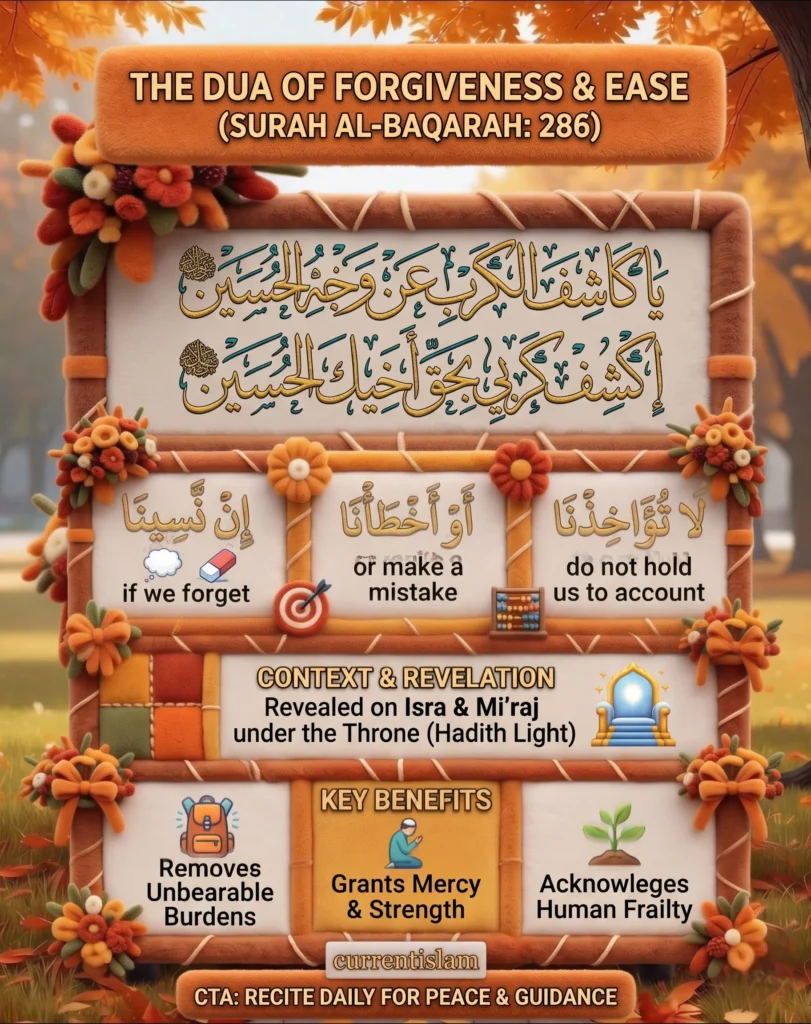
Word-by-Word Translation & Multilingual Proof
To truly connect with the invocation, you must understand what you are declaring.
Arabic:
يَا كَاشِفَ الْكَرْبِ عَنْ وَجْهِ الْحُسَيْنِ، اِكْشِفْ كَرْبِي بِحَقِّ أَخِيكَ الْحُسَيْنِ
Transliteration:
Ya Kashifal Karbi an wajhil Hussain, Ikshif karbi bihaqqi akhikal Hussain.
English Translation:
O the one who removes agony from the face of Hussain, remove my agony by the right of your brother Hussain.
Urdu Translation:
اے حسین (ع) کے چہرے سے تکلیف و پریشانی دور کرنے والے، اپنے بھائی حسین (ع) کے صدقے میری پریشانی دور فرما۔
The Historical Context: The Standard Bearer of Karbala
Hazrat Abbas was the standard bearer and fiercely loyal half-brother of Imam Hussain during the Battle of Karbala in 680 CE. His unwavering strength, courage, and devotion provided immense emotional relief to Imam Hussain amidst the unimaginable tragedy of losing his entire family.
This becomes important when you look at classical Islamic history. According to the foundational historical text Maqtal al-Husayn by Abu Mikhnaf, the psychological warfare inflicted upon Imam Hussain’s camp was immense. Thirst ravaged the women and children for three days. Companions fell one by one. Through this literal and emotional massacre, Hazrat Abbas stood as the impenetrable pillar of the camp.
Whenever Imam Hussain would look out at the surrounding army of tens of thousands, the weight of the tragedy would reflect on his face. But the moment his eyes fell upon Abbas—standing tall, holding the standard flag (Alam), entirely unshakeable—the Karb (agony) would leave Hussain’s face. Abbas was the physical manifestation of hope and safety.
When Hazrat Abbas finally rode out to fetch water and was brutally martyred on the banks of the Euphrates, history records Imam Hussain rushing to his body, weeping bitterly, and uttering words that echo through time: “Now my back is broken, and my options are diminished.”
By invoking this specific history, you are essentially reminding heaven of the greatest display of brotherly love and loyalty ever witnessed, using it as the ultimate spiritual currency.
The Concept of Tawassul in Islam: A Quranic Perspective
Tawassul is the Islamic practice of seeking closeness to Allah through an intermediary whom Allah loves. It is not worshiping the intermediary, but rather using their high spiritual status to present your prayers to God for a faster, more merciful response.
For many Muslims navigating heavy trials, understanding the concept of Tawassul in Islam is the key to unlocking answered prayers. We are often weighed down by our own sins and shortcomings, feeling unworthy to ask God for miracles. Tawassul solves this by asking a purified soul to endorse our request.
This practice is firmly rooted in the Holy Quran.
Quranic Proof: Surah Al-Ma’idah (5:35)
Arabic:
يَا أَيُّهَا الَّذِينَ آمَنُوا اتَّقُوا اللَّهَ وَابْتَغُوا إِلَيْهِ الْوَسِيلَةَ
Transliteration:
Ya ayyuha allatheena amanoo ittaqoo Allaha wabtaghoo ilayhi alwaseelata.
English Translation:
O you who have believed, fear Allah and seek the means [of approach] to Him.
Urdu Translation:
اے ایمان والو! اللہ سے ڈرو اور اس کی طرف (قربت کا) وسیلہ تلاش کرو۔
When you say, “by the right of your brother Hussain,” you are employing Tawassul. You are acknowledging that Hazrat Abbas is Bab al-Hawaij (The Door to Fulfilling Needs). You are effectively saying: I know that I am flawed, but I also know that Allah has elevated you, and that you can deny no request made in the sacred name of your brother Hussain. So, for his sake, please ask Allah to grant my need.
Why Recite Hazrat Abbas Dua 133 Times? (The Wazifa)
You recite this dua exactly 133 times because, in the ancient Arabic Abjad numerical system, the letters of the name “Abbas” mathematically equal 133. Islamic scholars and spiritual masters recognize this specific numerical alignment as a spiritual key for unlocking urgent prayers.
To break down the mathematics of the Abjad system (where every Arabic letter carries a numerical value):
- Ain (ع): 70
- Ba (ب): 2
- Alif (ا): 1
- Seen (س): 60
- Total: 133
According to narrations found in classical texts like Bihar al-Anwar by Allama Majlisi, reciting this invocation 133 times is a proven wazifa (spiritual prescription) for impossible situations. It is not merely chanting; it is a focused, targeted spiritual discipline.
How to Perform the Wazifa for Urgent Needs
If you are facing a crisis and need to perform this wazifa, order and purity are critical. You must approach this with absolute certainty that your prayer will be heard.
1.Perform Complete Ablution (Wudu):Ensure physical and spiritual purity.
Begin by ensuring your clothes and location are clean. Perform Wudu carefully, calming your mind and preparing to stand before the Divine.
2.Offer a 2-Rakat Hadiya Prayer:A gift to the soul of Hazrat Abbas.
Pray exactly like the morning (Fajr) prayer. Set your intention (Niyyah) that you are praying these 2 Rakats as a gift to the soul of Hazrat Abbas (Bab al-Hawaij).
3.Send Salawat on the Prophet and His Family:
Recite Allahumma salli ‘ala Muhammadin wa aali Muhammad 14 times. This acts as a spiritual seal, ensuring your prayer is elevated.
4.Recite the Dua 133 Times:Maintain uninterrupted focus.
Using a tasbeeh (prayer beads), recite Ya Kashifal Karbi an wajhil Hussain, Ikshif karbi bihaqqi akhikal Hussain exactly 133 times. Do not speak to anyone during this process. Focus deeply on the tragedies of the Battle of Karbala to soften your heart.
5.Present Your Hajat (Need):
Once you complete the 133rd recitation, raise your hands and ask Allah for your specific need, crying if you are able. Conclude again with Salawat 14 times.
Faith in Modern Crises: The Spiritual Anchor
Modern life is filled with high-anxiety crises like crippling debt, sudden terminal illnesses, career collapses, and emotional burnout. This dua acts as a spiritual anchor, connecting our private, modern agonies to the legendary resilience of Karbala, reminding us that no problem is too great for divine intervention.
Now let’s connect this to daily life. It is easy to view Islamic history as a distant event that belongs in textbooks. But the spiritual reality is that the archetypes of Karbala are entirely alive today. When a mother is sitting in a hospital waiting room, terrified for her sick child, she is experiencing her own form of Karb. When a father loses his job and cannot feed his family, that invisible weight crushing his chest is Karb.
The modern world tells us to rely solely on our own hustle, our doctors, or our bank accounts. But what happens when those fail?
This is where the title Bab al-Hawaij becomes a lifeline. Hazrat Abbas lost his hands in Karbala, but spiritually, he was granted hands that can reach across time and space to rescue those who call upon him. As a dua for severe distress and anxiety, this invocation shifts your reliance from the flawed, limited material world to the limitless, unseen mercy of Allah, accessed through His most loyal servant.
It trains the spiritual habit loop: instead of panicking when a crisis hits, your immediate reflex becomes turning to the Door of Needs.
People Also Ask
To perform the specific spiritual wazifa for fulfilling an urgent need, you should recite it exactly 133 times in a single, focused sitting. However, for general comfort and daily protection, you can recite it as many times as you like without a strict count.
Yes. While the 133-time wazifa is generally reserved for pressing, urgent needs, reciting this dua 7 times every morning and evening is a powerful spiritual habit to protect yourself from sudden calamities, daily anxieties, and unforeseen grief.
Hazrat Abbas ibn Ali, the brother of Imam Hussain, is universally recognized in Shia Islamic tradition as Bab al-Hawaij, which translates to “The Door to Fulfilling Needs.” He earned this title due to his selflessness; because he sacrificed his own desires for his brother and God, Allah granted him the authority to fulfill the desires of believers.
No, it is not shirk (polytheism). You are not believing that Hazrat Abbas is God or possesses power independent of Allah. You are asking him to use his immense favor with Allah to pray for you. Ultimately, it is only Allah who grants the miracle; Abbas is the honored intercessor presenting your case.
Your Next Step: Master the Practice
Reading about this powerful invocation is only the first step; actively bringing it into your life when you face your darkest moments is where true transformation happens. If you or someone you love is currently facing an impossible hardship, do not let despair win.
Download the Free PDF Guide: The 133x Wazifa & Step-by-Step Amaal.
This highly formatted, easy-to-read guide includes the exact Arabic script, transliteration, the complete method for the 2-Rakat preceding prayer, and spiritual framing to help you perform this powerful practice with absolute focus and confidence tonight. Ensure you have the exact methodology saved directly to your phone for whenever a crisis strikes.
