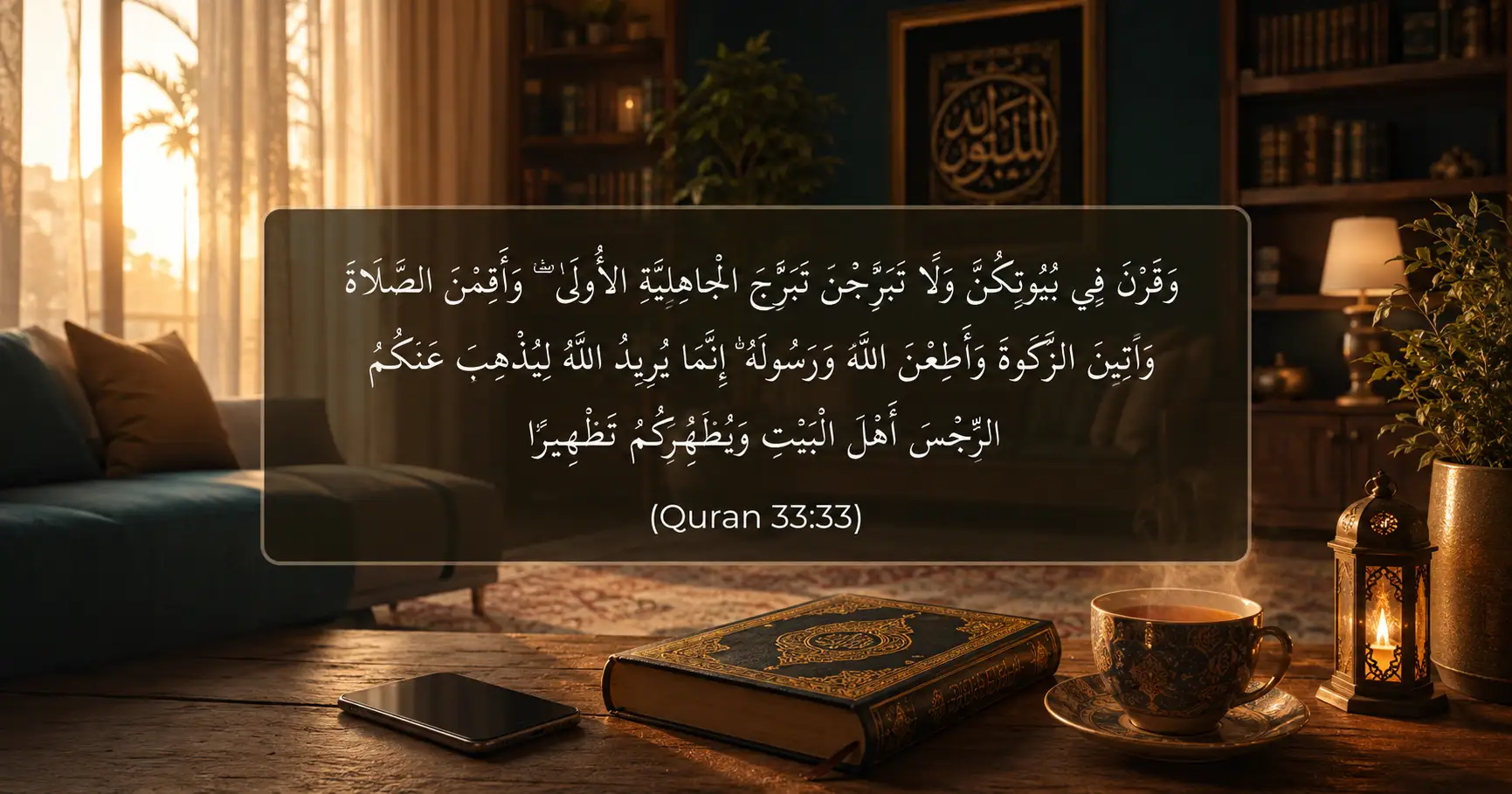
You wake up, reach for your phone, and instantly drown in a feed of perfect lives, endless debates, and the pressure to document your own existence. The anxiety is exhausting. Seeking public validation online drains your spiritual energy. Your home, which should be a sanctuary, now feels like a broadcast studio where the noise of the outside world never stops.
Over 1,400 years ago, Surah Ahzab Ayat 33 provided the ultimate remedy. By redefining the sanctity of the private home and condemning the “culture of display,” this Quranic revelation acts as a digital shield. It offers English-speaking Muslims a practical blueprint for finding peace, protecting their privacy, and curating a home that invites divine purification.
What is the Meaning of Surah Ahzab Ayat 33?
The best explanation for Quran 33:33 is that it commands the Prophet’s wives to maintain dignified privacy and avoid the pre-Islamic display of beauty. It establishes foundational worship while declaring Allah’s intention to completely purify the Ahl al-Bayt (the Prophet’s household) from all spiritual and moral sin.
Here is the exact text of the revelation:
Arabic Text:
وَقَرْنَ فِي بُيُوتِكُنَّ وَلَا تَبَرَّجْنَ تَبَرُّجَ الْجَاهِلِيَّةِ الْأُولَىٰ ۖ وَأَقِمْنَ الصَّلَاةَ وَآتِينَ الزَّكَاةَ وَأَطِعْنَ اللَّهَ وَرَسُولَهُ ۚ إِنَّمَا يُرِيدُ اللَّهُ لِيُذْهِبَ عَنكُمُ الرِّجْسَ أَهْلَ الْبَيْتِ وَيُطَهِّرَكُمْ تَطْهِيرًا
Transliteration: Wa qarna fi buyutikunna wa la tabarrajna tabarruj al-jahiliyyati al-ula, wa aqimna as-salata wa ateena az-zakata wa ati’na Allaha wa rasulahu. Innama yureedu Allahu liyudhhiba ‘ankumu ar-rijsa ahla al-bayti wa yutahhirakum tatheera.
English Translation: And abide in your houses and do not display yourselves as [was] the display of the former times of ignorance. And establish prayer and give zakah and obey Allah and His Messenger. Allah intends only to remove from you the impurity [of sin], O people of the [Prophet’s] household, and to purify you with [extensive] purification.
Urdu Translation:
اور اپنے گھروں میں ٹھہری رہو اور زمانۂ جاہلیت کی طرح اپنی سج دھج نہ دکھاتی پھرو، اور نماز قائم کرو اور زکوٰۃ دیتی رہو اور اللہ اور اس کے رسول کی اطاعت کرو۔ اللہ تو یہی چاہتا ہے کہ اے نبی کے گھر والو! تم سے ہر طرح کی گندگی دور کر دے اور تمہیں خوب پاکیزہ کر دے۔
Hindi Translation: और अपने घरों में टिक कर रहो और पहले अज्ञानकाल की तरह अपनी साज-सज्जा न दिखाती फिरो, और नमाज़ क़ायम करो और ज़कात देती रहो और अल्लाह और उसके रसूल की आज्ञा का पालन करो। अल्लाह तो यही चाहता है कि ऐ नबी के घर वालो! तुमसे हर प्रकार की गन्दगी दूर कर दे और तुम्हें ख़ूब पाक-साफ़ कर दे।
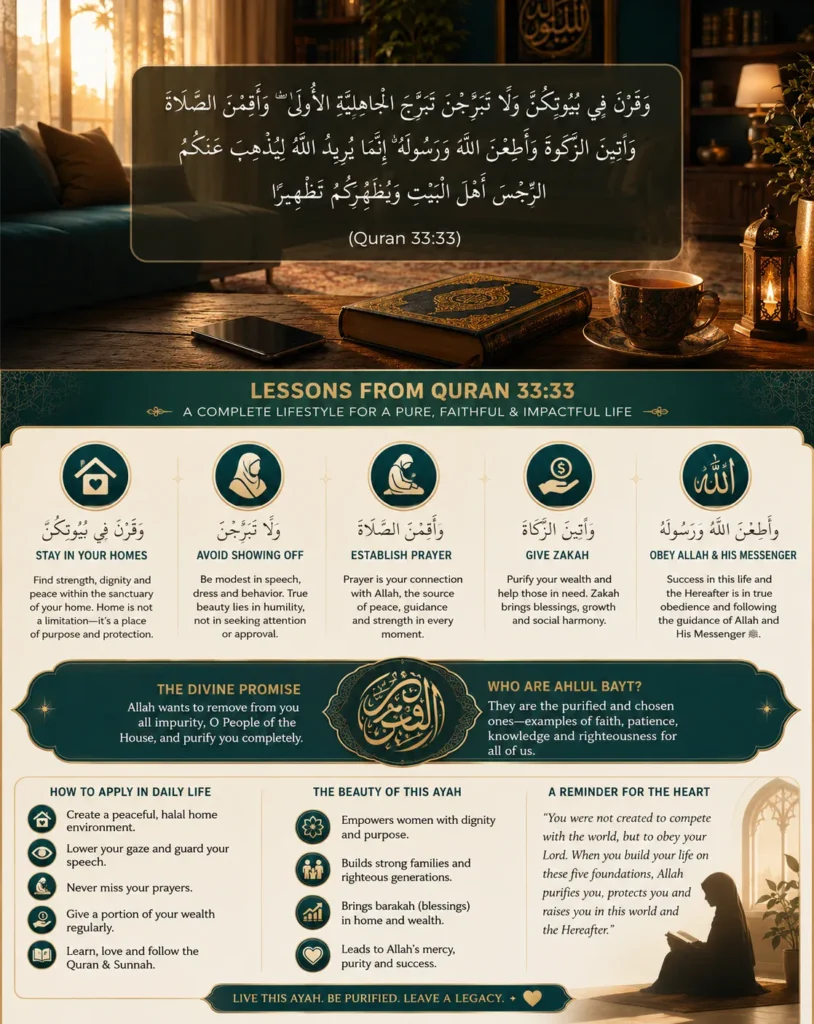
The Digital Sunnah: Breaking Free from “Modern Jahiliyyah”
Modern Jahiliyyah refers to the contemporary culture of oversharing and seeking public validation. Surah Ahzab Ayat 33 protects believers from this by commanding modesty (preventing Tabarruj) and establishing the private home as the ultimate source of spiritual safety, far removed from digital exhaustion.
Let’s break down the exact meaning of this verse and apply it to our modern struggles.
Understanding Tabarruj in the Age of Social Media
The Quran uses the phrase tabarruj al-jahiliyyah. In pre-Islamic Arabia (the era of ignorance), individuals would flaunt their wealth, status, and physical beauty in the marketplace to gain social currency.
Today, social media platforms are our digital marketplaces. Every time you feel the anxious urge to post a hyper-curated photo of your life just to count the likes, you are engaging in a digital form of Tabarruj. The psychological toll of this is massive. The Quran is teaching us that true honor does not come from public display. True honor comes from internal piety and obedience to Allah.
“Wa Qarna Fi Buyutikunna” – Reclaiming Your Private Sanctuary
The phrase wa qarna fi buyutikunna translates to “abide in your houses” or “settle in your homes with dignity.”
For the modern Muslim professional or diaspora parent, this is a profound psychological framework. Your home should be your fortress. When you bring the chaos of the internet into your living room—scrolling through toxic debates or comparing your life to influencers—you shatter that sanctuary. By intentionally logging off and establishing prayer (Salah) within your walls, you physically and spiritually anchor yourself.
This mindset shifts your reliance away from public approval. You learn to place your trust in Allah as your ultimate guardian, knowing His validation is the only metric that matters.
The Verse of Purification (Ayat al-Tathir) and Ahl al-Bayt
The second half of Surah 33:33 is known as the Verse of Purification. It marks a grammatical shift to declare that Allah has actively chosen to remove all spiritual impurity (Rijs) from the Prophet’s household (Ahl al-Bayt), elevating them as the perfect moral standard.
Who exactly are the Ahl al-Bayt?
While the preceding sentences address the Prophet’s wives, authentic traditions expand this definition. In Sahih Muslim (Hadith 2424), Aisha (RA) reported that the Prophet Muhammad (PBUH) went out one morning wearing a striped cloak. When Hasan, Husayn, Fatima, and Ali (RA) came to him, he wrapped them all under the cloak and recited: “Allah intends only to remove from you the impurity [of sin], O people of the [Prophet’s] household, and to purify you with [extensive] purification.”
This moment, known as the Event of the Cloak (Hadith al-Kisa), defines the spiritual elite. Loving the Prophet’s household is mandatory. This reverence is directly tied to his divine status, which is firmly established by the finality of his prophethood. We honor them because Allah purified them.
How to Apply Quran 33:33 in Your Daily Routine
You do not need to delete all your apps to practice this verse. You simply need to shift your relationship with them. Here is how this matters for your daily routine:
- Curate a “No-Scroll” Zone: Designate specific areas in your house—like your bedroom or prayer mat—where smartphones are forbidden. Reclaim the physical dignity of your home.
- Audit Your Intentions: Before you post anything online, ask yourself: Am I sharing this to benefit others, or is this digital Tabarruj?
- Send Salawat: The purity of the Prophet’s household reminds us of our duty to them. Whenever you feel overwhelmed by the modern world, spend a few minutes sending blessings upon the Prophet. This simple act refocuses your heart on the hereafter.
When the divine call to the believers is made, it requires action. You have the power to block out the noise of modern ignorance and build a spiritually thriving home.
Asked Questions
Surah Al-Ahzab (Chapter 33) Ayat 33 is located in Para (Juz) 22 of the Holy Quran.
No. Classical scholars agree this verse does not imprison women. The Prophet’s wives actively participated in society, taught thousands of hadith, and went to the mosque. The verse establishes the home as a dignified primary base, discouraging unnecessary wandering for the sake of public display.
The Arabic grammar shifts from the feminine plural (addressing the wives directly regarding their conduct) to the masculine/inclusive plural when mentioning the Ahl al-Bayt. Scholars explain this shift occurs because the “household” explicitly includes male figures like Ali, Hasan, and Husayn (RA), demonstrating that the divine purification encompasses the Prophet’s broader bloodline.
