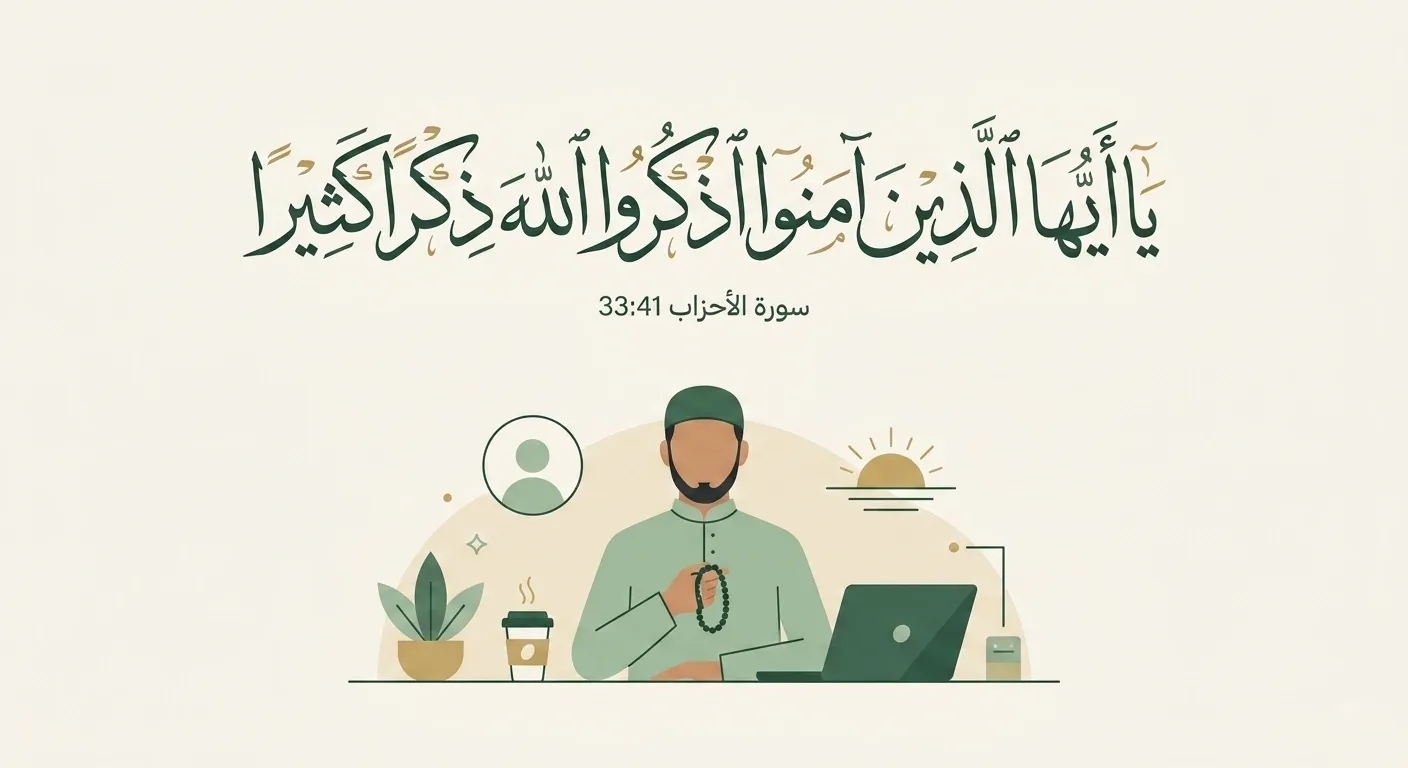
You wake up to a flooded inbox, endless smartphone notifications, and a creeping sense of spiritual guilt. Living in a demanding, secular environment leaves little room for traditional worship. You feel disconnected, overwhelmed, and spiritually burnt out, convinced that connecting with Allah requires a perfect, uninterrupted hour on a prayer mat.
The Quran offers a frictionless cure. By internalizing the command of Surah Al-Ahzab, Verse 41, you can transform your daily commute, your screen time, and your busiest workdays into profound acts of worship. This verse provides the ultimate psychological anchor for the modern believer.
What is the precise meaning of Surah Al-Ahzab Verse 41?
The exact meaning of Surah Al-Ahzab verse 40-41 is a direct divine command to believers, instructing them to engage in constant, abundant remembrance of Allah (Dhikr). It serves as a spiritual anchor that requires no specific time or ritual purity, making it the ultimate frictionless form of worship.
The Multilingual Blueprint: Surah Al-Ahzab 33:41
To truly grasp the weight of this command, we must look at the original text.
Arabic Text:
يَا أَيُّهَا الَّذِينَ آمَنُوا اذْكُرُوا اللَّهَ ذِكْرًا كَثِيرًا
Transliteration: Ya ayyuha allatheena amanoo othkuroo Allaha thikran katheera.
English Translation: O you who have believed, remember Allah with much remembrance.
Urdu Translation:
اے لوگو جو ایمان لائے ہو، اللہ کو کثرت سے یاد کرو۔
Hindi Translation: ऐ ईमान वालों! अल्लाह को बहुत ज़्यादा याद किया करो।
Word-by-Word Breakdown for Semantic Depth
How does the Arabic morphology of this verse guide our daily actions?
A word-by-word analysis of verse 33:41 reveals that the verse specifically targets those with existing faith. The verb used commands active, continuous remembrance, while the final Arabic terms emphasize that this action has absolutely no maximum limit or physical boundary.
Let’s break down the exact meaning of this verse:
- Ya ayyuha (يَا أَيُّهَا): A direct, attention-grabbing vocative particle. It is a loving, urgent call from the Creator.
- Allatheena amanoo (الَّذِينَ آمَنُوا): “Those who have believed.” Classical scholars like Ibn Kathir explain that this is a specific honor. Allah is not addressing all of humanity here; He is calling out to the believers who have already accepted the covenant.
- Othkuroo (اذْكُرُوا): An imperative command meaning “remember” or “mention.” This encompasses the tongue, the heart, and the physical limbs.
- Allaha (اللَّهَ): The Majestic Name of God.
- Thikran katheera (ذِكْرًا كَثِيرًا): “Abundant remembrance.” Unlike Zakat (which has a financial threshold) or Fasting (which is limited to a specific month), Dhikr has no cap.
Curing Spiritual Burnout
We rely on our phones to navigate the physical world, constantly refreshing feeds for dopamine hits. Yet, we neglect our spiritual nervous system. Modern Muslims face high-functioning anxiety because we lack a constant theological anchor.
Here is why this matters for your daily routine. When trying to implement massive changes to religious habits, you often hit a wall of friction. You might be at the office, unable to make Wudu, or sitting in traffic. Dhikr Katheer (abundant remembrance) is the digital Sunnah. It is a portable, invisible act of worship.
When we greet someone with assalamualaikum, we effortlessly make a powerful verbal dua for their peace. Dhikr functions exactly the same way. It requires zero physical friction. Furthermore, just as the Quran reminds us that kullu nafsin zaikatul maut (every soul will taste death), keeping our tongues moist with the remembrance of Allah keeps us grounded, humble, and prepared for that inevitable reality amidst our busy lives.
The Psychological and Spiritual Blueprint
How do we apply this at work or school? Understanding the dual benefits of Dhikr bridges the gap between theology and modern psychology.
The Difference Between the Living and the Dead
Which authentic Hadith perfectly explains the power of continuous Dhikr?
The most definitive Hadith supporting abundant Dhikr is found in Sahih Al-Bukhari. Prophet Muhammad (PBUH) directly compares a person who engages in remembrance of Allah to a living soul, while the one who neglects it is compared to a corpse.
Arabic Text:
مَثَلُ الَّذِي يَذْكُرُ رَبَّهُ وَالَّذِي لا يَذْكُرُ رَبَّهُ مَثَلُ الْحَيِّ وَالْمَيِّتِ
Transliteration: Mathalu allathee yathkuru rabbahu wallathee la yathkuru rabbahu mathalu alhayyi walmayyit.
English Translation: The example of the one who remembers his Lord in comparison to the one who does not remember his Lord is that of the living and the dead. (Sahih Al-Bukhari 6407)
Urdu Translation:
اس شخص کی مثال جو اپنے رب کا ذکر کرتا ہے اور جو نہیں کرتا، زندہ اور مردہ جیسی ہے۔
Hindi Translation: उस व्यक्ति का उदाहरण जो अपने रब को याद करता है और जो नहीं करता, जीवित और मृत जैसा है।
This authentic narration eliminates any doubt. Your spiritual vitality is directly tied to the frequency of your Dhikr, not just the perfection of your formal prayers.
Practical Wazifa: The 90-Second Micro-Transformation
You do not need an isolated mountain retreat to connect with Allah. You need micro-transformations.
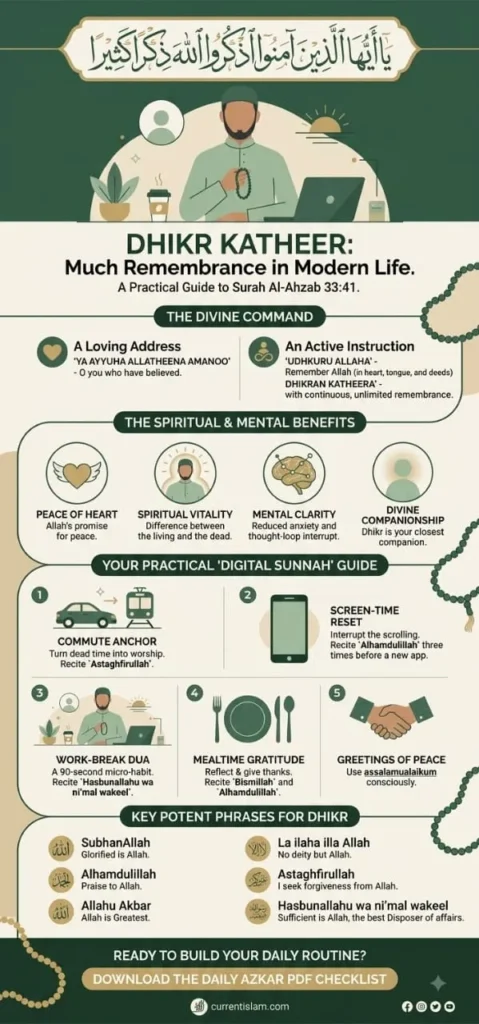
- The Commute Anchor: Use the time spent driving or on the train strictly for Astaghfirullah (seeking forgiveness). It turns dead time into highly rewarded worship.
- The Screen-Time Interruption: Before opening a social media app, recite Alhamdulillah three times. This breaks the subconscious habit loop of doom-scrolling and recenters your intention.
- The High-Stress Reset: When you feel an anxiety spike at work, silently recite Hasbunallahu wa ni’mal Wakeel (Sufficient for us is Allah, and He is the best Disposer of affairs).
People Also Ask
The exact phrase “Ya ayyuha allatheena amanoo” (O you who have believed) appears 89 times throughout the Quran. Each instance serves as a direct, specific instruction to the believers regarding legal, social, or spiritual matters.
Because the Quranic command explicitly uses the word “Katheera” (abundant/much), there is no restricted time. The best time to practice is continuously throughout your day—while walking, working, standing, or resting in bed before sleep.
No. You do not need to be in a state of Wudu (ritual ablution) to engage in verbal or internal Dhikr. This is what makes Dhikr the perfect, frictionless act of worship for busy professionals and students throughout their day.
Take the Next Step in Your Spiritual Routine
You now understand the theological depth, the psychological benefits, and the exact linguistic breakdown of this powerful Quranic command. Reading about it is the first step; implementation is the transformation.
We have compiled a beautifully designed, highly actionable checklist of morning and evening Azkar (remembrances) sourced directly from authentic Hadith collections to help you build your daily habit.
[Click here to download a PDF] of the ultimate daily Dhikr blueprint and start implementing the Digital Sunnah today.
