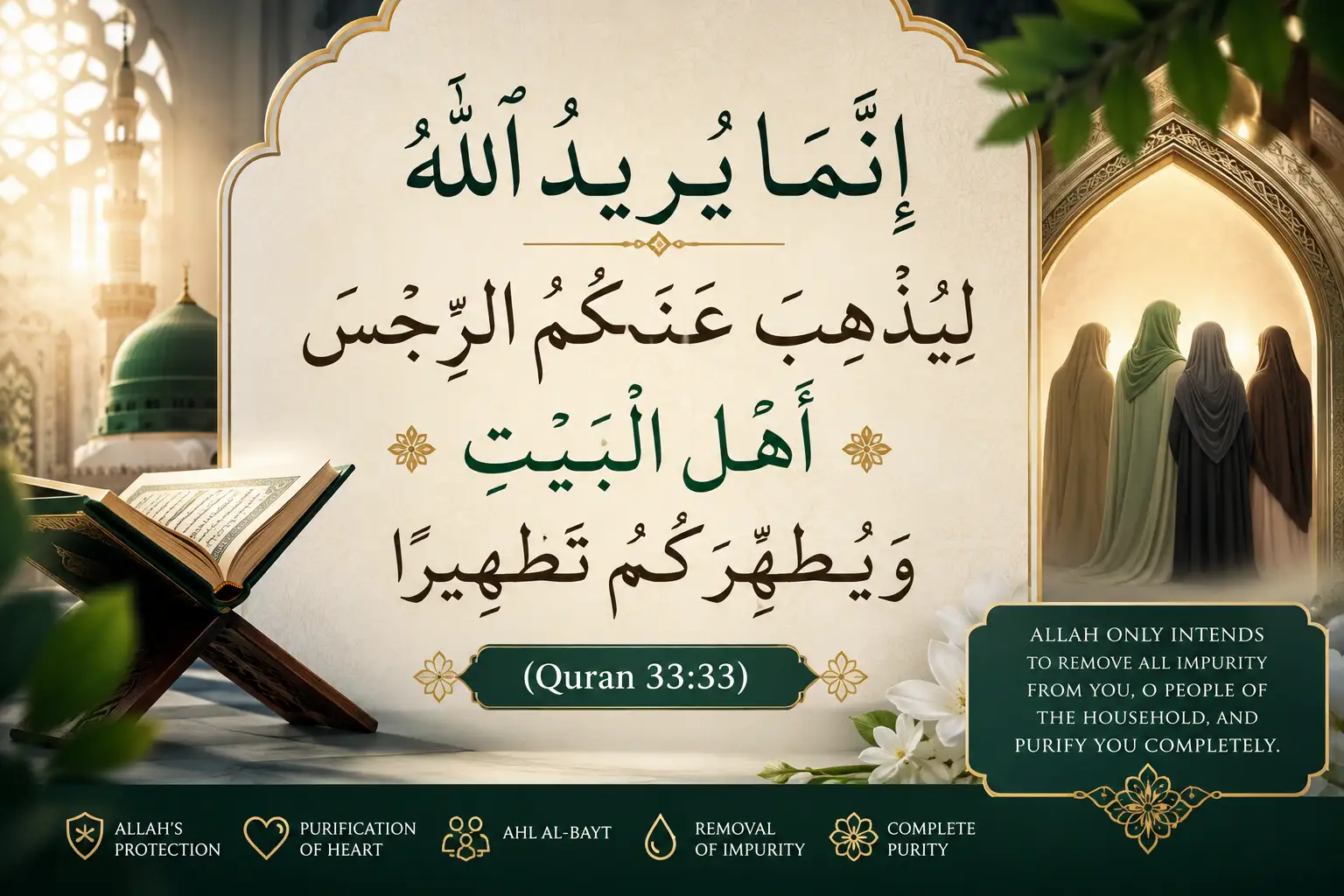
When your mind feels crowded, family life feels difficult, or faith feels harder to hold onto amid work, study, screens, and social pressure, a single Qur’anic passage can bring you back to a central Islamic principle: purification begins with obedience to Allah. Ayat-e-Tatheer, the “Verse of Purification,” is Qur’an Surah Al-Ahzab 33:33, especially the words “innama yuridu Allahu liyudhhiba ‘ankum al-rijsa ahla al-bayti wa yutahhirakum tathiran.”
What Is Ayat-e-Tatheer in the Qur’an?
Ayat-e-Tatheer refers to the purification passage in Surah Al-Ahzab 33:33. It states that Allah intends to remove rijs—impurity or evil—from the Prophet’s household and purify them completely. The verse appears within a broader passage addressing the Prophet Muhammad’s household and their conduct.
The Original Arabic, Transliteration and Translation
Arabic Text
إِنَّمَا يُرِيدُ ٱللَّهُ لِيُذْهِبَ عَنكُمُ ٱلرِّجْسَ أَهْلَ ٱلْبَيْتِ وَيُطَهِّرَكُمْ تَطْهِيرًا
Transliteration:
Innamā yurīdu Allāhu liyudhhiba ʿankumu r-rijsa ahla l-bayti wa yuṭahhirakum taṭhīrā.
English translation:
“Allah only intends to keep the causes of evil away from you and purify you completely, O members of the Prophet’s family.”
Urdu:
“اے اہلِ بیت! اللہ تو یہی چاہتا ہے کہ تم سے ہر قسم کی ناپاکی دور کر دے اور تمہیں خوب پاک صاف کر دے۔”
Hindi:
“ऐ अहले-बैत! अल्लाह तो यही चाहता है कि तुमसे हर प्रकार की अपवित्रता दूर कर दे और तुम्हें पूरी तरह पवित्र कर दे।”
What Does “Innama Yuridu Allahu Liyudhhiba” Mean?
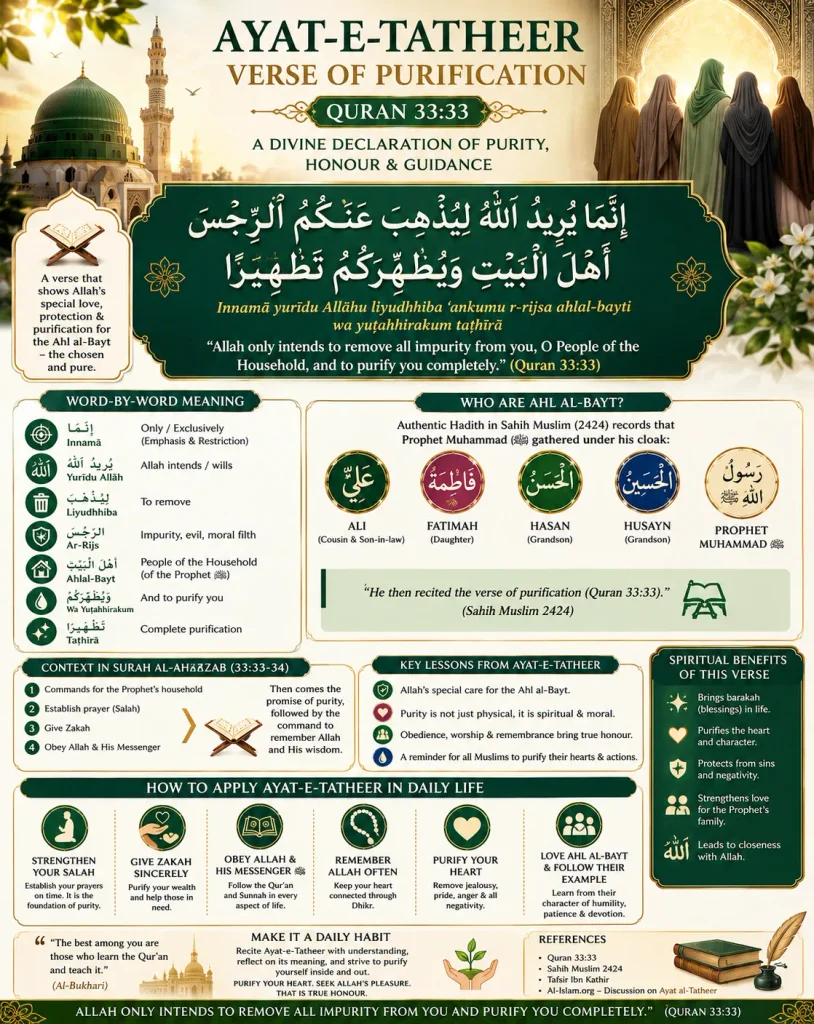
The phrase “innama yuridu Allahu liyudhhiba” means, in straightforward terms, “Allah only intends to remove.” Innama conveys restriction or emphasis, yuridu means “wills or intends,” and liyudhhiba means “to remove or take away.” The phrase places divine purification at the centre of the passage.
| Arabic phrase | Basic meaning | Why it matters |
|---|---|---|
| إِنَّمَا (innamā) | only / exclusively | Creates emphasis and restriction |
| يُرِيدُ (yurīdu) | He intends/wills | Points to Allah’s will |
| لِيُذْهِبَ (liyudhhiba) | to remove | Removing impurity |
| الرِّجْسَ (al-rijs) | impurity/evil | Moral or spiritual defilement |
| أَهْلَ الْبَيْتِ (ahl al-bayt) | People of the Household | The Prophet’s household |
| وَيُطَهِّرَكُمْ (wa-yutahhirakum) | and purify you | Complete purification |
| تَطْهِيرًا (taṭhīran) | thoroughly/purely | Strong emphasis on purification |
The Qur’anic Arabic structure is also reflected in the morphological analysis of the verse.
Who Are the Ahl al-Bayt in Ayat-e-Tatheer?
The identity and scope of Ahl al-Bayt, “People of the Household,” is discussed differently across Islamic traditions. The surrounding verses address the Prophet’s wives, while authentic hadith explicitly records the Prophet ﷺ placing Ali, Fatimah, Hasan and Husayn under his cloak and reciting the purification verse.
What Does Sahih Muslim Say About Ayat-e-Tatheer?
Sahih Muslim 2424 reports from Aisha that the Prophet ﷺ gathered Hasan, Husayn, Fatimah and Ali beneath his cloak and recited the purification passage. This narration is one of the strongest primary-text proofs connecting the verse with the celebrated Ahl al-Kisa, or People of the Cloak.
Hadith reference: Sahih Muslim 2424, Book of the Merits of the Companions.
The report describes Hasan ibn Ali entering first, followed by Husayn, Fatimah and Ali. The Prophet ﷺ then recited the words of Qur’an 33:33.
Transliteration of the relevant Qur’anic phrase:
Innamā yurīdu Allāhu liyudhhiba ʿankumu r-rijsa ahla l-bayti wa yuṭahhirakum taṭhīrā.
Urdu:
“بے شک اللہ چاہتا ہے کہ اے اہلِ بیت! تم سے ناپاکی دور کرے اور تمہیں خوب پاک کر دے۔”
Hindi:
“निस्संदेह अल्लाह चाहता है कि ऐ अहले-बैत! तुमसे अपवित्रता दूर कर दे और तुम्हें पूरी तरह पवित्र कर दे।”
How Do Classical Sunni and Shia Readings Differ?
Sunni and Shia scholarship both give Ayat-e-Tatheer major importance, but they differ over its scope and theological implications. Many Sunni authorities include the Prophet’s wives while affirming the special status of Ali, Fatimah, Hasan and Husayn; Shia interpretation gives the Ahl al-Kisa a more specific, central role.
This distinction matters because readers often encounter apparently contradictory explanations online. The disagreement is not over whether the verse exists or whether the Prophet’s family is honoured. The key questions concern who is included and what “purification” means.
Ibn Kathir discusses the Prophet’s wives in the immediate context while also reporting traditions concerning Ali, Fatimah, Hasan and Husayn.
A balanced reading should therefore distinguish Qur’anic wording, hadith evidence and later theological conclusions, rather than presenting one school’s interpretation as if no interpretive discussion exists.
What Is the Context and Meaning of Ayat-e-Tatheer?
Ayat-e-Tatheer appears in Surah Al-Ahzab within instructions concerning the Prophet’s household, including prayer, zakat, obedience and remembrance of Allah. The purification statement therefore sits inside a broader ethical framework: honour is linked with obedience, worship, moral discipline and closeness to divine guidance.
What Is the Main Lesson of the Verse?
The central practical lesson is that spiritual honour is connected to purity, obedience and remembrance of Allah. Ayat-e-Tatheer is not merely a phrase to repeat mechanically. Its Qur’anic setting points Muslims toward disciplined worship, moral conduct, respect for the Prophet’s household and a life shaped by obedience to Allah.
The surrounding passage tells the Prophet’s household to establish prayer, give zakat and obey Allah and His Messenger. The next verse instructs them to remember what is recited in their homes of Allah’s verses and wisdom.
That gives the verse a useful daily-life pattern:
Purification → obedience → remembrance → character.
For a Muslim living in London, New York, Toronto, Birmingham, Karachi or Kuala Lumpur, the principle remains relevant. Your environment may change. The need for spiritual discipline does not.
Is There a Fixed Wazifa or Sunnah Count for Ayat-e-Tatheer?
There is no universally established authentic Sunnah count requiring Muslims to recite Ayat-e-Tatheer a specific number of times each day for a guaranteed worldly result. Muslims may recite Qur’an for worship and reflection, but fixed counts should not be presented as Prophetic prescriptions without reliable evidence.
This distinction is essential. A person may read Qur’an 33:33 after Fajr, before sleep, during personal reflection or whenever they seek closeness to Allah. That is Qur’an recitation and contemplation.
But claims such as “recite Ayat-e-Tatheer exactly 313 times for this guaranteed outcome” require independent evidence. A website should never label an invented routine as an established Sunnah.
For a simple 90-second habit, read the verse slowly once or a few times, review its meaning, and then make a personal dua for purification, obedience and righteous character. This is a spiritual practice—not a claimed prophetic formula.
Does Ayat-e-Tatheer Have Psychological or Spiritual Benefits?
The safest evidence-based claim is spiritual rather than clinical: Qur’an recitation can encourage reflection, remembrance and emotional grounding for believers. Ayat-e-Tatheer can also remind Muslims that inner purification involves obedience and character. It should not be marketed as a medically proven treatment for anxiety, depression or other disorders.
Here is why this matters for daily routine: when a believer connects a short verse with a specific reflective moment, the practice becomes easier to remember.
Try this habit:
- Read the Arabic slowly.
- Understand al-rijs and taṭhīr.
- Reflect on one behaviour that needs purification.
- Act on that reflection before moving to the next task.
That turns a verse from something merely heard into something lived.
What Is the Best Way to Understand Ayat-e-Tatheer Today?
Understand Ayat-e-Tatheer through three layers: the Qur’an itself, authentic Prophetic reports, and responsible tafsir. Then apply its ethical message to ordinary life—prayer, family relationships, digital behaviour, modesty, honesty, patience and remembrance—without inventing religious promises that the sources do not establish.
The verse can become especially meaningful in a digital environment where Muslims face constant comparison, anger, distraction and public pressure.
Think of the smartphone as the place where many modern habits become visible. What you watch, share, argue about and repeatedly consume affects your character. Ayat-e-Tatheer gives a powerful spiritual question:
What needs to be removed from me before I ask Allah to increase what is good?
That connects the verse naturally with Tawakkul—reliance upon Allah—and Sabr—patient perseverance. Both require trust in Allah while actively correcting one’s own conduct.
Readers can also explore related supplications such as Surah Alaq Ayat 19, Rabbi habli minas saliheen,
🚀🚀🚀
and Rabbir hamhuma kama rabbayani sagheera as part of a wider Qur’an-and-dua study routine.
Ayat-e-Tatheer: Frequently Asked Questions
The most common questions about Ayat-e-Tatheer concern its location, meaning, Ahl al-Bayt, Hadith evidence and daily recitation. The clearest answers come directly from Qur’an 33:33 and authenticated hadith, while questions of theological interpretation should be explained according to the relevant school of scholarship.
Ayat-e-Tatheer is Surah Al-Ahzab, verse 33 (Qur’an 33:33). The name comes from its purification wording, especially “wa-yutahhirakum taṭhīrā”—“and purify you completely.”
It means “Allah only intends to remove.” The phrase begins the purification passage in Qur’an 33:33. It introduces Allah’s stated intention to remove al-rijs and bring about purification of the Ahl al-Bayt.
The purification passage is directly connected with authentic Hadith literature, most explicitly in Sahih Muslim 2424, where Aisha reports the cloak narration involving Hasan, Husayn, Fatimah and Ali. This is a major primary source for understanding the Ahl al-Bayt connection.
Muslims may recite Qur’an as worship and reflection, including Ayat-e-Tatheer. However, a specific daily number or guaranteed worldly result should not be attributed to the Prophet ﷺ without authentic evidence. Keep Qur’anic recitation connected to understanding, sincerity and righteous action.
Final Reflection: Let Purification Become a Practice
Ayat-e-Tatheer is more than a search query, a translation or a famous Arabic phrase. It is part of a Qur’anic passage about obedience, remembrance, purity and the honoured household of the Prophet Muhammad ﷺ.
Its strongest daily application may be surprisingly simple.
Before opening another app, answering another argument, or carrying another worry, pause for a moment.
Read:
إِنَّمَا يُرِيدُ ٱللَّهُ لِيُذْهِبَ عَنكُمُ ٱلرِّجْسَ أَهْلَ ٱلْبَيْتِ وَيُطَهِّرَكُمْ تَطْهِيرًا
Then ask yourself:
What can I remove from my life today so that my obedience to Allah becomes stronger?
For further reading, continue with our guide to Masjid Al-Aqsa.
