
Waking up with a racing heart is common. You check your phone, see a mountain of notifications, and the stress instantly takes over. We live in an era of hyper-connectivity, yet spiritual burnout is at an all-time high. Finding peace feels impossible when your mind refuses to slow down.
But there is a 90-second spiritual reset that completely alters your brain’s chemistry and your soul’s state. Sending blessings upon the Prophet Muhammad (ﷺ) through the phrase Assalatu Wassalamu Alaika Ya Rasool Allah is the ultimate, time-tested remedy for a restless heart.
Here is exactly how this powerful invocation works, what it means, and how to seamlessly build it into your daily routine.
What Does Assalatu Wassalamu Alaika Ya Rasool Allah Mean?
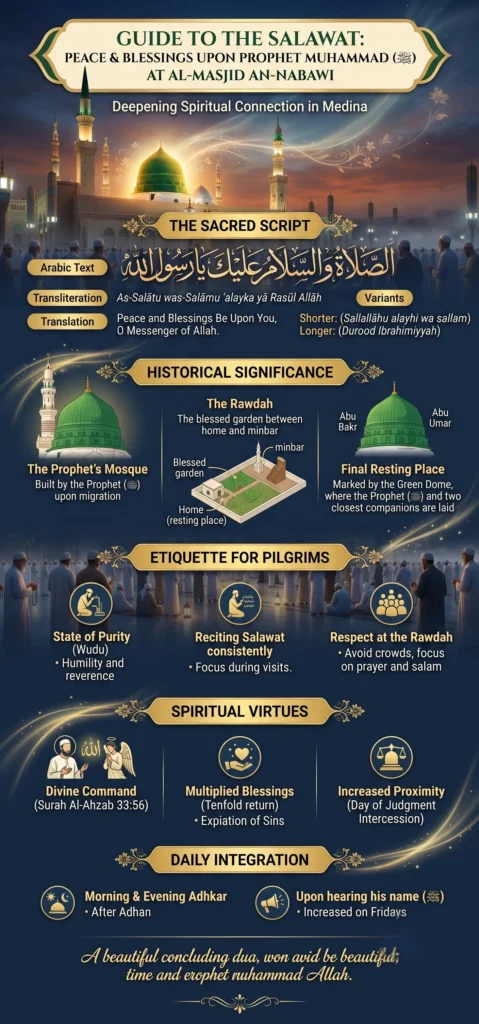
Assalatu Wassalamu Alaika Ya Rasool Allah means “Peace and blessings be upon you, O Messenger of Allah.” It is a direct, personal invocation (Durood) used by Muslims to send divine grace and absolute peace to the Prophet Muhammad (ﷺ).
Let’s break down the exact morphology of this phrase so you understand the weight of what you are saying:
- Assalatu (الصَّلَاةُ): Divine mercy, grace, and elevation of status. When we ask Allah for “Salat” upon the Prophet, we ask Him to praise His messenger in the highest heavenly assemblies.
- Wa (وَ): And.
- Assalamu (السَّلَامُ): Absolute peace, security, and tranquility. This is a prayer for the ultimate safeguarding of the Prophet’s legacy, his followers, and his message.
- Alaika (عَلَيْكَ): Upon you. This is a direct second-person address.
- Ya (يَا): O. A vocative particle of calling, denoting immense respect and spiritual presence.
- Rasool Allah (رَسُولَ اللَّهِ): Messenger of Allah.
When you recite this, you are not just repeating historical words. You are making a direct, personal connection. You ask Allah to elevate His messenger while simultaneously drawing down mercy upon yourself.
The Divine Command Behind Durood and Salam
Reciting blessings upon the Prophet is a direct command from Allah in Surah Al-Ahzab. It is the only act of worship that Allah and His angels actively perform before instructing believers to do the exact same thing.
This is where the practice shifts from a beautiful cultural tradition to a massive spiritual obligation. Here is the foundational text:
Quran 33:56 (Surah Al-Ahzab)
Arabic Text:
إِنَّ اللَّهَ وَمَلَائِكَتَهُ يُصَلُّونَ عَلَى النَّبِيِّ ۚ يَا أَيُّهَا الَّذِينَ آمَنُوا صَلُّوا عَلَيْهِ وَسَلِّمُوا تَسْلِيمًا
Transliteration: Innallaha wa mala’ikatahu yusalluna ‘alan-nabiyy. Ya ayyuhalladhina amanu sallu ‘alayhi wa sallimu taslima.
English Translation: “Indeed, Allah confers blessing upon the Prophet, and His angels [ask Him to do so]. O you who have believed, ask [Allah to confer] blessing upon him and ask [Allah to grant him] peace.”
Urdu Translation:
بیشک اللہ اور اس کے فرشتے نبی پر درود بھیجتے ہیں۔ اے ایمان والو! تم بھی ان پر درود اور خوب سلام بھیجا کرو۔
Hindi Translation: बेशक अल्लाह और उसके फ़रिश्ते नबी पर दरूद भेजते हैं। ऐ ईमान वालों! तुम भी उन पर दरूद और खूब सलाम भेजा करो।
This verse forms the core of why we practice Salawat. The love generated by this command is exactly why you will find this phrase deeply embedded in classic Ya Nabi Salam Alaika lyrics and recited across the globe during communal gatherings.
Why This Dua is Your Strongest Shield Against Anxiety
Sending Salawat removes daily worries and guarantees the forgiveness of sins. Psychologically, it shifts your focus away from personal anxieties and directs your mental energy toward gratitude and prophetic love, instantly breaking the cycle of overthinking.
Let’s apply this practically to modern life. When you feel overwhelmed at your desk or during a stressful commute, your brain hyper-focuses on the threat—bills, exams, or relationships. Reciting the Salawat acts as a cognitive pattern interrupt. You can easily integrate this into your morning and evening Azkar routine to bookend your day with peace.
Look at the absolute guarantee given by the Prophet (ﷺ) himself:
Hadith on Removing Worries (Jami` at-Tirmidhi 2457)
Arabic Text:
إِذًا تُكْفَى هَمَّكَ وَيُغْفَرُ لَكَ ذَنْبُكَ
Transliteration: Idhan tukfa hammaka wa yughfaru laka dhanbuka.
English Translation: “Then your worries will be taken care of, and your sins will be forgiven.” (Said to the companion Ubayy bin Ka’b when he offered to dedicate all his supplication time to sending Salawat).
Urdu Translation:
تب تمہاری تمام پریشانیاں دور کر دی جائیں گی اور تمہارے گناہ معاف کر دیے جائیں گے۔
Hindi Translation: तब तुम्हारी सभी चिंताएं दूर कर दी जाएंगी और तुम्हारे पाप क्षमा कर दिए जाएंगे।
If you are struggling with heavy burdens, making Durood a central part of your day is the most effective psychological and spiritual approach. For a broader, holistic strategy on handling severe stress, you should study our complete Islamic guide to overcoming modern anxiety. Always remember the Quranic promise that with hardship comes ease.
Micro-Transformations: Building Your Salawat Habit
You build a consistent Salawat habit by tying it to existing daily triggers—like waking up, stepping out of your car, or finishing your prayers. Start with just 10 repetitions a day and scale up gradually to avoid burnout.
You do not need a three-hour isolation session in a mosque to see results. Here is how to create a 90-second habit loop using different forms of Durood. While the direct greeting of Assalatu Wassalamu Alaika Ya Rasool Allah is incredibly powerful for immediate emotional grounding, you can also incorporate other highly authentic formulas.
Many classical scholars highly recommend exploring beautifully structured invocations. For instance, studying the deep benefits of Darood Taj or reciting Darood Muqadas can deeply enrich your spiritual vocabulary. For those seeking immense reward and ease in their affairs, classical texts often highlight the practice of Darood e Lakhi.
Here is a practical framework to structure your daily blessings:
| Practice Level | Suggested Salawat Form | Ideal Timing Trigger | Primary Spiritual Benefit |
| Beginner | Assalatu Wassalamu Alaika Ya Rasool Allah | Walking to the car/subway (10x) | Instant grounding, stops chronic overthinking. |
| Intermediate | Sallallahu Alayhi Wasallam | Immediately after daily Salah (10x) | Consistent daily connection, rapid accumulation of good deeds. |
| Advanced | Ibrahimiyyah / authentic Durood Shareef formulas like Allahumma Salli Ala Muhammadin | Friday afternoons (100x minimum) | Deep spiritual elevation, guaranteed prophetic intercession. |
FAQs:
Yes. Saying “Ya” (O) is a vocative particle used out of deep love, respect, and spiritual presence. Mainstream Islamic scholarship confirms that angels constantly roam the earth to convey our greetings directly to the Prophet (ﷺ), making the direct address completely valid from anywhere in the world.
There is no strict minimum required by Islamic law, but reciting it at least 10 times in the morning and 10 times in the evening carries a specific promise. According to a reliable Hadith reported by Al-Tabarani, whoever does this will be guaranteed the Prophet’s intercession on the Day of Judgment.
Yes. You can recite Durood and Salawat at any time—whether you are walking, driving, working, or cooking—even without being in a state of Wudu. However, scholars agree that being in a state of physical purity adds immense spiritual weight and light to your recitation.
They refer to the exact same act of worship. “Salawat” is the plural Arabic term for blessings, while “Durood” is the Persian and Urdu equivalent heavily used by Muslims in South Asia and the diaspora. Both fulfill the command of Surah Al-Ahzab.
Building a strong, unshakable spiritual core starts with small, deliberate actions. Make the choice to pause for just 90 seconds today. Take a deep breath, silence your phone, and send peace upon the Messenger of Allah.
