
Wa La Taqrabu Zina: Guarding the 7 Doors Before the Sin Opens
Quick Answer
- Surah Al-Isra (17:32) doesn’t only forbid zina itself — it forbids approaching it, because Allah is closing the path before the sin, not just punishing the act.
- A well-known hadith (Sahih Muslim 2658a) names seven “doors” of zina: the eyes, ears, tongue, hands, feet, heart, and the private parts — each one can sin on its own, long before anything physical happens.
- You don’t fix this with guilt. You fix it with a checkpoint — a 90-second pause before you look again, reply again, or open that chat again.
Table of Contents
- What “Wa La Taqrabu Zina” Actually Means
- The Hadith That Explains Why: The 7 Doors
- Halal Interest or Haram Interaction? Where the Line Is
- The 90-Second Checkpoint: Your Practice Plan
- Being the Only Muslim in the Room
- If You’ve Already Crossed a Line
- FAQ
It’s 1 a.m. and the phone is still lit up. Maybe it’s a DM that started as “just talking.” Maybe it’s a tab that shouldn’t be open. Maybe it’s a person at work you look forward to seeing a little too much. Nothing has “happened,” technically — and that word, technically, is doing a lot of work.
This is exactly the gap the Quran closes. Most people think zina is a single line you either cross or don’t. The Quran describes it as a road — and tells us not to walk toward it at all.
What “Wa La Taqrabu Zina” Actually Means
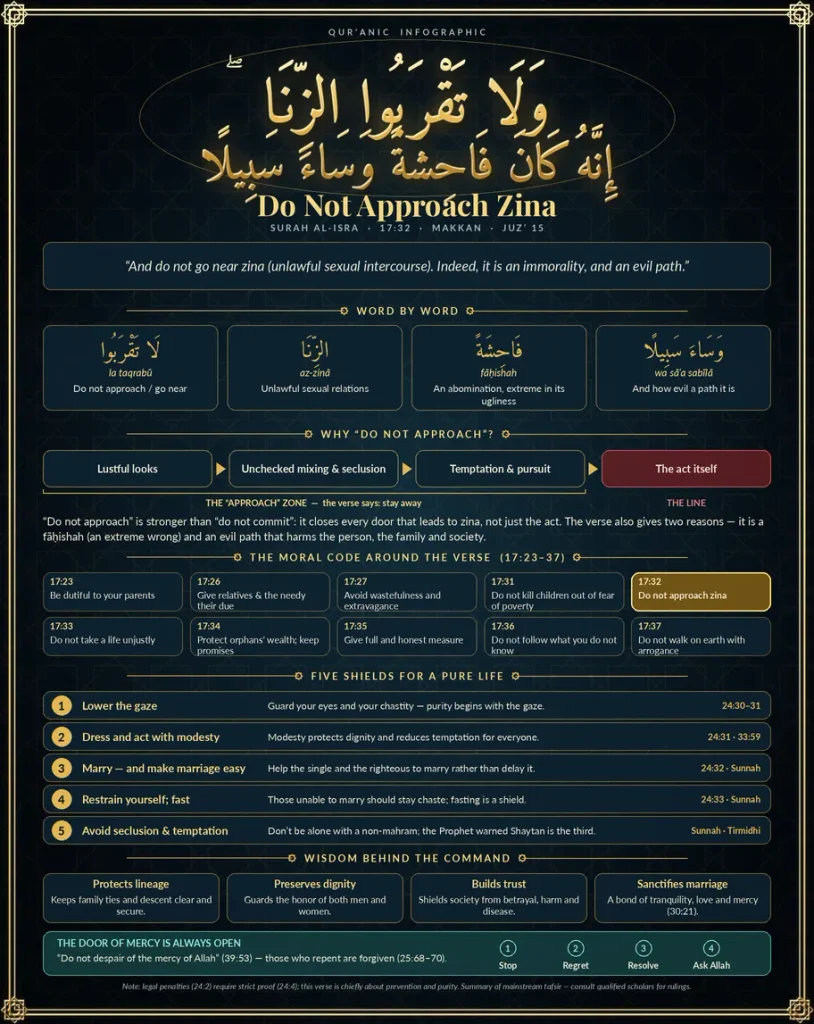
Surah Al-Isra 17:32 commands Muslims not to approach zina (unlawful sexual intercourse), not merely to avoid committing it. The Arabic word used is taqrabu — “draw near” — which covers the glances, conversations, and situations that lead toward the act, not just the act itself.
وَلَا تَقْرَبُوا الزِّنَا ۖ إِنَّهُ كَانَ فَاحِشَةً وَسَاءَ سَبِيلًا
Wa lā taqrabuz-zinā, innahu kāna fāḥishatan wa sā’a sabīlā
Meaning: “And do not go near zina — it is a shameful act, and an evil path to follow.” (Surah Al-Isra, 17:32)
Compare this to how the Quran forbids most other sins — usually with a direct “do not do [X].” Here, the wording is different on purpose. Allah isn’t just closing the door on the act; He’s closing the road that leads to it. That single word — approach — is the whole foundation of this article. It’s the same reason the Quran teaches protection from Shaytan’s whispers — the sin almost always starts as a suggestion, long before it becomes an action.
The Hadith That Explains Why: The 7 Doors
If you want a deeper grounding in how to make dua properly before working through this framework, that’s a good place to start — every checkpoint below leans on it.
The Prophet ﷺ explained that zina isn’t only physical — the eyes, ears, tongue, hands, feet, and heart each have their own “share” of it, and any one of them can sin before the body ever does.
كُتِبَ عَلَى ابْنِ آدَمَ نَصِيبُهُ مِنَ الزِّنَى مُدْرِكٌ ذَلِكَ لَا مَحَالَةَ، فَالْعَيْنَانِ زِنَاهُمَا النَّظَرُ، وَالْأُذُنَانِ زِنَاهُمَا الِاسْتِمَاعُ، وَاللِّسَانُ زِنَاهُ الْكَلَامُ، وَالْيَدُ زِنَاهَا الْبَطْشُ، وَالرِّجْلُ زِنَاهَا الْخُطَا، وَالْقَلْبُ يَهْوَى وَيَتَمَنَّى، وَيُصَدِّقُ ذَلِكَ الْفَرْجُ أَوْ يُكَذِّبُهُ
Kutiba ‘alab-ni ādama naṣībuhu minaz-zinā, mudrikun dhālika lā maḥālah…
Meaning: Abu Hurairah (ra) reported that the Prophet ﷺ said Allah has decreed for every person a share of zina they’re bound to encounter — the eyes’ share is the look, the ears’ share is the listening, the tongue’s share is the talk, the hand’s share is the touch, the feet’s share is the walk toward it — and the heart wants and wishes, while the private parts either act on that or hold back.
Source: Sahih Muslim 2658a; a shorter version is in Sahih al-Bukhari 6243.
| Door | Classical meaning | What it looks like today |
| Eyes | The lustful look | Re-watching a story, lingering on a profile picture |
| Ears | Listening to what stirs desire | Voice notes, suggestive songs, late-night calls |
| Tongue | Flirtatious or suggestive talk | “Just talking” DMs that drift into compliments and pet names |
| Hands | The touch | Physical contact outside marriage, even “innocent” contact that isn’t |
| Feet | Walking toward the situation | Making the plan, taking the detour, showing up “by coincidence” |
| Heart | Wanting and imagining | Daydreaming, replaying conversations, planning “what if” |
| Private parts | Acts on it, or resists | The final door — everything above either leads here or stops before it |
Every one of those first six doors can open without the seventh ever being touched — and the hadith is clear that they still count. That reframes a lot of what feels “not that serious.”
Halal Interest or Haram Interaction? Where the Line Is
Wanting marriage isn’t the problem — the Quran and Sunnah encourage it. The problem is trying to get the emotional and physical closeness of marriage through a private, undefined connection before the contract exists. If that longing is real, channel it into seeking a righteous spouse the halal way, rather than a private connection that has to stay hidden.
A common misconception: “We’re just talking, nothing physical is happening, so it’s fine.” But look back at the table above — the tongue and the heart are doors on their own. A private, ongoing conversation with a non-mahram that involves affection, secrecy from family, or emotional exclusivity is already walking the road the ayah warns about, even with zero physical contact.
The practical test: could this conversation happen in front of your parents, exactly as it is, without embarrassment? If not, that’s usually the answer.
The 90-Second Checkpoint: Your Practice Plan
Before you look again, reply again, or open the chat again, take 90 seconds: say “a’udhu billahi min ash-shaytanir-rajim,” name what door is opening (eyes, tongue, feet), and choose one small action that closes it.
Start tonight:
- Put the phone down. Physically leave the room for two minutes.
- Name the door out loud: “This is my tongue” or “this is my eyes.”
- Say the isti’adhah (seeking refuge from Shaytan) — three words, four seconds.
- Replace the action: message a friend, make wudu, read two ayat.
- If it’s a person, don’t reply until the next day. Urgency is the trick, not the need.
Do this for seven nights before judging whether it works. Habits built at night — when willpower is lowest — are the ones worth training first. For the thoughts that keep circling back afterward, there’s a specific dua for intrusive thoughts worth keeping close, and pairing this checkpoint with a steady morning and evening azkar routine makes the habit stick past the first week.
Being the Only Muslim in the Room
At work, a coworker becomes a close friend, and closeness turns into something else before either of you names it. At school, group projects put you alone with someone for hours. On the commute, dating apps are one thumb-swipe away with nobody watching. None of these situations are sins by themselves — but each one is a “foot” walking toward a door.
The fix isn’t isolation. It’s naming the door early: decide in advance what you won’t do (private messaging outside work hours, closed-door meetings, solo rides), before the situation decides for you.
If You’ve Already Crossed a Line
This ayah was revealed to a community, not a courtroom. If you’ve already looked too long, said too much, or gone further, the same Quran that says “do not approach” also says Allah loves those who turn back (Surah Al-Baqarah 2:222). Tawbah — sincere repentance — isn’t a formality; it’s the actual next step. Start with the full Sayyidul Istighfar, the master supplication for forgiveness, and say it like you mean it.
FAQ
What does “wala taqrabu zina” mean in English?
It means “do not approach zina” — from Surah Al-Isra 17:32. Zina is unlawful sexual intercourse. The verse forbids getting close to it, not only committing it.
Why does the Quran say “don’t approach” instead of “don’t commit”?
Because prevention is easier than recovery. Forbidding the approach — the look, the talk, the private meeting — closes the sin’s usual entry points before the act itself becomes a live possibility.
Is texting a non-mahram a sin?
It depends on content and intent. Necessary, public, or professional messages aren’t the issue. Private, affectionate, or secretive texting with romantic undertones falls under the “tongue” door in the hadith.
What’s the hadith about the seven types of zina?
Sahih Muslim 2658a (shorter version in Bukhari 6243): the Prophet ﷺ said the eyes, ears, tongue, hands, feet, and heart each have a “share” of zina, and the private parts either confirm it or hold back.
How do I stop looking at haram content?
Start with access, not willpower alone — content filters, accountability partners, and removing the app at night. Pair that with the 90-second checkpoint above.
What’s the difference between halal interest and haram interaction before marriage?
Halal interest moves toward marriage through family, openness, and a defined process (like taaruf). Haram interaction is private, secretive, emotionally exclusive, or physical — regardless of intent.
What dua helps with temptation?
The isti’adhah (“a’udhu billahi min ash-shaytanir-rajim”) is the first line of defense in the moment. For thoughts that linger afterward, see this dua for intrusive thoughts.
How do I make tawbah if I’ve already done something?
Stop the action immediately, feel genuine regret, ask Allah’s forgiveness sincerely, and resolve not to return to it. No sin is too large for Allah’s mercy if the repentance is sincere.
