By Shahab Khan | Reviewed for accuracy
You know the feeling. Your chest tightens. Your heart races without warning. A sudden wave of dread washes over you. In our culture, we call it ghabrahat—a sinking, fluttering sensation that clinical words like “acute anxiety” barely capture.
Often, this physical panic comes with a heavy dose of cultural guilt. People might tell you that feeling anxious means your faith (Iman) is weak. They might hand you unverified lists, telling you to read a specific wazifa hundreds of times.
Let us clear the air: panic is a human experience. Even the best of generations felt fear and sorrow. A racing heart does not make you a bad Muslim.
[SCHOLAR ANECDOTE: “I recently sat with a young professional who was suffering from severe midnight panic attacks. He confessed, his voice trembling, that relatives had told him his sudden ghabrahat was a sign of a hardened heart and weak faith, leaving him feeling terrified and completely disconnected from Allah. I stopped him right there and told him the truth: his nervous system was overwhelmed, not his soul. We worked together to separate this cultural guilt from true spirituality, pairing his doctor’s advice with a simple, immediate prophetic dua that reminded him Allah is a source of ultimate comfort, not a source of panic.”]
Your physical health and spiritual health are connected. Below, we provide the authentic dil ghabrane ki dua (supplications for a restless heart) from the Quran and Sunnah, complete with a practical method to use them right now.
Medical Disclaimer: Dua complements professional care and never replaces it. If you experience chronic heart palpitations or clinical anxiety disorders, please consult a medical professional. Seeking medical help is a core part of tawakkul (reliance on Allah).
Quick Answer: How to Calm a Racing Heart
- The Immediate Dua: Recite Ya Hayyu Ya Qayyum, bi-Rahmatika astagheeth for instant spiritual grounding during a panic spike.
- The Quranic Anchor: Recite Surah Ar-Ra’d (13:28) to remind your nervous system that hearts find rest in the remembrance of Allah.
- The Action Step: Download our free 90-Second Ghabrahat Reset Audio at the end of this article to guide you through your next moment of distress.
What is the most powerful dil ghabrane ki dua?
The most powerful dua for sudden anxiety and a racing heart is “Ya Hayyu Ya Qayyum, bi-Rahmatika astagheeth.” Prophet Muhammad ﷺ recited this specific supplication whenever a matter distressed him. It immediately connects your panicked state to the Ever-Living Sustainer, providing instant spiritual grounding and relief.
When the Prophet ﷺ faced severe stress or distress, he did not turn to complicated rituals. He turned to the beautiful names of Allah.
يَا حَيُّ يَا قَيُّومُ بِرَحْمَتِكَ أَسْتَغِيثُ
- Transliteration: Ya Hayyu Ya Qayyum, bi-Rahmatika astagheeth.
- English Meaning: “O Living, O Sustaining, in Your Mercy I seek relief!”
- Urdu Translation: اے زندہ اور قائم رکھنے والے! میں تیری ہی رحمت کے واسطے سے فریاد کرتا ہوں۔
- Hindi Translation: ऐ हमेशा ज़िंदा रहने वाले और सबको कायम रखने वाले! मैं तेरी ही रहमत के वास्ते से फरियाद करता हूँ।
- Source: Jami at-Tirmidhi 3524 [Hasan]
Word-by-Word Breakdown for Cognitive Focus
Focusing on the exact meaning of words can act as a grounding technique during a panic attack.
| Arabic Word | Pronunciation | English Meaning | Why it helps Ghabrahat |
| يَا حَيُّ | Ya Hayyu | O Ever-Living | Reminds you that Allah is alive and present with you right now. |
| يَا قَيُّومُ | Ya Qayyum | O Sustainer | Affirms that Allah sustains your heartbeat and your life; you do not have to carry the burden alone. |
| بِرَحْمَتِكَ | bi-Rahmatika | By Your Mercy | Appeals to His endless compassion, removing guilt. |
| أَسْتَغِيثُ | astagheeth | I seek relief | A desperate, honest cry for immediate rescue. |
If you are dealing with a flood of intrusive thoughts alongside your rapid heartbeat, you should pair this practice with the dua for bechaini and waswasa to quiet the mind.
Dil ko sukoon ki dua in Quran (Finding Peace)
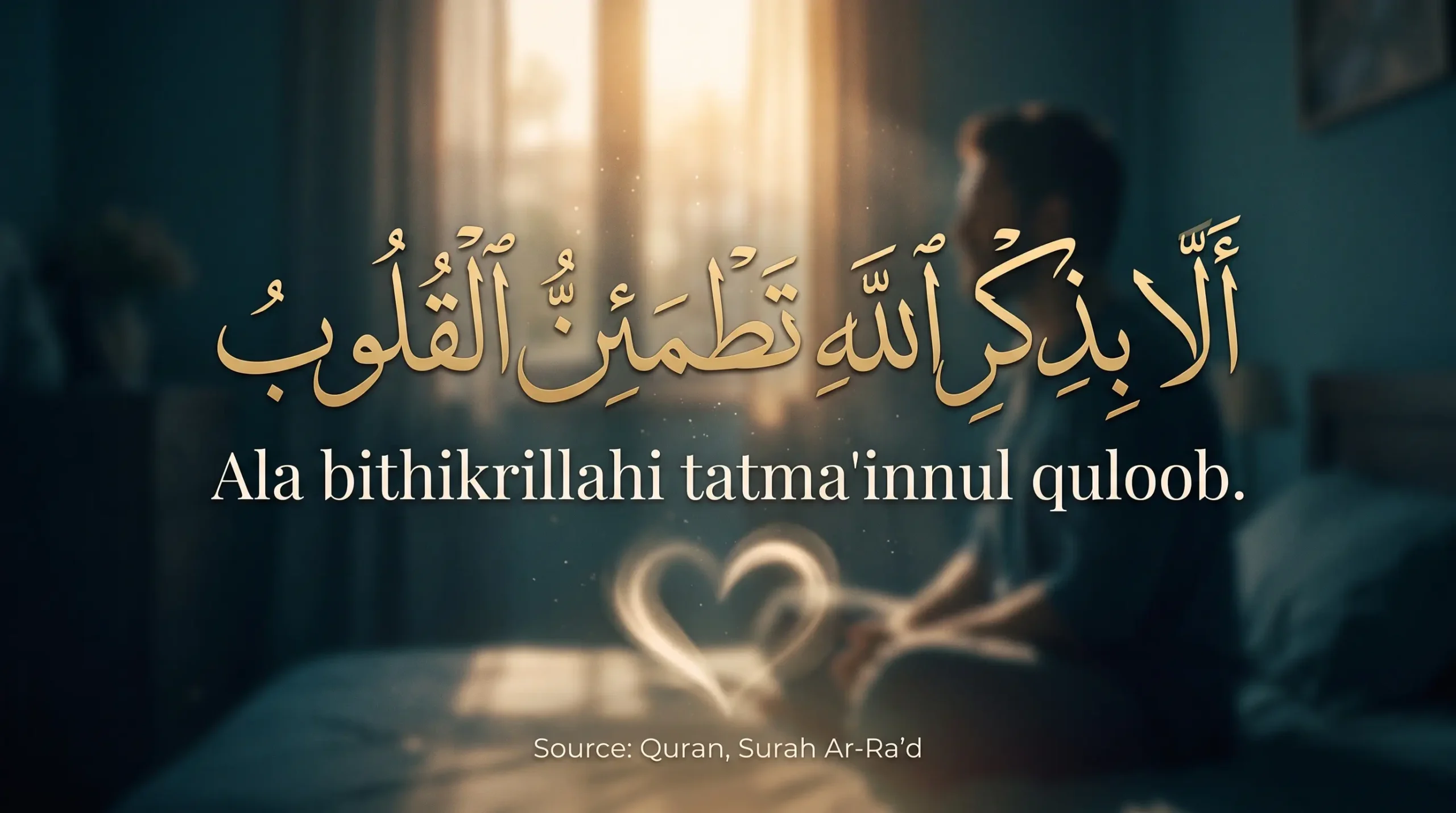
Surah Ar-Ra’d, verse 28 offers the ultimate Quranic cure for a restless heart: “Ala bithikrillahi tatma’innul quloob.” This means “Verily, in the remembrance of Allah do hearts find rest.” Reciting this acts as a spiritual anchor when your mind races, physically lowering your heart rate.
When your chest feels tight, remembering Allah shifts your focus from the unknown future back to the Creator of the future. The Quran explicitly guarantees that hearts find rest in His remembrance.
أَلَا بِذِكْرِ اللَّهِ تَطْمَئِنُّ الْقُلُوبُ
- Transliteration: Ala bithikrillahi tatma’innul quloob.
- English Meaning: “Unquestionably, by the remembrance of Allah hearts are assured.”
- Urdu Translation: سن لو! اللہ کی یاد ہی سے دلوں کو اطمینان نصیب ہوتا ہے۔
- Hindi Translation: सुन लो! अल्लाह की याद से ही दिलों को चैन मिलता है।
- Source: Quran, Surah Ar-Ra’d
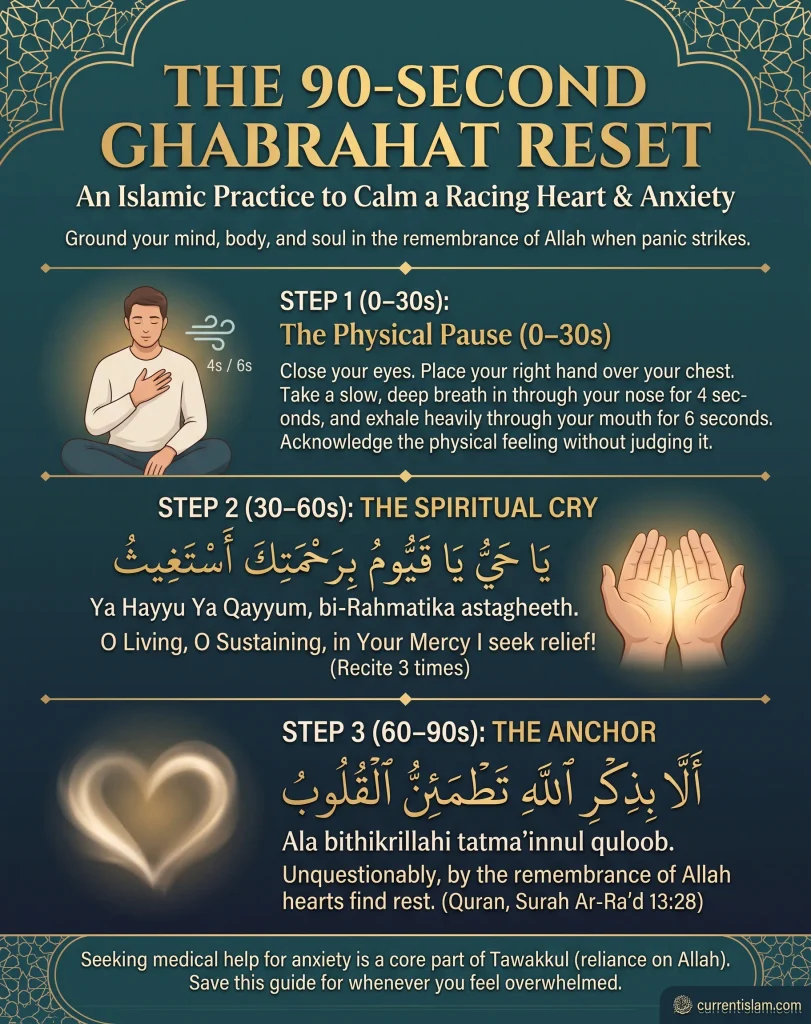
The 90-Second “Ghabrahat” Reset
To make this practical, we developed a simple framework you can use anywhere—whether you are on a stressful commute, at your desk, or waking up in a midnight panic. We call it The 90-Second Ghabrahat Reset.
- The Physical Pause (0-30 seconds): Close your eyes. Place your right hand over your chest. Take a slow, deep breath in through your nose for 4 seconds, and exhale heavily through your mouth for 6 seconds. Acknowledge the physical feeling without judging it.
- The Spiritual Cry (30-60 seconds): Recite Ya Hayyu Ya Qayyum, bi-Rahmatika astagheeth three times. Speak the words aloud, even if it is just a whisper. Let your ears hear your plea.
- The Anchor (60-90 seconds): Repeat Ala bithikrillahi tatma’innul quloob. Visualize the tightness in your chest softening with each word.
This short routine merges physiological breathwork with prophetic tradition.
Dil ki bimari ka wazifa: Is there a specific daily habit?
For daily spiritual maintenance, reciting the dua of Prophet Yunus, “La ilaha illa anta subhanaka inni kuntu minaz-zalimin,” is a proven habit for severe distress. This practice acknowledges human vulnerability while relying on Allah’s mercy, making it an ideal spiritual companion to clinical therapy.
Many cultures search for a dil ki bimari ka wazifa (a repetitive chant for heart ailments). Instead of unverified numbers, look to the dua of Prophet Yunus, which he recited in the darkness of the whale’s belly.
- Transliteration: La ilaha illa anta subhanaka inni kuntu minaz-zalimin.
- English Meaning: “There is no deity except You; exalted are You. Indeed, I have been of the wrongdoers.”
- Source: Quran, Surah Al-Anbiya
You can recite this abundantly throughout the day. It is highly effective for spiritual grounding and is considered a profound dua for anxiety and depression.
Understanding Anxiety: Medical vs. Spiritual
We must normalize seeking professional help. A racing heart (dil ghabrana) or physical heart pain (dil ke dard) can have dual roots.
Common Misconceptions
Mistake 1: Believing panic attacks mean Allah is angry with you.
Fear is a natural human emotion. Prophet Musa (AS) experienced intense fear when confronting Pharaoh. Having a physical anxiety response is biology, not a sin.
Mistake 2: Abandoning medicine for prayer alone.
The Prophet ﷺ commanded us to seek medical treatment. Treating a chemical imbalance or a nervous system issue with medicine is a fulfillment of the Sunnah, not a rejection of it.
Mistake 3: Chasing “magic numbers.”
There is no authentic Hadith requiring you to read a specific dua 313 times or 786 times to cure panic. Quality and sincerity matter more than arbitrary counting.
Next Steps for Your Heart
You do not have to fight the ghabrahat alone. Start tonight by writing Ya Hayyu Ya Qayyum, bi-Rahmatika astagheeth on a sticky note and placing it by your bed.
[DOWNLOAD]
👉 Click here to download “The 90-Second Ghabrahat Reset” PDF and Audio Guide. Save it to your phone so it is ready the next time your heart starts racing.
