When you wake up in New York at 6 AM EST, check your banking app, and feel the crushing weight of student loans or credit card bills before your day even starts, this ancient dua from Prophet Muhammad (PBUH) becomes your first weapon against financial anxiety.
The pressure of inflation and the rising cost of living in the West can leave many American and British Muslims feeling spiritually exhausted. But Islam does not leave us without a lifeline. Through the concept of a Daily Islamic Transformation—building small, 90-second spiritual habits into your busy routine—you can shift your financial mindset from panic to profound trust in Allah (Tawakkul).
Here is the exact framework, grounded in authentic scholarship, to help you navigate modern financial stress.
What Is the Best Dua for Debt Relief?
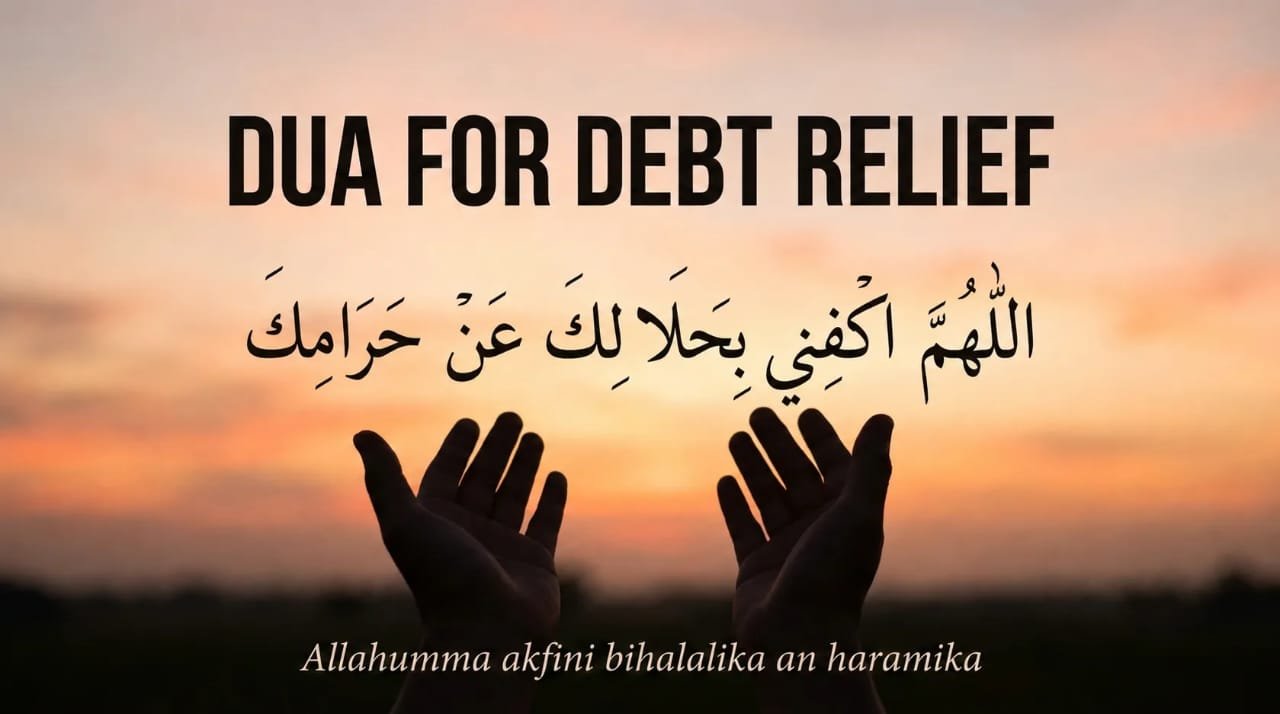
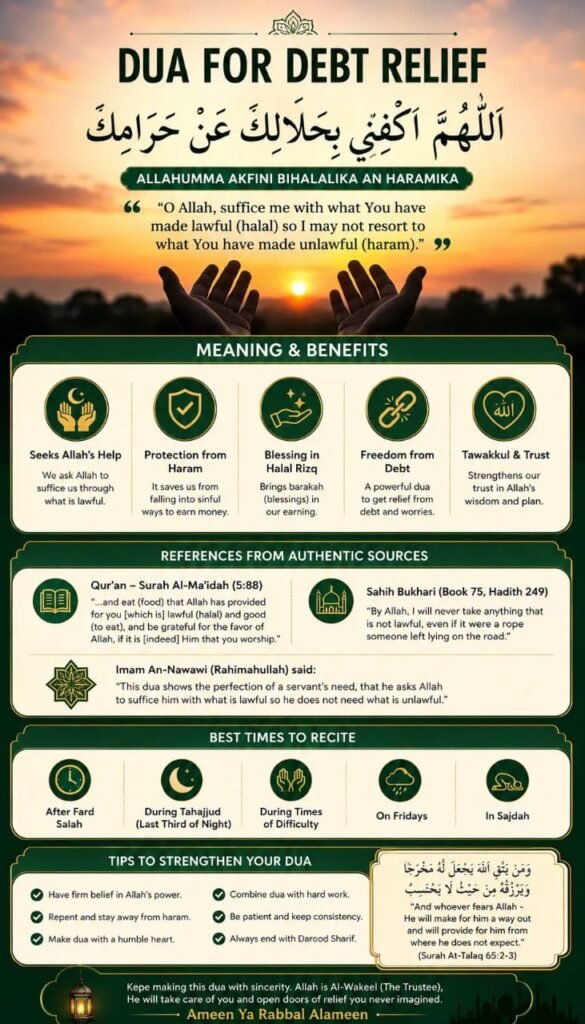
The best dua for debt relief is “Allahumma akfini bihalalika,” taught by Prophet Muhammad (PBUH) to his companion Ali ibn Abi Talib. Reciting this supplication daily asks Allah to provide enough lawful (halal) income to clear any debt, even if it is as large as a mountain.
Authentic Hadith Reference (Jami’ at-Tirmidhi, Hadith 3563)
- Arabic Text: اللَّهُمَّ اكْفِنِي بِحَلاَلِكَ عَنْ حَرَامِكَ وَأَغْنِنِي بِفَضْلِكَ عَمَّنْ سِوَاكَ
- Transliteration: Allahummak-fini bihalalika ‘an haramika wa aghnini bifadhlika ‘amman siwaka.
- English Translation: “O Allah, suffice me with what You have allowed instead of what You have forbidden, and make me independent of all others besides You.”
- Urdu Translation: اے اللہ! مجھے اپنے حلال کے ذریعے اپنے حرام سے بچا لے، اور مجھے اپنے فضل کے ذریعے اپنے سوا ہر کسی سے بے نیاز کر دے۔
The Scholarly Context: A Mountain of Debt
The historical context of this dua proves its power. A mukatab (a person who had drawn up a contract to buy his freedom but could not afford the payments) came to Ali ibn Abi Talib (RA) in distress. Ali told him, “Shall I not teach you some words which the Messenger of Allah (PBUH) taught me? If you say them, Allah will pay your debt for you, even if it were as large as a huge mountain.”
Here’s why this matters for you. Whether you are dealing with a massive mortgage in London or overwhelming university loans in Los Angeles, the scale of the debt is irrelevant to Allah. The Ar-Razzaq (The Supreme Provider) controls all resources.
The Daily Islamic Transformation: How to Use This Dua
To practice the Daily Islamic Transformation, recite this dua three times in the morning after Fajr and three times in the evening after Asr or Maghrib. It takes less than 90 seconds and integrates seamlessly into your daily Sunnah morning routine.
This becomes important when you look at your morning habits. You do not need an hour of isolation to build spiritual resilience. The beauty of this practice is its flexibility.
- During the Commute: If you are on the London Underground at 8 AM GMT or driving down the 405 in California, play an audio recitation of the dua in your car and repeat after it.
- At the Office: Before opening your laptop and confronting stressful emails, take 30 seconds at your desk to recite Allahumma akfini bihalalika an haramika.
- The Habit Loop: Tie the recitation to an existing habit. For example, every time you pour your morning coffee, recite the dua. This anchors the spiritual practice to a physical action, making it a permanent part of your life.
Quran Verse for Financial Stress and Anxiety
The best Quran verse for financial anxiety is Surah Al-Baqarah, verse 268. This verse directly addresses the psychological fear of poverty, reminding believers that financial panic comes from Satan, while Allah promises forgiveness and abundant bounty.
Quranic Reference (Surah Al-Baqarah, 2:268)
- Arabic Text: الشَّيْطَانُ يَعِدُكُمُ الْفَقْرَ وَيَأْمُرُكُم بِالْفَحْشَاءِ ۖ وَاللَّهُ يَعِدُكُم مَّغْفِرَةً مِّنْهُ وَفَضْلًا ۗ وَاللَّهُ وَاسِعٌ عَلِيمٌ
- Transliteration: Ash-shaytanu ya’idukumul-faqra wa ya’murukum bil-fahshaa’i; wallahu ya’idukum maghfiratan minhu wa fadhlan; wallahu wasi’un ‘aleem.
- English Translation: “Satan threatens you with poverty and orders you to immorality, while Allah promises you forgiveness from Him and bounty. And Allah is all-Encompassing and Knowing.”
- Urdu Translation: شیطان تمہیں غریبی سے ڈراتا ہے اور بے حیائی کا حکم دیتا ہے، اور اللہ تم سے اپنی بخشش اور فضل کا وعدہ کرتا ہے۔ اور اللہ وسعت والا، سب کچھ جاننے والا ہے۔
Classical Tafseer on Wealth and Fear
According to the classical scholar Ibn Kathir in his renowned Tafseer, this verse highlights a psychological warfare. Satan attempts to paralyze a believer with the fear of becoming poor, which often leads people to hold back from giving Zakat and Sadaqah (charity) or seek unlawful (haram) means of income.
Now let’s connect this to daily life. When inflation hits and groceries become expensive, that sudden spike of fear is natural, but dwelling in it is a trick of the Shaytan. Allah counters this fear with a promise of Fadl (bounty). Trusting this verse is the essence of true faith in a modern, capitalist society.
Practical Steps to Clear Debt in Islam
While making dua is a requirement, Islam also teaches us to tie our camel. Combining spiritual supplication with practical financial discipline is the complete Sunnah approach to eliminating debt.
Here is a practical checklist for Western Muslims:
- Make a Sincere Intention (Niyyah): Prophet Muhammad (PBUH) taught that whoever takes the money of people intending to repay it, Allah will repay it on his behalf (Sahih Bukhari, Hadith 2387).
- Audit Your Halal Income: Ensure your current job and investments are free from Riba (interest). If your income has barakah (blessings), a smaller amount will cover more needs.
- Prioritize High-Interest Debt First: If you are unfortunately caught in interest-bearing loans (like credit cards), mathematically target these first to stop the compounding financial drain.
People Also Ask
The dua for severe debt in English is: “O Allah, suffice me with what You have allowed instead of what You have forbidden, and make me independent of all others besides You.” It is a direct translation of the Arabic phrase Allahumma akfini bihalalika.
You should recite this dua at least once a day, but there is no strict limit. Many scholars recommend reciting it three times in the morning and three times in the evening as part of your daily adhkar routine for maximum benefit.
Yes, Prophet Muhammad (PBUH) passed away while his armor was mortgaged to a Jewish merchant in Madinah for thirty Sa’ of barley to feed his family (Sahih Bukhari 2916). This shows that incurring halal debt for basic necessities is permissible, and financial struggle is not a sign of Allah’s displeasure.
Surah Ash-Sharh (Chapter 94, Verses 5-6) is highly effective for anxiety. It states: “For indeed, with hardship [will be] ease. Indeed, with hardship [will be] ease.” Reciting this reminds the heart that financial relief is guaranteed to follow the struggle.
Continue Your Daily Islamic Transformation
Clearing your debt starts with a single, sincere supplication. By integrating the Allahumma akfini bihalalika dua into your busy Western lifestyle, you take the first step toward financial and spiritual freedom.
If you found this guide helpful, we highly recommend reading our related articles to strengthen your daily practices:
- Read our full guide on Morning Duas and Adhkar for American Muslims to start your day with barakah.
🚀🚀🚀
- Learn more about Quran Verses for Stress and Anxiety Relief to protect your mental health.
🚀🚀🚀
- Check out our comprehensive guide on Islamic Finance Rules in the West to ensure your income remains completely halal.
