When you find yourself awake at 3 AM, your mind racing through tomorrow’s bills, yesterday’s regrets, and every disaster scenario in between, motivation isn’t enough. You need divine intervention.
There is a specific, comprehensive protection prayer that Prophet Muhammad (ﷺ) recited daily. It acts as an eight-layered spiritual shield against life’s most debilitating mental, emotional, and physical struggles.
The Complete Supplication
This single breath of prayer seeks refuge from the root causes of human suffering.
Arabic:
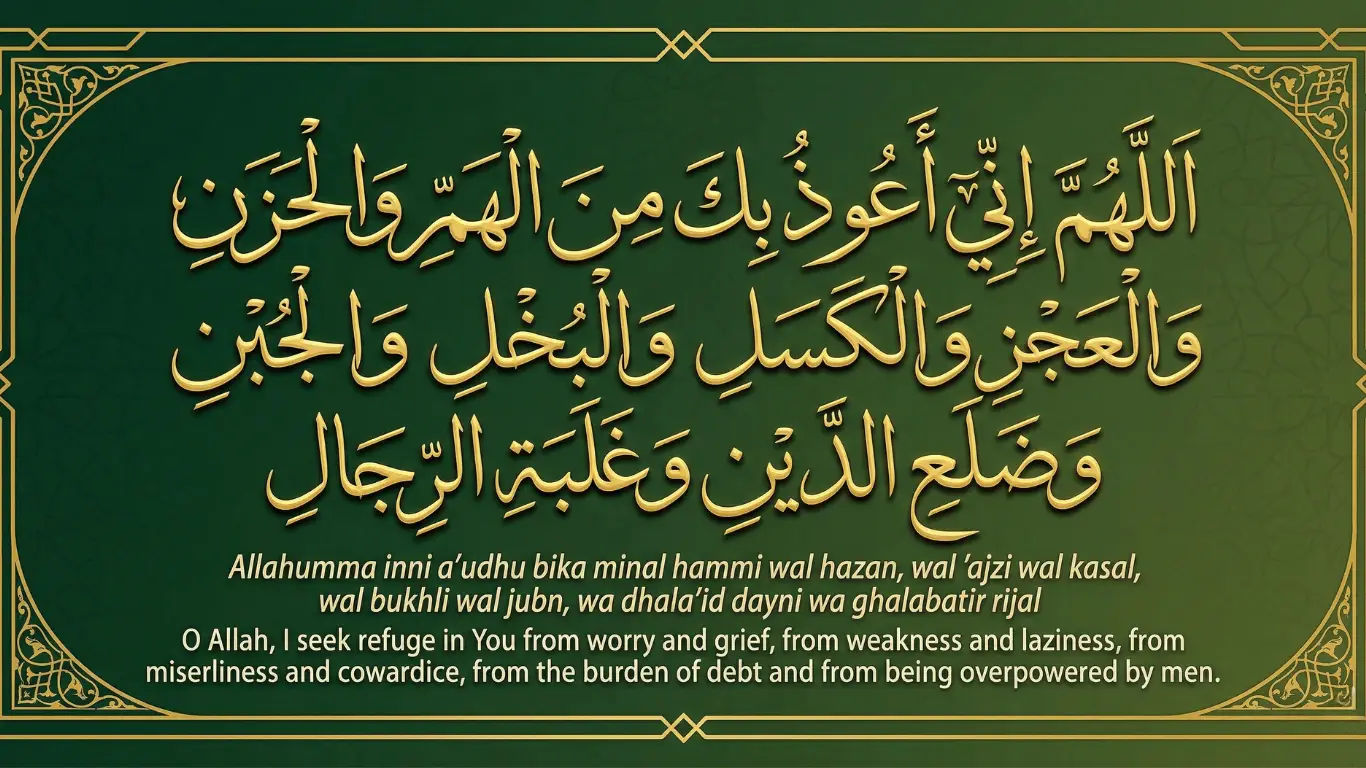
اللَّهُمَّ إِنِّي أَعُوذُ بِكَ مِنَ الْهَمِّ وَالْحَزَنِ، وَالْعَجْزِ وَالْكَسَلِ، وَالْبُخْلِ وَالْجُبْنِ، وَضَلَعِ الدَّيْنِ، وَغَلَبَةِ الرِّجَالِ
Transliteration: Allahumma inni a’udhu bika minal-hammi wal-hazani, wal-‘ajzi wal-kasali, wal-bukhli wal-jubni, wa dhala’id-dayni wa ghalabatir-rijal.
English Translation: “O Allah, indeed I seek refuge in You from worry and grief, and from inability and laziness, and from miserliness and cowardice, and from being overcome by debt and the oppression of men.”
Urdu Translation:
“اے اللہ! میں تیری پناہ مانگتا ہوں غم و الم سے، عاجزی سے، سستی سے، بزدلی سے، بخل، قرض چڑھ جانے اور لوگوں کے غلبہ سے۔”
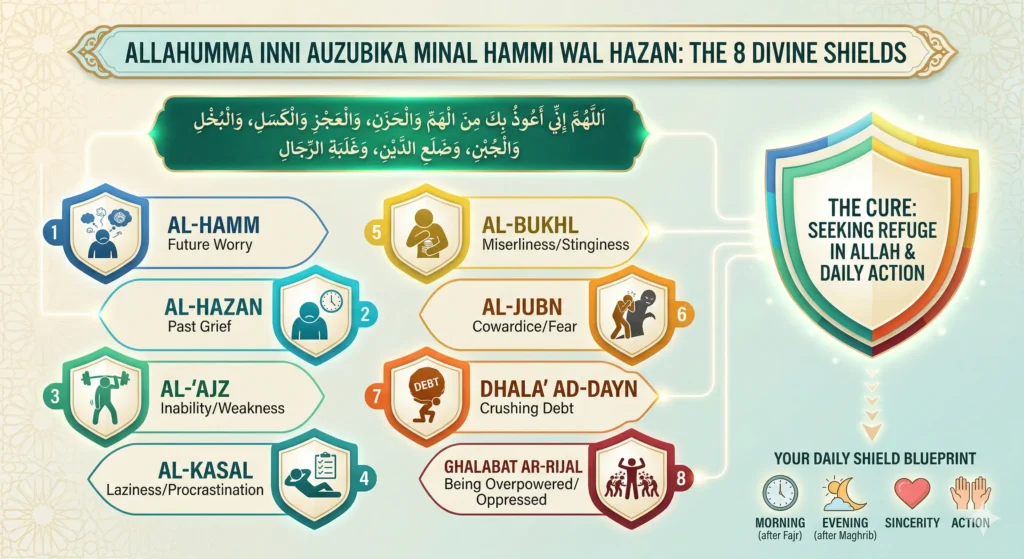
The 8-Shield System Explained
The brilliance of this dua is how it pairs our struggles, addressing every angle of human paralysis.
- Shield 1 & 2: The Time Destroyers (Al-Hamm & Al-Hazan)
- Al-Hamm (Future Anxiety): The mental torture of “what if?” that chains you to a future disaster that hasn’t happened.
- Al-Hazan (Past Grief): The trap of the rearview mirror, locking you into unchangeable past mistakes and losses.
- The Cure: This dua brings your consciousness back to the present moment, the only place where action is possible.
- Shield 3 & 4: The Paralysis Pair (Al-‘Ajz & Al-Kasal)
- Al-‘Ajz (Inability): Genuine weakness where you want to act but lack the physical, mental, or financial capacity.
- Al-Kasal (Laziness): The ability exists, but the motivation does not. You could act, but you choose comfort over growth.
- The Cure: Identifying whether you need resources (‘ajz) or discipline (kasal) is the first step to getting unstuck.
- Shield 5 & 6: The Scarcity Mindset (Al-Bukhl & Al-Jubn)
- Al-Bukhl (Miserliness): Hoarding wealth, time, or knowledge out of a fear that there isn’t enough to go around.
- Al-Jubn (Cowardice): Paralysis in the face of necessary risk, keeping you in toxic situations or preventing you from speaking the truth.
- The Cure: Verbalizing these as spiritual diseases shifts your mindset from fear-based survival to courageous abundance.
- Shield 7 & 8: The External Pressures (Dhala’ ad-Dayn & Ghalabat ar-Rijal)
- Dhala’ ad-Dayn (Crushing Debt): The overwhelming pressure of financial burden that compromises decision-making and steals your freedom.
- Ghalabat ar-Rijal (Oppression by People): Subjugation, workplace harassment, domestic abuse, or any unjust domination by others.
- The Cure: You are declaring war on bondage, trusting that Allah can open doors to financial and physical liberation.
How to Implement This Practice
This is not just theory; it is a tested solution. According to an authentic Hadith in Sunan Abi Dawud, the Prophet (ﷺ) taught this to a companion who was consumed by debt and worry. By following the prescription, the companion later testified: “Allah removed my worry and settled my debt.”
The Daily Blueprint: Recite this dua twice daily to build your spiritual defense:
- Morning: After the Fajr prayer to set your intention for the day.
- Evening: After the Maghrib prayer or before sleep to clear your mind.
By daily declaring your inability to handle anxiety, grief, laziness, and oppression alone, you are demolishing the dangerous lie that you must survive life on your own. You are anchoring yourself in Tawakkul (complete reliance on Allah)—the only true refuge that never collapses.
Allahumma inni auzubika minal hammi wal hazan PDF
Quick FAQs: The Dua for Anxiety and Debt
The most comprehensive supplication is: “Allahumma inni a’udhu bika minal-hammi wal-hazan” (O Allah, I seek refuge in You from worry and grief). It specifically targets both future-focused anxiety (hamm) and past-focused depression or grief (hazan).
According to the Sunnah, the optimal practice is to recite it twice daily: once in the morning (after Fajr prayer) to set a protected intention for the day, and once in the evening (after Maghrib or before sleep) to clear the mind.
Yes. The dua specifically seeks refuge from the “crushing burden of debt” (dhala’id-dayn). The companion Abu Umamah (رضي الله عنه) testified that after the Prophet (ﷺ) instructed him to recite this daily, Allah removed his consuming worries and facilitated the settling of his debts.
Hamm is the anxiety you feel about what might happen in the future. Hazan is the sorrow or grief you feel over what has already happened in the past. Seeking refuge from both anchors you safely in the present moment.
Ajz refers to a genuine physical, mental, or circumstantial inability to do something—you want to, but you can’t. Kasal refers to laziness—you have the ability and resources to act, but you choose not to out of a lack of motivation.
It translates to “being overpowered by men.” In a modern context, this means seeking divine protection against subjugation, abusive authority, workplace exploitation, or any situation where others unjustly dominate or oppress you.

1 thought on “Allahumma Inni Auzubika Minal Hammi Wal Hazan Dua”