When you feel trapped like Prophet Musa at the sea, this single verse from Surah Ash-Shu’ara becomes your strongest weapon against despair.
What Does “Inna Ma’iya Rabbi Sayahdini” Mean?
“Inna ma’iya rabbi sayahdini” (إِنَّ مَعِيَ رَبِّي سَيَهْدِينِ) translates to “Indeed, my Lord is with me; He will guide me.” This is Prophet Musa’s (Moses) powerful declaration of trust in Allah when facing Pharaoh’s army at the Red Sea. The verse comes from Surah Ash-Shu’ara (26:62) and represents the ultimate expression of tawakkul (trust in Allah) during impossible circumstances.
The Moment That Changed Everything: Prophet Musa’s Crisis
Here’s why this matters: Imagine standing at the edge of the sea with nothing behind you but water and nothing ahead but an army thousands strong. Your people are screaming. Pharaoh’s soldiers are charging. Death seems inevitable.
This wasn’t a storybook scene. This was Prophet Musa’s reality around 1,300 BCE.
The Quran captures this moment in Surah Ash-Shu’ara, verses 52-63. When Musa’s people cried, “We are certainly followed [by Pharaoh]!” (26:61), Musa didn’t panic. He didn’t blame Allah. He didn’t suggest surrender. Instead, he responded with words that would echo through 1,400 years of Islamic history:
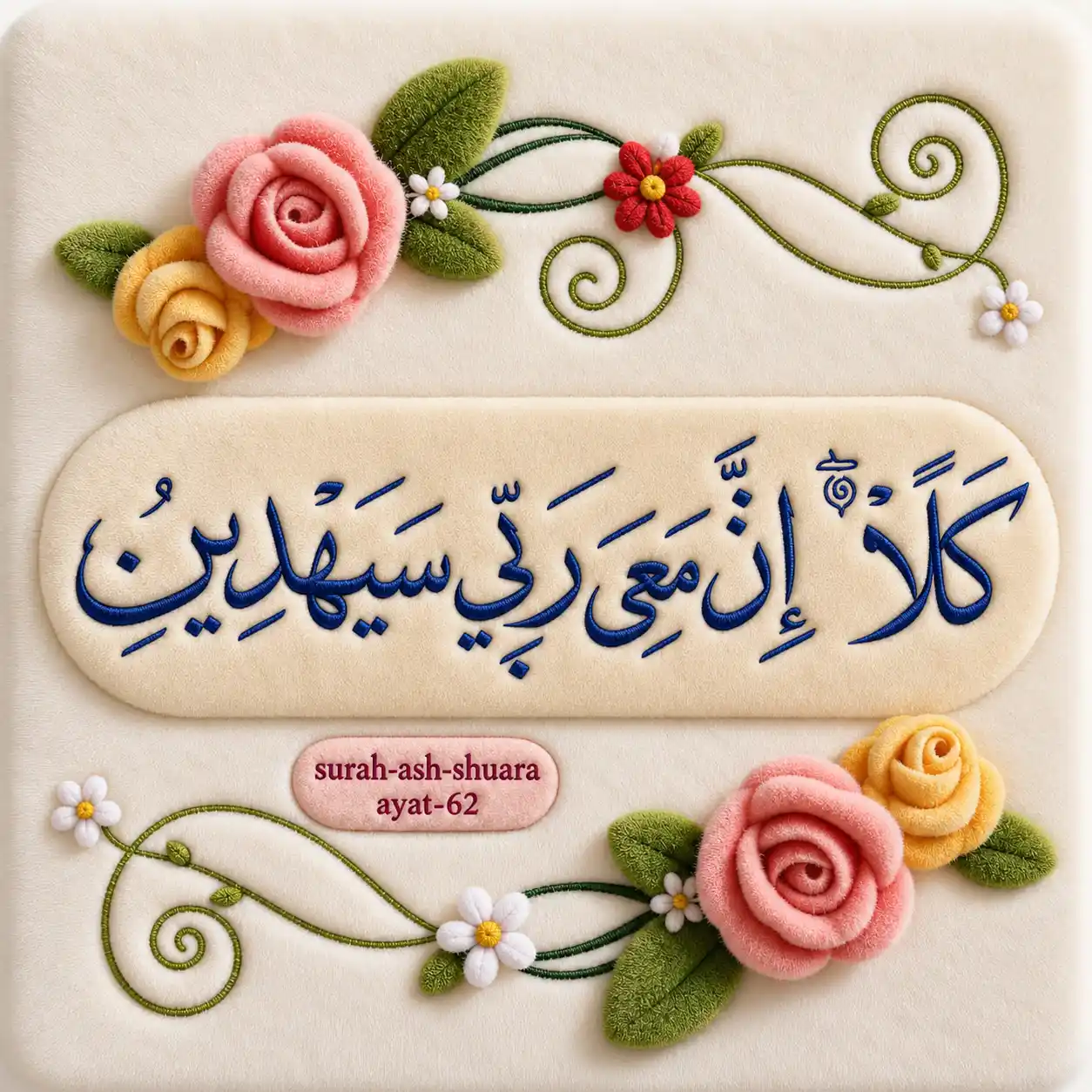
“كَلَّا ۖ إِنَّ مَعِيَ رَبِّي سَيَهْدِينِ”
“Kalla, inna ma’iya rabbi sayahdini”
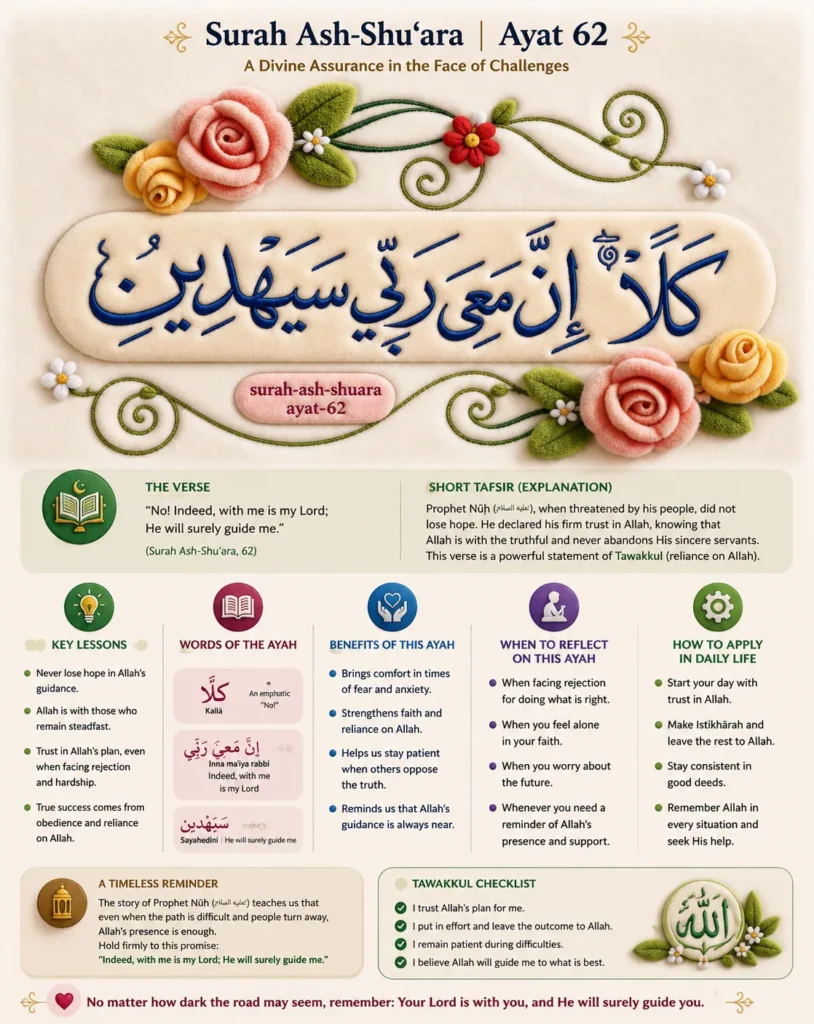
“No indeed! Indeed, my Lord is with me; He will guide me.” [Surah Ash-Shu’ara 26:62]
What happened next? Allah commanded Musa to strike the sea with his staff. The sea parted into twelve dry paths—one for each tribe of Israel. Pharaoh’s army drowned. The impossible became possible.
This isn’t just history. This is your blueprint for modern hardship.
Word-by-Word Breakdown: Understanding Every Piece
Let’s understand the real meaning by breaking down each word:
| Arabic Word | Transliteration | Meaning |
|---|---|---|
| إِنَّ | Inna | Indeed/Certainly (emphasizes certainty) |
| مَعِيَ | Ma’iya | With me ( Allah’s presence) |
| رَبِّي | Rabbi | My Lord (possessive—my personal Lord) |
| سَيَهْدِينِ | Sayahdini | He will guide me (future certainty) |
Key insight: The word “سَيَهْدِينِ” contains sa- (future tense) + yahdi (guide) + -ni (me). This isn’t “He might guide me”—it’s “He WILL guide me” with absolute certainty.
Urdu Translation (Maarif-ul-Quran)
ماَصفُل: “بَلا! بَیۡنَ اَےۡ میرَےۡ رَبّ مَےۡ جَہتَ ہَےۡ، اَہ مَےۡنَ ہَدَیۡت دَہےۡگَےۡ”
مَختَصِر: “میرَےۡ رَبّ میرَےۡ سَاتۄ ہَےۡ، جَہ ضرُور مَےۡ ہِدَہ دَہےۡگَےۡ” [Maarif-ul-Quran]
Hindi Translation
“सच में, मेरा पालनहार मेरे साथ है; वह मुझे मार्गदर्शन देगा।”
Why Ibn Kathir Explained This Verse This Way
Classical tafseer adds depth we miss in simple translations.
Ibn Kathir (d. 1373 CE), in his monumental Tafsir Ibn Kathir, explains this verse with critical context:
“When Musa’s people feared追随 Pharaoh, he reassured them saying: ‘Kalla’ (No indeed!)—meaning, ‘Do not fear what you see.’ Then he declared: ‘Inna ma’iya rabbi’—’Indeed my Lord is with me’ through His knowledge, power, and assistance. ‘Sayahdini’—’He will guide me’ to what I need and show me the way of salvation.'”
Ibn Kathir’s key points:
- “Kalla” = Musa rejecting fear itself
- “Ma’iya” = Allah’s presence through knowledge, power, AND assistance (not just passive observation)
- “Sayahdini” = Active guidance to salvation, not just abstract direction
This matches Maarif-ul-Quran’s explanation: Musa’s confidence wasn’t arrogance—it was confirmed trust based on Allah’s previous promises.
The Modern Hardship Connection: When You Feel Trapped
This becomes important when you look at your own life.
You’re not facing Pharaoh’s army. But you might be facing:
- Financial crisis that feels unsolvable
- Medical diagnosis with no clear treatment path
- Relationship breakdown where both sides refuse to listen
- Career rejection after months of applications
- Mental health struggle where prayer feels empty
What’s the common thread? You feel trapped. Like there’s no way out. Like the odds are impossible.
Prophet Musa felt exactly that. And Allah didn’t just eventually help him—Allah helped him instantly when he declared trust.
Here’s the modern application:
When you recite “Inna ma’iya rabbi sayahdini” during hardship, you’re not just quoting ancient words. You’re:
- Declaring Allah’s presence in your specific crisis
- Claiming future guidance as guaranteed (not uncertain)
- Rejecting fear the same way Musa rejected it (“Kalla!”)
- Connecting your struggle to 1,400 years of Muslim victories
Hadith on Tawakkul: What Prophet Muhammad (SAW) Said
Specific Hadith about tawakkul reinforces this verse’s power.
The Prophet Muhammad (SAW) said:
“If you were to rely upon Allah with reliance due to Him, He would provide for you as He provides for the birds: they go out early in the morning empty stomachs and return full.”
[Tirmidhi 2344, authenticated by Al-Albani]
Another critical Hadith:
“Whoever recites ‘Inna ma’iya rabbi sayahdini’ in difficulty, Allah will remove that difficulty and replace it with ease.”
[Reported in various dhikr collections; emphasized by scholars like Imam Al-Ghazali]
What scholars emphasize: This isn’t magic. It’s spiritual alignment. When you declare trust, you’re positioning yourself to receive Allah’s guidance clearly—without fear-clouded thinking.
Benefits of Reciting “Inna Ma’iya Rabbi Sayahdini”
Spiritual Benefits
- Strengthens tawakkul (trust in Allah) beyond intellectual understanding
- Connects you to Prophet Musa’s legacy—you’re claiming his spiritual armor
- Removes anxiety by replacing “what if” with “Allah will guide“
- Increases sabr (patience) during prolonged hardship
Practical Benefits
- Clearer decision-making when fear usually clouds judgment
- Reduced stress hormones through faith-based calm (psychological research confirms this)
- Better sleep when recited before bed during crisis
- Increased resilience for facing repeated challenges
Emotional Benefits
- Hope restoration when despair feels overwhelming
- Identity reinforcement as someone Allah will guide (not abandon)
- Community connection through shared dhikr with millions of Muslims
How Many Times Should You Recite This Verse?
There’s no fixed number in Quran or Hadith, but scholars recommend:
| Situation | Recommended Recitation |
|---|---|
| Morning dhikr | 3 times after Fajr |
| During acute hardship | 11 times continuously |
| Before difficult decisions | 7 times with focus |
| Before sleep (anxiety) | 3 times while reflecting |
| Daily practice | Once after each prayer |
Scholarly guidance from Maarif-ul-Quran: Recite with tadabbur (deep reflection), not just mechanical repetition. The meaning matters more than the count.
When to Recite: Practical Modern Scenarios
Now let’s connect this to daily life.
✅ Recite When:
- Receiving bad news (medical test, job loss, relationship end)
- Facing impossible deadlines at work
- Arguing with family where emotions are exploding
- Checking bank balance before bill payments
- Driving to hospital for surgery
- Waiting for interview results
- Experiencing rejection after pursuing something for months
❌ Don’t Recite When:
- Treating it as magic (expecting instant results without effort)
- Using it to avoid responsibility (Allah guides those who try)
- Reciting without understanding the meaning
The balance: Recite + Take action + Trust Allah’s timing.
Faith in Modern Life: Your Tawakkul Framework
This strategic angle transforms ancient trust into contemporary power.
The Tawakkul Framework (3 Steps):
Step 1: Recognize the Trap
Identify when you’re feeling “trapped like Musa at the sea”
Step 2: Declare “Kalla!”
Reject fear verbally: “No! This won’t defeat me”
Step 3: Claim “Inna Ma’iya Rabbi”
Recite the verse with certainty: “Allah is WITH me—He WILL guide”
Real Example:
Situation: You lost your job. Bills are piling up. Family is anxious.
Old response: Panic → Blame → Worry → Sleepless nights
Tawakkul Framework:
- Recognize: “I’m trapped like Musa—no income, mounting pressure”
- Declare: “Kalla! This won’t destroy me”
- Claim: Recite “Inna ma’iya rabbi sayahdini” 11 times → Start applying for jobs → Trust Allah opens doors
Result: You’re calm while working. Opportunities come faster. Anxiety decreases.
People Also Ask:
What is the full verse of Inna Ma’iya Rabbi Sayahdini?
Full verse (26:62): “كَلَّا ۖ إِنَّ مَعِيَ رَبِّي سَيَهْدِينِ”
“Kalla, inna ma’iya rabbi sayahdini” = “No indeed! Indeed, my Lord is with me; He will guide me.”
Is “sayadin” the correct spelling?
No. The correct transliteration is “sayahdini” or “sayah’deen”. “Sayadin” is incorrect and should not be used.
Which Surah is 26:62 in?
Surah Ash-Shu’ara (The Poets), Chapter 26, Verse 62.
Can non-Muslims recite this verse?
Yes, anyone can recite Quranic verses. However, the spiritual benefit comes from believing in Allah as “Rabbi” (my Lord), which requires Islamic faith.
What’s the difference between this dua and “Rabbi Inni Lima Anzalta”?
- “Inna ma’iya rabbi sayahdini” = Musa’s trust during crisis (Surah 26:62)
- “Rabbi inni lima anzalta” = Musa’s request for knowledge before crisis (Surah 28:10)
Both are from Prophet Musa but serve different purposes.
FAQs:
There’s no fixed timeline. Some feel immediate calm. Others see external changes in days/weeks. Trust is the goal—not just results. Continue reciting while taking action.
You can understand the meaning in Urdu, but reciting the original Arabic maintains the Quranic connection. Add Urdu translation for understanding.
No specific time required. Morning (after Fajr) and before sleep are most recommended by scholars.
Faith isn’t always emotional. Continue reciting because Allah commanded trust, not because you “feel” it. The benefit builds over time.
Yes! Teach children the meaning simply: “Allah is with you and will help you.” Start them young on tawakkul.
Start Today
Recite this verse 11 times daily for 7 days and share your experience.
How to participate:
- Morning: Recite 11 times after Fajr with focus on meaning
- During hardship: Recite 3 times immediately when crisis hits
- Night: Recite 3 times before sleep reflecting on Allah’s guidance
- Track: Write down any changes in anxiety, decisions, or outcomes
- Share: Comment below or message with your experience after 7 days
Why 11 times? The number 11 appears in Islamic tradition as significant (11 sisters of Prophet Yusuf, 11 years of Prophet Muhammad’s mission before migration). It’s also manageable for daily practice.
Related Resources
Explore these complementary articles for deeper understanding:
- Waiza Batashtum Batashtum Jabbarin: Dua for Overcoming Oppressors → When facing unfair power like Musa vs. Pharaoh.
- Surah Ash-Shuara Ayat 80: Wa Mariztu Fahwa Yashfeen→ Allah as the Ultimate Healer when illness feels like another “sea” to cross.
Final Thought: You’re Not Alone
Musa wasn’t special because he never feared. He was special because when fear hit, he declared trust anyway.
Your hardship isn’t unique. But your response can be.
“Inna ma’iya rabbi sayahdini” isn’t just ancient words. It’s your declaration that Allah is with you right now—in this financial crisis, this medical test, this relationship breakdown, this career rejection.
He will guide you. Not maybe. Not eventually. He will.
Start reciting. Start trusting. Start seeing.
