![An elegant landscape image centered on Arabic calligraphy of the verse 'Hal jazā'u al-iḥsāni illā al-iḥsān' and English text: 'Surah Ar-Rahman (Chapter 55, Verse 60) - "Is the reward of goodness [anything] but goodness?"' Set against a serene garden of roses, jasmine, a flowing river, and a glowing sunrise.](https://currentislam.com/wp-content/uploads/2026/08/surah-ar-rahman-55-60-verse-is-the-reward-of-goodness-nothing-but-goodness-landscape-scaled.webp)
You wake up exhausted, feeling like your daily routine—the commute, the corporate deadlines, the endless studying—is completely draining your soul without offering any real spiritual return.
Living as a Muslim in a highly secular, demanding society can feel incredibly isolating. You try to pray on time, give your annual charity, and maintain excellent character at work. But the sheer fatigue of modern life often makes you wonder if your quiet, hidden efforts are actually making a difference, or if you are just spinning your wheels.
The cure for this specific type of spiritual burnout lies in a single, profound divine promise found in Surah Ar-Rahman. When Allah asks, Hal jaza ul ihsan illal ihsan, He is handing you a shift in perspective. This verse moves your focus away from seeking temporary worldly validation and anchors it securely in an eternal, guaranteed reward.
What Does “Hal Jaza Ul Ihsan Illal Ihsan” Mean?
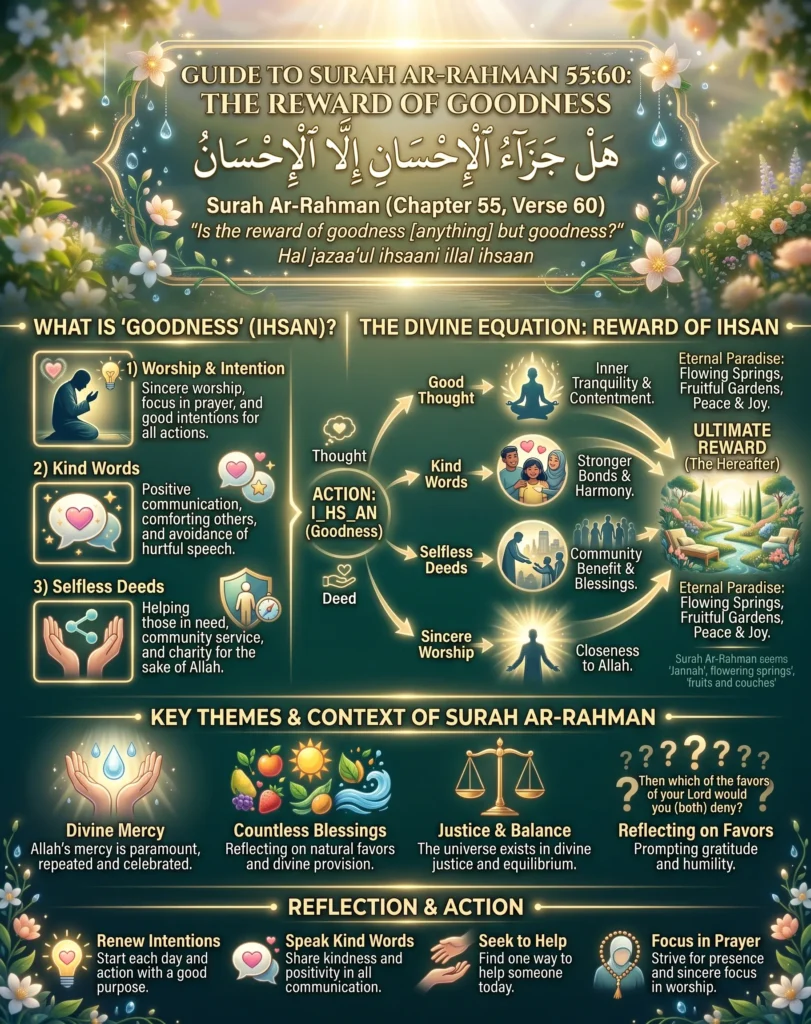
“Hal jaza ul ihsan illal ihsan” translates precisely to “Is there any reward for goodness other than goodness?” It is a powerful rhetorical question from Quran 55:60 (Surah Ar-Rahman), confirming that Allah guarantees ultimate excellence and Paradise as the absolute reward for believers who act with sincere excellence (Ihsan).
To fully grasp the magnitude of this promise, we must look at the exact linguistics of the revelation.
Surah Ar-Rahman (Chapter 55, Verse 60)
- Arabic Text: هَلْ جَزَاءُ الْإِحْسَانِ إِلَّا الْإِحْسَانُ
- Transliteration: Hal jazā’u al-iḥsāni illā al-iḥsān
- English Translation: “Is there any reward for goodness other than goodness?”
- Urdu Translation: نیکی کا بدلہ نیکی کے سوا اور کیا ہے۔
- Hindi Translation: भलाई का बदला भलाई के सिवा और क्या है?
(Quran 55:60)
Here is why this matters for your daily routine. The verse uses the word Ihsan twice. The first instance refers to your human effort—your patience (Sabr), your reliance on God (Tawakkul), and your good character. The second instance refers to Allah’s divine response. God is stating that human excellence is automatically met with divine excellence. It is a flawless, perfect spiritual transaction.
Why This Quran 55:60 Promise is Your Strongest Shield Against Burnout
Quran 55:60 protects against burnout by shifting your focus from temporary human approval to permanent divine reward. It trains your mind to practice the spiritual habit of Ihsan, ensuring every small, positive action builds a compounding reserve of spiritual excellence that Allah will reward.
We often burn out because we expect an immediate, equal return on our investment from the people around us. You help a colleague, you expect gratitude. You sacrifice for family, you expect recognition. When that human recognition fails, your motivation drops.
But how do we apply this at work or school? We apply it by hacking the spiritual habit loop.
In behavioral psychology, a habit loop consists of a cue, a routine, and a reward. Islam perfects this loop through the concept of Ihsan. When your “cue” is a difficult moment, your “routine” becomes an act of excellence for the sake of Allah, and your ultimate “reward” is guaranteed by the Creator of the heavens and the earth. You no longer need the colleague to thank you; your transaction was with God all along.
The Prophet Muhammad (PBUH) explicitly defined this state of mind in the famous Hadith of Jibril.
Sahih al-Bukhari (Hadith 50)
- Arabic Text: أَنْ تَعْبُدَ اللَّهَ كَأَنَّكَ تَرَاهُ، فَإِنْ لَمْ تَكُنْ تَرَاهُ فَإِنَّهُ يَرَاكَ
- Transliteration: An ta’bud Allaha ka’annaka tarahu, fa’in lam takun tarahu fa’innahu yarak
- English Translation: “That you worship Allah as if you see Him, for if you do not see Him, truly He sees you.”
- Urdu Translation: احسان یہ ہے کہ تم اللہ کی عبادت اس طرح کرو گویا تم اسے دیکھ رہے ہو، اور اگر تم اسے نہیں دیکھ رہے تو وہ تمہیں یقیناً دیکھ رہا ہے۔
- Hindi Translation: एहसान यह है कि तुम अल्लाह की इबादत इस तरह करो जैसे तुम उसे देख रहे हो, और अगर तुम उसे नहीं देख रहे हो तो वह तुम्हें यकीनन देख रहा है।
The Semantic Depth: Breaking Down the Arabic Morphology
The word ‘Ihsan’ stems from the Arabic root H-S-N (ح-س-ن), which signifies beauty, excellence, or doing something perfectly. In Surah Ar-Rahman, Allah uses this exact word to describe both human effort and divine reward, guaranteeing a perfectly mirrored, equitable spiritual transaction.
Let’s break down the exact meaning of this verse word-by-word to understand its psychological weight:
- Hal (هَلْ): A particle meaning “Is?” or “Is there?” It forces the listener to pause and think.
- Jaza (جَزَاءُ): This implies a recompense or a direct, earned consequence of an action. It is the inescapable result of what you put out into the world.
- Al-Ihsan (الْإِحْسَانِ): Doing something beautifully and with absolute sincerity.
- Illa (إِلَّا): Meaning “except.”
When read in context, Surah Ar-Rahman lists the magnificent, mind-bending luxuries of Jannah (Paradise). After describing flowing springs and shaded gardens, Allah asks this question. It serves as the ultimate logical conclusion. If you strive for excellence in a broken world, the Most Merciful will naturally provide an excellent eternity.
3 Core Verses to Complete Your Study of Surah Ar-Rahman
To fully grasp the thematic depth of this chapter and maximize your spiritual habit loop, it is highly recommended to study these three interconnected verses number-wise:
- The Reality of the Temporary World: Before seeking the eternal reward of Ihsan, we must recognize the fleeting nature of this life. Read our complete guide on Kullu man alaiha faan to shift your focus from this temporary world to the eternal reality.
- The Call to Perpetual Gratitude: The foundational theme of this chapter is acknowledging God’s continuous favors. Uncover the profound meaning of Fabiayiala irabbikuma tukazziban and discover how gratitude cures spiritual blindness and entitlement.
- The Majesty of the Creator’s Dominion: To worship with true Ihsan (acting as if you see God), one must comprehend His absolute, limitless authority. Explore the deep tafseer of Rabul mashriqain wa rabbul maghribain to strengthen your Tawakkul (trust) in the Master of all directions and possibilities.
Integrating the Habit of Ihsan into Your Daily Routine
You can practice Ihsan daily by implementing micro-habits like reciting morning adhkar, working with absolute honesty, treating family with extreme patience (Sabr), and relying fully on God (Tawakkul) during stressful moments. These small actions compound into massive spiritual rewards.
Building a lifestyle around Hal jaza ul ihsan illal ihsan requires practical, daily implementation. You do not need to overhaul your entire life overnight. Instead, focus on micro-transformations.
Use the table below to see how standard daily actions can be upgraded into acts of Ihsan, thereby activating the promise of Surah Ar-Rahman.
| Daily Action (The Cue) | Standard Habit (Basic) | The Habit of Ihsan (Excellence) | The Divine Reward (Jaza) |
| Waking up for work | Rushing out the door, stressed. | Reciting morning Duas and setting a sincere intention to earn halal income. | Barakah (blessing) in your wealth and time. |
| Dealing with a difficult person | Reacting with anger or frustration. | Practicing Sabr (patience) and responding with dignity. | Elevated ranks in Jannah and inner peace. |
| Performing daily Salah | Praying quickly just to get it done. | Praying as if you can see Allah, focusing on the meaning of the words. | Total spiritual purification and closeness to God. |
Asked Questions About Surah Ar-Rahman Verse 60
People frequently ask about the exact meaning, context, and spiritual benefits of verse 60 in Surah Ar-Rahman. Below are precise answers to the most common queries regarding this powerful Quranic promise of divine reciprocity.
Surah Ar-Rahman (Chapter 55), Verse 60 states “Hal jaza ul ihsan illal ihsan”, which directly translates to “Is there any reward for good except good?”. It is a foundational verse highlighting divine justice.
The main message of Surah Ar-Rahman focuses on acknowledging Allah’s countless blessings, practicing immense gratitude, and realizing that ultimate divine justice guarantees beautiful rewards for those who live with excellence.
You achieve Ihsan by worshipping and obeying Allah with absolute sincerity, acting as though you can see Him, and maintaining the deep awareness that He always sees you, as outlined in the Sahih Bukhari Hadith of Jibril.
Your spiritual efforts are never wasted. Every ounce of patience and every moment of sincerity is recorded. If you are ready to stop feeling spiritually exhausted and want to build a lifestyle of lasting excellence, subscribe to our weekly newsletter. We send out practical, actionable frameworks to help you integrate timeless Islamic habits into your modern life.

1 thought on “Hal jaza ul ihsan illal ihsan – Surah ar-rahman (Quran 55:60)”