
You wake up, reach for your phone, and the mental chatter begins instantly. Modern life bombards us with stress, intrusive thoughts, and a relentless feeling of being overwhelmed in a society that rarely pauses. This constant internal noise is exhausting, draining your focus and spiritual energy before you even start the day. The ultimate, time-tested remedy lies in the final chapter of the Holy Quran, specifically in the powerful protection of min sharril waswasil khannas.
What Does Min Sharril Waswasil Khannas Mean?
Min sharril waswasil khannas means “from the evil of the retreating whisperer.” It is the 4th verse of Surah An-Nas (Chapter 114), serving as a powerful supplication to seek refuge in Allah from intrusive thoughts, demonic whispers, and psychological anxiety.
Arabic Text:
مِن شَرِّ الْوَسْوَاسِ الْخَنَّاسِ
Transliteration: Min sharril waswāsil khannās
English Translation: From the evil of the retreating whisperer.
Urdu Translation: پیچھے ہٹ جانے والے وسوسہ ڈالنے والے کے شر سے۔
Hindi Translation: पीछे हट जाने वाले वसवसा डालने वाले की बुराई से।
(For the full context of this chapter, read the complete transliteration of Surah An-Nas.)
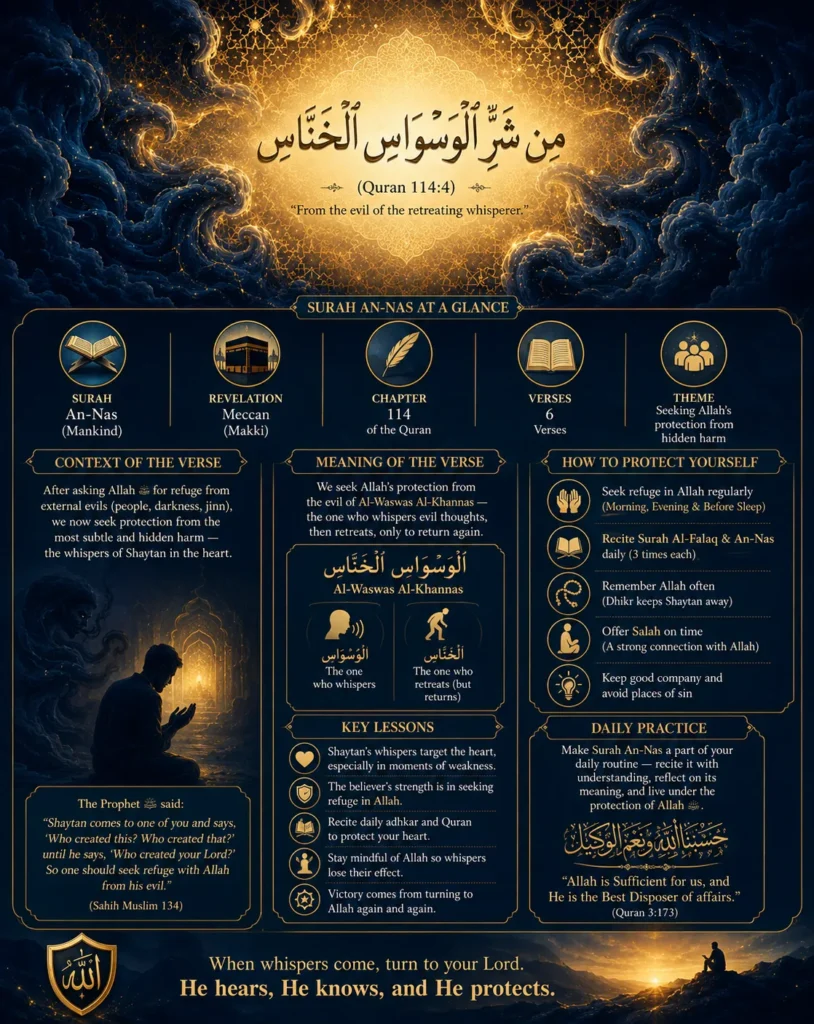
Breaking Down the Linguistics (Waswas and Khannas)
The term “waswas” refers to repeated, hidden whispers or intrusive thoughts, while “khannas” describes something that constantly retreats or shrinks away when confronted. Together, they describe Satan’s tactic of whispering doubts and immediately fleeing when Allah is remembered.
Let’s break down the exact meaning of this verse. The Arabic language is built on precise root words that convey action and state. Waswas (وَسْوَاس) stems from a root indicating a faint, repetitive rustling sound. It represents the subtle, continuous nature of intrusive thoughts, self-doubt, and spiritual misdirection.
Khannas (خَنَّاس) comes from a root meaning to withdraw, hide, or fall behind. This reveals a critical spiritual truth: the source of these negative whispers is inherently weak. The moment you engage in conscious remembrance of God, the whisperer completely retreats.
Why This Verse is Your Strongest Shield Against Anxiety
Reciting this verse merges psychological grounding with spiritual protection. It acknowledges the presence of internal negativity but empowers the believer by proving that these intrusive whispers immediately retreat upon the conscious remembrance of God through Tawakkul (reliance on Him).
Here is why this matters for your daily routine. We often try to fight overthinking with more thinking. The Islamic approach offers a direct micro-transformation. You disrupt the cycle of anxiety by recognizing it as an external influence (waswasa). By reciting Surah An-Nas (Quran 114:4), you actively apply Tawakkul (absolute trust in God). You shift your reliance from your overwhelmed mind to the Lord of mankind. Practicing Sabr (patience) alongside this recitation fortifies your mental resilience.
The Spiritual Habit Loop
We can build a powerful system using this verse. Every time a wave of unexplained anxiety, self-doubt, or temptation hits, use it as a trigger for a specific action.
| The Cue (Trigger) | The Routine (Action) | The Reward (Benefit) |
|---|---|---|
| Sudden anxiety, doubt, or temptation. | Recite Surah An-Nas, focusing deeply on min sharril waswasil khannas. | The whisperer retreats (khannas), restoring mental peace and spiritual clarity. |
| Scrolling social media with feelings of inadequacy. | Pause the screen. Recite the verse once with full meaning. | Immediate grounding in reality and detachment from digital envy. |
| Waking up at 3 AM with a racing mind. | Recite the Mu’awwidhatayn (Surah Al-Falaq and Surah An-Nas). | Protection from unseen anxieties, allowing restful sleep. |
(For maximum protection against external harms, pair this practice with the Surah Al-Falaq English translation.)
Historical Context: Why Was Surah An-Nas Revealed?
Surah An-Nas, alongside Surah Al-Falaq, was revealed to Prophet Muhammad (PBUH) to provide divine protection against unseen spiritual harm. They serve as the ultimate remedy for physical ailments, anxiety, and external negativity.
Classical scholars, including Ibn Kathir, emphasize that these chapters were sent down as a direct cure when the Prophet (PBUH) was experiencing spiritual distress. The historical revelation (Asbab al-Nuzul) provided a permanent blueprint for all Muslims: whenever afflicted by unseen harm, anxiety, or doubt, reliance on Allah’s words is the absolute cure.
The beauty of the final chapter of the Holy Quran is its universal, timeless application. While historical contexts dealt with specific trials, the daily reality for Western Muslims involves modern trials—digital overload, algorithms designed to fragment attention, and the resulting mental fatigue. The cure remains exactly the same.
Authentic Hadith: Prophet Muhammad’s (PBUH) Nightly Practice
Prophet Muhammad (PBUH) consistently recited Surah An-Nas, Surah Al-Ikhlas, and Surah Al-Falaq every night before sleeping. He would cup his hands, blow into them, recite the chapters, and wipe them over his body for divine protection.
Arabic Text:
كَانَ إِذَا أَوَى إِلَى فِرَاشِهِ كُلَّ لَيْلَةٍ جَمَعَ كَفَّيْهِ ثُمَّ نَفَثَ فِيهِمَا فَقَرَأَ فِيهِمَا: قُلْ هُوَ اللَّهُ أَحَدٌ وَقُلْ أَعُوذُ بِرَبِّ الْفَلَقِ وَقُلْ أَعُوذُ بِرَبِّ النَّاسِ
Transliteration: Kāna idhā awā ilā firāshihi kulla laylatin jama‘a kaffayhi thumma nafatha fīhimā faqara’a fīhimā: Qul huwa Allāhu ahad, wa Qul a‘ūdhu birabbil-falaq, wa Qul a‘ūdhu birabbin-nās…
English Translation: Whenever the Prophet (PBUH) went to bed every night, he used to cup his hands together and blow over them after reciting Surat Al-Ikhlas, Surat Al-Falaq, and Surat An-Nas, and then rub his hands over whatever parts of his body he was able to rub. (Sahih al-Bukhari 5017)
Urdu Translation:
نبی کریم صلی اللہ علیہ وسلم جب رات کو بستر پر آرام فرماتے تو اپنی دونوں ہتھیلیوں کو ملا کر ان میں قل ھو اللہ احد، قل اعوذ برب الفلق اور قل اعوذ برب الناس پڑھ کر پھونکتے اور پھر اپنے جسم پر پھیر لیتے۔
Hindi Translation: जब भी पैगंबर (PBUH) हर रात बिस्तर पर जाते, तो वह अपने हाथों को एक साथ मिलाते और सूरह अल-इखलास, सूरह अल-फलक और सूरह अन-नास पढ़ने के बाद उन पर फूंकते, और फिर अपने शरीर पर जहाँ तक हो सके फेरते।
The Wazifa: Actionable Daily Implementation
Direct Answer: The most effective times to recite Surah An-Nas to combat the retreating whisperer are after the five obligatory prayers, during the morning and evening Adhkar (supplications), and immediately before sleeping.
But how do we apply this at work or school? You do not need a prayer mat to engage this protection. It takes less than 30 seconds.
- Morning Routine: Incorporate it into your morning and evening Azkar. Reciting it 3 times after Fajr establishes a protective spiritual perimeter for the entire day.
- During the Day: Recite internally when faced with sudden stress, panic, or unethical temptations at the office or on campus.
- Night Routine: Recite 3 times before sleep, wiping the body as outlined in Sahih al-Bukhari. This clears the mind of the day’s accumulated waswasa.
FAQs:
The most effective Quranic dua for overthinking is Surah An-Nas. Specifically, the verse min sharril waswasil khannas targets the core of overthinking by seeking refuge from the persistent, hidden whispers that cause doubt and anxiety in the mind.
The phrase “retreating whisperer” is the exact English translation of verse 4 in Surah An-Nas, the final chapter of the Holy Quran (Quran 114:4). The original Arabic text is min sharril waswasil khannas.
You stop Waswas by ignoring the intrusive thoughts and immediately engaging in the remembrance of Allah (Dhikr). Reciting Ta’awwudh (seeking refuge in Allah) and consciously reading Surah An-Nas forces the internal whisperer to retreat, as explicitly denoted by the word khannas. If you struggle with severe restlessness, consider reciting the best dua for bechaini and waswasa.
Next Step: Are you ready to reclaim your peace of mind? Read our complete Islamic guide to overcoming modern anxiety to build a comprehensive spiritual toolkit for your daily life.
