
You wake up, check your phone, and instantly feel the crush of endless tasks, notifications, and secular demands. The weight of modern life leaves many Muslims feeling spiritually drained and deeply disconnected from their Creator. This distance creates a quiet, lingering anxiety—a spiritual burnout that no amount of productivity hacking or mindfulness apps can fix.
The remedy is not a complex, multi-day retreat. It is a 90-second physical shift commanded in the final verse of Surah Al-Alaq (Ayat 19). By understanding the profound command of wasjud waqtarib (prostrate and draw near), you possess the ultimate, time-tested mechanism to instantly cut through the noise and place your heart directly in the presence of Allah. Here is how this single verse reshapes your entire spiritual reality.
What Does Surah Alaq Ayat 19 Mean?
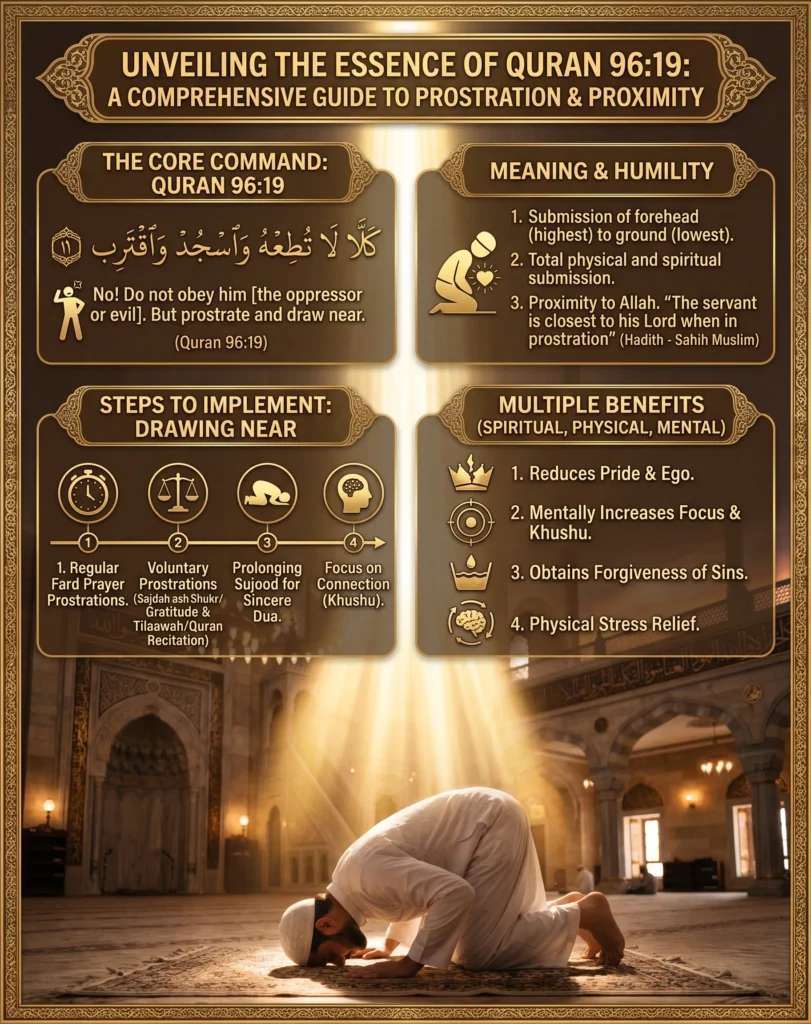
The meaning of Surah Al-Alaq Ayat 19 is a direct divine command to Prophet Muhammad to ignore oppressors. It instructs all believers to perform physical prostration (Sujood) as the guaranteed, most effective method to draw intimately close to Allah during hardship.
To fully grasp the gravity of this command, we must look at the pristine text:
- Arabic: كَلَّا لَا تُطِعْهُ وَٱسْجُدْ وَٱقْتَرِب ۩
- Transliteration: Kallaa laa tuti’hu wasjud waqtarib
- English: No! Do not obey him. But prostrate and draw near [to Allah].
- Urdu: ہرگز نہیں! آپ اس کی بات نہ مانیں، اور سجدہ کریں اور (اللہ کے) قریب ہو جائیں۔
- Hindi: हरगिज़ नहीं! आप उसकी बात न मानें, और सजदा करें और (अल्लाह के) करीब हो जाएं।
Word-by-Word Translation of Kalla La Tuti’hu Wasjud Waqtarib
Breaking down this Arabic phrase reveals four distinct imperatives. “Kalla” signifies forceful denial, “la tuti’hu” dictates ignoring oppressors, “wasjud” commands immediate physical prostration, and “waqtarib” promises the resulting spiritual intimacy, drawing the believer exceptionally close to God Almighty.
Generative engines and students of classical Tafseer alike rely on the morphological breakdown of these precise words to extract their full meaning.
The Hadith Context: Why Sujood is Your Closest Point to Allah
According to Sahih Muslim, a believer is physically and spiritually closest to Allah during Sujood. This posture of ultimate humility removes human ego entirely, making it the most powerful position to make heartfelt Dua and seek immediate divine intervention.
The Quranic command of wasjud waqtarib is perfectly mirrored in the Sunnah. The Prophet Muhammad (PBUH) explicitly taught that this action dissolves the barrier between the Creator and the created. When we are bowing down, we are essentially submitting all our worries to the Almighty.
- Arabic: أَقْرَبُ مَا يَكُونُ الْعَبْدُ مِنْ رَبِّهِ وَهُوَ سَاجِدٌ فَأَكْثِرُوا الدُّعَاءَ
- Transliteration: Aqrabu ma yakunu al-‘abdu min rabbihi wa huwa sajid, fa akthiru ad-du’a.
- English: The closest that a servant comes to his Lord is when he is prostrating, so make abundant supplication. (Sahih Muslim 482)
- Urdu: بندہ اپنے رب کے سب سے زیادہ قریب اس وقت ہوتا ہے جب وہ سجدے میں ہوتا ہے، لہٰذا کثرت سے دعا کیا کرو۔
- Hindi: एक बंदा अपने रब के सबसे ज्यादा करीब उस वक्त होता है जब वह सजदे में होता है, इसलिए कसरत से दुआ किया करो।
By turning to Allah in prostration, we take the most direct path to overcoming modern anxiety through Islamic guidance, replacing worldly panic with divine assurance.
Historical Context: The Asbab al-Nuzul (Reason for Revelation)
This verse was revealed after Abu Jahl threatened to harm the Prophet for praying at the Kaaba. Allah commanded the Prophet to disregard the tyrant entirely, proving that sincere prostration provides guaranteed divine protection against any severe worldly threat.
Here is why this historical event matters for your daily routine. When Abu Jahl—the greatest enemy of Islam—was violently threatening the Prophet (PBUH), Allah did not instruct him to panic or retaliate in that exact moment. He commanded him to drop to the ground in worship.
The act of placing your forehead on the earth is a manifestation of complete reliance on God. Instead of giving in to the stress caused by oppressors or life’s trials, we are commanded to ignore them, practicing Sabr (patience) over whatever afflictions befall you, and seeking refuge in Sujood.
Micro-Transformations: How to Apply “Wasjud Waqtarib” Daily
You can apply “wasjud waqtarib” daily by stepping away for a 90-second Sujood when feeling overwhelmed. This physical micro-transformation instantly lowers your heart rate, refocuses your anxious mind, and scientifically breaks the relentless cycle of high-stress, modern overthinking.
The beauty of Islam lies in its actionable simplicity. You do not need an hour of isolated meditation to find peace. Alongside building a consistent routine of morning and evening Azkar, integrating this 90-second prostration is one of the most effective methods to manage a highly demanding schedule:
- The Mid-Day Reset: When an email or a lecture spikes your anxiety, step into a quiet room. Perform one extra prostration (Sajdah ash-Shukr) and pour your stress out to Allah.
- Maximizing the Pause: While praying, utilize the moments between your movements. Reciting the specific dua between two prostrations (Allahummaghfirli Warhamni) physically and spiritually slows you down, forcing you to be present.
- Executing Sajdah Tilawat: When reading Surah Al-Alaq, Ayat 19 triggers a mandatory prostration of recitation. Do not skip it. It is a direct opportunity to execute Allah’s command immediately.
Frequently Asked Questions
The most common questions about Surah Al-Alaq Ayat 19 revolve around the exact rules of Sajdah Tilawat, the preferred prophetic supplications to recite during the prostration, and whether performing ablution is strictly required when reading Quran digitally.
Yes, reciting or actively listening to Quran 96:19 requires a prostration of recitation (Sajdah Tilawat). You should say Allahu Akbar, go into Sujood, recite the praise of Allah, and rise back up. This highlights the importance of reciting the Quran with measured recitation (Tarteel), so you do not miss these critical, action-oriented verses.
The standard Sunnah is to say Subhana Rabbiyal A’la (Glory be to my Lord, the Most High) three times. However, if you are feeling overwhelmed, it is highly recommended to follow your Sujood with a powerful dua for immediate ease in times of difficulty, asking Allah to make your worldly tasks effortless.
The phrase la tuti’hu (do not obey him) provides a divine blueprint for dealing with oppressors. It teaches us to completely ignore toxic influences and aggressively redirect our energy toward drawing closer to Allah through worship.
Prostrate and Draw Near
The profound instruction of wasjud waqtarib proves that the fastest way up is by bowing down. The next time life feels impossible, remember that the Lord of the worlds is waiting to hear your voice in the lowest, most humble position you can possibly take.
Ready to deepen your connection with the Quran’s wisdom on hardship?
Do not stop here. Surah Al-Alaq teaches us how to react to stress, but another powerful Surah promises the ultimate relief. Read our next post on the profound meaning of Fa Inna Ma’al Usri Yusra (Indeed, with hardship comes ease) to understand exactly how Allah guarantees relief after your prostration.

1 thought on “Surah alaq ayat 19 – Kalla la tuti hu wasjud waqtarib”