Medical Disclaimer: The Islamic prayers and supplications (duas) mentioned in this article are spiritual complements to proper medical care. Always consult your obstetrician, midwife, or healthcare provider for medical advice, prenatal care, and physical health concerns. Trusting Allah (Tawakkul) involves taking necessary medical precautions.
Pregnancy brings a profound mix of joy, anticipation, and vulnerability. The moment you see a positive test, your instinct is to protect the life growing inside you. Alongside the physical preparations, the anxiety of potential complications, miscarriage, or labor can feel overwhelming.
The Sunnah provides a direct remedy for this anxiety. If you are struggling heavily with fear, establishing a firm dua for anxiety and depression routine is a crucial first step. We look to the Prophets—specifically Prophet Zakariya (AS) and Prophet Ibrahim (AS)—who experienced their own intense struggles regarding children. Their words offer the most powerful supplications for a safe pregnancy, a healthy delivery, and a righteous child.
(Note: If you are new to structured daily supplications, review how to make dua effectively before beginning).
Quick Answer: Core Duas for Pregnancy
- For a Righteous Child: Recite Rabbi habli min ladunka zurriyatan tayyibatan (Surah Al Imran 3:38).
- For Fetal Protection: Recite Ayat al-Kursi and the Quls every morning and evening.
- For Ease in Delivery: Recite Dua Yunus (Surah Al-Anbiya 21:87) when feeling overwhelmed or in pain.
What is the Most Powerful Dua for Pregnancy?
The most comprehensive dua for pregnancy comes directly from the Quran, spoken by Prophet Zakariya (AS). It asks not just for a child, but for a “pure and righteous” child, addressing both physical health and spiritual well-being.
Prophet Zakariya’s Supplication (Surah Al Imran 3:38)
Prophet Zakariya (AS) made this dua when he was of advanced age and his wife was barren. Seeing the miraculous provisions Allah granted Maryam (Mary), his hope was renewed. He recognized that the laws of biology are subject to the will of Allah.
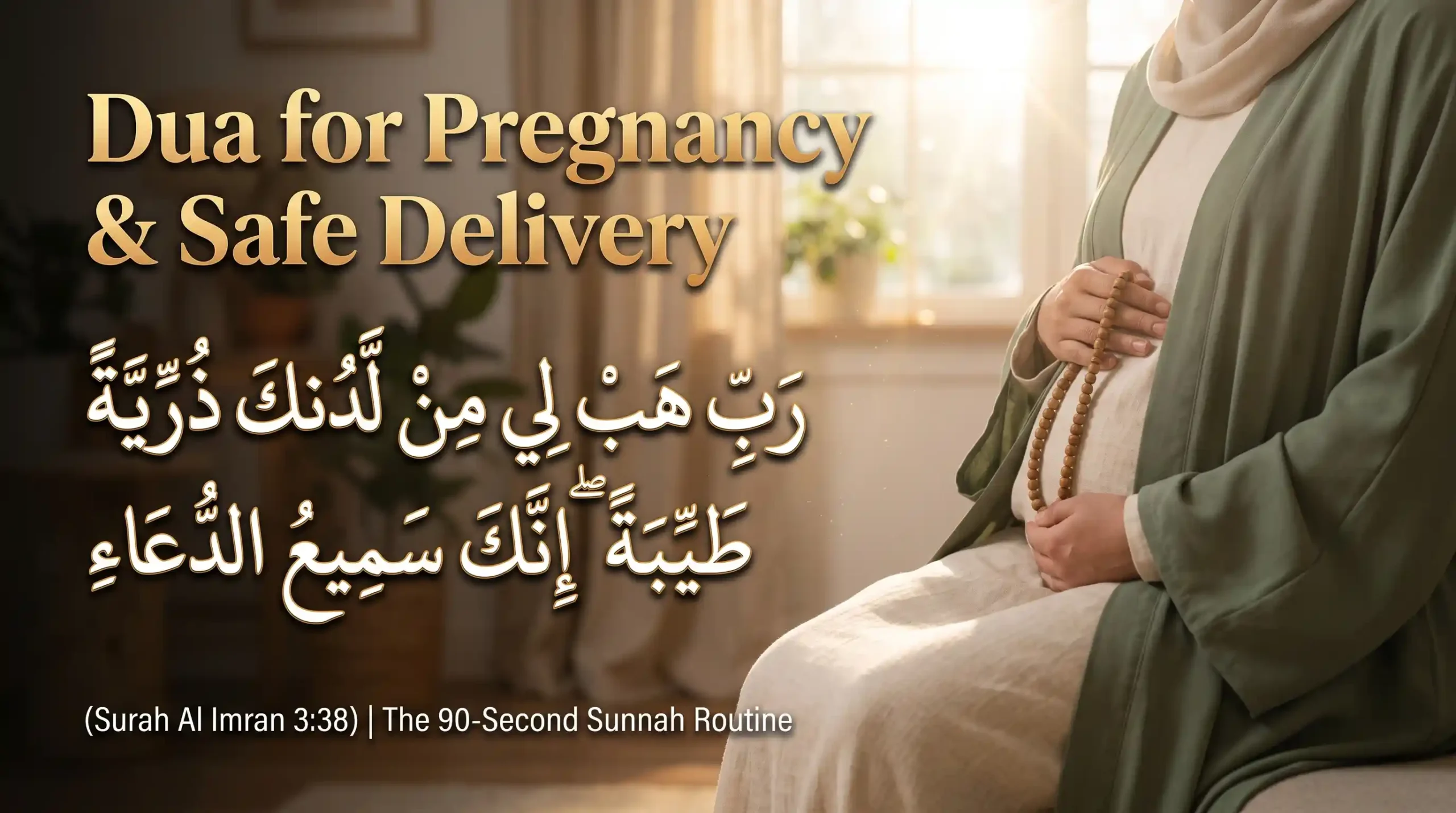
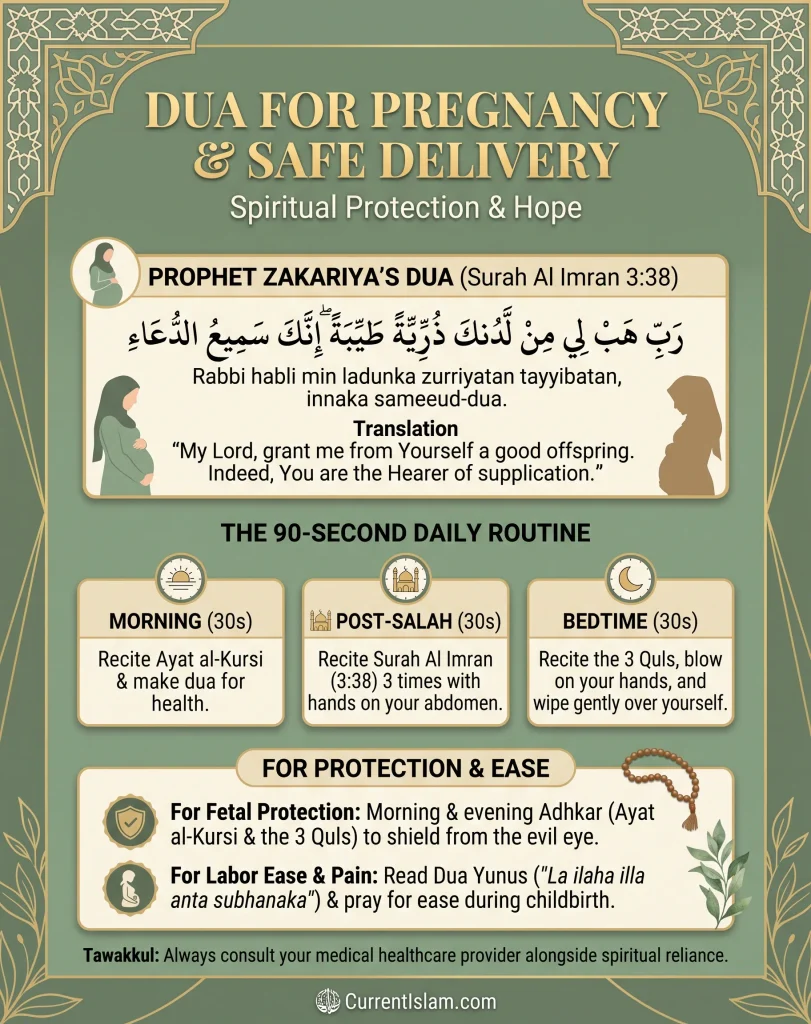
رَبِّ هَبْ لِي مِن لَّدُنكَ ذُرِّيَّةً طَيِّبَةً ۖ إِنَّكَ سَمِيعُ الدُّعَاءِ
Rabbi habli min ladunka zurriyatan tayyibatan, innaka sameeud-dua.
English Translation: “My Lord, grant me from Yourself a good offspring. Indeed, You are the Hearer of supplication.” (Quran 3:38)
Urdu Translation: اے میرے رب! مجھے اپنی طرف سے پاکیزہ اولاد عطا فرما، بیشک تو ہی دعا سننے والا ہے۔
Hindi Translation: हे मेरे रब! मुझे अपने पास से पवित्र संतान अता कर, निस्संदेह तू ही दुआ सुनने वाला है।
Word-by-Word Breakdown
Context and Tafsir: Classical scholars, including Ibn Kathir, note the specific use of the word hab (gift). A gift is given without the receiver having necessarily earned it. When facing pregnancy complications or anxiety, this dua reminds you that your child is a gift solely from Allah, detached from your own perceived physical limitations. The term tayyibah encompasses a child who is physically healthy, ethically sound, and a comfort to the parents’ eyes.
Prophet Ibrahim’s Supplication (Surah As-Saffat 37:100)
Similarly, Prophet Ibrahim (AS) prayed for a righteous child when he was older and childless.
رَبِّ هَبْ لِي مِنَ الصَّالِحِينَ
Rabbi habli minas-saliheen.
English Translation: “My Lord, grant me [a child] from among the righteous.” (Quran 37:100)
Urdu Translation: اے میرے رب! مجھے نیک لوگوں میں سے (بیٹا) عطا فرما۔
Hindi Translation: ऐ मेरे रब! मुझे नेक लोगों में से (संतान) अता कर।
[SCHOLAR ANECDOTE:”A few years ago, a young couple sat in my office, utterly exhausted by their fertility journey. They had endured multiple medical setbacks and were paralyzed by the fear of another heartbreak. In their anxiety, they were treating their bodies like failing machines. I asked them to pause the late-night internet searches and instead recite the dua of Prophet Zakariya every day after Asr, focusing entirely on the word ‘hab’ (a freely given gift). I reminded them that while medicine is a necessary Sunnah, biology is merely the means; the ultimate Giver is Allah.
Months later, the husband told me that this simple Quranic shift removed the crushing pressure from their marriage. Their home transformed from a place of anxious waiting into one of deep reliance on Allah. When they were finally blessed with a child the following year, their first tears weren’t just of joy, but of profound gratitude for the peace they had found in Tawakkul (trust in Allah) long before the test was ever positive.”]
Hamal Ki Hifazat Ki Dua: Protection for the Fetus
To protect the pregnancy (hamal ki hifazat), recite Ayat al-Kursi and the 4 Quls in English and Arabic every morning and evening. Blow lightly over your hands and pass them over your belly.
A specific Hadith notes that the angel breathes the soul into the fetus at 120 days (Sahih al-Bukhari 3208). Surrounding this developmental milestone with words of protection ensures spiritual safeguarding. Many mothers also choose to recite the dua for protection from black magic and evil eye to shield themselves from Nazar during vulnerable months.
The 90-Second Pregnancy Reset Routine
Many pregnant mothers feel they lack the energy for lengthy worship. The Sunnah favors small, consistent actions over sporadic, heavy burdens. Implement this 90-second routine to anchor your day.
- Morning (30 Seconds): Place your hand on your abdomen. Recite Ayat al-Kursi once for physical and spiritual protection, supplementing it with a general dua for health.
- Post-Salah (30 Seconds): After Dhuhr or Asr, recite Rabbi habli min ladunka zurriyatan tayyibatan three times. Keep the focus entirely on the word tayyibah (pure/healthy).
- Bedtime (30 Seconds): Recite the Quls, blow gently into your cupped palms, and wipe them over your body, including your abdomen.
Western-Life Application for Expectant Mothers
If you are working in a corporate office, commuting, or managing other children, carving out spiritual time is difficult.
- The Commute: Use the drive or train ride to listen to Surah Maryam. The rhythmic recitation naturally lowers cortisol levels, benefiting both mother and baby.
- Medical Appointments: While sitting in the waiting room before an ultrasound, silently recite Dua Yunus (La ilaha illa anta subhanaka inni kuntu minaz-zalimin). It is the ultimate Prophetic tool for removing distress.
- The Office: You do not need a prayer mat to make dua. Whispering Rabbi habli minas-saliheen at your desk while doing breathing exercises fulfills the Sunnah of constant remembrance.
Comparing the Primary Pregnancy Supplications
Frequently Asked Questions About Pregnancy Duas
What is the dua for a safe pregnancy and delivery?
Recite the dua of Zakariya: Rabbi habli min ladunka zurriyatan tayyibatan. During actual labor, it is highly recommended to rely on a dua for pain and the Dua of Yunus to alleviate physical distress.
How many times should I read Hamal ki Hifazat ki dua?
There is no fixed authentic number. Read it as often as your heart needs peace. Repeating it three times after your daily prayers is a strong, consistent habit.
Which Surah is best to listen to during pregnancy?
Surah Maryam and Surah Yusuf are highly recommended. Surah Maryam details the miraculous births of Yahya and Isa (AS), reinforcing Allah’s power, while Surah Yusuf teaches ultimate patience through hardship.
Can I recite these without Wudu?
Yes. You can recite duas from memory at any time, with or without Wudu. You only need Wudu to physically touch the Arabic text of the Quran.
What should the father recite?
The father should actively share the spiritual load. He can place his hand on his wife’s abdomen and recite the Quls, and make the same supplications of Ibrahim and Zakariya in his daily prayers.
Is there a specific wazifa to prevent miscarriage?
Islam does not prescribe rigid mathematical formulas (wazaif) for preventing medical events. Medical care combined with consistent morning and evening protection prayers (Adhkar) is the Prophet’s ﷺ standard.
Next Step for Parents:
Want to learn how to raise the child you are praying for? Read our complete guide on Islamic parenting tips for confidence to prepare for the journey ahead.
Last reviewed by: [ATIF KHAN] Date: 7,October 2026
