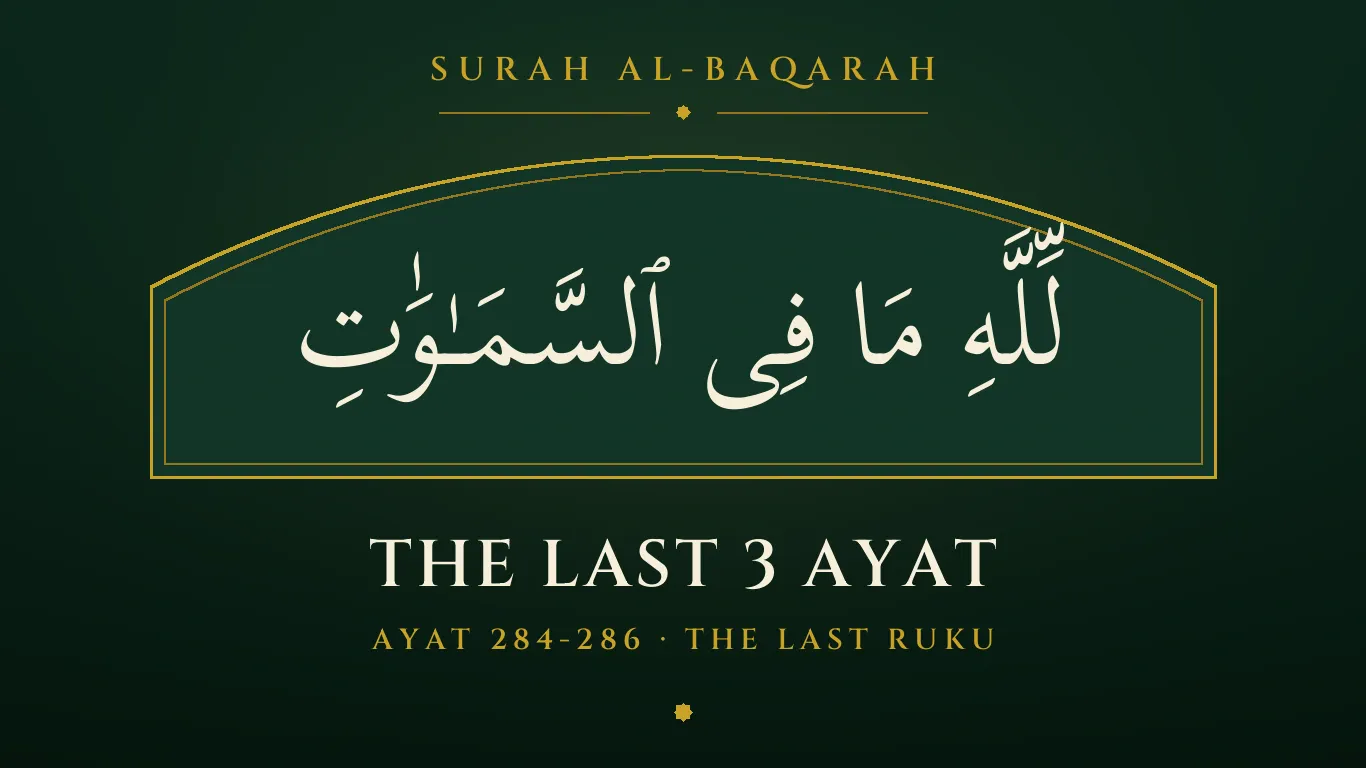
The closing verses of the Quran’s longest surah carry a promise quoted every night — and a first verse many pages quietly skip.
Quick Answer:
The Surah Baqarah last 3 ayat are verses 284, 285 and 286 — together, the last ruku (final section) of the Quran’s longest surah. Verse 284 is Allah’s account of hidden thoughts, 285 is the believers’ answer — “we hear and we obey” — and 286 is a set of duas Allah answered as they were revealed. The verified practice is the night one: recite the last two verses (285–286) at night, and “they will suffice him” (al-Bukhari 5009; Muslim 807). Each verse’s full Arabic, with Urdu and English meaning, is carried on the verified verse images below — with the printable Night Seal Card.
Contents:
1 · The screenshot problem ·
2 · What are the last 3 ayat? ·
3 · The verses, one by one ·
4 · Key words ·
5 · Why they weighed on the Companions ·
6 · The Seal ·
7 · Real benefits ·
8 · Wazifa and nazar — the honest answer ·
9 · Practise tonight ·
10 · An ordinary day ·
11 · Common mistakes ·
12 · FAQs ·
13 · Your next step
The night your feed sends you a screenshot
A bright poster lands in the family chat: read these verses a set number of times and your home is protected. You want three things first: the verses themselves, what they mean, and whether the promise is real. Most pages give you two verses and all of the promise. This page takes all three in order, the one promise the sources make, and a plain statement of what they do not.
What are the Surah Baqarah last 3 ayat?
The last three ayat of Surah al-Baqarah are verses 284, 285 and 286, the closing passage of the Quran’s longest surah. Together they form its last ruku, its final section: 284 on Allah’s account of hidden thoughts, 285 on faith and obedience, 286 on capacity, mercy and answered dua.
The passage closes the second and longest chapter of the Quran. A ruku is a section marker printed in the mushaf; the surah’s last ruku begins at verse 284. Counted word by word in the mushaf text: 104 words in total — 28, 27 and 49. The same surah carries Ayatul Kursi at verse 255, its most famous single verse. The famous night hadith names only the last two verses — which is why 284 gets dropped, and why this page restores it.
| Ayah | Theme | What it gives the reader |
|---|---|---|
| 2:284 | The Account | Everything belongs to Allah, and even hidden thoughts stand before Him — the verse that makes a reader honest about the inner life. |
| 2:285 | The Answer | The believers’ creed in one verse, ending in their line: sami’na wa ata’na, “we hear and we obey”. |
| 2:286 | The Answered Duas | The capacity promise — no soul burdened beyond what it can bear — then three Rabbana petitions Allah answered as they were revealed. |
What do the last three ayat say?
The three verses move in one direction. Verse 284: everything in the heavens and earth is Allah’s, and hidden thoughts are called to account. Verse 285 answers with the believers’ faith and their words, “we hear and obey.” Verse 286 promises no burden beyond capacity, ending in answered dua.
Read them in order: what Allah sees in you, how believers answer, finished words of dua in your mouth. Each verse’s full text — Arabic, Urdu and English — sits on its verified verse image, word-checked against the mushaf; this page works through the meaning.
Ayah 284 — the Account
The full verse — Arabic (Uthmani), Urdu (Jalandhari) and English (Khattab), word-checked — is on the verified verse image here: embed baqarah-ayat-284.png (Part 3).
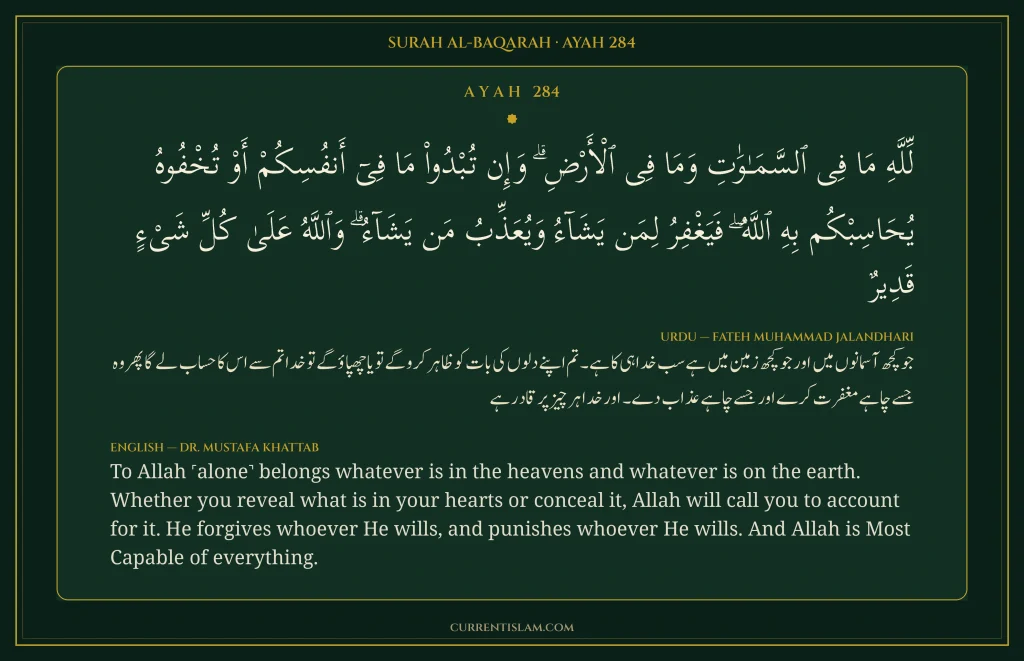
The verse opens with ownership — lillahi ma fis-samawati, “to Allah belongs whatever is in the heavens” — and closes with power and choice: He forgives and punishes whom He wills.
Ayah 285 — the Answer
The full verse — Arabic (Uthmani), Urdu (Jalandhari) and English (Khattab), word-checked — is on the verified verse image here: embed baqarah-ayat-285.png (Part 3).
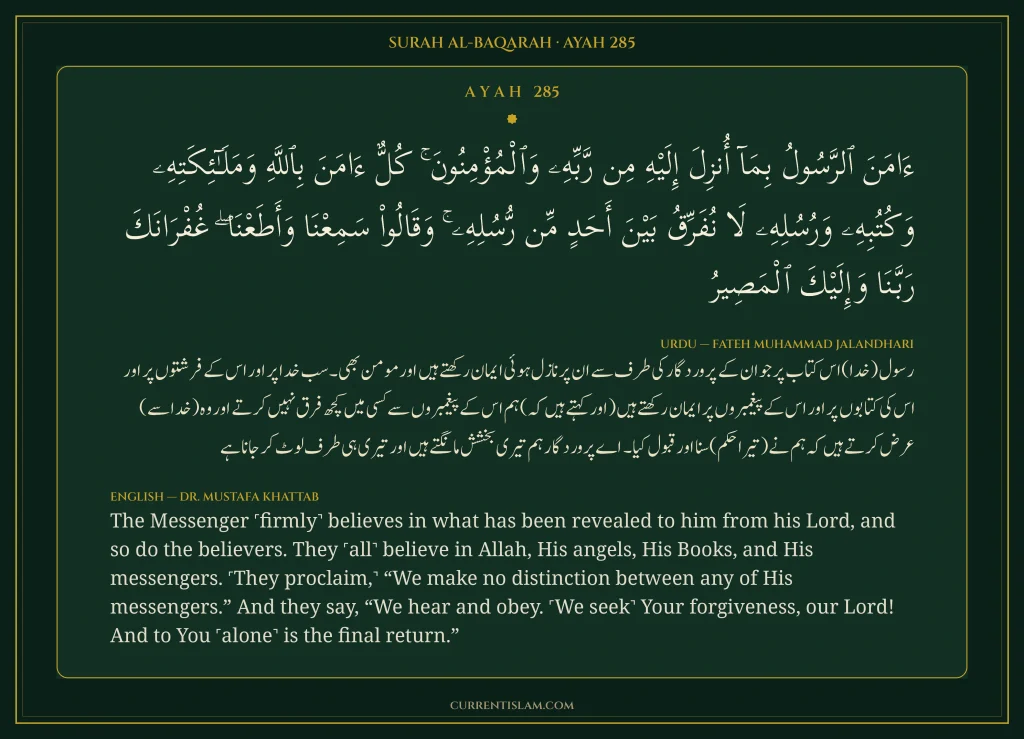
The creed is complete in one breath — Allah, His angels, His books, His messengers, none set apart — and it ends facing home: ghufranaka, “Your forgiveness,” and al-masir, the final return.
Readers call this verse Amanar-rasulu after its first words. It states the faith, then gives the believers their line: sami’na wa ata’na.
Ayah 286 — the Answered Duas
The full verse — Arabic (Uthmani), Urdu (Jalandhari) and English (Khattab), word-checked — is on the verified verse image here: embed baqarah-ayat-286.png (Part 3).
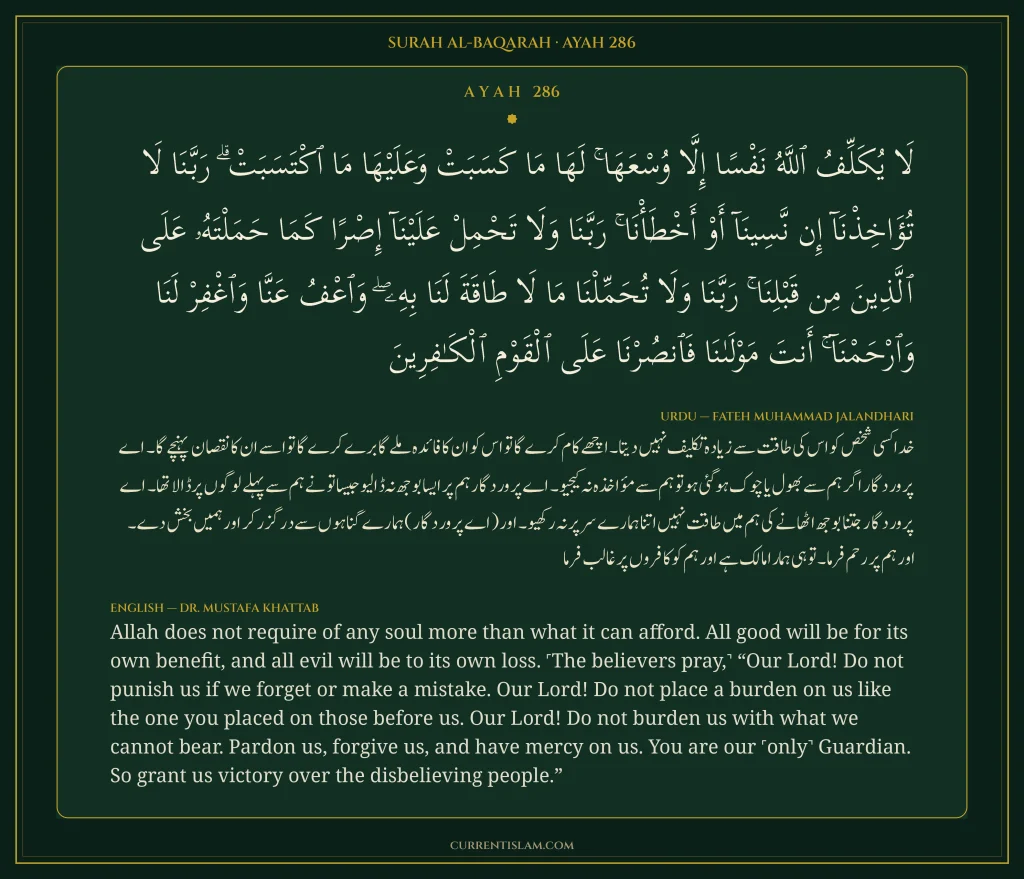
Its first line is the one quoted in hospital corridors and hard weeks: la yukallifu Allahu nafsan illa wus’aha, “Allah does not burden a soul beyond its capacity” — then the verse places the petitions in the reader’s mouth.
The longest of the three carries the promise about capacity, then three petitions opening Rabbana, “our Lord” — the same three duas gathered in our 40 Rabbana duas collection.
What do the key words mean?
Verse 284 says every hidden thought stands before Allah, who forgives or punishes as He wills. Verse 285 answers with the believers’ creed and their words, we hear and obey. Verse 286 promises no soul is burdened beyond capacity and teaches the duas Allah Himself answered.
Yuhasibkum, “He will call you to account,” is the weight of 284: it reaches what you conceal as much as what you show. Verse 285 turns on one contrast: the old answer, “we hear and disobey,” against the believers’ line: sami’na wa ata’na. In 286, wus’aha is capacity; isr is a crushing burden of the kind laid on earlier nations.
| Key phrase | Found in | Meaning |
|---|---|---|
| tukhfoohu | 2:284 | you conceal it |
| yuhasibkum | 2:284 | He will call you to account |
| sami’na wa ata’na | 2:285 | we hear and we obey |
| ghufranaka | 2:285 | Your forgiveness (we seek) |
| al-masir | 2:285 | the final return |
| wus’aha | 2:286 | its capacity |
| isr | 2:286 | a heavy burden |
Why did these verses weigh so heavily on the Companions?
When 284 was revealed, the Companions came to the Prophet ﷺ on their knees, saying its demand felt beyond their power. He ﷺ taught them to answer, we hear and obey, and Allah then revealed 285 and 286, answering every petition in 286 with yes (Sahih Muslim 125).
Sahih Muslim 125 tells the story. The Companions had accepted prayer, fasting, struggle and charity, but a verse accounting even for what the heart conceals was beyond them. The Prophet ﷺ refused them the old answer and trained their tongues on the new one. Then 285 came down. When they lived its answer, Allah lifted the ruling of 284 and revealed 286, where “Yes” follows petition after petition. Muslim 173 adds the Night Journey gift: the five prayers, these concluding verses, and forgiveness of major sins for whoever associates nothing with Allah.
The Seal: how verses 284, 285 and 286 work as one
Read them as one movement, the Seal of the surah. The Account: 284 puts your hidden life before Allah. The Answer: 285 replies, we hear and obey. The Answered Duas: 286 carries requests Allah already granted. Facing the account honestly produces obedience; obedience ends in answered prayer.
Most readings start at 285 because the hadith does, but the Seal only closes when all three movements land. Skip the Account and obedience becomes a slogan. Skip the Answer and 286 becomes a wish list. Skip the Answered Duas and the passage ends in fear — where the Companions stood before they were taught their line. Read it as a nightly order: face what is hidden, say the answer aloud, then ask with answered words.
What benefits do the last 3 ayat actually carry?
The verified benefit belongs to the last two verses at night: whoever recites them in a night, they will suffice him (al-Bukhari 5009; Muslim 807). Commentators read suffice him three ways: instead of night prayer, against Satan, and against afflictions, possibly all three together.
Abu Mas’ud reported it; the full wording sits in the quote below. The word kafatah drew three readings in the explanations travelling with Muslim’s text: in place of night prayer; protection from Satan that night; against afflictions — possibly all three at once. One more text belongs here, carefully labelled: “Satan runs away from the house in which Surah Baqara is recited” (Muslim 780) — a virtue of the whole surah, not of these verses alone.
> Narrated Abu Mas’ud: The Prophet ﷺ said, “If somebody recited the last two Verses of Surat Al-Baqara at night, that will be sufficient for him.” (Sahih al-Bukhari 5009)
Is there a wazifa count or a nazar promise for these ayat?
No. No authentic source fixes a count for these ayat, and no hadith promises them specifically against nazar, the evil eye. Sites selling a set number of repetitions for protection give you a method no scholar sourced. What is verified is the night recitation of 285 and 286.
A wazifa is a set recitation routine with a fixed count, and search results are full of them: so many repetitions for protection, black magic, the evil eye, a wish. Follow any to its source and the trail ends at another website. In the books opened for this article there is no count beyond the single nightly recitation the Prophet ﷺ described, and no verse-specific promise about nazar. That silence is the finding. The sources give something stronger: a named practice, a named result — they suffice him — and a house Satan flees when the whole surah is recited (Muslim 780). Both night verses also sit inside the Manzil Dua compilation.
How do I practise the last 3 ayat tonight?
Tonight, after Isha or in bed before sleep, recite all three verses once, slowly, with the meaning open on the verse images. The hadith’s promise attaches to 285 and 286 at night; adding 284 completes the passage and takes under two minutes. Repeat nightly until the words settle.
THE NIGHT SEAL CARD — save this
- After Isha, or once in bed: phone down, light low.
- The Account (284): read it once, slowly. Let one hidden thing from the day come to mind.
- The Answer (285): read it as your own words — sami’na wa ata’na, we hear and we obey.
- The Answered Duas (286): read it Rabbana by Rabbana, pausing to mean each one.
- Close with one personal dua in your own words.
The hadith’s promise — “they will suffice him” — rests on the last two verses at night (al-Bukhari 5009; Muslim 807). Verse 284 completes the Seal.
Anchor the habit to a cue you already keep: the phone on charge, the light off, the end of your evening azkar. Read 284 as the Account; let one hidden thing from the day surface. Read 285 as your Answer, said as your own. Read 286 slowly, Rabbana by Rabbana. For the fuller nightly routine, our last 2 ayat of Surah Baqarah page walks 285 and 286 line by line.
How do these verses meet an ordinary day?
The verses meet ordinary pressure points: a guilty thought you cannot switch off, a workload that feels beyond capacity, a family chat asking for a dua. Verse 284 names the hidden thing, 285 resets the response to obedience, and 286 hands you exact words to ask with.
On the commute, the account verse stops being abstract: the unseen thought life is its whole subject. At work or the school gate, when the load feels past capacity, hold 286’s first sentence — no soul is required to carry more than it can afford — then ask, as the verse teaches, for the overflow to be lifted. In the family chat, send three verses, their meaning, a practice anyone can start tonight.
What mistakes do people make with the last 3 ayat?
Three mistakes recur. People skip 284 and lose why 285 answers it. People repeat the verses chasing a count no source gave. And people quote the night promise for all three verses, when the hadith names the last two. Each mistake shrinks a passage that works whole.
Two more: numbering drift — this hadith circulates under different numbers in different printings, which is why this page cites the Darussalam numbering used by Sunnah.com: al-Bukhari 5009, Muslim 807. And treating 284 as cancelled and pointless: Muslim 125 says its hard ruling was lifted when 286 came, yet the verse stands in every mushaf, teaching the truth the Seal begins with — Allah knows what the heart conceals.
surah baqarah last 3 ayat pdf
Frequently asked questions
They are verses 284, 285 and 286 of Surah al-Baqarah, the second and longest chapter of the Quran. Together they form the surah’s last ruku, its final section: the account of hidden thoughts, the believers’ answer of obedience, and the answered duas about capacity and mercy.
Yes. A ruku is a section marker in the mushaf, and the final ruku of Surah al-Baqarah runs from verse 284 to the end, verse 286, so the last ruku and the last 3 ayat are the same passage named two ways: by its section or by its verses.
Amanar Rasulu, “the Messenger believes,” is the opening of verse 285 and the name readers give the whole verse. It states that the Messenger ﷺ and the believers believe in Allah, His angels, His Books and His messengers, and it gives their answer: we hear and we obey.
The sourced benefit belongs to the last two verses at night: they will suffice him (al-Bukhari 5009; Muslim 807), read by commentators as standing in for night prayer, protection from Satan, and protection from afflictions. Verse 284 completes the passage, and 286’s petitions were answered (Muslim 125).
Once a night is the practice the hadith describes: whoever recites the last two verses in a night, they will suffice him. No authentic source adds a fixed count, a number of days, or a set total for a wish, so treat any numbered routine as unsourced advice, not Sunnah.
No hadith promises these verses specifically against nazar, the evil eye, and this page will not invent one. What is verified is close by: the last two verses recited at night suffice the reciter (Muslim 807), and Satan flees a house where the whole surah is recited (Muslim 780).
Yes, according to the narration in Sahih Muslim 125. When verse 286 was revealed, its petitions were answered one by one — no punishment for forgetfulness or mistakes, no crushing burden, pardon, forgiveness and mercy — and the narration shows the answer given after each request: yes, it is granted.
Sahih Muslim 173 reports that on the Night Journey the Messenger of Allah ﷺ was given three things: the five daily prayers, the concluding verses of Surah al-Baqarah, and forgiveness of major sins for whoever of his ummah does not associate anything with Allah. The verses arrived as a gift.
Your next step
- Go deeper on the night practice itself: Last 2 Ayat of Surah Baqarah — 285 and 286 line by line, with the fuller nightly routine.
- Meet the most famous verse of the same surah: Ayatul Kursi (2:255).
- Compare the other famous closing passage: Surah Hashr Last 3 Ayat.
- Find verse 286’s three Rabbana duas in one collection: 40 Rabbana Duas.
- Read 285–286 inside the protection compilation: Manzil Dua.
