Quick Answer
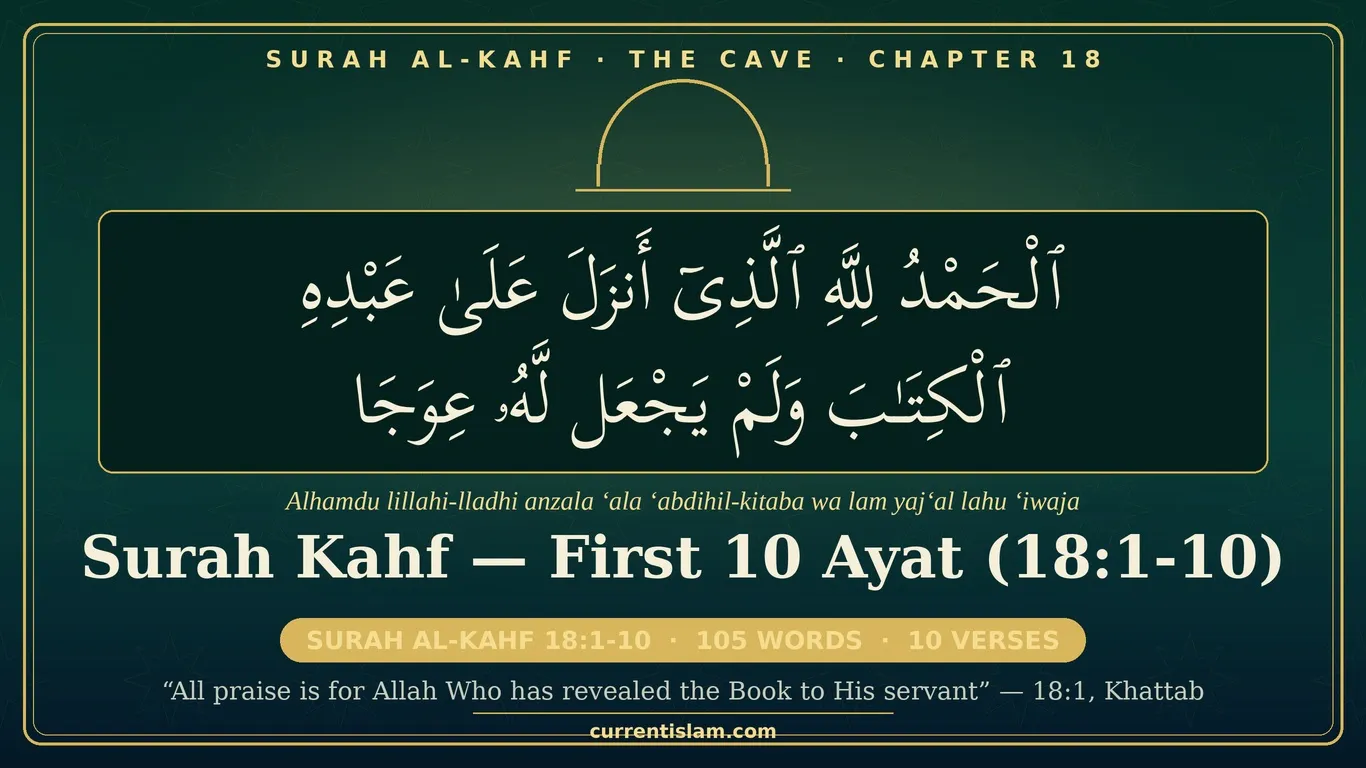
The surah kahf first 10 ayat are verses 1-10 of Surah Al-Kahf, chapter 18 of the Quran, 105 Arabic words from the opening praise to the dua of the cave youths.
Sahih Muslim 809a: whoever learns these ten verses by heart will be protected from the Dajjal.
You can learn them in seven days at two verses a day, using the Anchor Ten plan on this page.
Picture a Friday that keeps slipping past you. You mean to open Surah Al-Kahf (the Cave, chapter 18 of the Quran) after Fajr (the dawn prayer), then work runs long, the phone fills up, and sunset closes the day. The surah stays unread, again. Here is a smaller door into the same surah: its opening ten verses, learned by heart, carried with you into every Friday that follows.
Start here
New to Islam? Read the ten verses with translation
Returning to practice? Go to the seven-day Anchor Ten plan
Sent this link by a friend? Start with what the ten verses say
What are the surah kahf first 10 ayat?
The first ten verses of Surah Al-Kahf are 18:1 to 18:10, the opening of the Quran’s 18th chapter. They praise Allah for the Book, warn and give good news, and end with the dua of the youths who took refuge in the cave.
The surah kahf first 10 ayat are verses 1 to 10 of Surah Al-Kahf, the 18th chapter of the Quran, a Makki surah (revealed in Makkah) of 110 verses that begins on page 293 of the Madinah Mushaf (the standard printed Quran) in Juz 15. The ten verses hold 105 Arabic words. They open with praise for the Book itself, give a warning and good news, correct a false claim about Allah, comfort the Prophet ﷺ, call this world a test, and end at the mouth of the cave, where a group of young believers make the dua (supplication) this whole page builds toward.
The ten verses: Arabic, transliteration, English and Urdu
Surah Al-Kahf opens with the Basmalah:
بِسْمِ ٱللَّهِ ٱلرَّحْمَٰنِ ٱلرَّحِيمِ
— Bismillahir-Rahmanir-Rahim — In the Name of Allah, the Most Compassionate, Most Merciful (Khattab).
Verse 1 — Surah Al-Kahf 18:1 (11 Arabic words)
ٱلْحَمْدُ لِلَّهِ ٱلَّذِىٓ أَنزَلَ عَلَىٰ عَبْدِهِ ٱلْكِتَـٰبَ وَلَمْ يَجْعَل لَّهُۥ عِوَجَا ۜ
Alhamdu lillahi-lladhi anzala ‘ala ‘abdihil-kitaba wa lam yaj‘al lahu ‘iwaja
English (Khattab, The Clear Quran): All praise is for Allah Who has revealed the Book to His servant,¹ allowing no crookedness in it,
Urdu (Jalandhari):
سب تعریف خدا ہی کو ہے جس نے اپنے بندے (محمدﷺ) پر (یہ) کتاب نازل کی اور اس میں کسی طرح کی کجی (اور پیچیدگی) نہ رکھی
Verse 2 — Surah Al-Kahf 18:2 (15 Arabic words)
قَيِّمًا لِّيُنذِرَ بَأْسًا شَدِيدًا مِّن لَّدُنْهُ وَيُبَشِّرَ ٱلْمُؤْمِنِينَ ٱلَّذِينَ يَعْمَلُونَ ٱلصَّـٰلِحَـٰتِ أَنَّ لَهُمْ أَجْرًا حَسَنًا
Qayyiman liyundhira ba’san shadidam-min ladunhu wa yubashshiral-mu’minina-lladhina ya‘malunas-salihati anna lahum ajran hasana
English (Khattab, The Clear Quran): ˹making it˺ perfectly upright, to warn ˹the disbelievers˺ of a severe torment from Him; to give good news to the believers—who do good—that they will have a fine reward,
Urdu (Jalandhari):
سیدھی (اور سلیس اتاری) تاکہ لوگوں کو عذاب سخت سے جو اس کی طرف سے (آنے والا) ہے ڈرائے اور مومنوں کو جو نیک عمل کرتے ہیں خوشخبری سنائے کہ اُن کے لئے (ان کے کاموں کا) نیک بدلہ (یعنی) بہشت ہے
Verse 3 — Surah Al-Kahf 18:3 (3 Arabic words)
مَّـٰكِثِينَ فِيهِ أَبَدًا
Makithina fihi abada
English (Khattab, The Clear Quran): in which they will remain forever;
Urdu (Jalandhari):
جس میں وہ ابدا لاآباد رہیں گے
Verse 4 — Surah Al-Kahf 18:4 (6 Arabic words)
وَيُنذِرَ ٱلَّذِينَ قَالُوا۟ ٱتَّخَذَ ٱللَّهُ وَلَدًا
Wa yundhira-lladhina qalut-takhadha-llahu walada
English (Khattab, The Clear Quran): and to warn those who claim, “Allah has offspring.”¹
Urdu (Jalandhari):
اور ان لوگوں کو بھی ڈرائے جو کہتے ہیں کہ خدا نے (کسی کو) بیٹا بنا لیا ہے
Verse 5 — Surah Al-Kahf 18:5 (16 Arabic words)
مَّا لَهُم بِهِۦ مِنْ عِلْمٍ وَلَا لِـَٔابَآئِهِمْ ۚ كَبُرَتْ كَلِمَةً تَخْرُجُ مِنْ أَفْوَٰهِهِمْ ۚ إِن يَقُولُونَ إِلَّا كَذِبًا
Ma lahum bihi min ‘ilmin wa la li-aba’ihim, kaburat kalimatan takhruju min afwahihim, in yaquluna illa kadhiba
English (Khattab, The Clear Quran): They have no knowledge of this, nor did their forefathers. What a terrible claim that comes out of their mouths! They say nothing but lies.
Urdu (Jalandhari):
ان کو اس بات کا کچھ بھی علم نہیں اور نہ ان کے باپ دادا ہی کو تھا۔ (یہ) بڑی سخت بات ہے جو ان کے منہ سے نکلتی ہے (اور کچھ شک نہیں) کہ یہ جو کہتے ہیں محض جھوٹ ہے
Verse 6 — Surah Al-Kahf 18:6 (11 Arabic words)
فَلَعَلَّكَ بَـٰخِعٌ نَّفْسَكَ عَلَىٰٓ ءَاثَـٰرِهِمْ إِن لَّمْ يُؤْمِنُوا۟ بِهَـٰذَا ٱلْحَدِيثِ أَسَفًا
Fala‘allaka bakhi‘un nafsaka ‘ala atharihim il-lam yu’minu bihadhal-hadithi asafa
English (Khattab, The Clear Quran): Now, perhaps you ˹O Prophet˺ will grieve yourself to death over their denial, if they ˹continue to˺ disbelieve in this message.
Urdu (Jalandhari):
(اے پیغمبر) اگر یہ اس کلام پر ایمان نہ لائیں تو شاید تم کے ان پیچھے رنج کر کر کے اپنے تئیں ہلاک کردو گے
Verse 7 — Surah Al-Kahf 18:7 (11 Arabic words)
إِنَّا جَعَلْنَا مَا عَلَى ٱلْأَرْضِ زِينَةً لَّهَا لِنَبْلُوَهُمْ أَيُّهُمْ أَحْسَنُ عَمَلًا
Inna ja‘alna ma ‘alal-ardi zinatan laha linabluwahum ayyuhum ahsanu ‘amala
English (Khattab, The Clear Quran): We have indeed made whatever is on earth as an adornment for it, in order to test which of them is best in deeds.
Urdu (Jalandhari):
جو چیز زمین پر ہے ہم نے اس کو زمین کے لئے آرائش بنایا ہے تاکہ لوگوں کی آزمائش کریں کہ ان میں کون اچھے عمل کرنے والا ہے
Verse 8 — Surah Al-Kahf 18:8 (6 Arabic words)
وَإِنَّا لَجَـٰعِلُونَ مَا عَلَيْهَا صَعِيدًا جُرُزًا
Wa inna laja’iluna ma ‘alayha sa‘idan juruza
English (Khattab, The Clear Quran): And We will certainly reduce whatever is on it to barren ground.
Urdu (Jalandhari):
اور جو چیز زمین پر ہے ہم اس کو (نابود کرکے) بنجر میدان کردیں گے
Verse 9 — Surah Al-Kahf 18:9 (10 Arabic words)
أَمْ حَسِبْتَ أَنَّ أَصْحَـٰبَ ٱلْكَهْفِ وَٱلرَّقِيمِ كَانُوا۟ مِنْ ءَايَـٰتِنَا عَجَبًا
Am hasibta anna ashabal-kahfi war-raqimi kanu min ayatina ‘ajaba
English (Khattab, The Clear Quran): Have you ˹O Prophet˺ thought that the people of the cave and the plaque¹ were ˹the only˺ wonders of Our signs?
Urdu (Jalandhari):
کیا تم خیال کرتے ہو کہ غار اور لوح والے ہمارے نشانیوں میں سے عجیب تھے
Verse 10 — Surah Al-Kahf 18:10 (16 Arabic words)
إِذْ أَوَى ٱلْفِتْيَةُ إِلَى ٱلْكَهْفِ فَقَالُوا۟ رَبَّنَآ ءَاتِنَا مِن لَّدُنكَ رَحْمَةً وَهَيِّئْ لَنَا مِنْ أَمْرِنَا رَشَدًا
Idh awal-fityatu ilal-kahfi faqaloo rabbana atina min ladunka rahmatan wa hayyi’ lana min amrina rashada
English (Khattab, The Clear Quran): ˹Remember˺ when those youths took refuge in the cave, and said, “Our Lord! Grant us mercy from Yourself and guide us rightly through our ordeal.”
Urdu (Jalandhari):
جب وہ جوان غار میں جا رہے تو کہنے لگے کہ اے ہمارے پروردگار ہم پر اپنے ہاں سے رحمت نازل فرما۔ اور ہمارے کام درستی (کے سامان) مہیا کر
Verse 1 word by word: alhamdulillahilladzi anzala ala abdihil
Verse 1 carries the whole surah in seed form: praise, the Book, the servant, and straightness. Here it is word by word. The transliteration under each Arabic word follows the Quran.com word data, and the meanings are kept plain on purpose.
ٱلْحَمْدُ — al-hamdu — All praise. Complete, deserved praise. The surah gives it to Allah before anything is asked or promised.
لِلَّهِ — lillahi — (is) for Allah
ٱلَّذِىٓ — alladhi — the One who
أَنزَلَ — anzala — sent down, revealed. The verb used across the Quran for the sending down of revelation.
عَلَىٰ — ‘ala — upon, to
عَبْدِهِ — ‘abdihi — His servant. The servant is the Prophet Muhammad ﷺ, who received the Book.
ٱلْكِتَـٰبَ — al-kitaba — the Book. The Book is the Quran.
وَلَمْ — wa lam — and (He) did not
يَجْعَل — yaj’al — make, place
لَّهُۥ — lahu — in it
عِوَجَا — ‘iwaja — any crookedness. Crookedness here means deviation or contradiction in what the Book says, not a physical bend.

Why memorise the first ten verses?
You memorise them because the Prophet ﷺ tied a named protection to these exact verses. Sahih Muslim 809a says whoever learns the first ten verses of Surah Al-Kahf by heart will be protected from the Dajjal, the false messiah of the end times.
Abu al-Darda reported that Allah’s Apostle ﷺ said: “If anyone learns by heart the first ten verses of the Surah al-Kahf, he will be protected from the Dajjal.” Source: Sahih Muslim 809a, Book of Prayer — Travellers, chapter “The virtue of Surat al-Kahf and Ayat al-Kursi,” in-book Book 6, Hadith 311.
The same report appears in Sunan Abi Dawud 4323 with the same meaning, graded Sahih by Al-Albani on Sunnah.com. Source: Sunan Abi Dawud 4323, in-book Book 39, Hadith 33.
Narrated Abu al-Darda: the Prophet ﷺ said: “Whoever recites three Ayat from the beginning of Al-Kahf he is protected from the turmoil of the Dajjal.” Source: Jami’ at-Tirmidhi 2886, in-book Book 45, Hadith 12. Grade: Sahih (Darussalam), as shown on Sunnah.com.
Protection from the Dajjal (the false messiah) is the promise attached to these verses, and the wording matters. The hadith (a recorded saying of the Prophet ﷺ) speaks of learning by heart. Reading the verses on a screen is good; carrying them in memory is the act the promise names. That is why this page treats memorisation as the goal and reading as the first step toward it. Abu al-Darda, the Companion who narrated the report, also narrates the shorter three-verse version in At-Tirmidhi, so the opening of this surah appears in the sources at two lengths: three verses recited, ten verses learned by heart.
What the ten verses say, movement by movement
Read the ten verses as four short movements. Verses 1 to 3 set the frame: Allah praises Himself for sending down a Book with no crookedness in it, straight and upright, carrying a warning of severe punishment and good news of a fine reward for believers who do good deeds, a reward they will remain in forever. The reward is tied to deeds from the second verse onward. Faith here is never a label you wear; it is work you do.
Verses 4 and 5 correct a claim. Some said Allah has taken a son. The answer is blunt: they have no knowledge of this, and neither did their forefathers. A claim repeated for generations is still a claim with no knowledge behind it. Verse 6 then turns to the Prophet ﷺ himself, who grieved over people who refused to believe. Allah consoles him. Your grief for someone who will not listen is real, and it has a limit set by mercy, not by your exhaustion.
Verses 7 and 8 hold the world up to the light. Everything on earth is an adornment, placed there so Allah can test which of us is best in deeds, and one day He will reduce all of it to barren ground. The phone upgrade, the bigger house, the feed that never ends: decoration on a test paper. Verses 9 and 10 open the story the surah is named for. Young men took refuge in a cave and prayed. Ibn Kathir, the classical commentator, notes that Allah tells their story first in brief, then in detail. Their dua is the detail to learn first.
What is the dua in verse 10?
The dua is verse 10, spoken by the youths as they entered the cave: “Our Lord! Grant us mercy from Yourself and guide us rightly through our ordeal.” It asks Allah for two things together: mercy from Him directly, and right guidance inside trouble.
Verse 10 is the verse readers keep. A full page on this site walks through rabbana atina min ladunka rahmatan word by word, including how to use it in your own prayers. When the pressure is confusion itself, many readers pair it with the dua of Yunus, the prayer made from inside the fish.
First ten verses or last ten verses?
Both wordings exist in the sources, and this page teaches the first ten. Muslim 809a says the first ten verses; Muslim 809b records a narrator who said the end of the surah. Learning either wording follows a transmitted report, not a personal preference.
The first ten verses
The first ten verses. Meaning: verses 1 to 10 of Surah Al-Kahf, from the opening praise to the dua of the cave youths. Source: Sahih Muslim 809a, where the Prophet ﷺ said that whoever learns them by heart will be protected from the Dajjal. Practice: this is the set this page teaches, because Muslim’s chapter on the virtue of Surah Al-Kahf places the beginning first, and Hammam, one of its narrators, said the beginning of the surah.
The last ten verses
The last ten verses. Meaning: the closing verses of the same surah; the narration says the end of the surah, without counting them. Source: Sahih Muslim 809b records that Shu’ba, another narrator of the same hadith, said the end of Surah Al-Kahf, and Abu Dawud 4323 notes the same closing wording in its chain. Practice: some believers learn the closing verses as well, or instead, following that narration.
The difference is one of narration, not of rank: both wordings travel inside one report from one Companion, and Muslim 809b says the hadith came through Qatada with the same chain of transmitters, the narrators differing on beginning or end.
Does Friday change anything?
No. The Friday report covers reciting the whole surah, all 110 verses, and its promise is light between the two Fridays. The first ten verses carry a different promise, tied to memorising them. Do both: memorise the ten, and recite the full surah weekly.
Abu Sa’id reported the Prophet ﷺ as saying: “If anyone recites sura al-Kahf (Quran, 18) on Friday, light will shine brightly for him till the next Friday.” Source: Mishkat al-Masabih 2175, transmitted by al-Bayhaqi in al-Da’awat al-Kabir, as shown on Sunnah.com. Grade: Hasan (Al-Albani). This report is not in Sahih al-Bukhari or Sahih Muslim.
Friday (Jumu’ah, the weekly congregational prayer day) has its own separate report about this surah, and keeping the two reports apart keeps your practice honest. The Friday report is about reciting the whole surah, all 110 verses, on the day of Jumu’ah. It is not in Sahih Muslim or Sahih al-Bukhari. It comes through al-Hakim and al-Bayhaqi, and it is recorded in Mishkat al-Masabih 2175 with the grading Hasan (good) by Al-Albani, as shown on Sunnah.com. The memorisation report, by contrast, sits in Sahih Muslim itself. Two reports, two practices: memorise the first ten once, deeply; recite the whole surah each week, lightly and often.
The Anchor Ten: a seven-day starter plan
You can learn all ten verses in seven days at two verses a day, with two days of review built in, following the plan on this page. The ten verses hold 105 Arabic words, and verse 3 has only three words, so the load is lighter than it looks.
The Anchor Ten is the practice system on this page. An anchor does two jobs: it holds you in place, and it gives you a fixed point to return to. The system has three moves. Pair them: learn two verses a day, always reciting from verse 1 up to your new pair, so the chain never breaks. Pile them: stack each new pair onto the ones before it, in salah (the ritual prayer) first, where repetition is built into your day. Pray them: close every day with the dua of verse 10 in your own words after the Arabic, so the memorised words turn into a request you actually mean.
Start tonight
Read verses 1 and 2 aloud three times from the blocks above.
Close the page and say them once from memory.
End with the verse 10 dua, in Arabic, then in your own words.
The seven days
Day 1: Learn verses 1-2 (26 words). Recite them in one prayer today.
Day 2: Learn verses 3-4 (9 words). Begin from verse 1 every time.
Day 3: Learn verses 5-6 (27 words). Say verses 1-4 before you start.
Day 4: Learn verses 7-8 (17 words). Test yourself with the page closed.
Day 5: Learn verses 9-10 (26 words). You now hold all ten.
Day 6: Full run-through, three times. Mark the two joins where you hesitate.
Day 7: Recite all ten from memory inside your Friday reading of the full surah.
This plan is a starter routine built for this page. It is a learning pace, not a religious prescription; the hadith names the verses, not a timetable.
Save this: the Anchor Ten checklist
Verses 1-2 learned, page closed test passed
Verses 3-4 learned, chain from verse 1 unbroken
Verses 5-6 learned, verse 2 semicolon split used
Verses 7-8 learned, full run attempted
Verses 9-10 learned, dua said in my own words
Day 6 run-through done, two weak joins marked
Day 7 Friday recitation done, weekly review set
Fitting ten verses into a real day
Ten verses fit the life you already have. On the commute, two verses on loop through one earpiece beat a full surah you keep postponing. At a lunch break, one verse read from the page, then repeated with the phone face down, is a complete session. In a family group chat, send one verse and its meaning on Thursday evening; you become the reason three other people open the surah. If you are the only Muslim in your office or classroom, nobody needs to know. The verses sit in memory, and memory makes no sound.
Common mistakes with these verses
Four mistakes show up again and again with these verses. Each one is easy to make and easy to fix.
Reading once and calling it memorisation. It happens because the promise is often quoted without its wording. The hadith says learns by heart, so test yourself with the page closed. Skipping verse 2 because it is long. It happens because verse 2 carries the warning and the good news in one breath. Split it at the semicolon and learn it as two half-verses. Treating the first ten as a Friday-only task. It happens because the Friday report is better known. The memorisation hadith names no day; Friday is for the full surah. Chasing a repetition count someone sent you. It happens because a number feels like a plan. No count for these verses is established in the sources opened for this page, so use the seven-day plan below instead.
Honest limits: claims with no verified source
Three popular claims need a plain answer. First: reading the first ten verses once, one time, guarantees protection. The sources do not say that. Muslim 809a ties protection to learning the verses by heart, and At-Tirmidhi 2886 speaks of reciting the first three. Second: a set number of repetitions, such as a count repeated for a set number of days, brings wealth or a specific worldly result. No such count or promise was found in any source opened for this page. Third: the Friday light report is in Bukhari or Muslim. It is not; its route is al-Hakim and al-Bayhaqi, graded Hasan in Mishkat al-Masabih 2175. What the sources do give is enough: ten verses, learned by heart, and a surah to meet every week.
Questions people ask about these verses
The first 10 ayat are verses 1 to 10 of Surah Al-Kahf, chapter 18 of the Quran. They begin with alhamdulillahilladzi anzala ala abdihil (all praise is for Allah, who sent down the Book to His servant) and end with the cave youths’ dua.
Sahih Muslim 809a, narrated by Abu al-Darda, says whoever learns by heart the first ten verses of Surah Al-Kahf will be protected from the Dajjal. Abu Dawud 4323 carries the same report, graded Sahih by Al-Albani, and notes a closing-verses wording.
Muslim’s own pages hold both wordings. Muslim 809a says the first ten verses. Muslim 809b records that the narrator Shu’ba said the end of Surah Al-Kahf, while Hammam said the beginning. This page teaches the first ten, following 809a as its main text.
At two verses a day, five days of learning plus two days of review covers all ten inside one week. The verses total 105 Arabic words. Short daily sessions after a prayer work better than one long session once a week.
The Friday practice is reciting the whole surah, and it rests on a separate report in Mishkat al-Masabih 2175, graded Hasan, promising light between the two Fridays. Memorising the first ten is a one-time project with weekly review; Friday recitation continues alongside it.
Reading the English meaning teaches you what the verses say, and that helps memorisation stick. The hadith, though, speaks of learning the verses themselves, which are Arabic. Use the transliteration on this page as a bridge while you learn the Arabic script.
Verse 10 records the youths praying as they entered the cave: “Our Lord! Grant us mercy from Yourself and guide us rightly through our ordeal.” Read it as your own prayer when a situation feels closed in, asking for mercy and a right way through it.
No fixed count for these verses appears in Sahih Muslim 809a, Abu Dawud 4323 or At-Tirmidhi 2886, the sources opened for this page. Counts shared in forwards and videos appear in none of those reports. Learn the verses; skip the count.
Next step
Start tonight. Read verses 1 and 2 aloud three times, close the page, and say them once from memory before you sleep. That small act puts the anchor down. Follow the seven days, and next Friday can open with words you already own, at the head of the whole surah. Send this page to one person who keeps meaning to start. You may be the nudge their Friday was waiting for.
Rabbana Atina Min Ladunka Rahmatan (18:10)
Which surah to recite on Friday
The last 10 surahs of the Quran
Last reviewed: 20 November 2026 · Author: SHAHAB KHAN · Reviewed by: ATIF KHAN
