You wake up, and worry starts fast. Work, money, family, health — it piles up, and you carry it alone. That weight is real.
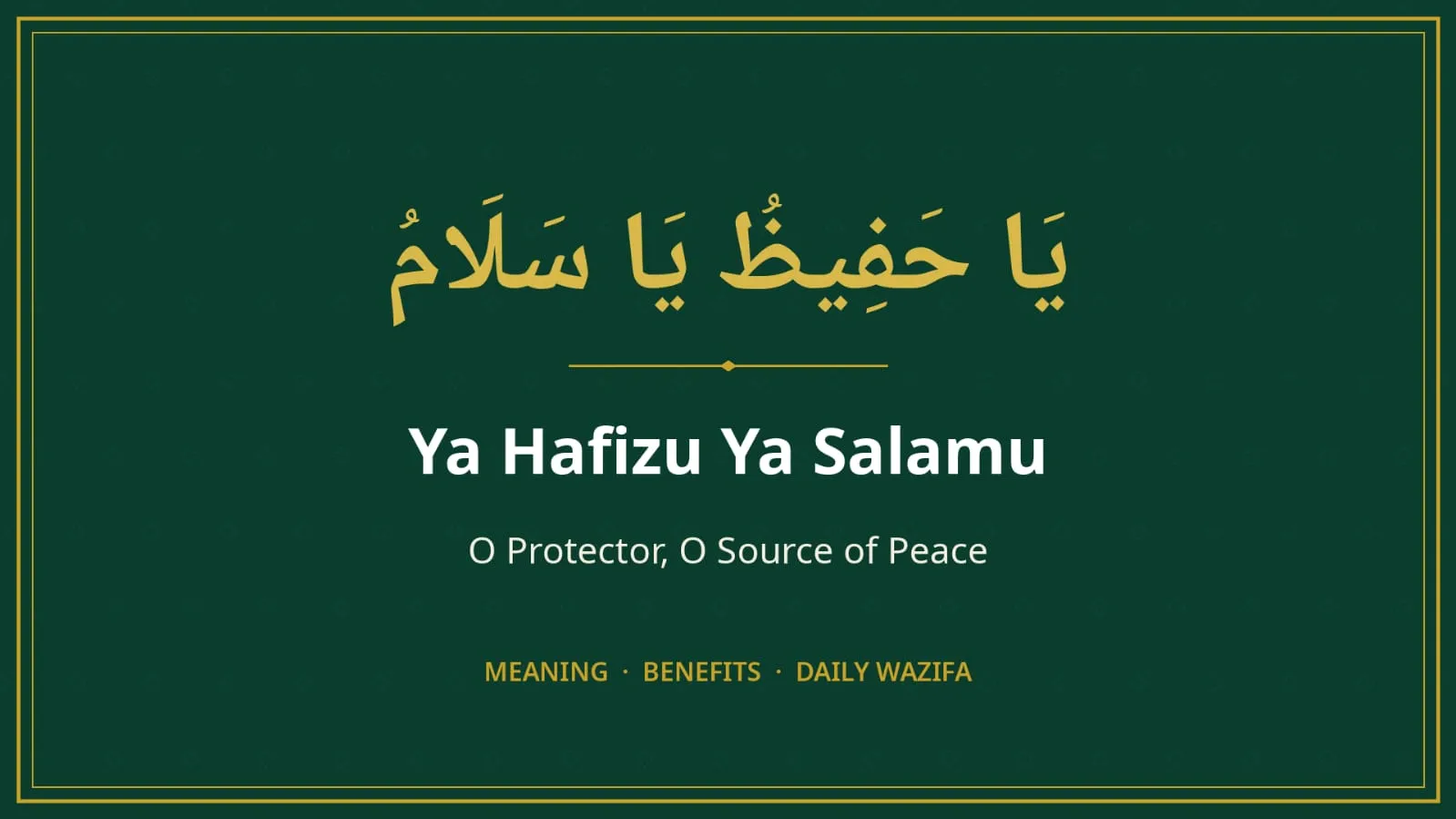
For centuries, Muslims have turned to one short phrase: Ya Hafizu Ya Salamu — O Protector, O Source of Peace.
What Does Ya Hafizu Ya Salamu Mean?
Ya Hafizu Ya Salamu means “O Guardian and Protector, O Source of Peace and Safety.” Ya Hafizu calls on Allah as Al-Hafiz, the One who guards all things, and Ya Salamu calls on Him as As-Salam, the Source of Peace.
Word by word:
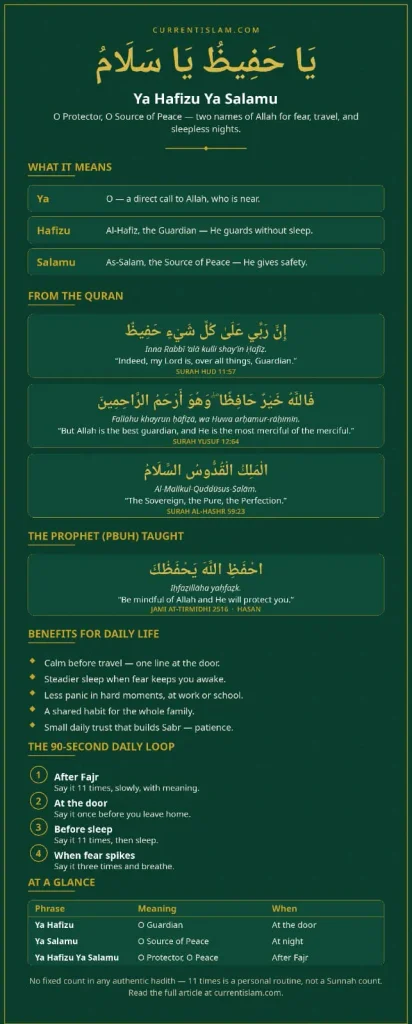
- Ya — O, a call to Allah, who is near.
- Hafizu — Al-Hafiz, the Guardian, who never sleeps.
- Salamu — As-Salam, the Source of Peace.
Al-Hafiz guards you from harm outside. As-Salam settles fear inside. Both are among the 99 Names of Allah.
Why This Dua Shields You From Anxiety
This dua shields against anxiety because it names the cure, not the fear. It reminds you that protection is Allah’s work and peace is Allah’s gift, so your job is to call on Him, take the means, and trust the result.
Here is why this matters for your daily routine. Anxiety grows when you try to control what you cannot control. This phrase breaks that loop. That is Tawakkul, reliance on God: do your part, then hand the outcome to Allah. Pair it with our dua for anxiety and depression.
Where the Quran Names Al-Hafiz and As-Salam
The Quran names Allah As-Salam in Surah Al-Hashr 59:23, calls Him Guardian over all things in Surah Hud 11:57, and calls Him the best guardian in Surah Yusuf 12:64. These verses are the Quranic base for Ya Hafizu Ya Salamu.
Surah Al-Hashr 59:23 — As-Salam, the Source of Peace
Arabic (key phrase):
الْمَلِكُ الْقُدُّوسُ السَّلَامُ
Transliteration: Al-Malikul-Quddūsus-Salām.
English translation (Sahih International): “The Sovereign, the Pure, the Perfection.”
Urdu translation:
بادشاہ، پاک، سلامتی والا۔
Hindi translation: बादशाह, पाक, सलामती वाला।
See the last three verses of Surah Al-Hashr.
Surah Hud 11:57 — “My Lord is Guardian over all things”
Arabic:
إِنَّ رَبِّي عَلَىٰ كُلِّ شَيْءٍ حَفِيظٌ
Transliteration: Inna Rabbī ‘alā kulli shay’in Ḥafīẓ.
English translation (Sahih International): “Indeed, my Lord is, over all things, Guardian.”
Urdu translation:
بے شک میرا رب ہر چیز پر نگہبان ہے۔
Hindi translation: बेशक मेरा रब हर चीज़ पर निगहबान है।
Hud (peace be upon him) said this to his people.
Surah Yusuf 12:64 — “Allah is the best guardian”
Arabic:
فَاللَّهُ خَيْرٌ حَافِظًا ۖ وَهُوَ أَرْحَمُ الرَّاحِمِينَ
Transliteration: Fallāhu khayrun ḥāfiẓā, wa Huwa arḥamur-rāḥimīn.
English translation (Sahih International): “But Allah is the best guardian, and He is the most merciful of the merciful.”
Urdu translation:
پس اللہ بہترین حفاظت کرنے والا ہے، اور وہ سب سے زیادہ رحم کرنے والا ہے۔
Hindi translation: अतः अल्लाह सबसे बेहतर हिफ़ाज़त करने वाला है, और वह सबसे ज़्यादा रहम करने वाला है।
Yaqub (peace be upon him) said this about his son. Read more on Allah is the best guardian.
What the Prophet (PBUH) Taught
The Prophet Muhammad (peace be upon him) taught Ibn Abbas: “Be mindful of Allah and He will protect you.” This hadith, Jami at-Tirmidhi 2516, graded Hasan, links protection to prayer, obedience, and trust in Allah, not to a magic count.
Arabic:
احْفَظِ اللَّهَ يَحْفَظْكَ
Transliteration: Iḥfaẓillāha yaḥfaẓk.
English translation: “Be mindful of Allah and He will protect you.” (Jami at-Tirmidhi 2516, Hasan)
Urdu translation:
اللہ کا خیال رکھو، اللہ تمہاری حفاظت کرے گا۔
Hindi translation: अल्लाह का ख़याल रखो, अल्लाह तुम्हारी हिफ़ाज़त करेगा।
The full hadith adds: when you ask, ask Allah. It is not a charm. The Prophet (peace be upon him) also said Allah has ninety-nine names, and whoever knows them will go to Paradise (Sahih al-Bukhari 7392).
Arabic:
إِنَّ لِلَّهِ تِسْعَةً وَتِسْعِينَ اسْمًا مِائَةً إِلَّا وَاحِدًا مَنْ أَحْصَاهَا دَخَلَ الْجَنَّةَ
Transliteration: Inna lillāhi tis’atan wa tis’īna ismā, mi’atan illā wāḥidā, man aḥṣāhā dakhalal-jannah.
English translation: “Allah has ninety-nine names, one hundred minus one, and whoever knows them will go to Paradise.”
Urdu translation:
بے شک اللہ کے ننانوے نام ہیں، جس نے انہیں یاد کیا وہ جنت میں داخل ہوگا۔
Hindi translation: बेशक अल्लाह के निन्यानवे नाम हैं, जिसने उन्हें याद किया वह जन्नत में दाख़िल होगा।
Benefits for Daily Life
The benefits of Ya Hafizu Ya Salamu are calm before travel, steadier sleep, less panic in hard moments, a stronger habit of trust in Allah, and a short dhikr you can keep up every day of your life, without fail.
- Leaving home: one calm line at the door.
- At night: a short dhikr when fear keeps you awake, with Ayat al-Kursi for protection.
- At work or school: a quiet reset between tasks.
- For family and the long run: a shared habit that builds Sabr, patience.
The gain is the habit itself.
How Many Times Should You Recite It?
No authentic hadith sets a fixed count for Ya Hafizu Ya Salamu. Recite it 11 times after Fajr and 11 times before you leave home as a simple personal routine, not as a Sunnah count, and more on hard days is fine.
Most pages hide this gap. Books quote counts like 998, 1009, or 136. Those come from later wazifa books, not from Sahih Bukhari or Sahih Muslim. Treat them as people’s practice, not the Prophet’s order.
But how do we apply this at work or school? Pick one anchor: after Fajr, or as you lock the door. Say it slowly, 11 times. That is 90 seconds. The Spiritual Habit Loop is simple: cue, action, reward.
A 90-Second Daily Wazifa
A daily wazifa is: after Fajr, say Ya Hafizu Ya Salamu 11 times with meaning, then once before you leave home, once before sleep, and when fear spikes. Keep it and judge it by calm and trust, not by a number.
- After Fajr, say Ya Hafizu Ya Salamu 11 times, slowly.
- At the door, say it once, with the morning and evening azkar.
- Before sleep, say it 11 times, plus the Manzil Dua for protection.
- When fear spikes, say it three times and breathe.
| Phrase | Meaning | When | Builds |
|---|---|---|---|
| Ya Hafizu | O Guardian, O Protector | At the door | Trust |
| Ya Salamu | O Source of Peace | At night | Calm |
| Ya Hafizu Ya Salamu | O Protector, O Source of Peace | After Fajr | Steady habit |
At home, add the dua for home protection to the same routine.
For fear of harm, read protection from black magic — not a replacement for daily prayer.
FAQ:
The best dua before leaving home is to say Bismillah, trust in Allah, and add Ya Hafizu Ya Salamu once with meaning. No fixed count is set in the Sunnah, so one sincere time at the door is enough to start.
Surah Yusuf 12:64 says Allah is the best guardian: “Fallahu khayrun hafizan, wa Huwa arhamur-rahemeen.” Prophet Yaqub said it when he trusted his son to Allah’s care, after human care had failed him once before, and he still trusted Allah alone.
No, no authentic hadith sets a fixed wazifa count for Ya Hafizu Ya Salamu. Counts online come from later books. Use 11 times as a daily routine if it helps you stay regular, and do not treat any number as a rule.
Start Small Today
You need one line, one moment, and one honest turn to Allah. The same root lives in our greeting — see the meaning of Assalamu Alaikum.
Say Ya Hafizu Ya Salamu 11 times after Fajr tomorrow, and once at the door. Then watch what changes: not the world around you, but the fear inside you.
