
Being diagnosed with an illness or watching a family member suffer drains you physically, mentally, and emotionally. The endless hospital visits, the waiting rooms, and the uncertainty of medical treatments weigh heavily on the human soul. For Muslims living in secular societies where the medical system feels highly clinical, it is incredibly easy to feel isolated during sickness.
But the Quran and Sunnah offer an unbreakable lifeline. When modern medicine reaches its limits, Divine words provide both spiritual tranquility and physical cure. Building a spiritual habit loop around the bimari se shifa ki dua bridges the gap between medical care and absolute reliance on Allah (Tawakkul).
Here is the exact, scholar-verified guide to seeking a cure through the authentic supplications of the Prophet Muhammad (PBUH) and the Quran.
What is the Most Powerful Bimari Se Shifa Ki Dua?
The most authentic bimari se shifa ki dua is recited by Prophet Muhammad (PBUH) while placing his right hand on the sick person. It asks Allah, the Lord of mankind, to remove the hardship and grant a cure that leaves no trace of illness behind.
According to Sahih Al-Bukhari (Hadith 5742), whenever someone fell ill, the Messenger of Allah (PBUH) would wipe them with his right hand and recite this profound supplication. This acts as the foundational dua for sick patients.
Arabic Text:
اللَّهُمَّ رَبَّ النَّاسِ أَذْهِبِ الْبَأْسَ اشْفِهِ وَأَنْتَ الشَّافِي لَا شِفَاءَ إِلَّا شِفَاؤُكَ شِفَاءً لَا يُغَادِرُ سَقَمًا
Transliteration:
Allahumma Rabban-nasi, azhibil-ba’sa, washfi, Antash-Shaafee, la shifa’a illa shifa’uka, shifa’an la yughadiru saqaman.
English Translation:
“O Allah, Lord of mankind, remove the affliction and send down cure and healing, for no one can cure but You; so cure in such a way that no trace of illness is left.”
Urdu Translation:
اے اللہ! لوگوں کے رب، تکلیف کو دور کر دے، شفا عطا فرما، تو ہی شفا دینے والا ہے، تیری شفا کے سوا کوئی شفا نہیں، ایسی شفا دے جو کوئی بیماری نہ چھوڑے۔
Hindi Translation:
ऐ अल्लाह! इंसानों के रब, तकलीफ को दूर कर दे, शिफा अता फरमा, तू ही शिफा देने वाला है, तेरी शिफा के सिवा कोई शिफा नहीं, ऐसी शिफा दे जो कोई बीमारी न छोड़े।
Hazrat Ayub Alaihis Salam Ki Dua: The Ultimate Plea for Healing
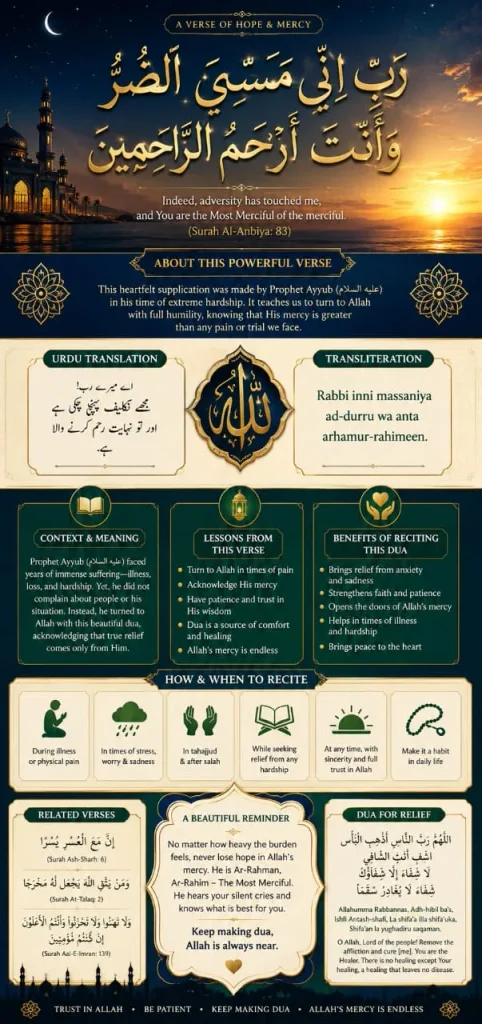
Hazrat Ayub alaihis salam ki dua is found in Surah Al-Anbiya (Ayat 83). It is a powerful supplication for those suffering from severe, long-term illness, expressing total reliance on Allah’s ultimate mercy during moments of intense physical and emotional distress.
Prophet Ayub (Job) endured years of devastating chronic illness, loss of wealth, and isolation. Yet, he never complained to the people. He turned his pain directly to Allah. The words he used form one of the most miraculous prayers in the Quran.
Arabic Text:
رَبِّ إِنِّي مَسَّنِيَ الضُّرُّ وَأَنتَ أَرْحَمُ الرَّاحِمِينَ
Transliteration: Rabbi inni massaniyad-durru wa Anta arhamur-rahimeen.
English Translation: “Indeed, adversity has touched me, and You are the Most Merciful of the merciful.”
Urdu Translation:
اے میرے رب! مجھے تکلیف پہنچی ہے، اور تو سب رحم کرنے والوں سے بڑھ کر رحم کرنے والا ہے۔
Hindi Translation: ऐ मेरे रब! मुझे तकलीफ पहुँची है, और तू सब रहम करने वालों से बढ़कर रहम करने वाला है।
The Linguistic Miracle of “Massani”
Let’s break down the exact meaning of this verse. Prophet Ayub uses the word Massani (مَسَّنِيَ), which literally translates to “a light touch” or “grazed me.” Even though his flesh was severely affected for years, his etiquette (Adab) before Allah was so profound that he minimized his massive suffering, calling it a mere “touch” compared to the infinite greatness of Allah.
He didn’t demand an immediate cure. He simply stated his pain and recognized Allah’s mercy. This teaches us the perfect mindset for enduring sickness: absolute trust that when I am ill, it is He who cures me.
Quranic Verses for Complete Recovery
The Quran itself is a direct source of healing. Reciting specific verses acts as Ruqyah, providing a spiritual and physical cure. The most potent verses include Surah Al-Fatiha and verses from Surah Al-Isra, which specifically mention the Quran as a healing mechanism.
Allah explicitly states that the Quran was sent down as a mercy and a cure for the believers. Therefore, incorporating Quranic verses for healing into your medical care routine is a highly effective Sunnah.
The absolute greatest chapter for seeking a cure is Surah Fatiha. In the authentic Sunnah, Surah Al-Fatiha is referred to as Ash-Shafiyah (The Cure). Reading it over a sick person is a proven, authentic practice.
Establishing a Har Bimari Se Shifa Ka Wazifa
A highly effective har bimari se shifa ka wazifa involves reciting Surah Al-Fatiha seven times, blowing gently into your cupped hands, and wiping them over your body. Combine this with morning and evening supplications to create a daily spiritual shield around your health.
If you are a busy professional or a student balancing a heavy workload alongside health issues, you do not need complex, unverified rituals. Micro-transformations in your daily routine create massive spiritual shifts.
Here is how to apply this practically:
- The Physical Touch: When you feel an ache, place your right hand on the exact spot of the pain. Say Bismillah three times, followed by the specific supplication for localized pain seven times.
- The Morning Habit: Before checking your phone or reading the news, recite the dua for physical well-being three times. This protects your body, hearing, and sight for the entire day.
- Emotional First Aid: Chronic physical illness often breeds mental fatigue. Do not ignore your mental health; supplement your medical care with specific prayers for emotional distress to maintain a strong, resilient mindset.
Quick Reference Guide: Sickness & Healing Supplications
| Supplication Type | Primary Source | Best Time to Recite | Primary Benefit |
|---|---|---|---|
| Bimari Se Shifa Ki Dua | Sahih Al-Bukhari (5742) | When visiting a sick person | Removes the root cause of the illness without leaving a trace. |
| Hazrat Ayub’s Dua | Surah Al-Anbiya (21:83) | During chronic or long-term pain | Brings immediate divine mercy and emotional contentment. |
| Ruqyah via Fatiha | Sahih Muslim (2201) | Daily, or when feeling sudden symptoms | Acts as a direct spiritual cure (Ash-Shifa) for the body. |
| Pain Relief Dua | Sahih Muslim (2202) | While placing right hand on pain | Numbs and removes localized physical suffering. |
(People Also Ask)
The best practice is to place your right hand on the patient’s forehead or the affected area and recite Allahumma Rabban-nasi, azhibil-ba’sa… (O Allah, Lord of mankind, remove the affliction). Additionally, reciting Surah Al-Fatiha, Surah Al-Falaq, and Surah An-Nas over the patient is highly recommended in the Sunnah.
Surah Al-Fatiha is universally recognized as the greatest Surah for healing. Prophet Muhammad (PBUH) approved of using it as Ruqyah (spiritual healing) for physical ailments. Furthermore, Surah Al-Baqarah protects the home and the patient from spiritual harm.
Make dua for them with absolute conviction (Yaqeen) that Allah will cure them. Ask Allah by His beautiful names, specifically Ya Shaafi (The Healer). It is Sunnah to visit the sick person, sit near their head, and pray for their complete recovery directly in their presence.
Healing requires patience, medical intervention, and unyielding faith. By integrating these authentic supplications into your daily routine, you invite the mercy of Ash-Shaafi (The Ultimate Healer) into your life.
To fortify your daily spiritual defense system beyond times of illness, make sure to integrate the complete morning and evening azkar into your everyday routine. Building this habit when you are healthy ensures Allah’s protection when you are most vulnerable.

1 thought on “Bimari se shifa ki dua – Rabi ani masani yazuru wa anta arhamur rahimin”