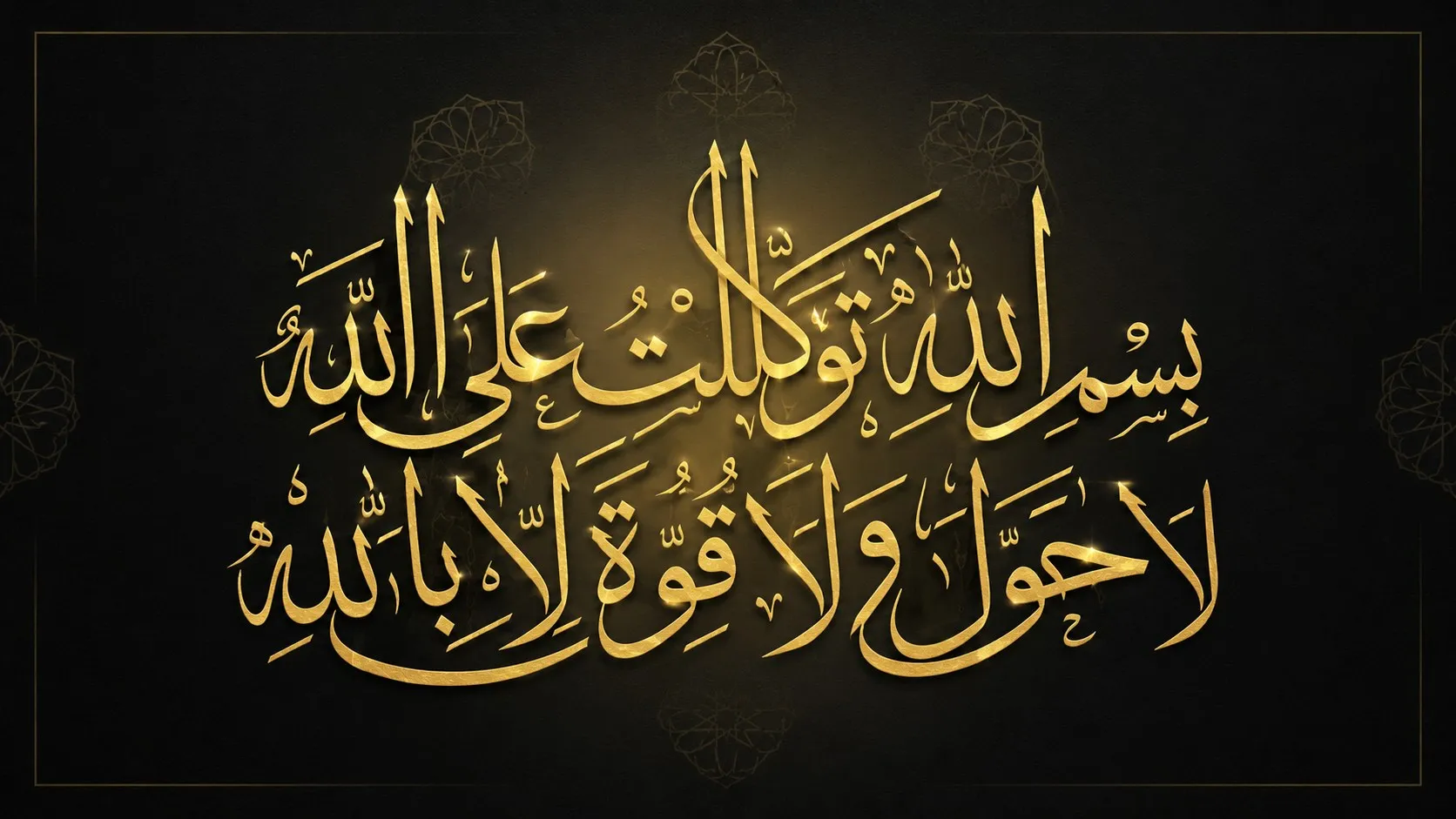
When You Step Out Your Door, What Protects You?
Have you ever walked out of your home feeling vulnerable, unsure of what challenges await? The Prophet Muhammad ﷺ gave us a powerful key—a simple dua that transforms ordinary moments into acts of worship and protection. “Bismillahi tawakkaltu ala Allah wala hawla wala quwwata illa billah” isn’t just words; it’s your spiritual armor when facing the unknown.
Many Muslims recite this dua daily but don’t know its exact meaning, correct pronunciation, or the immense promise Allah made to those who recite it. Let’s understand the real meaning and how this ancient practice protects you in modern life.
What Does Bismillahi Tawakkaltu Ala Allah Mean?
The complete dua means: “In the name of Allah, I place my trust in Allah; there is no might and no power except with Allah.” This powerful supplication combines three essential elements: starting with Allah’s name, expressing complete reliance on Him, and acknowledging that all strength comes from Him alone.
Full Dua Text
Arabic Text
بِسْمِ اللَّهِ تَوَكَّلْتُ عَلَى اللَّهِ لَا حَوْلَ وَلَا قُوَّةَ إِلَّا بِاللَّهِWith full diacritical marks (tashkeel):
بِسْمِ اللَّهِ تَوَكَّلْتُ عَلَى اللَّهِ لَا حَوْلَ وَلَا قُوَّةَ إِلَّا بِاللَّهِTransliteration
Primary Version (Most Common):
Bismillāhi tawakkaltu 'alā Allāh, lā ḥawla wa lā quwwata illā billāhAlternative Version (With “wa”):
Bismillāhi wa tawakkaltu 'alā Allāh, lā ḥawla wa lā quwwata illā billāhSlow Pronunciation Guide (word-by-word):
Bis-mi-llā-hi | ta-wak-kal-tu | 'a-lā | Allāh
Lā | ḥaw-la | wa-lā | quw-wa-ta | illā | bil-lāh
English Translation
Complete Translation:
“In the name of Allah, I place my trust in Allah. There is no might and no power except with Allah.”
Complete Urdu Translation:
“اللہ کے نام سے، میں اللہ پر بھروسہ کرتا ہوں۔ اللہ کے سوا کوئی طاقت اور زور نہیں۔”
Alternative Urdu (more formal):
“بحمث اللہ، میں اللہ ہی پر توکل کرتا ہوں، اللہ کے سوا کوئی ہلچل اور کوئی طاقت نہیں۔”
Word-by-Word Breakdown
| Arabic | Transliteration | English Meaning |
|---|---|---|
| بِسْمِ | Bismi | In the name of |
| اللَّهِ | Allahi | Allah |
| تَوَكَّلْتُ | Tawakkaltu | I have placed my trust |
| عَلَى | ‘ala | upon/on |
| اللَّهِ | Allah | Allah |
| لَا حَوْلَ | La hawla | There is no power (to move) |
| وَلَا قُوَّةَ | wa la quwwata | and no strength (to stay) |
| إِلَّا | illa | except |
| بِاللَّهِ | billah | with Allah |
The phrase “la hawla wala quwwata illa billah” acknowledges human weakness without Allah’s help.
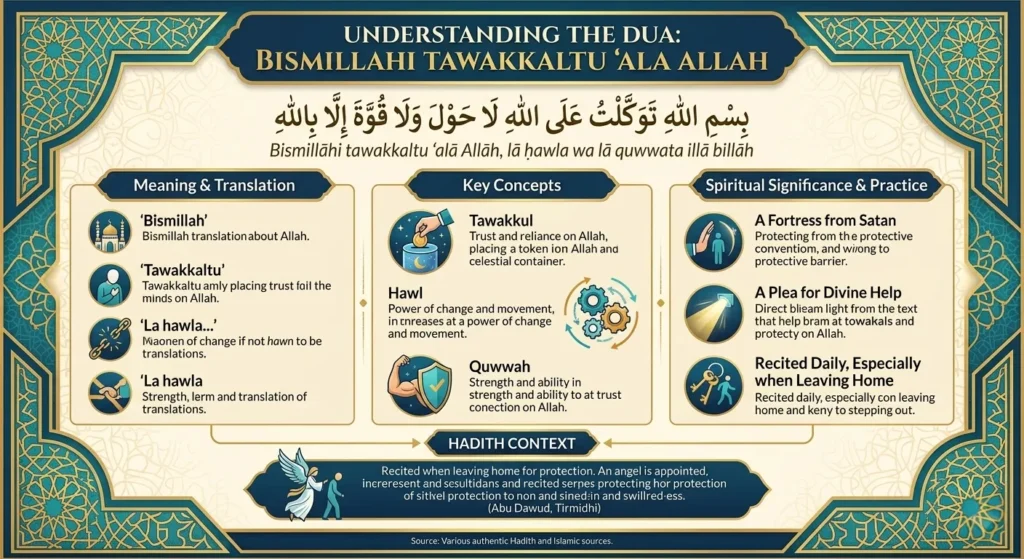
Which Version Is Correct? The Two Authentic Wordings
Both versions are authentic because they appear in different sahih hadith narrations. The first version—”Bismillahi tawakkaltu ala Allah”—appears in Riyad as-Salihin and Sunan Abi Dawud. The second version—”Bismillah wa tawakkaltu alallah” (with “wa” meaning “and”)—appears in Jami’ at-Tirmidhi 3426.
Key Differences Between Versions
| Aspect | Version 1 (More Common) | Version 2 (With “Wa”) |
|---|---|---|
| Arabic | بِسْمِ اللَّهِ تَوَكَّلْتُ | بِسْمِ اللَّهِ وَتَوَكَّلْتُ |
| Transliteration | Bismillahi tawakkaltu | Bismillah wa tawakkaltu |
| Grammar | Genitive case (Bismillahi) | Added conjunction (wa) |
| Source | Riyad as-Salihin 83 | Jami’ at-Tirmidhi 3426 |
Your second version has two spelling errors: “alallah” should be “‘alallah” (علي الله) and “walakuata” should be “wala quwwata” (ولا قوة). Both carry identical meaning and spiritual benefit.
The Authentic Hadith: What Prophet Muhammad ﷺ Said
The complete hadith states: Whoever says this dua when leaving their house will be told, “You have been sufficed and protected,” and Satan will become distant from them.
Full Hadith Reference
Arabic Text:
مَنْ قَالَ بِسْمِ اللَّهِ وَتَوَكَّلْتُ عَلَى اللَّهِ لَا حَوْلَ وَلَا قُوَّةَ إِلَّا بِاللَّهِ
قِيلَ لَهُ حُفِظْتَ فَيَتْخَلَّى عَنْهُ الشَّيْطَانُ
Transliteration:
“Man qala bismillah wa tawakkaltu ‘alallah la hawla wa la quwwata illa billah, qila lahu: hughifta, fatakhallā ‘anhu ash-shaytan”
English Translation:
“Whoever says – when leaving his house – ‘In the Name of Allah, I place my trust in Allah, there is no might or power except by Allah,’ it will be said to him: ‘You have been sufficed and protected,’ and Shaitan will become distant from him”
Urdu Translation:
“جو شخص گھر سے نکلتے ہوئے بے شک اللہ کے نام سے اور میں اللہ پر بھروسہ کرتا ہوں، اللہ کے سوا کوئی طاقت اور زور نہیں کہے، تو اسے کہا جاتا ہے: تجھے حفاظت مل گئی، اور شیطان اس سے دور ہو جاتا ہے”
Hadith Authentication:
- Source: Jami’ at-Tirmidhi 3426, Sunan Abi Dawud 5095, Riyad as-Salihin 83
- Narrator: Anas ibn Malik (RA)
- Verification: Certified as sahih (authentic) by Sheikh Al-Albani
Now let’s connect this to daily life—this isn’t just theoretical knowledge; it’s practical protection you can use today.
Quranic Foundation: What Does Allah Say About Tawakkul?
The Quran emphasizes tawakkul (reliance on Allah) in multiple verses, showing this dua’s deep Islamic foundation. When you say “tawakkaltu ala Allah,” you’re living what Allah commands in the Quran.
Key Quranic Verses on Tawakkul
Surah Ali ‘Imran 3:159:
فَبِمَا رَحْمَةٍ مِّنَ اللَّهِ لِنتَ لَهُمْ ۖ وَلَوْ كُنتَ فَظًّا غَلِيظَ الْقَلْبِ لَانفَضُّوا مِنْ حَوْلِكَ ۖ
فَإِذَا عَزَمْتَ فَتَوَكَّلْ عَلَى اللَّهِ ۚ إِنَّ اللَّهَ يُحِبُّ الْمُتَوَكِّلِينَTranslation: “So by mercy from Allah, you were lenient with them. And if you had been rude and harsh in heart, they would have disbanded from about you. So when you decided, rely upon Allah. Indeed, Allah loves those who rely [upon Him]”.
Surah At-Talaq 65:3:
وَمَن يَتَوَكَّلْ عَلَى اللَّهِ فَهُوَ حَسْبُهُTranslation: “And whoever relies upon Allah—then He is sufficient for him”. This directly connects to the hadith promise: “You have been sufficed.”
Surah As-Sajdah 32:13:
إِنَّمَا تَوَكَّلْنَا عَلَى اللَّهِ رَبَّنَاTranslation: “We have relied upon our Lord”.
These verses show that tawakkul isn’t optional—it’s a core Islamic principle that Allah loves and rewards.
When Should You Recite This Dua? Practical Applications
Recite this dua whenever you leave your home, whether going to work, school, market, travel, or any journey. It’s specifically designed for stepping into uncertainty.
Specific Situations for Recitation
- Leaving home for any purpose (work, school, shopping)
- Starting travel (car, plane, bus, train)
- Facing uncertainty or fear
- Before important meetings or decisions
- When feeling anxious or vulnerable
- Morning departures (most common time)
This becomes important when you look at modern life—we face constant stress, traffic, work pressure, and unexpected challenges. This dua transforms your daily commute into an act of worship with divine protection.
How many times to recite? Scholars say recite it once with complete focus and understanding. Quality matters more than quantity. The hadith doesn’t specify multiple repetitions—it emphasizes saying it when leaving with sincere intention.
The Spiritual Benefits: What Happens When You Recite?
Three powerful spiritual benefits occur: You receive divine protection, Satan stays away from you, and Allah promises to suffice you.
Detailed Benefits Breakdown
Here’s why this matters: In today’s world of traffic accidents, workplace stress, and unpredictable situations, this dua provides spiritual security that no material preparation can offer.
Common Mistakes People Make When Reciting
Most errors involve pronunciation and spelling, not intention. Avoid these common mistakes to ensure your recitation is correct.
Pronunciation Errors to Avoid
| Wrong | Correct | Why It Matters |
|---|---|---|
| “alallah” | “‘alallah” (علي الله) | Missing ‘ain sound changes meaning |
| “walakuata” | “wala quwwata” (ولا قوة) | Missing “qaf” and double “waw” |
| “Bismillah tawakkaltu” | “Bismillahi tawakkaltu” | Missing “i” case ending |
| Missing “wa” | Add “wa” in second version | Affects grammar flow |
Urdu speakers: The Arabic letter “ع” (ain) in “‘ala” must be pronounced clearly—it’s not just “ala” but “‘ala” with a throat sound.
How to Make This Dua a Daily Spiritual Habit
Build the habit by connecting it to a trigger: Every time you touch your door handle or put on shoes, recite the dua automatically. This creates what psychologists call a “habit loop”.
Simple Habit-Building Strategy
- Trigger: Put on your shoes or grab your keys
- Action: Recite the dua with understanding
- Reward: Feel peace knowing Allah protects you
- Reminder: Place a sticky note on your door for the first week
For families: Teach children this dua when they leave for school. Make it part of your morning routine alongside dressing and eating breakfast.
People Also Ask:
Both are authentic. The first appears in Riyad as-Salihin, the second in Jami’ at-Tirmidhi. The “wa” (and) is optional—both mean the same and carry the same reward.
Primarily yes, but scholars say it’s also beneficial when facing any uncertainty, starting difficult tasks, or feeling vulnerable.
For maximum benefit, recite in Arabic as the Prophet ﷺ taught. You can understand the meaning in Urdu/English, but the spiritual reward comes from Arabic recitation.
Until you return home or face a new situation. Make it a habit to recite every time you leave.
Don’t worry. Recite when you remember, and make sincere intention to remember next time. Allah is merciful.
Connect This Protection to Your Entire Spiritual Practice
This dua works best when combined with other protective supplications. For comprehensive home protection, read our guide on ghar ki hifazat ki dua (home protection dua)
🚀🚀🚀
For spiritual healing during difficult times, learn Dua Yunus—the prayer Prophet Yunus used when trapped in the whale
🚀🚀🚀
For continuous dhikr practice throughout your day, master Subhanallahi wa bihamdihi, Subhanallahil-Azeem, Astaghfirullah—the most powerful daily remembrances
Share This Protection With Someone Who Needs It
The primary call to action: Forward this complete guide to family members, friends, or new Muslims who need spiritual protection. Share it on WhatsApp, Facebook, or send it directly to someone leaving for travel, starting a new job, or facing difficulties.
When you share this knowledge, you’re not just passing information—you’re giving someone divine protection they can use every single day. The Prophet ﷺ said the best of you are those who learn the Quran and teach it. This dua is your Quranic-based protection in motion.
Final Thought: Your Daily Spiritual Armor
Bismillahi tawakkaltu ala Allah wala hawla wala quwwata illa billah transforms ordinary departures into acts of worship. Every time you step out, you’re not just walking—you’re declaring trust in Allah, acknowledging His power, and receiving His promise of protection.
The authenticity is clear, the benefits are proven, and the practice is simple. Now the choice is yours: Will you start reciting this dua today when you leave your home? Your family, your journey, and your peace of mind depend on it.
May Allah make us among those who truly rely on Him and receive His protection. Ameen.
