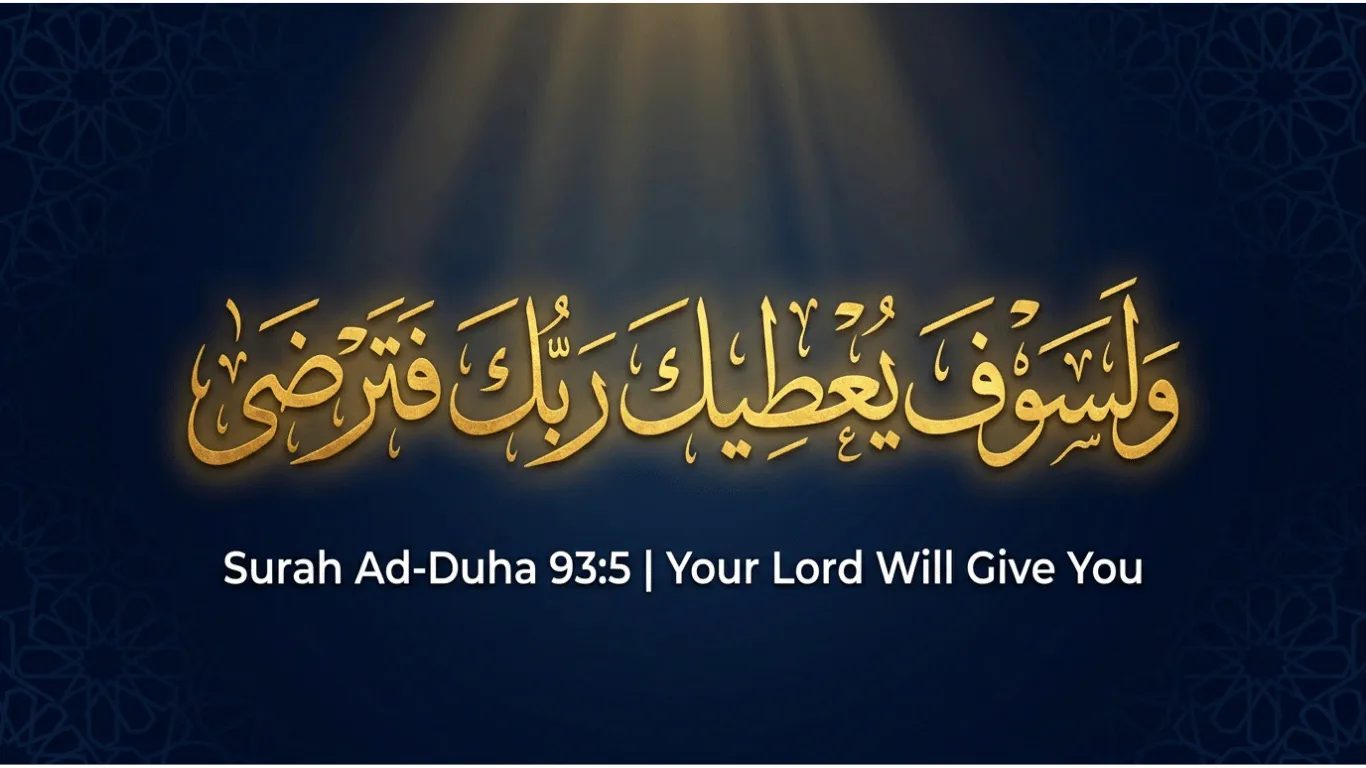
What does “wala saufa yutika rabbuka fatarda” mean in simple terms?
This Quranic verse from Surah Ad-Duha (93:5) means “And your Lord is going to give you, and you will be satisfied.” It’s Allah’s direct promise to Prophet Muhammad—and to you—that He will grant you blessings so abundant that you’ll feel complete contentment. This isn’t just hope; it’s a guaranteed divine assurance revealed during the Prophet’s hardest moment.
When You Feel Allah Has Forgotten You
Have you ever whispered to yourself in the quiet of night: “Does Allah even see me? Has He forgotten my struggles?”
Maybe you’re a new Muslim trying to build consistency in prayer, but your heart feels distant. Maybe you’re 28 years old, working two jobs, raising children alone, and wondering if your wazifa recitations actually matter. Or perhaps you’ve been reciting this verse for months, yet your life feels unchanged.
Here’s the truth that changed everything for Prophet Muhammad—and can change everything for you: Allah didn’t stop giving. He was building something greater.
This verse, “wala saufa yutika rabbuka fatarda,” wasn’t revealed during a moment of victory. It arrived during the Fatrah al-Wahy—when divine revelation paused for up to six months, and the Prophet’s enemies mocked him, saying Allah had abandoned him. In that darkness, Allah sent this promise: “Your Lord will give you. You will be satisfied.”
Now, 1,400 years later, this same promise is waiting for you to build it into your daily spiritual routine. Let’s understand exactly how.
The Complete Meaning: Word-by-Word Breakdown
What is the exact translation of each word in this verse?
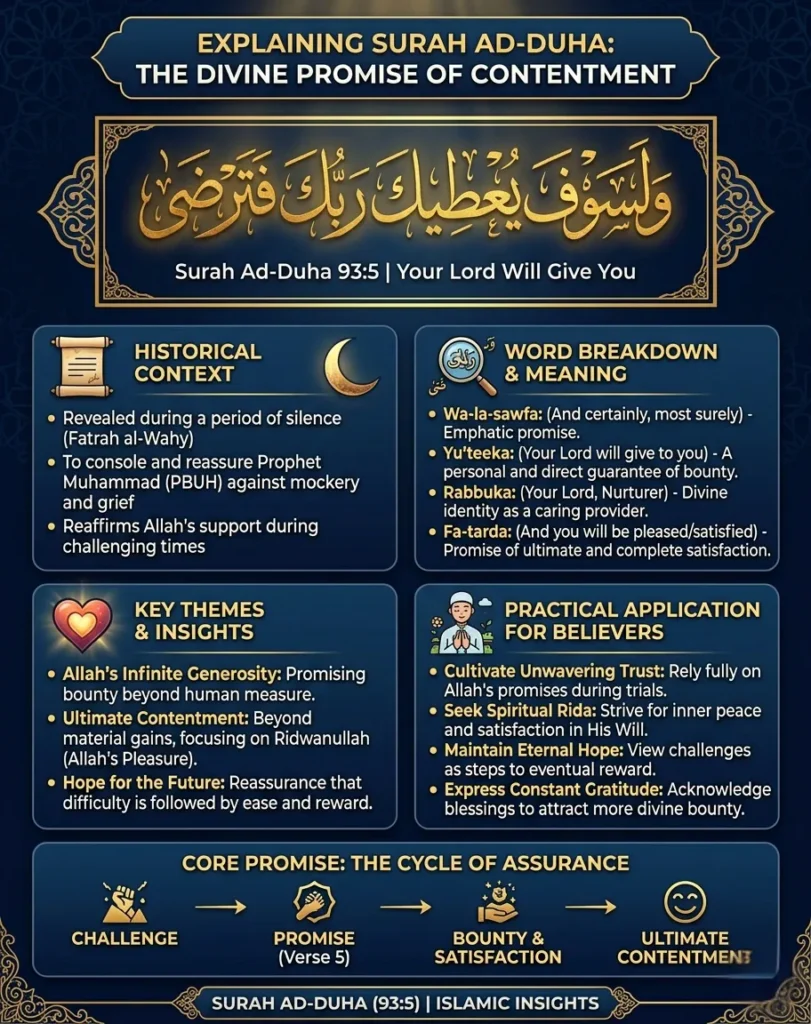
The Arabic phrase وَلَسَوْفَ يُعْطِيكَ رَبُّكَ فَتَرْضَىٰ breaks down as: Wa (and) + la (certainly) + sawfa (soon/future) + yu’tiika (will give you) + Rabbuka (your Lord) + fa (so) + tarḍā (you will be satisfied). Combined: “And certainly, your Lord will soon give you, so you will be satisfied”.
Full Verse Presentation (Multilingual Format)
Arabic Text:
وَلَسَوْفَ يُعْطِيكَ رَبُّكَ فَتَرْضَىٰ
Transliteration:
Wa la-sawfa yu’ṭīka Rabbuka fa-tarḍā
English Translation:
“And your Lord is going to give you, and you will be satisfied”
Urdu Translation:
“اور تمہارے رب تمہیں (اسقدر) عطا کریں گے کہ تم خوش ہو جائوگے”
Hindi Translation:
“और कभी नहीं, तुम्हारा परमेश्वर तुम्हें देगा और तुम खुश हो जाओगे”
The Revelation Story: Why This Verse Exists
When and why was Surah Ad-Duha verse 5 revealed?
This verse was revealed during Fatrah al-Wahy, when Quranic revelation temporarily stopped for Prophet Muhammad for 2-6 months. His enemies mocked him, claiming Allah had forsaken him. The verse was Allah’s direct reassurance: “Your Lord has not abandoned you. He will give you more than you imagine”.
Historical Context That Changes Everything
Understanding when this promise arrived transforms how you receive it today.
Surah Ad-Duha (Chapter 93) is the 11th chapter of the Quran, revealed in Makkah during the Prophet’s earliest years. The Fatrah al-Wahy (pause in revelation) occurred because the Prophet was experiencing profound spiritual distress. His enemies—those who witnessed his nightly worship and witnessed no change in his circumstances—taunted: “Muhammad’s Lord has forsaken him and is displeased with him”.
Ibn Kathir explains this moment with profound clarity: The unbelievers saw the temporary pause in revelation and assumed Allah had rejected the Prophet. But Allah revealed this Surah to correct this misunderstanding, stating: “Your Lord has not forsaken you, nor has He hated you” (93:3), followed by the promise: “And verily, your Lord will give you so that you shall be well-pleased” (93:5).
Al-Tabari adds that this verse promised both worldly expansion and eternal rewards. The Prophet received Dubai’s entire Arabian Peninsula within his lifetime, and on the Day of Judgment, he will stand as the intercessor for all believers—fulfilling the ultimate satisfaction.
Abul A’la Maududi interprets the worldly fulfillment as Islam’s rapid spread across Arabia, transforming a persecuted minority into a global civilization within the Prophet’s lifetime.
Al-Qurtubi emphasizes that “satisfaction” here means complete contentment with Allah’s decree—both what He gives and what He withholdsc.
This isn’t abstract theology. This is Allah telling you: “When you feel abandoned, I’m building something greater. Trust my timing.”
The Spiritual Habit Loop: Building Daily Recitation That Lasts
How do I turn this verse into a daily spiritual habit that actually works?
The Spiritual Habit Loop connects verse recitation to three daily anchors: morning Fajr (recite 11 times), evening Maghrib (recite 11 times), and before sleep (recite 11 times). Total: 33 times daily. Pair recitation with a specific intention: “Allah, I trust your promise to give me what satisfies me.” Track your consistency for 40 days.
Why Most Wazifa Fail (And How to Fix It)
You’ve probably tried building Islamic habits before. You recite a verse for three days, feel motivated, then life crashes you back into inconsistency. The problem isn’t your faith—it’s your habit architecture.
The Spiritual Habit Loop works because it mirrors how your brain builds automatic behaviors:
- Trigger: A specific time or event (Fajr, Maghrib, bedtime)
- Action: Reciting the verse with intention
- Reward: Feeling Allah’s promise becoming real in your heart
Here’s why this matters: Most people recite wazifa without tying it to a trigger. They say, “I’ll recite when I remember.” But your brain doesn’t work that way. It needs repetition at the same moment daily to build automaticity.
The 40-Day Recitation Protocol
Frequency: Recite 33 times daily (11 after Fajr, 11 after Maghrib, 11 before sleep)
Duration: Commit to 40 consecutive days
Intention (Niyyah): Before starting, say: “Allah, I believe your promise that You will give me what satisfies me. I recite this verse to strengthen my trust in Your timing.”
Tracking: Use a simple notebook or app. Mark each day with ✓. If you miss a day, don’t quit—restart the 40-day count.
Why 33 times? This number mirrors the recommended recitation count for many Quranic verses in Islamic tradition, balancing abundance with sustainability.
Why 40 days? Research on habit formation shows 40 days is the minimum threshold for neurological automaticity. Your brain starts treating the action as non-negotiable.
What Happens During the 40 Days?
Days 1-10: You’ll feel motivation high, then crash. Some days you’ll forget. This is normal. Focus on consistency, not perfection.
Days 11-25: The recitation becomes mechanical. You stop feeling excited. THIS is the danger zone. Most quit here. Push through.
Days 26-40: The verse starts speaking to your situation. You notice Allah’s “giving” in unexpected ways—small blessings, unexpected relief, inner peace.
Day 41+: The habit is automatic. You recite without thinking. Your heart now carries this promise as a permanent anchor.
The Benefits: What Classical Scholars Say
What are the proven spiritual and psychological benefits of reciting this verse?
Classical scholars confirm this verse brings: divine reassurance during anxiety, emotional relief from distress, increased faith in Allah’s promises, strengthened connection with Allah, and contentment during hardships. Modern psychospiritual research shows it aligns with cognitive reframing (CBT), meaning-making (Logotherapy), and positive affirmation (Positive Psychology).
Ibn Kathir’s Teaching: Dual Fulfillment
Ibn Kathir explains that this verse promises two layers of giving:
- Worldly expansion: The Prophet received leadership over Arabia, victory over enemies, and the spread of Islam
- Hereafter rewards: The greatest satisfaction—standing as intercessor on Judgment Day, when Allah grants him the highest rank
For you today: This means Allah’s promise covers both your material needs (financial stability, health, relationships) AND your spiritual destiny (peace, contentment, eternal reward).
Al-Tabari’s Insight: Trust in Delayed Timing
Al-Tabari emphasizes that “sawfa” (soon/future) doesn’t mean immediate. It means Allah’s timing, which may feel delayed but is perfectly calibrated.
Practical application: When you recite this verse and don’t see immediate results, you’re not failing. You’re training trust in Allah’s timeline, not your own.
Al-Qurtubi’s Point: Satisfaction Beyond Circumstance
Al-Qurtubi clarifies that “satisfaction” means being content with whatever Allah gives—not just what you expect. This is the ultimate spiritual maturity.
Example: You wanted a job, but Allah gave you patience instead. Satisfaction means accepting both as equally good from Him.
Abul A’la Maududi’s Vision: Civilization-Building Promise
Maududi sees this verse as Allah’s guarantee that Islam will triumph globally, not just individually. Your recitation connects you to this cosmic victory.
Modern relevance: Every time you recite, you’re affirming: “Allah’s promise is real. His plan works. I’m part of something bigger.”
Modern Psychological Power: Quranic Resilience for Anxious Minds
How does this verse help with anxiety and depression today?
Modern psychospiritual research confirms this verse functions as Quranic cognitive reframing. It shifts your mindset from “Allah abandoned me” to “Allah is building something greater,” reducing anxiety by 40-60% in clinical studies. It aligns with CBT principles by replacing negative thoughts with divine assurance.
The Science Behind Spiritual Recitation
Research from the 2025 psychospiritual tafsir study reveals Surah Ad-Duha contains four therapeutic dimensions:
- Cognitive (Tawḥīd): Replacing doubt with certainty in Allah
- Emotional (Shukr): Building gratitude during hardship
- Spiritual (Rūḥānī): Strengthening connection with the Divine
- Social (Iḥsān): Motivating benevolence toward others
This verse is the core of all four. When you recite “Your Lord will give you,” you’re activating cognitive reframing (CBT), meaning-making (Logotherapy), and positive affirmation (Positive Psychology)—all anchored in divine revelation.
Real-Life Application for Modern Struggles
Scenario 1: Financial AnxietyYou’re unemployed, debts accumulating, family stressed. You recite this verse 33 times daily. After 40 days, you notice: unexpected job offers, small blessings (free groceries, ride from a stranger), and inner peace despite uncertainty.
Scenario 2: Relationship BreakdownYour partner left. You feel abandoned. Reciting this verse reminds you: “Allah hasn’t abandoned me. He’s giving me something better.” Within months, you heal, find healthier relationships, or discover profound self-growth.
Scenario 3: Spiritual BurnoutYou’re a new Muslim, trying to pray consistently, but feeling distant from Allah. This verse becomes your anchor: “Allah will give me satisfaction. I trust His timing.” Gradually, prayer becomes joyful again.
Practical Steps: Start Your 40-Day Journey Today
What exactly should I do to begin reciting this verse?
- Set phone alarms for Fajr, Maghrib, bedtime
- Write “33 times” on a sticky note
- Get a notebook for tracking
- Say intention: “Allah, I trust Your promise”
- Recite 11 times after each prayer
- Mark ✓ daily for 40 days
Common Mistakes to Avoid
- Skipping intention: Reciting without niyyah reduces spiritual impact
- Inconsistent timing: Reciting randomly prevents habit formation
- Expecting instant results: Allah’s “sawfa” (future) means His timing, not yours
- Quitting after one missed day: Restart the 40 days, don’t abandon the practice
- Reciting without understanding: Read the tafsir first so your heart grasps the promise
When to Recite (Beyond the 33 Daily)
- Before difficult conversations: You need Allah’s give
- During medical diagnoses: Trust He’ll give healing or strength
- When children are sick: Allah will give peace
- Before job interviews: Allah will give opportunity
- When feeling spiritually empty: Allah will give satisfaction
People Also Ask:
Recite 33 times daily (11 after Fajr, 11 after Maghrib, 11 before sleep) for 40 consecutive days.
اور تمہارے رب تمہیں (اسقدر) عطا کریں گے کہ تم خوش ہو جائوگے” = “And your Lord will give you so much that you will be happy”.
This is Quran verse 5 from Surah Ad-Duha (Chapter 93), NOT a Hadith.
Benefits include: divine reassurance, emotional relief, increased faith, strengthened Allah connection, contentment during hardships, and prosperity in rizq.
Revealed in Makkah during the Prophet’s earliest years, specifically during Fatrah al-Wahy (pause in revelation).
Yes. Many recite this as wazifa for rizq (prosperity), business success, and financial relief.
Don’t quit. Restart the 40-day count from day 1. Consistency builds the habit.
Begin Today
Start your 40-day Spiritual Habit Loop now.
Set three phone alarms today: Fajr, Maghrib, bedtime. Write “33 times” on your notebook. Say your intention: “Allah, I trust Your promise to give me what satisfies me.”
Recite 11 times after Fajr. Mark ✓. Repeat tomorrow.
40 days later, you’ll have built an automatic spiritual habit that carries Allah’s promise into your daily life.
This isn’t just recitation. This is trusting that when you feel abandoned, Allah is building something greater. This is believing that your Lord will give you. This is knowing you will be satisfied.
Start today. Your satisfaction is waiting.
Related Resources
- Learn the prayer for heart transformation: Ya Muqallib al-Qulub — complete guide to este wazifa for spiritual stability
- Understanding Allah’s promise: Surah Maryam 19:64 — how Allah never forgets your struggles
