You wake up, reach for your phone, and instantly drown in notifications, emails, and the endless demands of modern life. For college students, working professionals, and diaspora parents balancing faith in a secular society, the pressure is constant.
You know you need to pray. You know you need spiritual grounding. Yet, the immediate dopamine hits of a hyper-connected world keep pulling you away. A subtle numbness sets in. This is not just distraction; it is a spiritual deception.
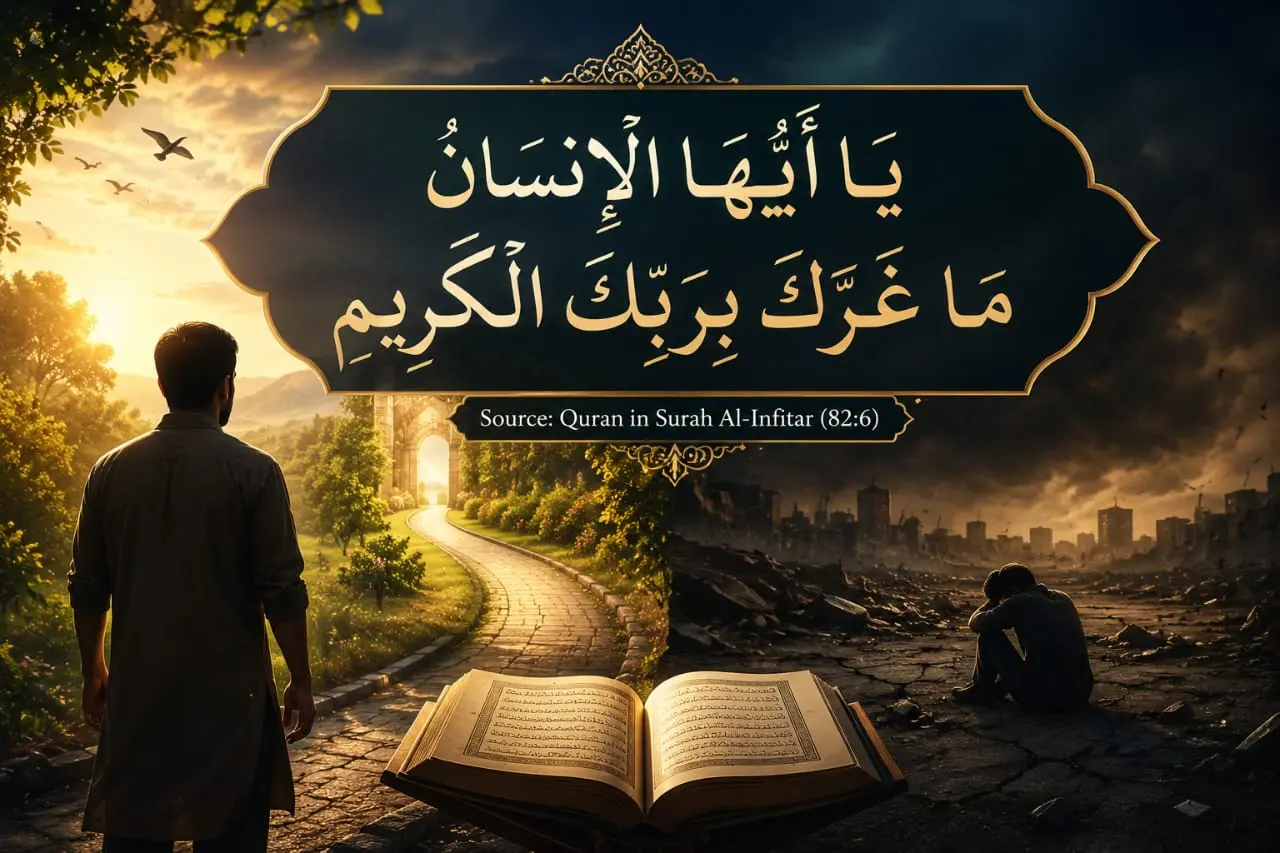
There is one piercing verse from the Quran in Surah Al-Infitar (82:6) designed to shatter this exact illusion. It forces a hard reset on your heart, pulling you out of autopilot. Let’s break down the exact meaning of this verse and how it provides the ultimate reality check for the modern Muslim.
What is the Meaning of Ya Ayyuhal Insanu Ma Gharraka Birabbikal Kareem?
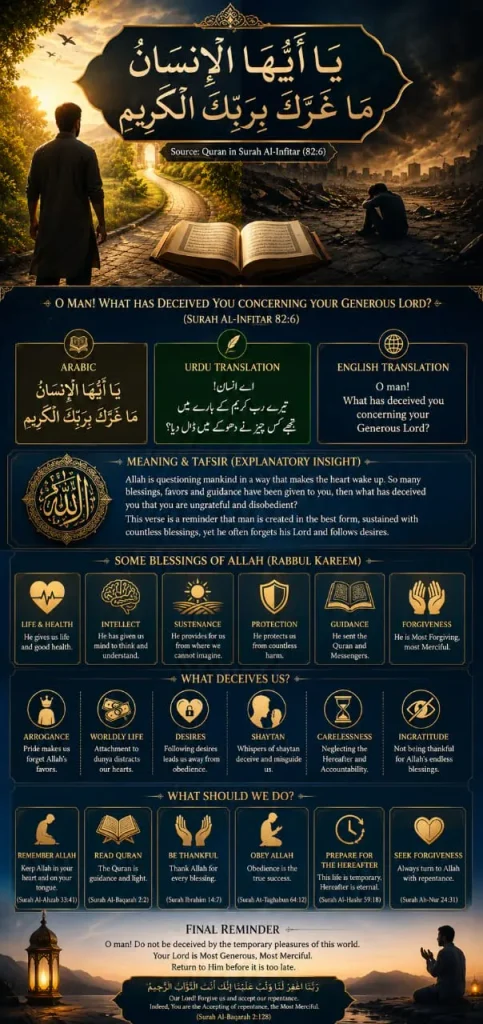
The exact meaning of “Ya ayyuhal insanu ma gharraka birabbikal kareem” is “O humanity! What has emboldened you against your Lord, the Most Generous?” This verse from the Quran in Surah Al-Infitar (82:6) questions why humans use God’s blessings to disobey Him instead of showing gratitude.
To truly grasp the emotional weight of this ayah, we must study the authentic Arabic text alongside its translations.
Arabic Text:
يَا أَيُّهَا الْإِنسَانُ مَا غَرَّكَ بِرَبِّكَ الْكَرِيمِ
Transliteration: Ya ayyuhal insanu ma gharraka birabbikal kareem
English Translation: O humanity! What has emboldened you against your Lord, the Most Generous?
Urdu Translation: اے انسان! تجھے اپنے کرم والے رب کے بارے میں کس چیز نے دھوکے میں ڈال دیا؟
Hindi Translation: ऐ इंसान! तुझे अपने करम वाले (महान) रब के बारे में किस चीज़ ने धोखे में डाल दिया?
Morphological Breakdown of the Arabic
Here is why this matters for your daily routine. The words chosen by Allah carry precise psychological weight:
- Insan (الْإِنسَانُ): Derived from the root word nasiya, meaning to forget. Allah addresses us by our most vulnerable trait—our tendency to forget our true purpose. We see this exact theme echoed in Wal asri innal insana lafi khusr, reminding us that mankind is constantly at a loss regarding time.
- Gharraka (غَرَّكَ): This comes from Ghurur, which means a deceptive illusion. It refers to something that looks shiny and valuable on the outside but is hollow on the inside.
- Al-Kareem (الْكَرِيمِ): The Most Generous, the Noble. The One who gives without being asked and gives without measure.
| The Modern Deception (Ghurur) | The False Promise | The Islamic Reality (Haqq) & Solution |
|---|---|---|
| Hustle Culture | “If I just work 80 hours a week, my future is completely secure.” | Wealth is distributed by Allah. Anchor yourself by seeking the Ihdinas siratal mustaqim (straight path) in all your worldly pursuits. |
| Social Media Validation | “My worth is determined by how others perceive my lifestyle.” | True honor belongs to Allah. Protect your mental space by reading our guide on overcoming modern anxiety. |
| Delaying Repentance | “I have plenty of time to fix my prayers and habits later.” | Time is an evaporating asset. Counter this by reciting a daily dua for forgiveness. |
Why Do We Become Emboldened Against The Most Generous?
We become emboldened against Allah because we mistake His patience for approval. When we sin or delay our prayers and face no immediate punishment, the deceptive nature of the world convinces us that our actions have no consequences. We take His generosity for granted.
Classical scholars like Ibn Kathir explain that this verse is a profound expression of divine disappointment. Imagine a parent who provides their child with everything—education, shelter, and health—only for the child to use those exact gifts to rebel.
This deception heavily impacts diaspora parents trying to raise strong families. If you are struggling with this balance, integrating Islamic parenting tips for confidence can help ground your household against the illusions of secular society.
The Prophetic Warning on Deception
Prophet Muhammad (PBUH) specifically warned us about the two main blessings that deceive humanity.
Arabic Text:
نِعْمَتَانِ مَغْبُونٌ فِيهِمَا كَثِيرٌ مِنَ النَّاسِ الصِّحَّةُ وَالْفَرَاغُ
Transliteration: Ni’matani maghbunun fihima kathirun minan-nasi: as-sihhatu wal-faragh.
English Translation: “There are two blessings which many people lose (are deceived by): health and free time.” (Sahih Bukhari 6412)
Urdu Translation:
دو نعمتیں ایسی ہیں جن کے بارے میں بہت سے لوگ دھوکے میں ہیں: صحت اور فراغت۔
Hindi Translation: दो नेमतें ऐसी हैं जिनके बारे में बहुत से लोग धोखे में हैं: स्वास्थ्य और खाली समय।
When we have health and time, we assume we will always have them. We tell ourselves we will pray tomorrow, make dua later, and repent when we are older.
The Spiritual Habit Loop: Breaking the Delusion
To stop being deceived by the world, you must build a spiritual habit loop. Use this verse from the Quran in Surah Al-Infitar (82:6) as a mental trigger to interrupt your distractions, renew your intentions, and immediately re-establish your connection with Allah.
You do not need hours of isolation to fix your heart; you only need sharp, intentional awareness. When anxiety about your career or social standing paralyzes you, reciting a specific dua for anxiety and depression shifts your reliance back to the Creator.
Here is a practical breakdown of how modern society deceives us, and how to counter it:
Step-by-Step Daily Implementation
- The Trigger: Identify your personal deception. Is it endless scrolling? Is it corporate burnout?
- The Interruption: The moment you catch yourself prioritizing a temporary goal over a permanent spiritual obligation, say the verse out loud: Ya ayyuhal insanu ma gharraka birabbikal kareem.
- The Reset Action: Immediately engage in remembrance. Start by building a routine with your morning and evening azkar to physically and mentally break the psychological trance of the world.
People Also Ask:
This exact phrase is located in Surah Al-Infitar, which is Chapter 82 of the Holy Quran, specifically in Verse 6. It is an early Meccan Surah focusing heavily on the events of the Day of Judgment.
In Arabic, Gharraka refers to a state of being deceived, deluded, or tricked. It describes a person who has been lured into a false sense of security by something that appears beneficial but is actually spiritually harmful.
It is written in the standard Quranic script as: يَا أَيُّهَا الْإِنسَانُ مَا غَرَّكَ بِرَبِّكَ الْكَرِيمِ.
The context involves the Day of Resurrection. The preceding verses describe the sky breaking apart and the graves turning inside out. Suddenly, Allah shifts from cosmic destruction to a deeply personal question, asking humanity why they ignored their generous Creator.
Securing Your Heart Against Delusion
Understanding the verse from the Quran in Surah Al-Infitar (82:6) is the first step toward waking up. Your Lord is Al-Kareem. He is waiting for you to return, to put down the screen, to step away from the endless chase, and to bow in submission. When the world feels overwhelming, remind yourself that ultimate reliance is only on Him by declaring Hasbunallahu wa ni’mal wakeel.
Your Next Step:
If you truly want to break free from worldly deception and connect with Al-Kareem in the most intimate, powerful way possible, you must establish the night prayer. Read our complete, step-by-step guide on What is Tahajjud namaz and how to pray it to transform your spiritual life tonight.
