
Have you ever felt like your voice is getting lost in the noise of a busy household? Between managing daily schedules, guiding your children, and trying to hold onto your own peace of mind, it is easy to feel overwhelmed and disconnected. You want to build a peaceful, faith-driven home, but some days, it feels like an uphill battle. You are not alone.
Let’s understand the real meaning behind one of the most comforting phrases in the Quran. When the weight of daily life feels heavy, remembering the profound guarantee of Inna rabbi qareebun mujeeb shifts everything. It anchors your heart and provides a perfect framework for building a resilient family routine.
What is the Meaning of Inna Rabbi Qareebun Mujeeb?
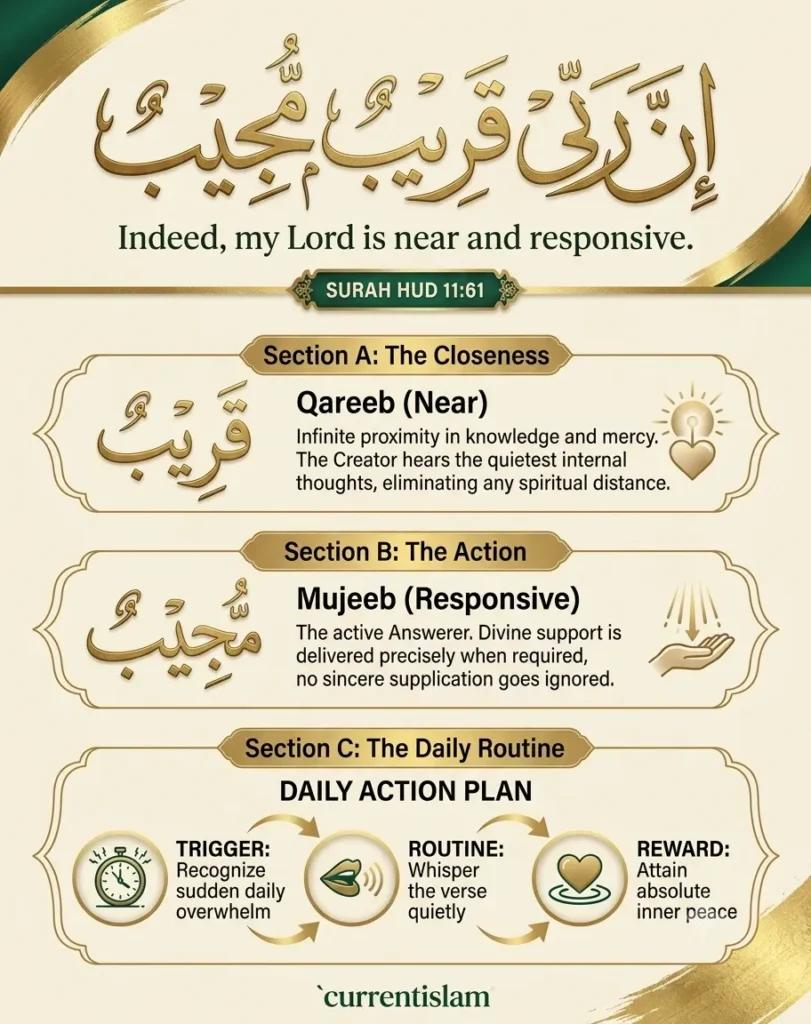
Inna rabbi qareebun mujeeb” translates to “Indeed, my Lord is near and responsive.” Found in Surah Hud (11:61), this verse is a divine guarantee that Allah is intimately close to His creation and actively answers the prayers of those who call upon Him.
Multilingual Translation Guide
For complete clarity and accurate memorization, here is the exact text across multiple languages:
- Arabic Text: إِنَّ رَبِّي قَرِيبٌ مُّجِيبٌ
- Transliteration: Inna rabbi qareebun mujeeb.
- English Translation: “Indeed, my Lord is near and responsive.”
- Urdu Translation: بیشک میرا رب قریب ہے اور دعائیں قبول کرنے والا ہے۔
- Hindi Translation: बेशक मेरा रब करीब है और दुआएं कबूल करने वाला है।
The Origin: Surah Hud 11:61 Explained
This phrase was spoken by Prophet Salih (peace be upon him) to his people, the Thamud. He urged them to worship Allah alone, ask for forgiveness, and repent, sealing his message with the powerful reminder that Allah is always near and ready to respond.
This becomes important when you look at the context of the verse. Prophet Salih was dealing with a stubborn, distracted nation. His advice was not just theological; it was a practical lifeline. According to Tafsir Ibn Kathir, one of the most trusted classical commentaries, the mention of Allah being “Near” (Qareeb) and “Responsive” (Mujeeb) immediately following the command to repent is deliberate. It eliminates the despair of thinking your mistakes have pushed you too far away. The door of return is always open, and the distance to reach it is zero.
Here is why this matters for modern families. We often teach our children about the rules of faith, but we sometimes forget to emphasize the intimacy of faith. Teaching your family that Allah is immediately accessible changes how they view mistakes, accountability, and emotional support.
The Linguistic Beauty: Qareeb and Mujeeb
The linguistic pairing of “Qareeb” (Near) and “Mujeeb” (Responsive) creates a perfect balance. Closeness without the ability to help is incomplete, and the power to help without closeness feels distant. Together, they form absolute divine support.
Let’s break down the exact wording to fully appreciate the depth:
- Inna (إِنَّ): Verily, or Indeed. This is a particle of absolute certainty. It removes all doubt from the reader’s mind.
- Rabbi (رَبِّي): My Lord. The addition of the “ya” (my) makes the relationship profoundly personal. It is the Nurturer, Sustainer, and Guardian who specifically takes care of you.
- Qareeb (قَرِيبٌ): Near. This is not a physical distance, but a nearness in knowledge, hearing, seeing, and mercy. He is closer to us than our own jugular vein.
- Mujeeb (مُّجِيبٌ): Responsive. He is the active Answerer. He does not just listen passively; He responds to the call with exactly what is needed, at the perfect time.
The Hadith Connection: You Are Not Calling the Absent
Prophet Muhammad (peace be upon him) reinforced this concept during a journey. When his companions raised their voices in prayer, he reminded them to lower their voices, stating they were calling upon the One who is Hearing and Near.
In a beautiful narration found in Sahih al-Bukhari, Abu Musa Al-Ash’ari reported that the companions were traveling with the Prophet (PBUH). As they ascended a hill, they began to say “Allahu Akbar” (God is the Greatest) with loud voices.
The Prophet (PBUH) gently corrected them, saying: “O people, be easy on yourselves, for you are not calling upon one who is deaf or absent. Verily, you are calling upon One who is Hearing and Near (Qareeb).”
Now let’s connect this to daily life. You do not need to wait for a special occasion, scream in desperation, or use complicated vocabulary to be heard. A whispered dua in the kitchen, a silent plea while driving the kids to school, or a quiet moment of reflection before sleeping is fully heard by the Mujeeb.
The Spiritual Habit Loop: Implementing Faith at Home
The Spiritual Habit Loop is a practical method to integrate faith into your daily routine. By using a trigger (a moment of need), a routine (whispering the dua), and a reward (recognizing Allah’s response), you build lasting spiritual resilience.
For parents looking to establish family habits, reading about faith is simply not enough. You need actionable frameworks. “Inna rabbi qareebun mujeeb” is the perfect anchor for building a spiritual habit loop.
1. The Trigger (Identifying the Need)
Every habit needs a cue. In a busy household, the trigger can be a moment of sudden stress, a child’s tantrum, or anxiety about finances. Instead of reacting with frustration, train yourself to recognize this specific emotion as the exact moment to pause.
2. The Routine (The Voice-First Dua)
The routine must be simple. You do not need a lengthy ritual. The moment the trigger occurs, quietly recite, Inna rabbi qareebun mujeeb. Teach your children to do the same before a difficult school test or when they feel scared. It acts as an immediate psychological reset, reminding the brain that help is already present.
3. The Reward (Observing the Response)
The Mujeeb always answers. However, the reward might not look exactly how you imagined. It might arrive as a sudden wave of calm, a shifted perspective, or an unexpected solution later in the week. By actively looking for the response, you train your family to recognize the blessings and closeness of Allah continuously.
Practical Modern Application: Building Family Resilience
Applying this verse daily transforms a household from chaos to calm. It teaches children Tawheed (the oneness of God) in a practical way and provides parents with an immediate tool to manage daily anxieties and stress.
When you are actively building a spiritual habit loop, consistency is more important than intensity. Here are actionable ways to make this verse a living reality in your home:
- Morning Reminders: Write the Arabic and English translation on a small card and place it near the family calendar or the kitchen fridge. Visual cues are essential for habit formation.
- The Post-School Check-In: When asking your children about their day, ask them if there was a moment they needed help. Remind them that the Qareeb was with them during that exact moment.
- Bedtime Reflection: Before sleep, ask your family to identify one way they saw Allah act as the Mujeeb (Responsive) that day. This replaces bedtime anxiety with profound gratitude.
Wazifa: Inna Rabbi Qareebun Mujeeb for Husband
Recite “Inna Rabbi Qareebun Mujeeb” (Surah Hud 11:61) daily with sincerity to improve love, understanding, and harmony with your husband.
Method:
- After any salah (preferably after Fajr or Isha), recite Durood Shareef 11 times.
- Then recite “Inna Rabbi Qareebun Mujeeb” 100 times.
- Again recite Durood Shareef 11 times.
- Make a heartfelt dua for love, peace, and softness in your husband’s heart.
Do this regularly for 21 days with firm belief that Allah is Near and answers prayers.
People Also Ask:
You should say this beautiful phrase during moments of distress, after committing a mistake when seeking forgiveness, or simply when you feel lonely and need reassurance that divine help is near.
There is no fixed number of times mandated in the authentic Sunnah to recite this specific portion of Surah Hud. It is highly recommended to repeat it naturally during your personal dua until your heart feels at peace.
Many people recite this verse to seek peace in their household and marriage. Because the verse focuses on asking Allah to respond and recognizing His closeness, it is an excellent supplication to bring harmony into a marriage. Recite it sincerely after your daily prayers, asking the Mujeeb to soften hearts and resolve family conflicts.
Pronounce it clearly as: In-na Rab-bee Qa-ree-bun Mu-jeeb. Ensure the “Q” in Qareeb is pronounced from the back of the throat, and the “H” in Mujeeb is silent, extending the “ee” sound slightly.
Moving Forward: Your Next Steps
Understanding the profound meaning of this verse is just the beginning of the journey. To truly transform your household, you must take these concepts out of the article and put them into daily practice.
Knowledge requires action. If you are serious about anchoring your family’s routine and teaching your children how to call upon the Mujeeb effectively, it requires structured, gentle consistency. To help you implement these exact principles, download our 7-Day Practice Plan PDF. This beautifully designed guide provides daily checkpoints, short reflection prompts, and an easy-to-use tracker to establish lasting spiritual family habits at home.
Download PDF