
When your alarm goes off at 6 AM in New York or London, the first thing you likely reach for is your phone. Before your day even starts, you are flooded with emails, notifications, and endless tasks. For many Muslims in the West, this modern overload creates a severe disconnect, leading to the quiet, persistent struggle of maintaining spiritual routines. We live in an era of infinite information, yet we often feel spiritually numb.
This is where a 7th-century revelation provides a profound psychological reset. Qur’an 67:10 captures a breathtaking moment of regret from the hereafter, but it is actually a blueprint for Daily Islamic Transformation today. It teaches us exactly how to rebuild our faith using two simple human faculties: mindful listening and critical reasoning.
Let’s understand the real meaning of this Arabic verse and how you can use it to build an unbreakable spiritual routine, whether you are commuting on the London Tube or sitting in Los Angeles traffic.
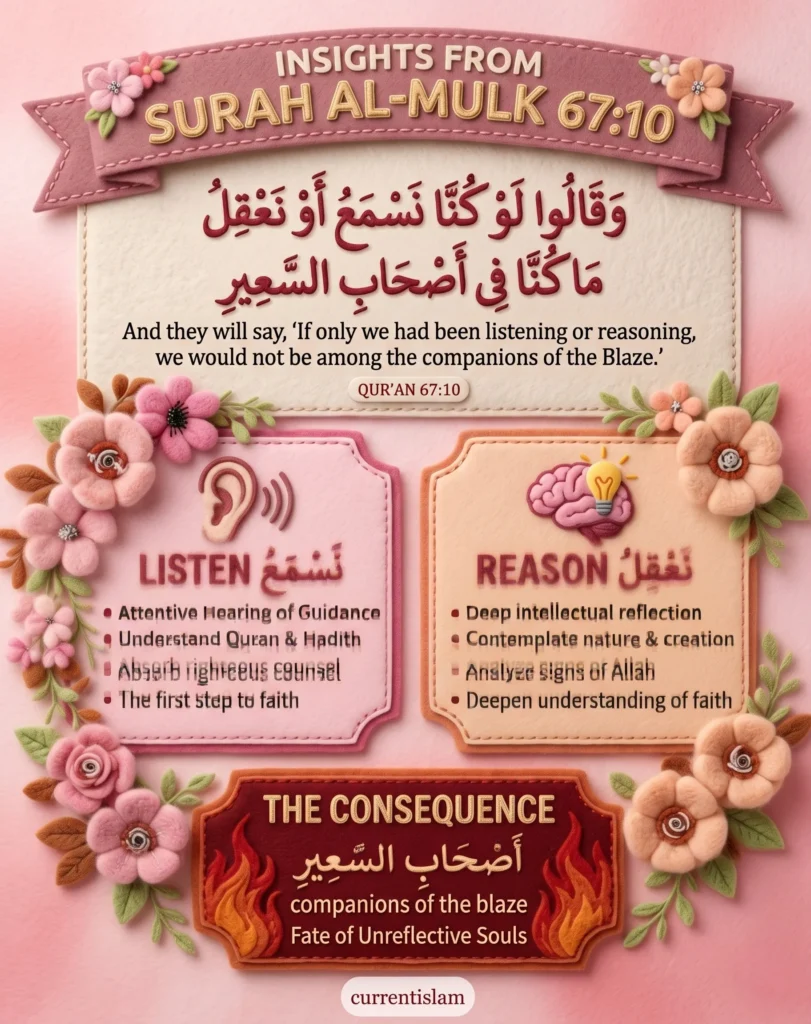
What Is the Meaning of Qur’an 67:10?
The core meaning of Qur’an 67:10 is a confession by the inhabitants of the fire, acknowledging that their failure to achieve salvation was due to neglecting two distinct gifts from Allah: the ability to listen attentively to divine guidance, and the intellect to process it logically.
1. Arabic Text:
وَقَالُوا لَوْ كُنَّا نَسْمَعُ أَوْ نَعْقِلُ مَا كُنَّا فِي أَصْحَابِ السَّعِيرِ
2. Transliteration: “Wa qalu lau kunna nasma’u aw na’qilu maa kunnaa fee as haabis sa’eer.”
3. English Translation: “And they will say, ‘If only we had been listening or reasoning, we would not be among the companions of the Blaze.'”
4. Urdu Translation:
“اور وہ کہیں گے: اگر ہم سنتے یا عقل سے کام لیتے تو ہم دوزخ والوں میں نہ ہوتے۔”
Here is why this matters for you. The verse specifically uses the word nasma’u (we listen) and na’qilu (we reason). It does not say “if only we prayed more.” It points to the root cause of lost faith: going through life on autopilot.
Tafseer and Scholarly Depth: Ibn Kathir’s Perspective
Classical scholars view this verse as the ultimate proof of human accountability. Imam Ibn Kathir, in his renowned Tafseer, explains that the people of the hereafter will blame themselves for suspending their God-given intellect.
They will realize they had the ears to hear the truth and the minds to comprehend it, but they willingly chose distraction. Ibn Kathir notes that true guidance requires both revelation (what we hear from the Prophet) and intellect (how we process it). In Islam, science, logic, and faith are not enemies; they are partners.
When you apply this to daily life at your office or university, it becomes a powerful framework. You are not expected to have blind, unthinking faith. Allah wants you to use your intellect to observe the world around you and align your daily habits with His guidance.
The Daily Islamic Transformation: Fixing Your Spiritual Routine
The biggest pain point for Muslims in the US, UK, and the broader diaspora is consistency. You might feel a burst of faith on Friday during Jum’ah, but by Tuesday morning at 9 AM EST, that spiritual high is entirely gone.
This happens because we treat faith as an isolated event rather than a cognitive habit. Qur’an 67:10 offers a unique, highly effective tactic for a Daily Islamic Transformation. We can call it the “Listen and Reason Protocol.”
Instead of trying to force hours of worship into an already exhausted schedule, this verse asks you to simply activate your awareness.
- The “Listen” Phase: Replace just 15 minutes of your daily podcast or music during your commute with active listening to the Quran or beneficial Islamic knowledge.
- The “Reason” Phase: Spend just 90 seconds after any prayer looking at the sky, your surroundings, or your own hands, and rationally reflecting on the Creator.
By actively listening and reasoning, you break the autopilot loop of modern corporate life. You anchor your mind back to your true purpose, making your spiritual routine effortless rather than burdensome.
The Power of Surah Al-Mulk: A Prophetic Guarantee
Why is this specific Surah so vital for your daily routine? Prophet Muhammad (PBUH) emphasized the daily recitation of Surah Al-Mulk as a protective shield.
The Sunnah count for reciting Surah Al-Mulk is once daily, specifically at night before sleeping.
1. Arabic Text:
إِنَّ سُورَةً مِنَ الْقُرْآنِ ثَلَاثُونَ آيَةً شَفَعَتْ لِرَجُلٍ حَتَّى غُفِرَ لَهُ، وَهِيَ سُورَةُ تَبَارَكَ الَّذِي بِيَدِهِ الْمُلْكُ
2. Transliteration: “Inna suratan minal-qur’ani thalathuna ayatan shafa’at lirajulin hatta ghufira lahu, wa hiya suratu tabarakal-ladhi biyadihil-mulk.”
3. English Translation: Prophet Muhammad (PBUH) said: “Indeed there is a Surah in the Quran of thirty verses, which intercedes for a man until he is forgiven. It is [Surah] Tabarak Alladhi Biyadihil-Mulk.” (Jami` at-Tirmidhi 2891)
4. Urdu Translation:
“بے شک قرآن میں تیس آیات پر مشتمل ایک سورت ہے جو ایک آدمی کی سفارش کرے گی یہاں تک کہ اس کی مغفرت ہو جائے گی۔ اور وہ سورت تبارک الذی بیدہ الملک ہے۔”
Just as we see mathematical precision in the Quran verse about numbers, the exact thirty verses of Surah Al-Mulk serve a highly specific, protective function. Establishing this simple nighttime habit creates a powerful spiritual bookend to your day.
How to Apply This Verse in Western Muslim Life
Establishing this connection does not require abandoning your modern life; it requires optimizing it. Here are three practical ways to implement the wisdom of verse 10:
- The 10 PM GMT / 5 PM EST Audit: Before you go to sleep, take a moment to evaluate your day. Did you use your intellect (‘aql) today to make ethical choices at work? Did you listen (sama’) to anything that brought you closer to Allah?
- Voice Search Your Faith: Make learning frictionless. If you are struggling with a concept, use your devices intentionally. Ask your phone, “What is the English translation of Surah Al Mulk?” while making your morning coffee.
- Protecting the Departed: Remembering our mortality is a core theme of Surah Al-Mulk. As this Surah protects us in the grave, supplementing it by frequently reciting the dua for the departed keeps our hearts soft and our perspective grounded in reality, not just the temporary stress of our careers.
People Also Ask:
The meaning of Qur’an 67:10 is an acknowledgment by the people of Hellfire that their ultimate downfall was due to their refusal to actively listen to divine guidance and their failure to use logic and reasoning during their lives.
Surah Al-Mulk, Verse 10 (Qur’an 67:10) specifically addresses the critical importance of listening (nasma’u) and reasoning (na’qilu) as the two primary pathways to discovering the truth and avoiding the Hellfire.
According to the Sunnah of Prophet Muhammad (PBUH), you should recite Surah Al-Mulk once every night before going to sleep. It acts as an intercessor and a protector from the trials of the grave.
Yes, reciting Surah Al-Mulk provides immense psychological comfort. By shifting your focus from temporary daily stressors to the ultimate dominion and control of Allah over the universe, it naturally reduces modern anxiety and grounds your perspective.
Your spiritual routine does not need to be a constant struggle against your modern lifestyle. By applying the “Listen and Reason Protocol” found in Qur’an 67:10, you can transform your daily grind into an opportunity for consistent, manageable Islamic growth.
Want to deepen your daily practice?
Continue your journey and explore our extensive library to read related articles on building unshakeable habits and mastering your daily prayers.
