
You wake up with a decision already waiting for you. A career move. A difficult conversation. A family problem. A choice that could change your future.
You think about it again. Then again. You ask three people, search ten opinions, open another tab—and still feel stuck.
Quran 3:159 offers a remarkably practical framework: consult wisely, decide firmly, then entrust the outcome to Allah. It combines Shura (consultation), ʿAzm (firm resolve), and Tawakkul (reliance upon Allah) with mercy and forgiveness.
The verse does not teach passive faith. It teaches responsible action followed by trust.
What does Quran 3:159 actually say?
Quran 3:159 teaches that effective leadership and decision-making begin with mercy and gentleness, include forgiveness and consultation, and end with decisive action and reliance upon Allah. Its central sequence is: consult → decide → trust Allah.
Arabic
فَبِمَا رَحْمَةٍ مِّنَ ٱللَّهِ لِنتَ لَهُمْ ۖ وَلَوْ كُنتَ فَظًّا غَلِيظَ ٱلْقَلْبِ لَٱنفَضُّواْ مِنْ حَوْلِكَ ۖ فَٱعْفُ عَنْهُمْ وَٱسْتَغْفِرْ لَهُمْ وَشَاوِرْهُمْ فِي ٱلْأَمْرِ ۖ فَإِذَا عَزَمْتَ فَتَوَكَّلْ عَلَى ٱللَّهِ ۚ إِنَّ ٱللَّهَ يُحِبُّ ٱلْمُتَوَكِّلِينَ
Transliteration:
Fa-bimā raḥmatin mina Allāhi linta lahum, wa law kunta faẓẓan ghalīẓal-qalbi lanfaḍḍū min ḥawlik. Faʿfu ʿanhum wastaghfir lahum wa shāwirhum fil-amr. Fa-idhā ʿazamta fatawakkal ʿalallāh. Innallāha yuḥibbul-mutawakkilīn.
English Translation:
“It is out of Allah’s mercy that you ˹O Prophet˺ have been lenient with them. Had you been cruel or hard-hearted, they would have certainly abandoned you. So pardon them, ask Allah’s forgiveness for them, and consult with them in ˹conducting˺ matters. Once you make a decision, put your trust in Allah. Surely Allah loves those who trust in Him.”
Urdu Translation:
“پس اللہ کی رحمت ہی سے آپ ان کے لیے نرم ہو گئے۔ اور اگر آپ سخت مزاج اور سخت دل ہوتے تو یہ لوگ آپ کے گرد سے منتشر ہو جاتے۔ پس انہیں معاف کر دیجیے، ان کے لیے مغفرت طلب کیجیے اور معاملات میں ان سے مشورہ کیجیے۔ پھر جب آپ پختہ ارادہ کر لیں تو اللہ پر بھروسہ کیجیے۔ بے شک اللہ توکل کرنے والوں سے محبت کرتا ہے۔”
Hindi Translation:
“तो यह अल्लाह की रहमत ही है कि आप उनके लिए नरम हो गए। और अगर आप सख़्त मिज़ाज और कठोर दिल होते तो वे आपके आसपास से बिखर जाते। अतः उन्हें माफ़ कर दीजिए, उनके लिए क्षमा माँगिए और मामलों में उनसे परामर्श कीजिए। फिर जब आप दृढ़ निर्णय कर लें तो अल्लाह पर भरोसा कीजिए। निश्चय ही अल्लाह भरोसा करने वालों से प्रेम करता है।”
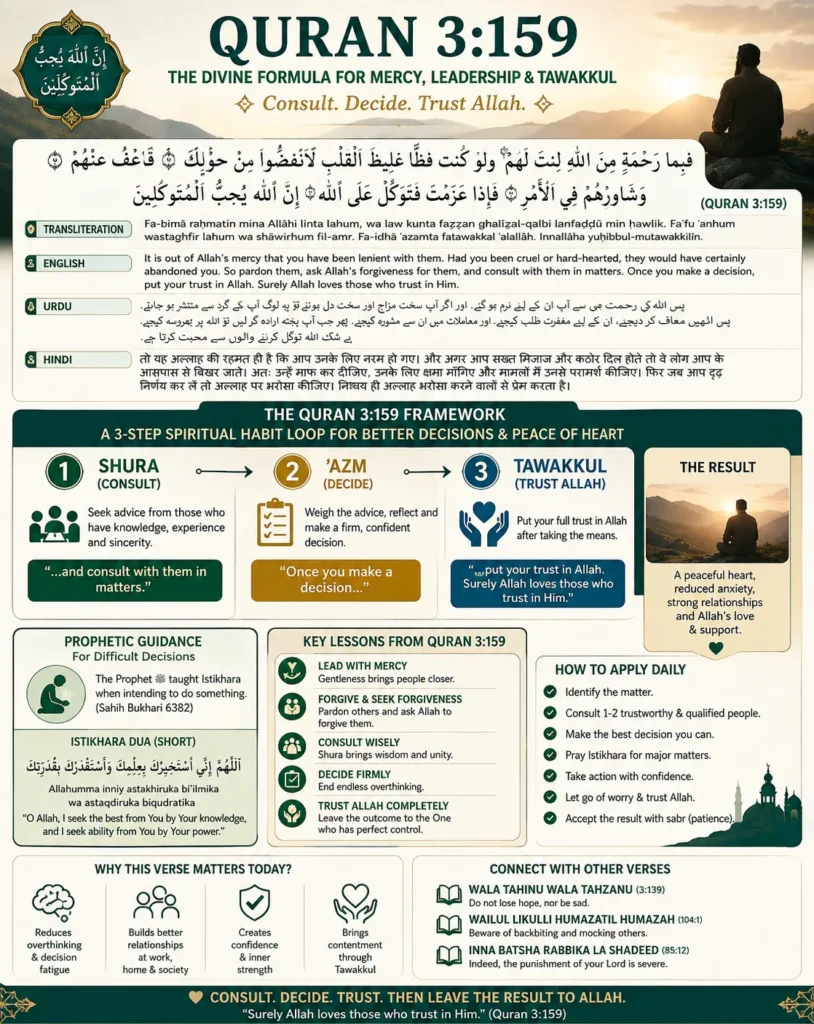
Why Quran 3:159 is a powerful framework for overthinking
The practical strength of Quran 3:159 is its sequence. It prevents two opposite mistakes: making impulsive decisions without advice and endlessly seeking advice without acting. Shura gives perspective, ʿAzm creates commitment, and Tawakkul releases unhealthy attachment to the result.
Think of it as a three-stage spiritual habit loop.
1. Shura: Stop carrying every decision alone
Shura means seeking counsel before making an important decision. Quran 3:159 places consultation before firm resolve, showing that asking trustworthy people for perspective is not weakness. It is part of a disciplined Islamic approach to decision-making.
The Prophet Muhammad ﷺ was commanded to consult his Companions even though revelation guided him.
The Qur’an also praises believers whose affairs are conducted through mutual consultation:
Arabic:
وَأَمْرُهُمْ شُورَىٰ بَيْنَهُمْ
Transliteration:
Wa-amruhum shūrā baynahum.
English:
“And whose affairs are determined by mutual consultation.”
Urdu:
“اور ان کے معاملات باہمی مشورے سے طے ہوتے ہیں۔”
Hindi:
“और उनके मामले आपसी परामर्श से तय होते हैं।”
Here is the modern application: do not ask everyone. Ask the right people.
For a career decision, consult someone with relevant experience. For a marriage issue, seek wise and trustworthy counsel. For a religious ruling, ask qualified scholars rather than relying on random social-media comments.
Consultation should improve your judgment—not replace it.
2. ʿAzm: Know when to stop researching
The phrase fa-idhā ʿazamta means “once you have decided” or “when you have resolved.” Islam does not encourage endless hesitation. After reasonable consultation and consideration, a believer is expected to move from analysis to responsible action.
The key word is:
عَزَمْتَ — ʿazamta
It comes from the Arabic root ʿ-z-m (ع ز م), associated with resolve, determination, and firm intention.
This matters for people trapped in decision fatigue.
You can research forever.
You can compare every university, every job, every neighbourhood, every financial option, every possible outcome.
But information has diminishing returns.
The Qur’anic sequence gives you a stopping point:
Shura → ʿAzm → Tawakkul.
The goal is not perfect certainty.
The goal is responsible decision-making under uncertainty.
What does “fa tawakkal ʿala Allah” mean?
Fa-tawakkal ʿala Allah means “then put your trust in Allah.” Tawakkul does not mean abandoning effort or refusing to plan. It means taking lawful and sensible means while recognizing that the final outcome belongs to Allah.
Arabic
فَإِذَا عَزَمْتَ فَتَوَكَّلْ عَلَى ٱللَّهِ ۚ إِنَّ ٱللَّهَ يُحِبُّ ٱلْمُتَوَكِّلِينَ
Transliteration:
Fa-idhā ʿazamta fatawakkal ʿalallāh. Innallāha yuḥibbul-mutawakkilīn.
English:
“Once you make a decision, put your trust in Allah. Surely Allah loves those who trust in Him.”
Urdu:
“پھر جب آپ پختہ ارادہ کر لیں تو اللہ پر بھروسہ کیجیے۔ بے شک اللہ توکل کرنے والوں سے محبت کرتا ہے۔”
Hindi:
“फिर जब आप दृढ़ निर्णय कर लें तो अल्लाह पर भरोसा कीजिए। निश्चय ही अल्लाह भरोसा करने वालों से प्रेम करता है।”
Tawakkul therefore changes the question.
Instead of:
“How can I guarantee that this decision works?”
You begin asking:
“Have I used the means Allah has given me, sought sound advice, and made the best decision I reasonably can?”
If yes, release the outcome.
The Prophet’s Sunnah: Istikhara before difficult decisions
The Prophet ﷺ taught his Companions to perform Istikhara when they intended to undertake a matter. It involves two voluntary units of prayer followed by a supplication asking Allah to facilitate what is good and turn away what is harmful. Sahih al-Bukhari records this practice in Hadith 6382.
The Prophet ﷺ taught Jabir ibn Abdullah:
Arabic:
اللَّهُمَّ إِنِّي أَسْتَخِيرُكَ بِعِلْمِكَ، وَأَسْتَقْدِرُكَ بِقُدْرَتِكَ
Transliteration:
Allāhumma innī astakhīruka biʿilmik, wa astaqdiruka biqudratik.
English Translation:
“O Allah, I seek the best from You by Your knowledge, and I seek ability from You by Your power.”
Urdu Translation:
“اے اللہ! میں تیرے علم کے ذریعے تجھ سے خیر طلب کرتا ہوں اور تیری قدرت کے ذریعے تجھ سے قدرت مانگتا ہوں۔”
Hindi Translation:
“ऐ अल्लाह! मैं तेरे ज्ञान के द्वारा तुझसे भलाई माँगता हूँ और तेरी शक्ति के द्वारा तुझसे सामर्थ्य माँगता हूँ।”
The full supplication asks Allah to facilitate an affair if it is good for one’s religion, livelihood, and ultimate outcome, and to turn it away if it is harmful.
Notice the harmony with Quran 3:159:
Consult. Decide. Ask Allah for guidance. Then trust Him.
Istikhara is not a requirement to wait for a dream. The authentic hadith teaches a supplication and two voluntary prayers; it does not state that a dream must follow.
A 90-second Quran 3:159 habit for your daily decisions
Turn Quran 3:159 into a short decision routine: identify the matter, consult one or two qualified and trustworthy people, make a reasoned decision, then consciously hand the outcome to Allah. Repeat this whenever uncertainty begins turning into repetitive, unproductive overthinking.
| Step | Islamic Principle | Practical Question | Action |
|---|---|---|---|
| 1 | Shura | Who has useful wisdom or experience? | Seek focused counsel |
| 2 | ʿAzm | What is the best decision I can make now? | Decide and act |
| 3 | Tawakkul | What outcome am I trying to control? | Entrust it to Allah |
| 4 | Sabr | What if the result is difficult? | Remain patient and faithful |
Does this have psychological benefits?
The Qur’an presents this as spiritual guidance, not as a clinical treatment. Still, the sequence can support healthy decision habits: consultation can broaden perspective, a clear decision can reduce repeated deliberation, and Tawakkul can help a believer separate responsible effort from obsession over outcomes.
That distinction matters.
We should not claim that Quran 3:159 is a scientifically proven treatment for anxiety. Its primary authority is revelation.
Its practical wisdom, however, is strikingly relevant to modern cognitive overload.
How to use Quran 3:159 at work, school, and home
Apply the verse by changing how you handle ordinary disagreements and decisions. Lead gently, forgive mistakes, seek relevant advice, decide when the evidence is sufficient, and then trust Allah rather than demanding certainty about the future.
At work: Consult colleagues before a major project decision, but do not endlessly poll the entire team.
At university: Ask a qualified adviser about your options, weigh the evidence, then choose a direction without replaying the decision every night.
In marriage and family life: Start with gentleness. Quran 3:159 connects effective leadership with mercy, forgiveness, and asking others for counsel.
Online: Do not turn every comment section into a Shura council. Seek wisdom from people with knowledge and sound judgment.
For another Qur’anic reminder about strength during hardship, read wala tahinu wala tahzanu.
🚀🚀🚀
For guidance about harmful speech and character, explore Wailul likulli humazatil humazah.
🚀🚀🚀
And for reflection on Allah’s severe punishment and ultimate power, read Inna batsha rabbika la shadeed.
What is the simple Sunnah-based decision formula?
A practical formula inspired by Quran 3:159 is: be gentle → forgive → consult → decide → make Tawakkul → remain patient with the result. For major permissible choices, add Istikhara as taught by the Prophet ﷺ.
Keep this formula somewhere you will actually see it:
SHURA → ʿAZM → TAWAKKUL
Not:
Overthink → panic → delay → overthink again.
And remember the final promise of the verse:
إِنَّ ٱللَّهَ يُحِبُّ ٱلْمُتَوَكِّلِينَ
Innallāha yuḥibbul-mutawakkilīn.
“Surely Allah loves those who trust in Him.”
People Also Ask: Quran 3:159
The main message is that believers should combine mercy and forgiveness with consultation and decisive action. After making a sound decision, they should place their trust in Allah. The verse presents Tawakkul as something practiced after responsible effort, not instead of it.
Surah Ali ‘Imran 3:159 says, “Once you make a decision, put your trust in Allah.” The Arabic phrase is fa-idhā ʿazamta fatawakkal ʿalallāh. The verse then states that Allah loves those who place their trust in Him.
Fa-idhā ʿazamta fatawakkal ʿalallāh means, “Once you make a decision, put your trust in Allah.” It describes the movement from firm resolve to Tawakkul: make a responsible decision, then entrust the result to Allah.
The established Sunnah is Salat al-Istikhara, followed by its supplication asking Allah to choose what is good and turn away what is harmful. The Prophet ﷺ taught this practice to his Companions, as recorded in Sahih al-Bukhari 6382.
There is no authentic evidence establishing a specific number of repetitions of Quran 3:159 as a fixed wazifa. You may recite and reflect upon the verse regularly, but a special count should not be presented as an established Sunnah without evidence.
No. Quran 3:159 places Tawakkul after consultation and decision-making. Islamic reliance on Allah does not cancel effort. The believer uses appropriate means, makes a responsible choice, and then entrusts the outcome to Allah.
The verse links successful human relationships with mercy and soft-heartedness. It warns that harshness can drive people away, then commands forgiveness, seeking forgiveness for others, and consultation. The sequence shows that good decisions depend not only on intelligence but also on character.
The deeper lesson of Quran 3:159
Quran 3:159 is not merely a verse to quote when you are uncertain.
It is a way to make decisions.
When your mind is overloaded, return to its sequence.
Be merciful.
Forgive.
Consult wisely.
Decide.
Trust Allah.
You are responsible for your effort.
You are not responsible for controlling the unseen.
That is where Tawakkul begins.
