You wake up thinking about everything you might lose today. A job, a relationship, financial stability, or even your health. For working professionals pushing for the next promotion, diaspora parents worrying about their children, or college students facing uncertain futures, this constant dread of loss creates paralyzing anxiety.
We live in a society obsessed with permanence. We buy insurance, hoard wealth, and build rigid routines trying to control the uncontrollable. When things inevitably break, change, or end, our mental health crashes. We feel completely unanchored.
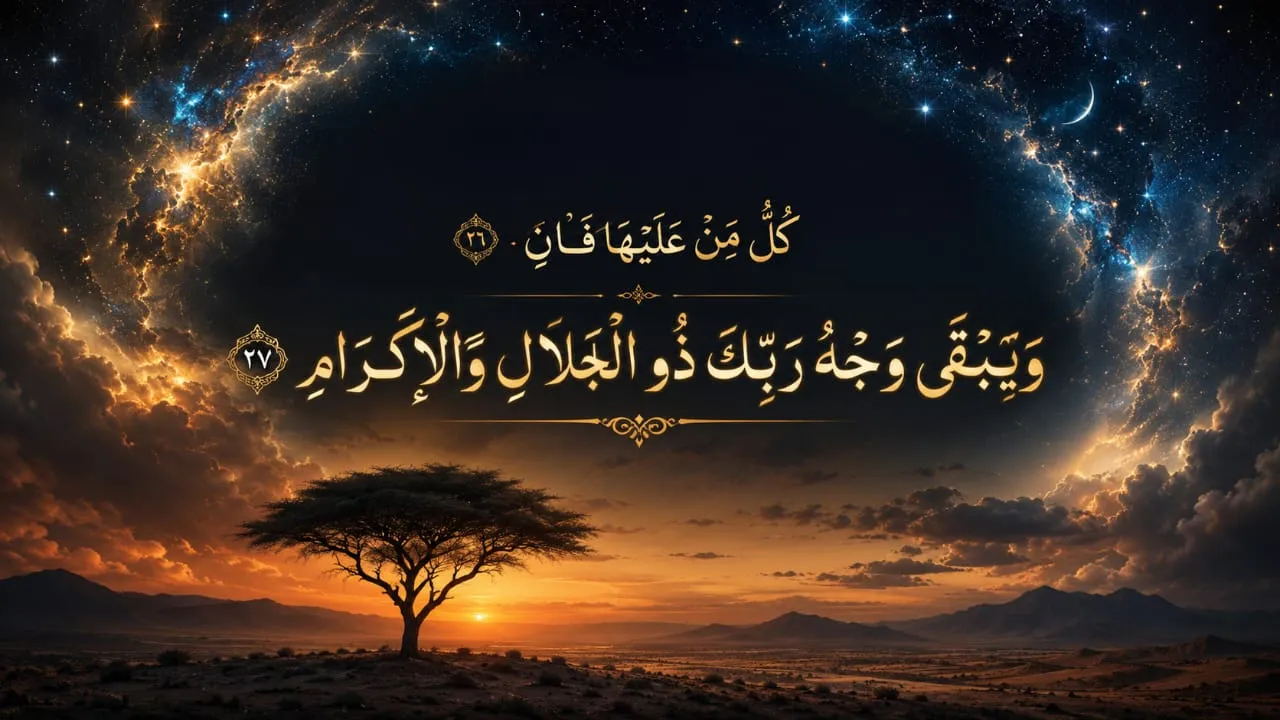
Islam offers a profound psychological reset. By internalizing the reality that everything is temporary except the Creator, we find true stability. The ultimate shield against this anxiety is understanding and applying the powerful Quranic verse: Wa yabqa wajhu rabbika zul jalali wal ikram.
What Does “Wa Yabqa Wajhu Rabbika Zul Jalali Wal Ikram” Mean?
This verse means that while every created thing in the universe will eventually perish, only the profound Essence of Allah will remain eternally. It reminds believers that God is the ultimate Owner of Majesty and Honor, demanding our awe and granting infinite grace.
Let’s break down the exact meaning of this verse. In Surah Ar-Rahman, Allah presents a stark contrast between the creation and the Creator. To fully grasp this, we must look at verse 27 alongside the verse immediately preceding it.
Quranic Evidence (Surah Ar-Rahman 55:26-27)
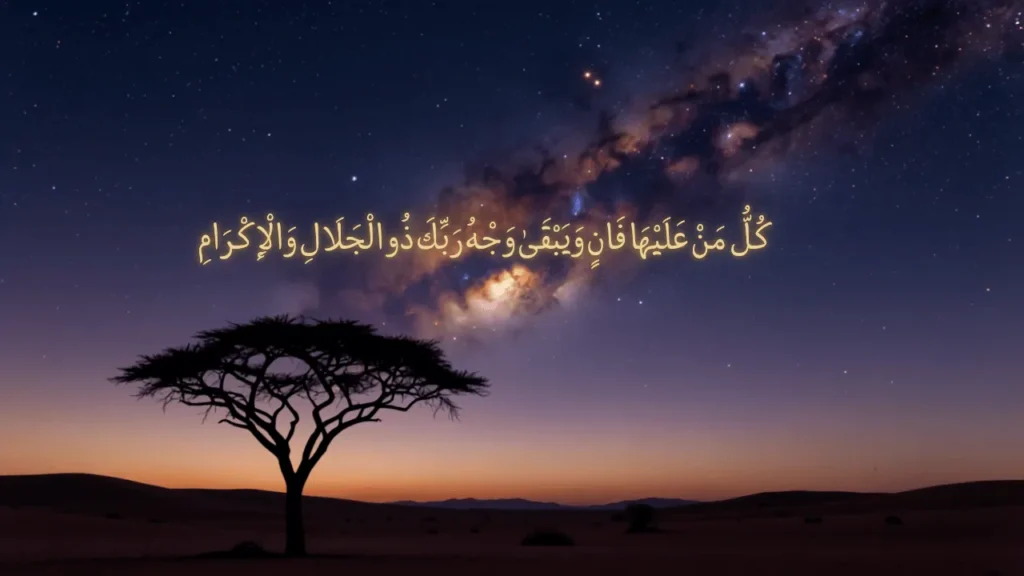
- Arabic: كُلُّ مَنْ عَلَيْهَا فَانٍ وَيَبْقَىٰ وَجْهُ رَبِّكَ ذُو الْجَلَالِ وَالْإِكْرَامِ
- Transliteration: Kullu man ‘alayha fan. Wa yabqa wajhu rabbika thul-jalali wal-ikram.
- English: Everyone upon the earth will perish. And there will remain the Face of your Lord, Owner of Majesty and Honor.
- Urdu: زمین پر جو بھی ہے فنا ہونے والا ہے۔ اور صرف آپ کے رب کی ذات باقی رہے گی جو عظمت اور جلال والی ہے۔
- Hindi: ज़मीन पर जो भी है, सब फ़ना होने वाला है। और सिर्फ आपके रब की ज़ात बाक़ी रहेगी, जो जलाल और बुज़ुर्गी वाली है।
The phrase Kullu man alaiha faan establishes the universal law of Fana (annihilation). Everything we stress over will eventually cease to exist. Immediately after, verse 27 establishes Baqa (eternal subsistence). Only the “Face” (meaning the complete, perfect Essence) of Allah remains. This realization is a massive blessing, which is why the Surah repeatedly asks, Fabiayiala irabbikuma tukazziban (Then which of the favors of your Lord will you deny?).
Breaking Down the Divine Attributes: Majesty and Honor
Zul Jalali” refers to Allah’s absolute power, might, and majesty which inspires profound awe. “Wal Ikram” refers to His boundless generosity, love, and honor which inspires immense hope. Together, they create the perfect spiritual balance for a believer’s heart.
Islamic theology often categorizes the attributes of Allah into two distinct groups:
- Jalal (Majesty): These are attributes of sheer power, justice, and supremacy. When we think of the universe ending, we are witnessing the Jalal of Allah. It humbles the human ego.
- Jamal (Beauty): These are attributes of mercy, compassion, and generosity. The word Ikram falls perfectly into this category.
Here is why this matters for your daily routine. If God were only described with “Majesty,” we might feel too terrified to approach Him. If He were only described with “Honor and Generosity,” we might take His rules lightly. Combining them creates the perfect psychological environment for true worship. Whenever you feel overwhelmed, knowing that the Supreme Ruler is also the Most Generous acts as the ultimate dua for anxiety and depression. You realize that Allah is sufficient for us, handling all your affairs with both perfect power and perfect care.
The Grammatical Secret: Zhu vs. Zhi in Surah Ar-Rahman
In verse 27, it reads Zhu l-Jalali to describe the eternal Face of God surviving the universe’s end. In verse 78, it reads Zhi l-Jalali to directly praise the Name of your Lord. This precise grammar shifts the focus beautifully.
One of the most remarkable linguistic miracles of the Quran is how a single vowel changes the entire theological depth of a verse. The phrase “Owner of Majesty and Honor” appears twice in Surah Ar-Rahman.
- Verse 27: Zhu l-Jalali wal-Ikram. The word Zhu (nominative case) grammatically attaches to Wajh (Face/Essence). Because the context is the destruction of all creation, the grammar ensures our focus is strictly on the indestructible Essence of God.
- Verse 78: Zhi l-Jalali wal-Ikram. In the final verse of the Surah, it says, “Blessed is the name of your Lord.” Here, Zhi (genitive case) attaches to the word Rabbika (Your Lord). The context is praise, so the majesty modifies the Lord directly.
Understanding this level of precision brings immense peace, proving that not a single letter in the Quran is placed randomly. It is through this deep reflection that hearts find rest in the remembrance of Allah.
The Prophetic Practice: Reciting This After Every Prayer
Prophet Muhammad (PBUH) directly applied this Quranic concept into daily life. Immediately after finishing any obligatory prayer, the proven Sunnah is to seek forgiveness three times and recite a specific supplication calling upon the Owner of Majesty and Honor.
But how do we apply this at work or school? You do not need to wait for a moment of crisis to connect with the Eternal. The Prophet (PBUH) made this a non-negotiable part of his daily habits.
Hadith Evidence (Sahih Muslim 591) Thawban reported: When the Messenger of Allah (PBUH) finished his prayer, he would ask for forgiveness three times and then say:
- Arabic: اللَّهُمَّ أَنْتَ السَّلَامُ وَمِنْكَ السَّلَامُ، تَبَارَكْتَ يَا ذَا الْجَلَالِ وَالْإِكْرَامِ
- Transliteration: Allahumma antas-salam wa minkas-salam, tabarakta ya Dhal-Jalali wal-Ikram.
- English: O Allah, You are Peace and from You is peace. Blessed are You, O Owner of Majesty and Honor.
- Urdu: اے اللہ، تو ہی سلامتی والا ہے اور تیری ہی طرف سے سلامتی ہے۔ تو بڑی برکت والا ہے، اے جلال اور بزرگی والے۔
- Hindi: ऐ अल्लाह, तू ही सलामती वाला है और तेरी ही तरफ़ से सलामती है। तू बड़ी बरकत वाला है, ऐ जलाल और बुज़ुर्गी वाले।
By incorporating this into your dua after salah, you actively reset your mind five times a day. You remind yourself that any stress from your job or studies is temporary, and true peace (Salam) only comes from the One who remains forever. Before reciting this, always start by seeking forgiveness (saying Astaghfirullah three times) to cleanse your heart of worldly distractions.
Practical Wazifa: How to Apply This in Your Daily Life
You can implement this verse by detaching your heart from temporary worldly results and attaching your efforts solely to Allah. Use this specific phrase during morning supplications, after daily prayers, and during moments of extreme stress to regain focus.
To make this actionable, here is a structured daily habit loop you can build starting today.
| Spiritual Practice (Wazifa) | Ideal Timing (Sunnah) | Psychological & Spiritual Benefit |
|---|---|---|
| Recite: Allahumma antas-salam… | Immediately after the Tasleem of the 5 daily obligatory prayers. | Detaches your heart from worldly stress and acts as a grounding anchor for daily anxiety. |
| Recite: Ya Zal Jalali Wal Ikram | During Sujood (prostration) or late-night Tahajjud prayer. | Invokes Allah’s absolute power to resolve problems and His infinite generosity to grant wishes. |
| Morning Reflection | Read Surah Ar-Rahman Verse 55:27 alongside your morning and evening azkar. | Sets the spiritual intention that worldly achievements are temporary, anchoring your focus entirely on the eternal reward. |
FAQs:
The phrase “Zul Jalali wal Ikram” (Owner of Majesty and Honor) is found in Surah Ar-Rahman (Chapter 55 of the Quran). It appears twice in this chapter: first in verse 27 as Zhu l-Jalali wal-Ikram, and again in the final verse, verse 78, as Zhi l-Jalali wal-Ikram.
Reciting “Ya Zal Jalali Wal Ikram” acts as a powerful catalyst for having your prayers answered. Prophet Muhammad (PBUH) advised believers to be constant and persistent in calling upon Allah using this specific phrase, as it acknowledges both His supreme power to grant the request and His infinite generosity.
Next Steps for Your Spiritual Routine
Understanding the temporary nature of this world is the first step toward genuine mental peace. When you truly internalize that only the Face of your Lord remains, the daily pressures of modern life begin to lose their grip on your heart.
To continue building a resilient, faith-based mindset, I highly recommend you read another post from our platform. Take action today and explore our complete guide to overcoming modern anxiety to find more time-tested prophetic solutions for your daily life.
