
Allahumma alhimni rushdi (اللَّهُمَّ أَلْهِمْنِي رُشْدِي) is a short Arabic dua, a personal prayer asking Allah for help. It means, “O Allah, inspire me with my right judgment.” Muslims say it before decisions, exams, and hard conversations. This guide covers its meaning, its source, and a simple 90-second routine you can start tonight.
Quick Answer
- Meaning: “O Allah, inspire me with my right judgment, and protect me from the evil of my own self.”
- Source: a dua the Prophet ﷺ taught, reported in Jami at-Tirmidhi [VERIFY: number and grading].
- Use: say it once slowly, ask trusted people, decide, then rely on Allah.
Contents
- What does it mean?
- What is the full Arabic text?
- Where is this dua from?
- Is there a wazifa or set number of repetitions?
- What are the benefits?
- How do I use it? The 90-Second Rushd Reset
- How can I use it at work, at school, or as the only Muslim in the room?
- What are common mistakes?
- How is it different from istikhara?
- Frequently asked questions
It is 11 p.m. Two job offers sit in your inbox. Your family wants an answer. Your gut wants the other option. You have read three articles and feel worse. [SCHOLAR ANECDOTE: insert a real story of a decision made with this dua.]
That weight is real. Often we do not fear the choice itself. We fear our own rush, doubt, and pride. The Sunnah (the Prophet’s way) offers a short remedy: ask Allah to guide your judgment first.
What Does “Allahumma Alhimni Rushdi” Mean?
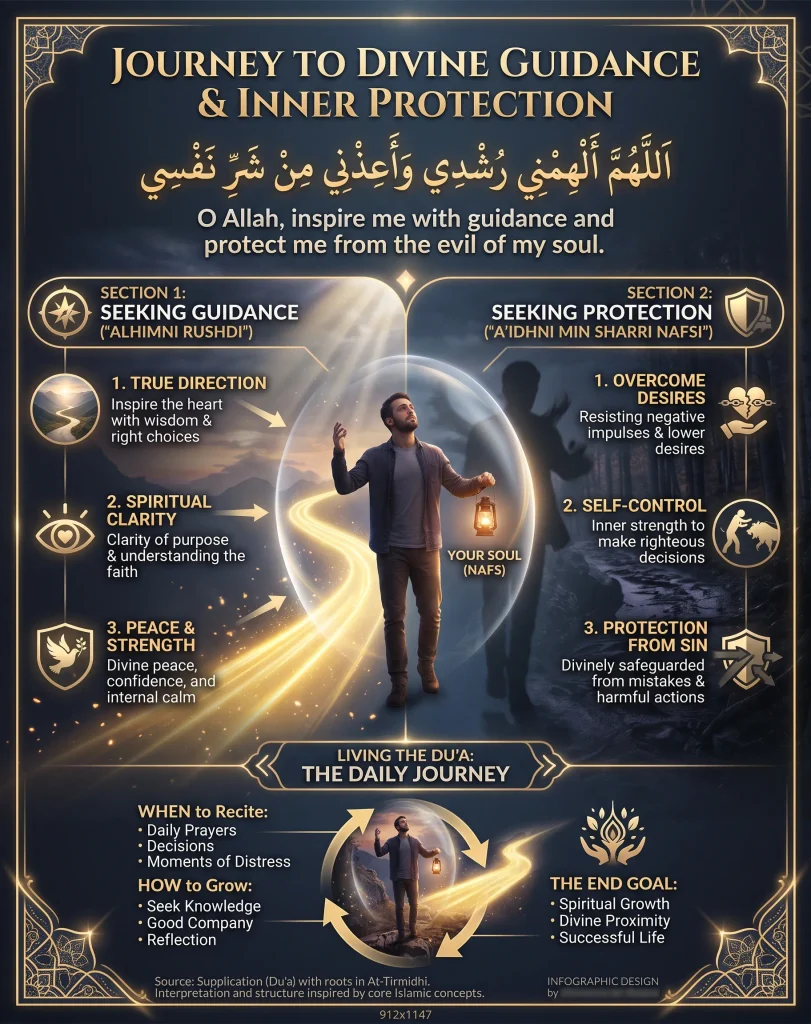
It means, “O Allah, inspire me with my right judgment.” The word rushd means right guidance and sound judgment, choosing what is truly good for you. The full dua adds a request for protection from the evil of your own self, such as rash impulses and pride.
What Is the Full Arabic Text?
اللَّهُمَّ أَلْهِمْنِي رُشْدِي وَأَعِذْنِي مِنْ شَرِّ نَفْسِي
Allahumma alhimni rushdi, wa a’idhni min sharri nafsi.
Meaning: “O Allah, inspire me with my right judgment, and protect me from the evil of my own self.” [VERIFY against the Sunnah.com wording.]
| Arabic | Transliteration | Meaning |
|---|---|---|
| اللَّهُمَّ | Allahumma | O Allah |
| أَلْهِمْنِي | alhimni | inspire me (place the right thought in my heart) |
| رُشْدِي | rushdi | my right guidance, my sound judgment |
| وَ | wa | and |
| أَعِذْنِي | a’idhni | protect me, shelter me |
| مِنْ | min | from |
| شَرِّ | sharri | the evil of |
| نَفْسِي | nafsi | my self, my impulses |
Where Is This Dua From?
This dua is reported in Jami at-Tirmidhi. The report says the Prophet ﷺ taught it to the companion Husayn, and it is narrated through his son Imran ibn Husayn. [VERIFY: hadith number, chain, and grading on Sunnah.com. Some scholars may grade this report as weak, so state the grading clearly and do not present it as sahih unless your reviewer confirms.]
Sunnah.com numbering: Jami at-Tirmidhi [NUMBER] · Grading: [VERIFY].
Is There a Wazifa or Set Number of Repetitions?
No fixed count or wazifa (a set routine of repeated recitation) is established for this dua in the source above [VERIFY with reviewer]. Say it as often as you need it. If you build a personal routine, call it a habit, not a Sunnah number.
What Are the Benefits of This Dua?
The benefits are spiritual, and we make no promise about outcomes.
- Humility. You admit you need Allah’s help before you act.
- Self-awareness. The second half asks for protection from your own worst impulses, not only from outside problems.
- A better habit. You ask first, then decide.
How Do I Use It? The 90-Second Rushd Reset
Use the 90-Second Rushd Reset: Pause, Ask, Act. Pause for 20 seconds and name the decision. Ask for 30 seconds by saying the dua slowly. Act for 40 seconds by writing one next step. The timings are a practical routine, not a reported Sunnah timing.
Step 1: Pause (20 seconds)
Stop. Breathe. Say the decision in one sentence: “I must choose between A and B.”
Step 2: Ask (30 seconds)
Say the dua once, slowly, in Arabic or your own words. If you want the etiquette of asking, read how to make dua properly.
Step 3: Act (40 seconds)
Write one small next step, such as “ask my mentor tonight.” Then decide with care. The Quran teaches this order in Quran 3:159 on tawakkul: consult others, decide, then rely on Allah.
Start tonight: before sleep, name tomorrow’s biggest decision, say the dua once, and write your next step.
How Can I Use It at Work, at School, or as the Only Muslim in the Room?
Say it silently. It needs no prayer mat, no spoken words, and no explanation to anyone. Take one breath, ask in your heart, then act calmly.
- Before an exam: pair it with the dua for exams.
- Before a presentation or interview: add the dua for speaking with confidence.
- When irritation rises in a meeting: the “evil of my self” half fits here. See the dua for anger control.
- When invited somewhere uncomfortable: ask first, then decline kindly if needed. You do not have to explain your faith.
What Are Common Mistakes With This Dua?
- Treating it as magic. It is a request, not a formula that forces results.
- Skipping advice. Dua and consultation work together.
- Waiting for a dream or sign. No such condition is reported [VERIFY].
- Inventing a count. Do not add numbers you cannot source.
- Replacing care. If anxiety or impulses control your life, seek a doctor or therapist too. Dua supports professional care and never replaces it.
- Fearing the outcome. After acting, entrust your affair to Allah.
How Is It Different From Istikhara and Other Guidance Duas?
| Practice | What it is | Best used for |
|---|---|---|
| Allahumma alhimni rushdi | Short general dua | Any moment needing sound judgment |
| Istikhara | Two rak’ahs (units) of voluntary prayer, then a set dua | Choosing between permissible options |
| Quran 1:6 | “Guide us to the straight path” [VERIFY exact Sahih International wording], recited in every prayer unit | Daily, big-picture guidance |
| Quran 3:159 | Consult, decide, then rely on Allah | The steps after you ask |
For the istikhara supplication itself, read Allahumma khirli wakhtarli. For the broader request, see Ihdinas siratal mustaqim.
Make it part of a daily rhythm with the morning and evening azkar.
FAQs:
What is the dua to ask Allah for right guidance?
Allahumma alhimni rushdi wa a’idhni min sharri nafsi is a short dua reported from the Prophet ﷺ. It asks Allah to inspire right judgment and protect you from your own harmful impulses. You can say it in Arabic or add your own words in English.
Can I say it in English?
Yes. Say the Arabic if you can, because it is the reported wording. You may also ask in English or your own language. Allah understands every language, and dua is a conversation, so speak honestly about the decision you face.
Is it the same as istikhara?
No. Istikhara is a specific practice: two rak’ahs of voluntary prayer followed by a set dua, used when choosing between permissible options. This dua is a short, general request for good judgment. You can say it any time, including before istikhara.
When should I say it?
Say it whenever you face a choice, feel a strong impulse, or notice anger or pride rising. No specific time is reported for it [VERIFY]. A calm moment, such as after prayer, may help you focus.
Does it replace asking people for advice?
No. Quran 3:159 tells the Prophet ﷺ to consult his companions. Ask the dua, then seek advice from trusted, knowledgeable people. Guidance often arrives through wise counsel, so dua and consultation work together.
Should I wait for a dream or sign?
Do not wait for one. No such condition is reported for this dua [VERIFY]. Ask, consult, choose carefully, and rely on Allah. Guidance may come as clarity, wise advice, or doors opening and closing over time.
Health note: This dua complements professional care and never replaces it. If anxiety, low mood, or strong impulses affect daily life, please also speak to a doctor or qualified therapist.
Next step: Read how to make dua properly🚀·🚀 Learn the istikhara supplication🚀·🚀Build your morning and evening azkar
