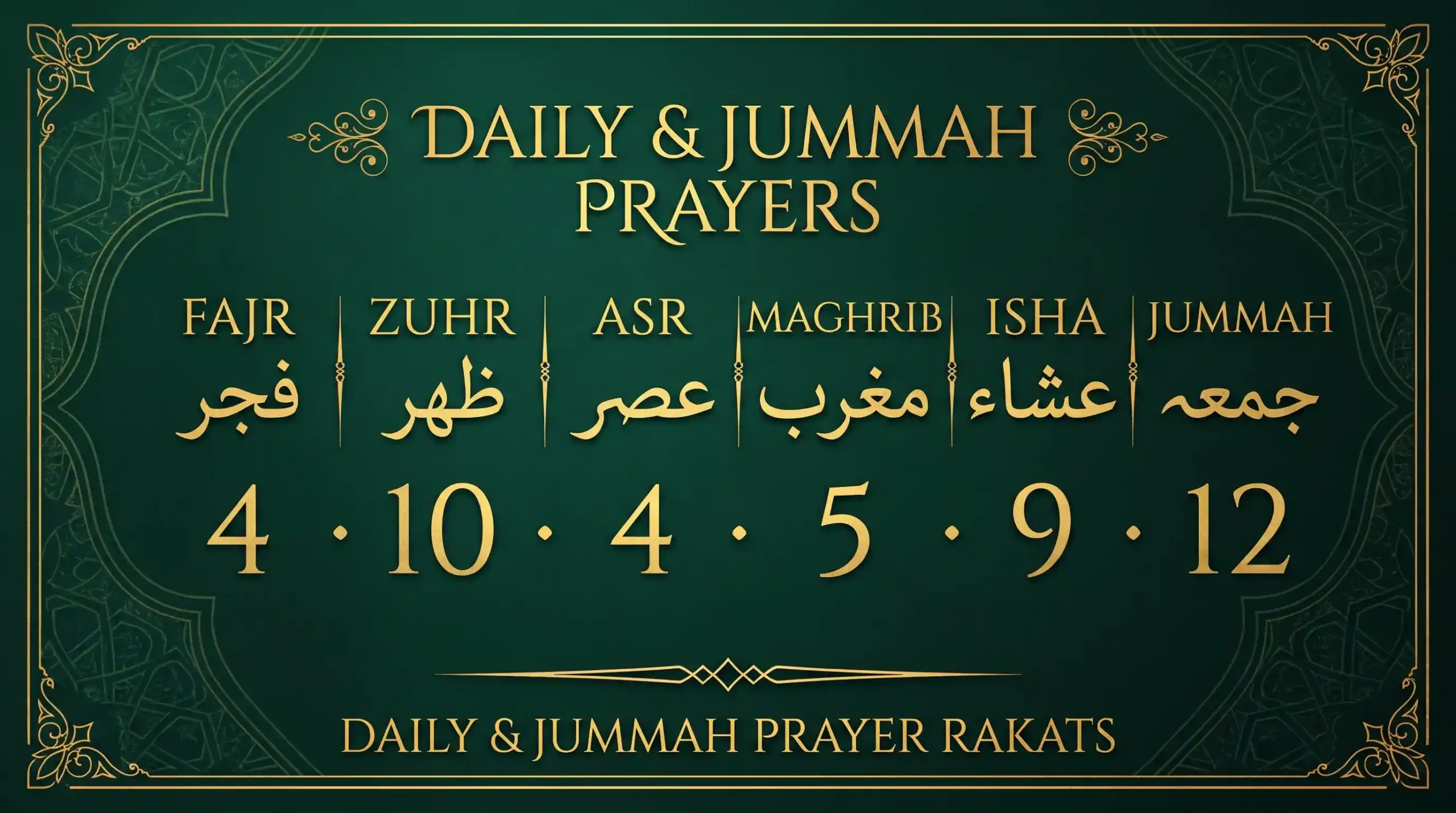
You are standing on the prayer mat, ready to begin, and one question stops you: how many rakat was it — was Asr four or eight, and does Isha end at nine, thirteen or seventeen? Almost every Muslim has frozen there, too embarrassed to ask. This guide settles the namaz rakat counts once, in one table, with proof for every number, following the Hanafi school, and noting where other schools differ.
Quick Answer
- The Hanafi chart in this guide counts what should not be skipped — fard, sunnah muakkadah and witr: 32 rakat a day: Fajr 4, Zuhar 10, Asr 4, Maghrib 5, Isha 9. The fard inside them is 17: 2, 4, 4, 3, 4.
- Jumma (the Friday prayer) replaces Zuhar that day: 2 fard rak’ahs with the imam, 12 on this chart (4 sunnah before, 2 fard, 4 + 2 sunnah after). Optional extras (sunnah ghayr muakkadah and nafl) can raise the day to 48 — they are tabled separately, never hidden inside the totals.
- Short on time or learning? Pray the fard first. The Prophet ﷺ told a new Muslim that five prayers in a day and night were his duty, and nothing more was obligatory (Sahih al-Bukhari 46).
Contents: What a rak’ah is · Namaz rakat table · Fajr namaz rakat · Zuhar namaz rakat · Asr namaz rakat · Maghrib namaz rakat · Isha namaz rakat · Jumma namaz rakat · Travelling and special prayers · Why charts differ · Mistakes to avoid · FAQs · Next steps
What is a rak’ah, and how many rakat fill a day?
A rak’ah is one complete unit of prayer: standing and reciting, one bowing (ruku’), and two prostrations (sujud), then rising or sitting to close it. Counted in rak’ahs, the essential Hanafi day holds thirty-two, built on seventeen obligatory rak’ahs that no school disputes.
Every rak’ah opens the same way: the opening takbir, then — in the first rak’ah only — the opening supplication, the Sana, Subhanakallahumma wa bihamdika; our Sana in namaz guide gives its words and meaning. Surah Al-Fatihah follows in every rak’ah, with a further passage added in the first two. Because the pattern never changes, the only thing to memorise for each prayer is a number. Why fixed counts at fixed hours? Allah says:
فَإِذَا قَضَيْتُمُ ٱلصَّلَوٰةَ فَٱذْكُرُوا۟ ٱللَّهَ قِيَـٰمًا وَقُعُودًا وَعَلَىٰ جُنُوبِكُمْ ۚ فَإِذَا ٱطْمَأْنَنتُمْ فَأَقِيمُوا۟ ٱلصَّلَوٰةَ ۚ إِنَّ ٱلصَّلَوٰةَ كَانَتْ عَلَى ٱلْمُؤْمِنِينَ كِتَـٰبًا مَّوْقُوتًا
English (Khattab, The Clear Quran): “When the prayers are over, remember Allah—whether you are standing, sitting, or lying down. But when you are secure, establish regular prayers. Indeed, performing prayers is a duty on the believers at the appointed times.” (Surah An-Nisa 4:103)
Urdu (Jalandhari):
پھر جب تم نماز تمام کرچکو تو کھڑے اور بیٹھے اور لیٹے (ہر حالت میں) خدا کو یاد کرو پھر جب خوف جاتا رہے تو (اس طرح سے) نماز پڑھو (جس طرح امن کی حالت میں پڑھتے ہو) بےشک نماز کا مومنوں پر اوقات (مقررہ) میں ادا کرنا فرض ہے
Namaz rakat table: every prayer at a glance
The namaz rakat table below gives the Hanafi chart for one day, in praying order: emphasized sunnah, the fard itself, then what follows it, with witr closing Isha. It counts thirty-two rak’ahs — the ones a Hanafi should not casually skip — and the optional extras sit beneath it.
| Prayer | Sunnah Muakkadah (Before) | Fard | Sunnah Muakkadah (After) | Witr | Total |
|---|---|---|---|---|---|
| Fajr | 2 | 2 | — | — | 4 |
| Zuhar | 4 | 4 | 2 | — | 10 |
| Asr | — | 4 | — | — | 4 |
| Maghrib | — | 3 | 2 | — | 5 |
| Isha | — | 4 | 2 | 3 | 9 |
Optional extras many Hanafis add — sunnah ghayr muakkadah and nafl, counted separately so the chart above stays clean:
| Prayer | This Chart | With Optional Extras |
|---|---|---|
| Fajr | 4 | 4 |
| Zuhar | 10 | 12 (adds 2 nafl) |
| Asr | 4 | 8 (adds 4 ghayr muakkadah before) |
| Maghrib | 5 | 7 (adds 2 nafl) |
| Isha | 9 | 17 (adds 4 ghayr muakkadah before, 2 nafl before witr, 2 after) |
| Jumma | 12 | 14 (adds 2 nafl) |
| Total (Day) | 32 | 48 |
Two terms unlock the table. Muakkadah means emphasized: sunnah prayers the Prophet ﷺ performed persistently and rarely left. Ghayr muakkadah means non-emphasized: prayers he performed often but sometimes left, so missing them carries no blame. Nafl is purely voluntary. Every disagreement between charts concerns those layers — never the fard.
This page teaches one memory framework: the 17–12–3 Lock. Seventeen fard are the lock itself. Twelve sunnah muakkadah guard it, and they are no estimate: the Prophet ﷺ listed them — four before Zuhar and two after it, two after Maghrib, two after Isha, two before Fajr — promising a house in Paradise to whoever prays them daily (Sahih Muslim 728a; Jami’ at-Tirmidhi 415, Sahih, Darussalam). Three witr close the night. Add them — 17 + 12 + 3 — and you get this chart’s day exactly: thirty-two.
The Rakat Chart Card (save this): Fard — 2 · 4 · 4 · 3 · 4 = 17. Guards — 2 before Fajr; 4 before and 2 after Zuhar; 2 after Maghrib; 2 after Isha = 12. Close — 3 witr after Isha. Chart day = 32: Fajr 4 · Zuhar 10 · Asr 4 · Maghrib 5 · Isha 9 · Jumma 12. Optional extras take the day to 48. Travelling = the three 4s become 2s. New to praying? Week one: the 17 fard alone. Week two: add the 12 guards. Week three: add witr. A small count prayed daily outweighs a heroic chart abandoned by Friday.
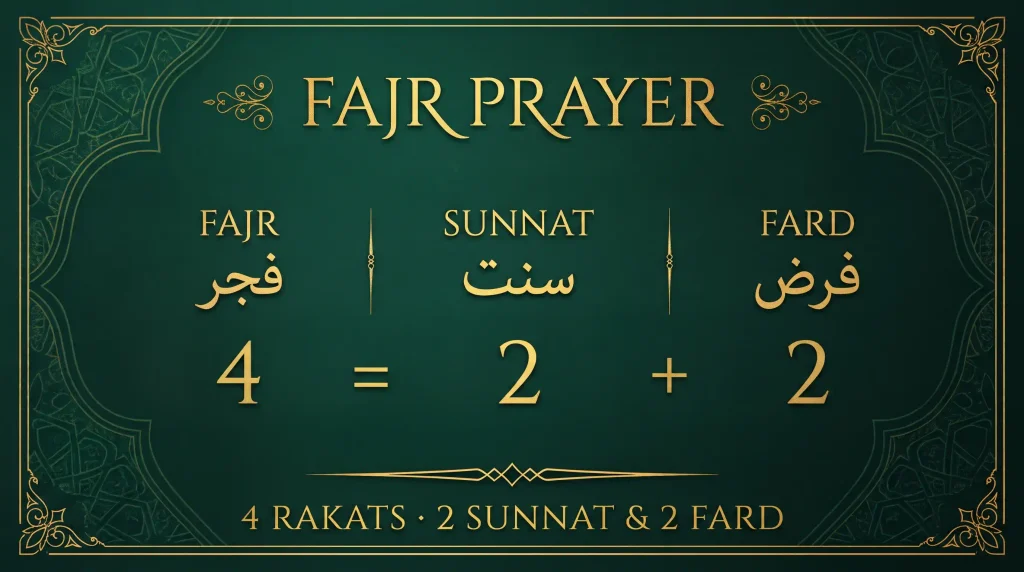
How many rakat in Fajr namaz?
Fajr namaz holds four rakat: two sunnah muakkadah rak’ahs first, prayed quietly on your own, then two fard rak’ahs, usually led by an imam in the mosque. Fajr is the shortest prayer of the day, and its two sunnah rak’ahs carry a reward described in unmatched terms.
| Stage | Rak’ahs | Type |
|---|---|---|
| Before fard | 2 | Sunnah muakkadah |
| Main prayer | 2 | Fard |
| Total | 4 | — |
Of those two dawn rak’ahs the Prophet ﷺ said: “The two rak’ahs at dawn are better than this world and what it contains” (Sahih Muslim 725a). He kept them even when travelling, when other sunnah prayers were left. Pray them at home before the mosque; for timings and the step-by-step method, see our Fajr prayer guide.
How many rakat in Zuhar namaz?
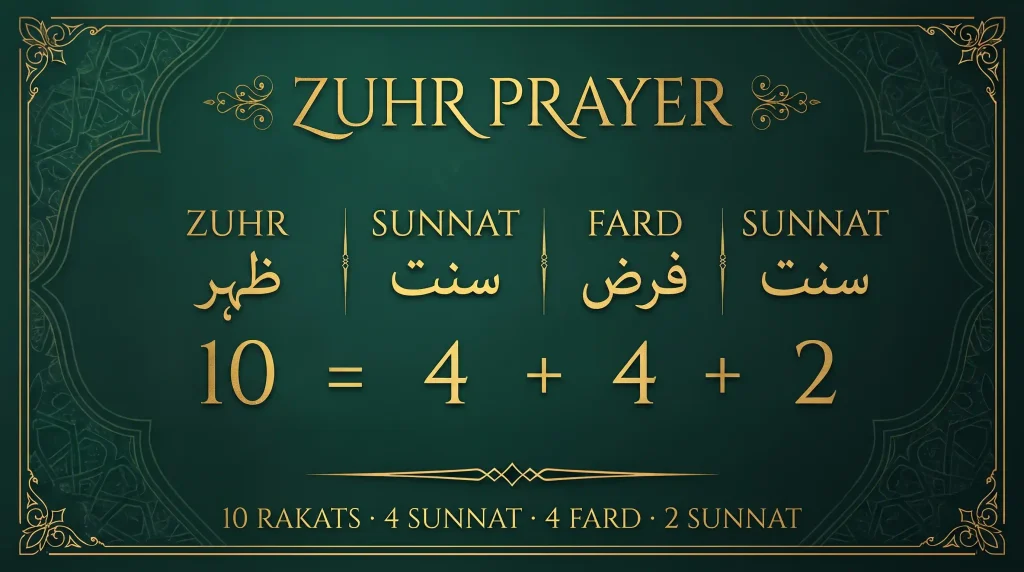
Zuhar namaz — also spelled Zuhr, and called Dhuhr in many books — holds ten rakat on the Hanafi chart: four sunnah muakkadah before the fard, the four fard rak’ahs, and two sunnah muakkadah after them. Two optional nafl rak’ahs at the end would take the count to twelve.
| Stage | Rak’ahs | Type |
|---|---|---|
| Before fard | 4 | Sunnah muakkadah |
| Main prayer | 4 | Fard |
| After fard | 2 | Sunnah muakkadah |
| Optional extra | 2 | Nafl (not counted) |
| Total | 10 | — |
Six of the twelve guarded rak’ahs in Tirmidhi 415 belong to Zuhar alone — four before, two after. The four before may be prayed as two pairs or one set of four. Zuhar is a silent prayer; its fard third and fourth rak’ahs hold Surah Al-Fatihah alone. Our Zuhr namaz rakat guide walks through each rak’ah.
How many rakat in namaz?
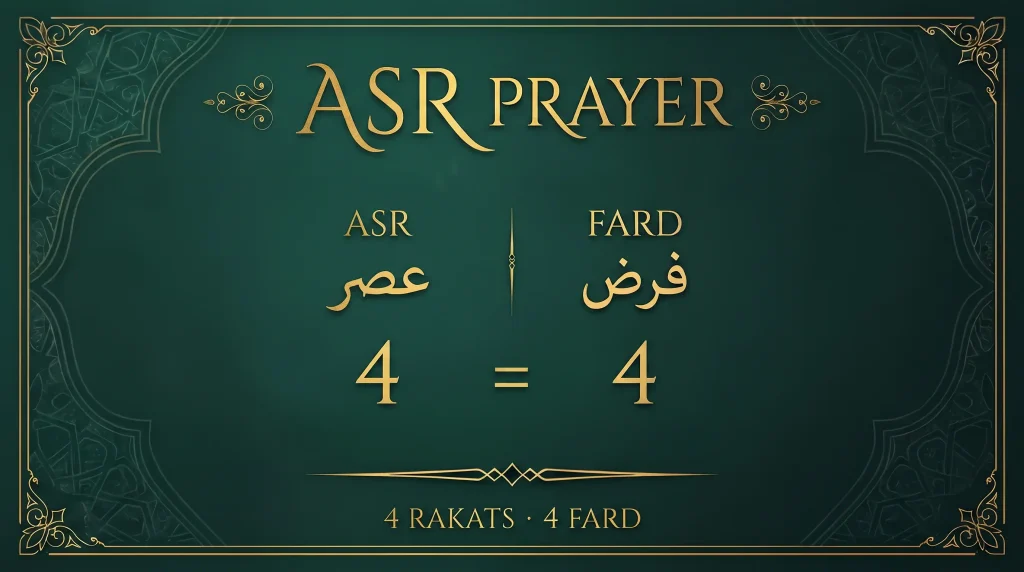
Asr namaz holds four rakat on the Hanafi chart: the four fard rak’ahs, and nothing counted before or after them. Four sunnah rak’ahs before it are prayed by many and rewarded, but they are ghayr muakkadah — non-emphasized — so this chart leaves Asr at four.
| Stage | Rak’ahs | Type |
|---|---|---|
| Optional before fard | 4 | Sunnah ghayr muakkadah (not counted) |
| Main prayer | 4 | Fard |
| Total | 4 | — |
The four before Asr rest on the Prophet’s ﷺ words: “May Allah have mercy upon a man who prays four before Al-Asr” (Jami’ at-Tirmidhi 430, Hasan, Darussalam) — a prayer for whoever prays them, not a command. One timing note: Hanafis begin Asr later than other schools, when a shadow reaches twice an object’s length. The count — four fard — is identical everywhere.
How many rakat in Maghrib namaz?
Maghrib namaz holds five rakat on the Hanafi chart: three fard rak’ahs first — the only fard prayer with an odd number — then two sunnah muakkadah rak’ahs. Two optional nafl rak’ahs would take it to seven. Maghrib has the shortest window of prayer, so its order matters most.
| Stage | Rak’ahs | Type |
|---|---|---|
| Main prayer | 3 | Fard |
| After fard | 2 | Sunnah muakkadah |
| Optional extra | 2 | Nafl (not counted) |
| Total | 5 | — |
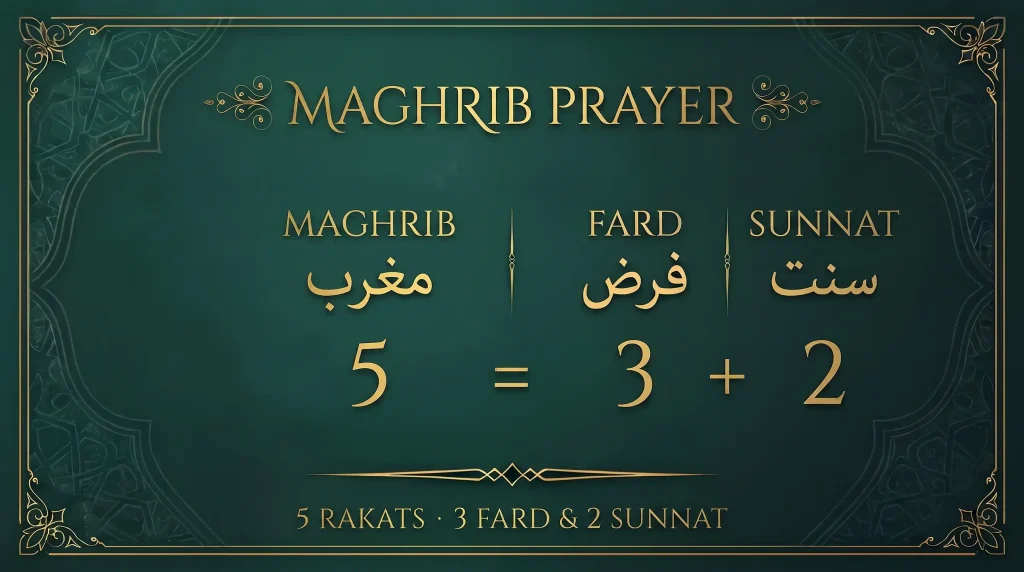
The three fard rak’ahs have a shape worth memorising: sit for the first tashahhud (the seated testimony) after the second rak’ah, then rise for a third rak’ah of Surah Al-Fatihah alone — a four-rak’ah pattern minus one rak’ah. Because the window runs only from sunset to fading twilight, pray Maghrib’s sunnah immediately after its fard.
How many rakat in Isha namaz?
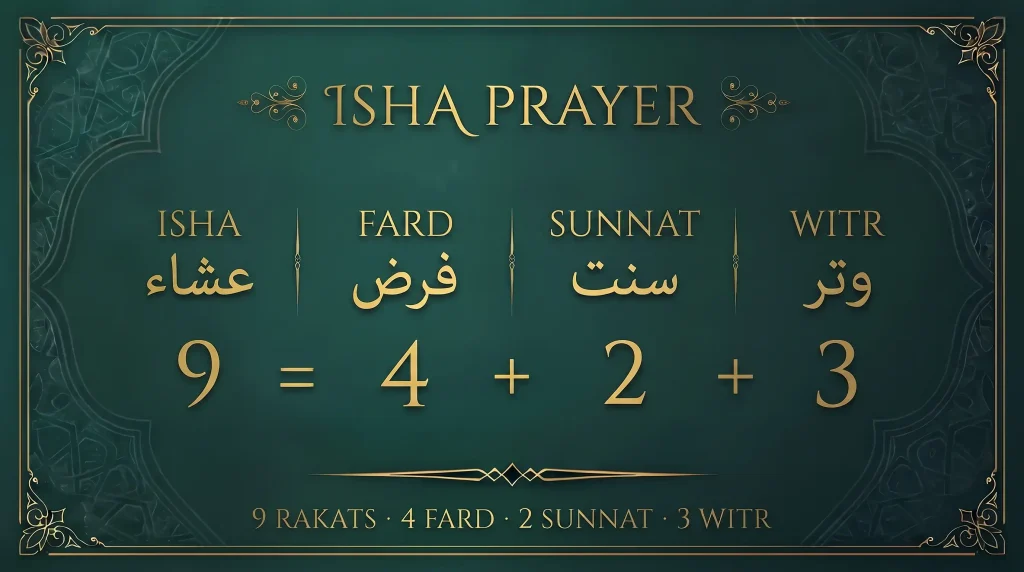
Isha namaz holds nine rakat on the Hanafi chart: four fard rak’ahs, two sunnah muakkadah after them, and three witr rak’ahs closing the night. With every optional extra added — four ghayr muakkadah before and four nafl around the witr — the same prayer stretches to seventeen.
| Stage | Rak’ahs | Type |
|---|---|---|
| Optional before fard | 4 | Sunnah ghayr muakkadah (not counted) |
| Main prayer | 4 | Fard |
| After fard | 2 | Sunnah muakkadah |
| Night closing | 3 | Witr (wajib) |
| Optional extras | 2 + 2 | Nafl, before and after witr (not counted) |
| Total | 9 | — |
Witr needs a plain ruling. In the Hanafi school it is wajib — necessary, just below fard — prayed as three rak’ahs with a sitting after the second and the Dua Qunoot in the third; in the other schools it is an emphasized sunnah. Its timing flexes: “If anyone is afraid that he may not get up in the latter part of the night, he should observe witr in the first part of it” (Sahih Muslim 755a). See our Isha rakats page and the Dua e Qunoot guide.
How many rakat in Jumma namaz?
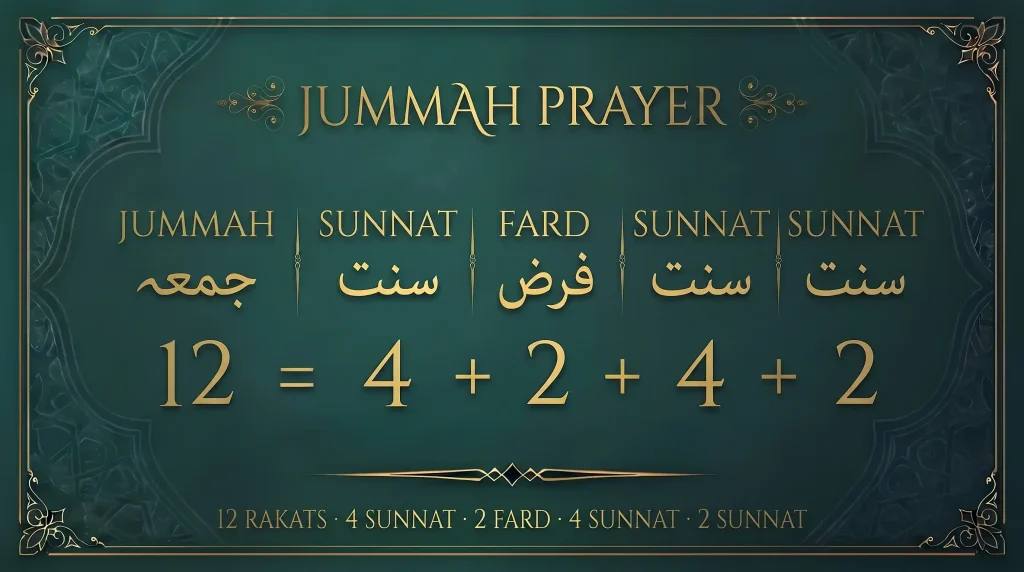
Jumma namaz — Jumu’ah, the Friday prayer — holds two fard rak’ahs, prayed with the imam after the khutbah (sermon), in place of that day’s Zuhar. The Hanafi chart around it totals twelve: four sunnah muakkadah before, the two fard, then four sunnah muakkadah and two more sunnah afterwards.
| Stage | Rak’ahs | Type |
|---|---|---|
| Before khutbah | 4 | Sunnah muakkadah |
| With the imam | 2 | Fard |
| After fard | 4 | Sunnah muakkadah |
| After that | 2 | Sunnah muakkadah |
| Optional extra | 2 | Nafl (not counted) |
| Total | 12 | — |
يَـٰٓأَيُّهَا ٱلَّذِينَ ءَامَنُوٓا۟ إِذَا نُودِىَ لِلصَّلَوٰةِ مِن يَوْمِ ٱلْجُمُعَةِ فَٱسْعَوْا۟ إِلَىٰ ذِكْرِ ٱللَّهِ وَذَرُوا۟ ٱلْبَيْعَ ۚ ذَٰلِكُمْ خَيْرٌ لَّكُمْ إِن كُنتُمْ تَعْلَمُونَ
English (Khattab, The Clear Quran): “O believers! When the call to prayer is made on Friday, then proceed ˹diligently˺ to the remembrance of Allah and leave off ˹your˺ business. That is best for you, if only you knew.” (Surah Al-Jumu’ah 62:9)
Urdu (Jalandhari):
مومنو! جب جمعے کے دن نماز کے لئے اذان دی جائے تو خدا کی یاد (یعنی نماز) کے لئے جلدی کرو اور (خریدو) فروخت ترک کردو۔ اگر سمجھو تو یہ تمہارے حق میں بہتر ہے
The Prophet ﷺ fixed the after-Jumu’ah count himself: “When any one of you observes the Jumu’a prayer (two obligatory rak’ahs in congregation), he should observe four (rak’ahs) afterwards” (Sahih Muslim 881a). Two honest notes. The four sunnah before the khutbah are Hanafi emphasized practice; other schools encourage voluntary prayer on arrival without fixing four. Two optional nafl rak’ahs after the sunnahs take the count to fourteen, as many Hanafi books print. And Jumu’ah is obligatory for adult men who are resident and able; women, travellers and anyone who misses the congregation pray Zuhar’s four fard instead.
What changes when you travel, and which prayers sit outside the daily table?
When a Hanafi Muslim travels beyond the sharia distance (roughly 77 km, or 48 miles) and stays fewer than fifteen days, the four-rak’ah fard prayers — Zuhar, Asr and Isha — shorten to two; Fajr, Maghrib and witr never change. Eid, Janaza, Taraweeh and Tahajjud stand outside the daily table entirely.
وَإِذَا ضَرَبْتُمْ فِى ٱلْأَرْضِ فَلَيْسَ عَلَيْكُمْ جُنَاحٌ أَن تَقْصُرُوا۟ مِنَ ٱلصَّلَوٰةِ إِنْ خِفْتُمْ أَن يَفْتِنَكُمُ ٱلَّذِينَ كَفَرُوا۟ ۚ إِنَّ ٱلْكَـٰفِرِينَ كَانُوا۟ لَكُمْ عَدُوًّا مُّبِينًا
English (Khattab, The Clear Quran): “When you travel through the land, it is permissible for you to shorten the prayer—˹especially˺ if you fear an attack by the disbelievers. Indeed, the disbelievers are your sworn enemies.” (Surah An-Nisa 4:101)
Urdu (Jalandhari):
اور جب تم سفر کو جاؤ تو تم پر کچھ گناہ نہیں کہ نماز کو کم کرکے پڑھو بشرطیکہ تم کو خوف ہو کہ کافر لوگ تم کو ایذا دیں گے بےشک کافر تمہارے کھلے دشمن ہیں
This shortening is called qasr. The Prophet ﷺ shortened on safe journeys too and called it a charity from Allah to be accepted (Sahih Muslim 686a) — so travellers shorten in safety as in hardship.
| Special Prayer | Rak’ahs | When |
|---|---|---|
| Eid (Fitr and Adha) | 2, with extra takbirs | Eid morning, in congregation |
| Janaza (funeral) | 0 — four takbirs standing, no bowing or prostration | When a Muslim dies |
| Taraweeh | 20 (Hanafi practice) | Ramadan nights, after Isha |
| Tahajjud | 2 or more, in pairs | Last part of the night, after sleeping |
The funeral prayer surprises people most: Namaz Janaza contains no rak’ah at all — just four takbirs standing — which is why it never appears in rakat charts. Taraweeh’s twenty are the Hanafi communal practice set under Umar; eight plus witr is also widely prayed, and our Taraweeh guide treats that fairly. Tahajjud begins with a single pair. A missed prayer is made up later at its usual fard count, as our Qaza namaz guide explains.
Why do some rakat charts give different totals?
Charts differ because they count different layers, not because anyone disagrees about the fard. Every school and every honest chart gives Fajr two, Zuhar four, Asr four, Maghrib three and Isha four. Totals move only when a chart adds, drops or re-labels sunnah ghayr muakkadah, nafl or witr rak’ahs.
Test it on Isha. Nine counts this chart’s layers: fard, emphasized sunnah and witr. Thirteen adds the four ghayr muakkadah before the fard. Fifteen adds one nafl pair as well; seventeen counts both nafl pairs. Four totals, one identical prayer. Jumma’s twelve-versus-fourteen is the same story: a single optional nafl pair. Two real school differences remain: witr is wajib for Hanafis and emphasized sunnah elsewhere, and Taraweeh is fixed at twenty in Hanafi communal practice while many follow the Prophet’s ﷺ shorter personal pattern. Neither touches a single fard rak’ah.
What mistakes do people make with rakat counts?
The commonest rakat mistake is treating every number on a chart as obligatory, then giving up when thirty-two feels impossible. The fard is seventeen. Most other mistakes are smaller: praying witr before Isha, sitting in the wrong place in Maghrib, or counting a traveller’s shortened prayer as invalid.
Four more reach this site often. Praying Fajr’s sunnah after sunrise by habit, when it belongs before the fard. Leaving the mosque on Friday straight after the two fard, before the four of Muslim 881a. Assuming Asr has no sunnah at all, and never meeting the mercy promised in Tirmidhi 430. And the quietest mistake: asking no one for years because the question felt too basic — when the man in Bukhari 46 asked the Prophet ﷺ face to face what was due from him, and was praised for asking.
Frequently asked questions
How many rakat in Fajr namaz?
Fajr namaz has four rakat in the Hanafi pattern: two sunnah muakkadah rak’ahs prayed first, then two fard rak’ahs. The fard alone is the obligation; the two sunnah before it are the pair the Prophet ﷺ called better than the world and everything it contains (Sahih Muslim 725a).
How many rakat in Zuhar namaz?
Zuhar namaz has ten rakat on the Hanafi chart: four sunnah muakkadah, four fard and two sunnah muakkadah. Two optional nafl rak’ahs at the end would make twelve. On Friday, Zuhar is replaced by the two fard rak’ahs of Jumma for everyone who attends the congregation.
How many rakat in Asr namaz?
Asr namaz has four rakat on the Hanafi chart: the four fard rak’ahs alone. Four sunnah rak’ahs before it are prayed by many and carry a promise of mercy (Tirmidhi 430), but they are ghayr muakkadah — non-emphasized — so the chart counts Asr as four, or eight with them.
How many rakat in Maghrib namaz?
Maghrib namaz has five rakat: three fard and two sunnah muakkadah; two optional nafl would make seven. Its three fard rak’ahs make it the only obligatory prayer with an odd count, and you sit for tashahhud after the second rak’ah before rising for a third of Al-Fatihah alone.
How many rakat in Isha namaz?
Isha namaz has nine rakat on the Hanafi chart: four fard, two sunnah muakkadah and three witr. Charts showing thirteen, fifteen or seventeen have added the optional layers — four ghayr muakkadah before the fard and nafl pairs around the witr. The fard across every chart stays four.
How many rakat in Jumma namaz?
Jumma namaz has two fard rak’ahs, prayed with the imam after the Friday khutbah in place of Zuhar. The Hanafi chart totals twelve: four sunnah muakkadah before, the two fard, four sunnah muakkadah after and two more sunnah. The Prophet ﷺ specified four rak’ahs after Jumu’ah (Muslim 881a).
How many rakat are there in a full day of namaz?
A full day on the Hanafi chart holds thirty-two rakat: Fajr four, Zuhar ten, Asr four, Maghrib five and Isha nine. Seventeen are fardrd — two, four, four, three, four. Twelve are the emphasized sunnah guards, and three are witr. Optional extras can raise the day to forty-eight.
What if I only pray the fard rakat?
Your prayer is valid and your obligation is met. The Prophet ﷺ told a questioner that five prayers in a day and night were his duty, nothing further obligatory unless he volunteered it, and promised him success for holding to it (Sahih al-Bukhari 46). Add sunnah layers gradually, without guilt.
Next steps
- Begin tonight with Isha on the chart — nine rak’ahs that close the day inside the Lock.
- Keep the habit with the dua after salah — the words taught for the moments right after each prayer.
- Pray for consistency itself with Rabbi jalni muqimas salati — Ibrahim’s dua for a family established in prayer (Quran 14:40).
