You scroll past a hundred small mercies before breakfast. The light came on. Water ran. Your lungs worked all night without asking you once. Most days none of it registers, because a favour you see every day slowly turns invisible. Surah Luqman ayat 20 is the verse that turns them visible again: Allah says He has put everything in the heavens and the earth at your service, and poured His favours over you, seen and unseen. Read it slowly once, and the ordinary day starts to look crowded with gifts.
Quick Answer
- Surah Luqman ayat 20 (31:20) says Allah has made everything in the heavens and on earth serve your benefit, and poured His favours over you, seen and unseen.
- Its twin verse, Surah Al-Hajj 22:65, adds the ships sailing by His command and the sky held back from falling.
- No authentic source gives a wazifa count for this verse. Its practice is gratitude: the Seen, Unseen and Held Check.
Start here: New to Islam? Go to what the verse means. Returning to practice? Go to the two-minute Check. Sent this link by a friend? Start with the twin verse.
What does Surah Luqman ayat 20 mean?
Surah Luqman ayat 20 means that Allah has made everything in the heavens and on earth serve your benefit, and has poured His favours over you, the ones you can see and the ones you cannot. Yet some people still argue about Allah with no knowledge behind the argument.
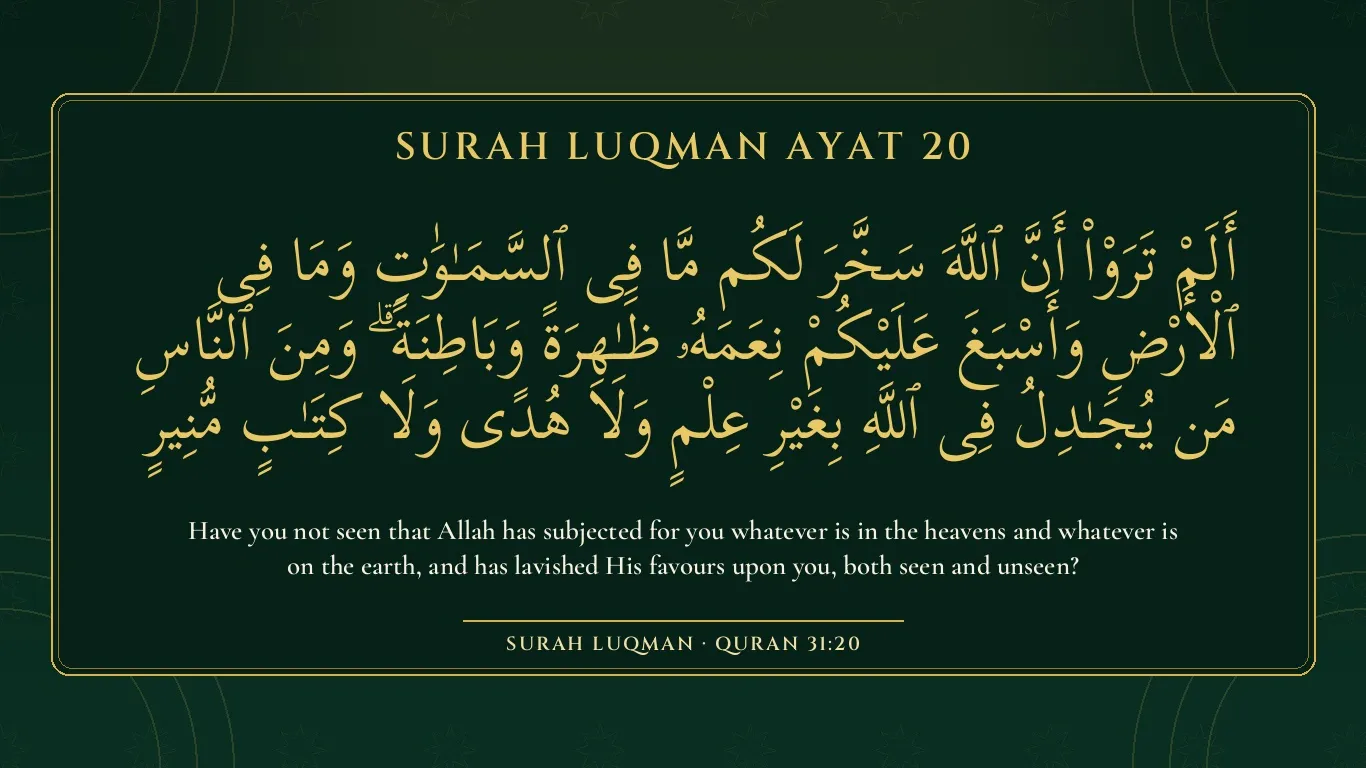
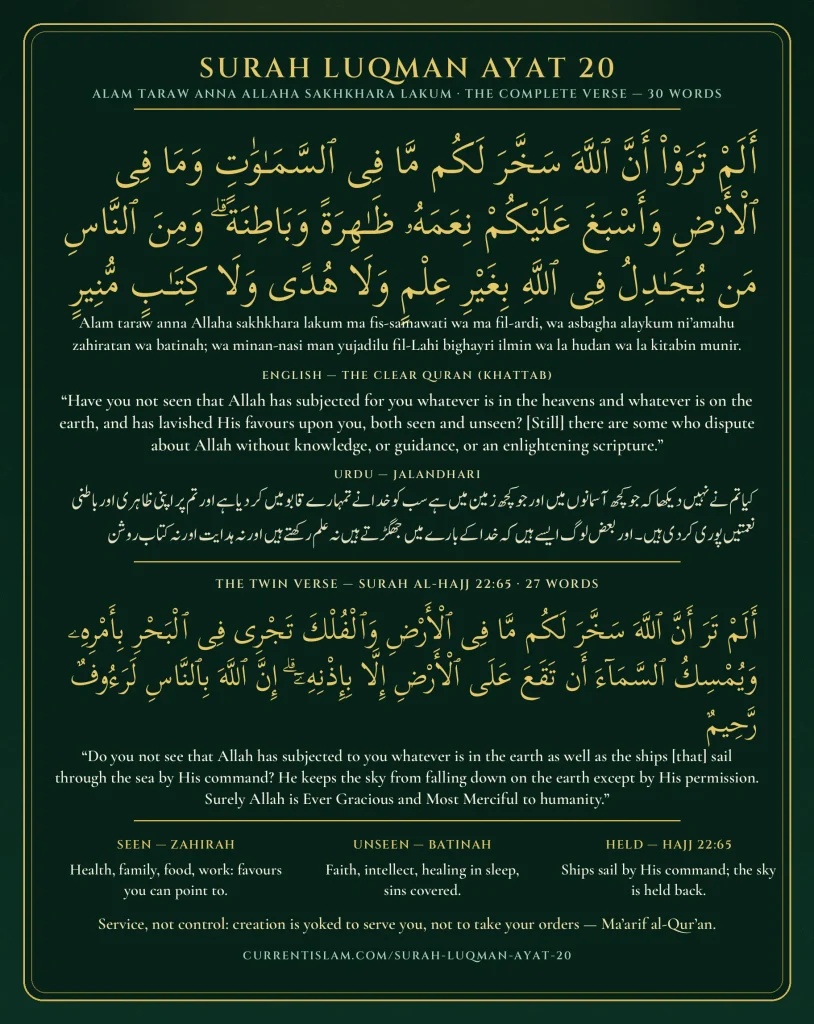
أَلَمْ تَرَوْا۟ أَنَّ ٱللَّهَ سَخَّرَ لَكُم مَّا فِى ٱلسَّمَـٰوَٰتِ وَمَا فِى ٱلْأَرْضِ وَأَسْبَغَ عَلَيْكُمْ نِعَمَهُۥ ظَـٰهِرَةً وَبَاطِنَةً ۗ وَمِنَ ٱلنَّاسِ مَن يُجَـٰدِلُ فِى ٱللَّهِ بِغَيْرِ عِلْمٍ وَلَا هُدًى وَلَا كِتَـٰبٍ مُّنِيرٍ
Alam taraw anna Allaha sakhkhara lakum ma fis-samawati wa ma fil-ardi, wa asbagha alaykum ni’amahu zahiratan wa batinah; wa minan-nasi man yujadilu fil-Lahi bighayri ilmin wa la hudan wa la kitabin munir.
“Have you not seen that Allah has subjected for you whatever is in the heavens and whatever is on the earth, and has lavished His favours upon you, both seen and unseen? ˹Still˺ there are some who dispute about Allah without knowledge, or guidance, or an enlightening scripture.” — Surah Luqman 31:20, The Clear Quran (Khattab)
— Urdu translation (Jalandhari)
کیا تم نے نہیں دیکھا کہ جو کچھ آسمانوں میں اور جو کچھ زمین میں ہے سب کو خدا نے تمہارے قابو میں کر دیا ہے اور تم پر اپنی ظاہری اور باطنی نعمتیں پوری کردی ہیں۔ اور بعض لوگ ایسے ہیں کہ خدا کے بارے میں جھگڑتے ہیں نہ علم رکھتے ہیں اور نہ ہدایت اور نہ کتاب روشن
The verse opens with a question, not a command: alam taraw, “have you not seen?” Seeing here is not only eyesight. The question treats the evidence as so clear that not seeing it is the surprise. Ibn Kathir, in the abridged tafsir on Quran.com, calls this passage a reminder of blessings: in the heavens, stars, clouds, rain, snow and hail; on earth, rivers, trees, crops and fruit, and ground made stable under your feet.
Notice where the verse sits. Luqman’s own advice to his son ends one verse earlier. Then the camera pulls back from one father’s counsel to the whole of creation. The order is the argument: first the evidence, spread across sky and earth, then the warning about arguing without it.
What does sakhkhara lakum mean — service, not control?
Sakhkhara lakum means Allah commissioned creation to work for your benefit. It does not mean He handed you the controls. Rain, sun and seasons serve you every day, yet none of them takes your orders, and that distance is itself part of the mercy, as the classical commentators explain below.
Mufti Muhammad Shafi, in Ma’arif al-Qur’an, asks the obvious question: how can the heavens be subjected to us when the sun does not rise a minute early because we ask? His answer draws a line this article will keep returning to. Subjugation here means a thing is yoked to a job that benefits you. Some things were also placed under your command, to use as you wish. Others, like the sun, the rain and the stars, were commissioned to serve you without taking your instructions. You say this same root on every journey in the safar ki dua: glory to the One who subjected this mount to us.
Had the rain obeyed people, one farmer would call it down while a traveller in the open field begged it away, and the system that feeds both would break. So you receive the service without holding the controls. That distinction protects the verse from two errors: imagining creation is your property, and imagining the verse is mere poetry.
What are the seen and unseen favours?
The seen favours are the ones you could list today: health, family, work, food, a home. The unseen favours work in the background: a body repairing itself while you sleep, knowledge and intellect, and, as Ma’arif al-Qur’an lists them, sins left unexposed and not punished on the spot.
The Arabic verb is asbagha: He poured in full measure, completely, the way water is poured until nothing is held back. Paired with it, the verse splits those favours into zahirah, apparent, and batinah, hidden. Ma’arif al-Qur’an places provisions, health and wellbeing among the apparent ones, and puts iman, faith, intellect, reason and good character among the hidden ones. One hidden favour on its list deserves a pause: your faults covered, not displayed.
This is where the verse becomes personal in a Luqman-shaped way. Two passages earlier in the same surah, a parent is told to thank Allah and thank your parents. Verse 20 widens that same gratitude from the home to the whole sky. And a few verses earlier, Luqman’s son learns that Allah knows a mustard seed hidden inside a rock: the God who sees the unseen is the same One giving unseen favours.
Surah Al-Hajj 22:65 — the twin verse
Surah Al-Hajj 22:65 is the twin of our verse, opening with the same words in the singular: Allah has subjected to you whatever is in the earth, and the ships that sail the sea by His command, and He holds the sky back from falling.
أَلَمْ تَرَ أَنَّ ٱللَّهَ سَخَّرَ لَكُم مَّا فِى ٱلْأَرْضِ وَٱلْفُلْكَ تَجْرِى فِى ٱلْبَحْرِ بِأَمْرِهِۦ وَيُمْسِكُ ٱلسَّمَآءَ أَن تَقَعَ عَلَى ٱلْأَرْضِ إِلَّا بِإِذْنِهِۦٓ ۗ إِنَّ ٱللَّهَ بِٱلنَّاسِ لَرَءُوفٌ رَّحِيمٌ
Alam tara anna Allaha sakhkhara lakum ma fil-ardi wal-fulka tajri fil-bahri bi-amrih, wa yumsikus-sama’a an taqa’a alal-ardi illa bi-iznihi; inna Allaha bin-nasi la-Ra’ufur-Rahim.
“Do you not see that Allah has subjected to you whatever is in the earth as well as the ships ˹that˺ sail through the sea by His command? He keeps the sky from falling down on the earth except by His permission. Surely Allah is Ever Gracious and Most Merciful to humanity.” — Surah Al-Hajj 22:65, The Clear Quran (Khattab)
— Urdu translation (Jalandhari)
کیا تم نہیں دیکھتے کہ جتنی چیزیں زمین میں ہیں (سب) خدا نے تمہارے زیرفرمان کر رکھی ہیں اور کشتیاں (بھی) جو اسی کے حکم سے دریا میں چلتی ہیں۔ اور وہ آسمان کو تھامے رہتا ہے کہ زمین پر (نہ) گڑ پڑے مگر اس کے حکم سے۔ بےشک خدا لوگوں پر نہایت شفقت کرنے والا مہربان ہے
Only the address narrows, from “you all” to “you.” Then the two verses part company. Luqman spreads the canvas across heavens and earth and ends with the unseen favours and the baseless argument. Hajj stays on earth, names one working example, the ships, and adds a second kind of mercy Luqman does not mention: restraint. The same Lord who releases the ships to sail also holds the sky in place, and the verse calls both acts by one closing description: surely Allah is Ever Gracious and Most Merciful to humanity.
Read together, the pair corrects a half-picture. We usually count mercy as what arrives: the rain, the cargo, the safe crossing. Hajj asks you to also count what never arrives, the disaster held back above your head while you walked under it, unaware. One verse earlier, the surah states that everything in the heavens and earth belongs to Him; one verse later, that He gave you life itself. Between ownership and life stands service. The same preservation is named in Ayatul Kursi: His Kursi extends over the heavens and the earth, and guarding them does not tire Him.
Why does the verse end with people who argue about Allah?
The verse ends with the person who disputes about Allah without knowledge, guidance or an enlightening book, meaning a revealed scripture that gives light. After listing favours that surround everyone, the verse treats arguing from ignorance, not questioning itself, as the failure, and it names the three missing credentials.
Those three missing things map neatly onto three habits. Knowledge means learning before speaking about Allah: what He actually said, in context. Guidance means letting a trustworthy teacher correct you, rather than collecting opinions that agree with you. A book giving light means returning to the Quran itself when a family chat argument about religion heats up, instead of trading screenshots. The next verse shows the alternative the surah rejects: “we will follow what we found our fathers doing,” even, Allah asks, if Satan were inviting them to the punishment of the Blaze?
This is not a ban on honest questions. A new Muslim asking why is doing the opposite of what the verse rebukes. The rebuke lands on confidence without evidence. It is also why honesty about religious claims matters here: a made-up benefit, or lying for the sake of Islam, is still speaking about Allah without knowledge.
The Seen, Unseen and Held Check — a two-minute practice
The Seen, Unseen and Held Check is a two-minute practice built only from these two verses. Before sleep, name one favour you saw today, one favour that worked unseen, and one harm or chaos held back from you. Then thank Allah for the three of them by name.
The Seen, Unseen and Held Card — save this
- Seen: one favour you noticed today. Say it by name.
- Unseen: one favour that worked in the background. Say it by name.
- Held: one harm, delay or disaster that never reached you. Say it by name.
- Thank Allah for the three of them, then sleep.
7-day tracker: Seen / Unseen / Held — one line a day, seven lines a week.
Keep it concrete or it fades into a slogan. Seen: the colleague who covered your shift, the train that ran on time. Unseen: the headache that lifted on its own, the message you almost sent in anger and did not. Held: the storm that passed your street by, the sky itself, in the Hajj verse’s own example, still in its place. Within a week you start collecting evidence during the day for the list you will make at night.
The practice needs no count. Neither verse sets a number of repetitions, a time of day, or a reward per sitting, so this article sets none either. Before sleep is only a suggestion, chosen because the day is complete by then and its favours can be counted honestly. If mornings suit you better, after Fajr works the same way.
Common mistakes with this verse
Three mistakes gather around this verse. The first is reading “subjected to you” as a licence to waste or abuse creation; service is a trust, and Luqman’s son was taught humility in his walk one verse earlier. The second mistake is counting only visible blessings, then concluding on a hard day that the favours have stopped, when the verse insists the hidden half never stopped. The third is using the verse to end arguments, quoting “without knowledge” at anyone who disagrees with you, while skipping the learning the verse actually requires.
Honest limits: is there a wazifa for Surah Luqman ayat 20?
Now the plain limits, because this site states them on every verse. No authentic source we opened promises that reciting Surah Luqman ayat 20 a set number of times brings wealth, success or protection, and no such count appears in the verse, in Ibn Kathir, or in Ma’arif al-Qur’an. If a page or video offers you a number, it is not from these sources. What the verse does promise is a way of seeing. It also never says the favours are payment for good behaviour: they were poured over people who argue about Allah too, which is the whole force of its closing rebuke.
Word-by-word breakdown of Surah Luqman ayat 20
| # | Arabic | Transliteration | Meaning |
|---|---|---|---|
| 1 | أَلَمْ | alam | Have not |
| 2 | تَرَوْا۟ | taraw | you (all) see |
| 3 | أَنَّ | anna | that |
| 4 | ٱللَّهَ | Allaha | Allah |
| 5 | سَخَّرَ | sakhkhara | has subjected, made serviceable |
| 6 | لَكُم | lakum | for you |
| 7 | مَّا | ma | whatever |
| 8 | فِى | fi | is in |
| 9 | ٱلسَّمَـٰوَٰتِ | as-samawati | the heavens |
| 10 | وَمَا | wa ma | and whatever |
| 11 | فِى | fi | is in |
| 12 | ٱلْأَرْضِ | al-ardi | the earth |
| 13 | وَأَسْبَغَ | wa asbagha | and He lavished in full |
| 14 | عَلَيْكُمْ | alaykum | upon you |
| 15 | نِعَمَهُۥ | ni’amahu | His favours |
| 16 | ظَـٰهِرَةًۭ | zahiratan | apparent, seen |
| 17 | وَبَاطِنَةًۭ ۗ | wa batinatan | and hidden, unseen |
| 18 | وَمِنَ | wa mina | and among |
| 19 | ٱلنَّاسِ | an-nasi | the people |
| 20 | مَن | man | is one who |
| 21 | يُجَـٰدِلُ | yujadilu | disputes, argues |
| 22 | فِى | fi | about |
| 23 | ٱللَّهِ | Allahi | Allah |
| 24 | بِغَيْرِ | bighayri | without |
| 25 | عِلْمٍۢ | ilmin | knowledge |
| 26 | وَلَا | wa la | and without |
| 27 | هُدًۭى | hudan | guidance |
| 28 | وَلَا | wa la | and without |
| 29 | كِتَـٰبٍۢ | kitabin | a book, scripture |
| 30 | مُّنِيرٍۢ | munirin | enlightening |
Surah Luqman ayat 20 and Surah Al-Hajj 22:65, side by side
| Point of Comparison | Surah Luqman 31:20 | Surah Al-Hajj 22:65 |
|---|---|---|
| Address | “you all” (plural) | “you” (singular) |
| Scope | Heavens and earth | Earth, then ships at sea |
| Words | 30 | 27 |
| Unique Gift | Favours lavished, seen and unseen | The sky held back from falling |
| Closing | The baseless argument about Allah | Allah is Ra’uf (Ever Gracious), Rahim (Most Merciful) |
| Next Verse | Blind following of forefathers (31:21) | He gave you life, yet man is ungrateful (22:66) |
Frequently asked questions
It means Allah has commissioned everything in the heavens and on earth to work for your benefit. As Ma’arif al-Qur’an explains, some things also obey your direct use, while others, like rain and the sun, serve you daily without ever taking your orders or answering to your timetable.
The seen favours are the blessings you can point to: health, family, food, work, safety and the practice of your faith. The unseen favours work quietly behind them: intellect, faith in your heart, a body healing while you sleep, and sins covered instead of exposed before people.
Both open with the same words, but Luqman addresses people in the plural and covers the heavens and the earth, ending with favours seen and unseen. Hajj addresses one person, stays on earth, names the ships sailing by Allah’s command, and adds the sky held back from falling.
No. No source opened for this article, not the verse itself, not Ibn Kathir, and not Ma’arif al-Qur’an, gives any fixed number of recitations, any number of days, or any promised result for repeating this verse. Any count you meet elsewhere was added later by people, without evidence.
Because the favours are the evidence, and the argument ignores it. The verse says some people dispute about Allah’s oneness and His messengers without knowledge, without guidance from a trustworthy teacher, and without a revealed book giving light, then the next verse shows them following their forefathers instead.
Use the Seen, Unseen and Held Check before sleep. Name one favour you noticed today, one favour that worked quietly in the background, and one harm that never reached you. Thank Allah for each by name. Two minutes is enough, and no fixed repetition count is required by the verse.
In Jalandhari’s Urdu translation, it says that Allah has put everything in the heavens and the earth under your service and completed His apparent and hidden blessings upon you, yet some people argue about Allah without knowledge, guidance, or a shining book. The full Urdu text is quoted above.
Luqman is the wise man whose counsel to his son fills the middle of this surah, and Allah says in verse twelve that He gave Luqman wisdom, beginning with gratitude to Allah. Verse twenty widens that family lesson to all people, turning one father’s teaching into universal evidence.
Next step
- Read the warning that opens Luqman’s counsel: Surah Luqman ayat 13 on shirk
- Continue the counsel one verse past our passage’s neighbour: Luqman ayat 17 on patience
- See the ownership line behind both twin verses: Surah Baqarah last 3 ayat
If this verse helped you see a favour you had stopped noticing, send this to someone who needs it tonight.
