
When you are waiting for the London Tube at 8 AM GMT or navigating heavy traffic in New York City on a busy Tuesday morning, the modern world can feel overwhelmingly chaotic. Between endless notifications and tight schedules, finding spiritual clarity often feels impossible. Yet, Islamic tradition offers profound anchors of divine wisdom that cut through the noise. If you have ever wondered why certain specific numbers appear in the Quran, or if you are searching for the deeper meaning behind the Quran verse about numbers 31, you are looking at one of the most fascinating tests of faith in Islam.
Here is why this matters for you. The Quran does not just offer spiritual comfort; it provides a sharp intellectual framework that applies directly to our modern lives. Let’s break down the divine wisdom behind these verses and how they help Western Muslims navigate daily life.
What Is the Quran Verse About Numbers 31?
The most prominent Quran verse mentioning the philosophy of numbers is Surah Al-Muddaththir, Chapter 74, Verse 31. This verse explains that Allah uses specific numbers, like the 19 angels guarding Hell, as a spiritual test for humanity’s faith and intellect.
When the Prophet Muhammad (PBUH) revealed the specific number of angels guarding the Hellfire, skeptics immediately mocked it. Why 19? Why not 20? This verse was revealed to clarify that numbers in the Quran serve as a diagnostic tool for the human heart.
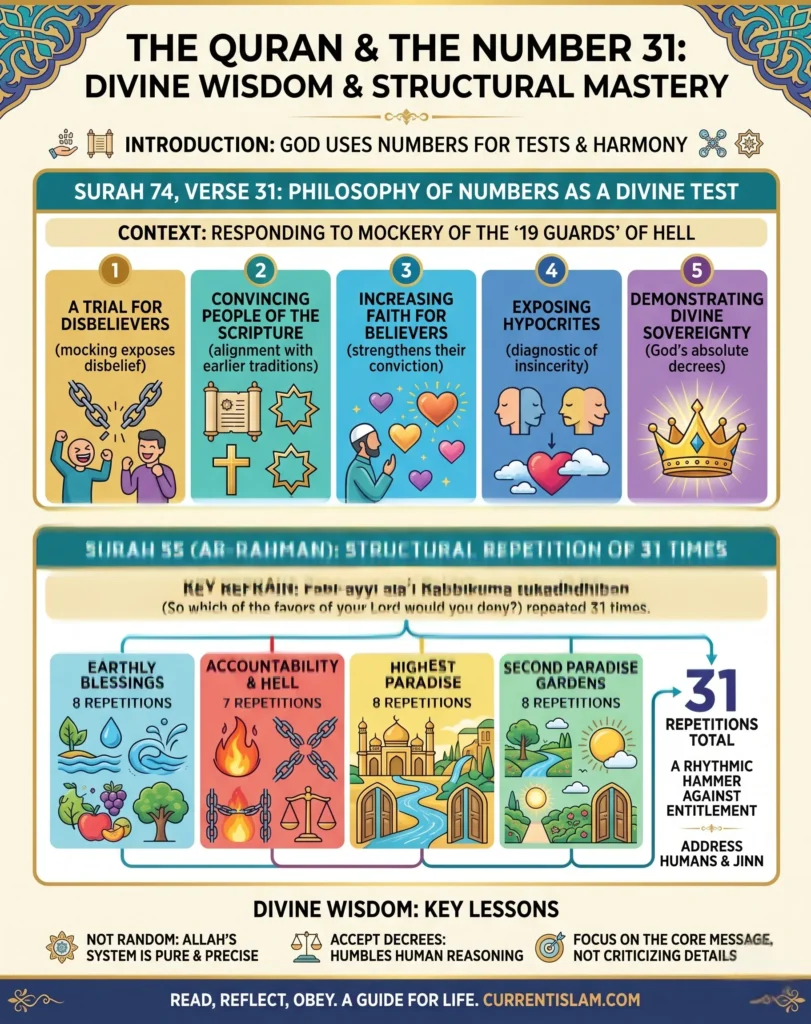
Surah Al-Muddaththir (74:31) – The Core Segment:
Arabic:
وَمَا جَعَلْنَآ أَصْحَـٰبَ ٱلنَّارِ إِلَّا مَلَـٰٓئِكَةً ۙ وَمَا جَعَلْنَا عِدَّتَهُمْ إِلَّا فِتْنَةً لِّـلَّذِينَ كَفَرُوا۟ لِيَسْتَيْقِنَ ٱلَّذِينَ أُوتُوا۟ ٱلْكِتَـٰبَ وَيَزْدَادَ ٱلَّذِينَ ءَامَنُوٓا۟ إِيمَـٰنًا
Transliteration: “Wa ma ja’alna ashaba annari illa mala-ikatan, wa ma ja’alna ‘iddatahum illa fitnatan lillatheena kafaroo liyastayqinal-latheena ootul-kitaba wa yazdadal-latheena amanoo eemanan…”
English Translation: “And We have not made the keepers of the Fire except angels. And We have not made their number except as a trial for those who disbelieve – that those who were given the Scripture will be convinced and those who have believed will increase in faith…”
Urdu Translation:
“اور ہم نے دوزخ کے داروغہ صرف فرشتے بنائے ہیں، اور ہم نے ان کی گنتی صرف اس لیے مقرر کی ہے کہ کافروں کے لیے ایک آزمائش ہو، تاکہ اہل کتاب یقین کر لیں اور ایمان والوں کے ایمان میں اضافہ ہو…”
Surah Luqman 31:31 and the Ocean of Divine Wisdom
Surah Luqman, Chapter 31, Verse 31, illustrates Allah’s absolute power and mercy. It describes massive ships sailing through the ocean by God’s grace, serving as a reminder of divine signs for those who are deeply patient and consistently grateful.
Another incredible connection to the number 31 is the 31st verse of the 31st chapter. This verse points us toward nature and technology, reminding us that every system we rely on operates solely by the permission of the Creator.
Surah Luqman (31:31):
Arabic:
أَلَمْ تَرَ أَنَّ ٱلْفُلْكَ تَجْرِى فِى ٱلْبَحْرِ بِنِعْمَتِ ٱللَّهِ لِيُرِيَكُم مِّنْ ءَايَـٰتِهِۦٓ ۚ إِنَّ فِى ذَٰلِكَ لَـَٔايَـٰتٍ لِّكُلِّ صَبَّارٍ شَكُورٍ
Transliteration: “Alam tara annal-fulka tajree fil-bahri bini’matillahi liyuriyakum min ayatih; inna fee thalika la-ayatin likulli sabbarin shakoor.”
English Translation: “Do you not see that the ships sail through the sea by the favor of Allah that He may show you of His signs? Indeed in that are signs for everyone patient and grateful.”
Urdu Translation:
“کیا تم نے نہیں دیکھا کہ کشتیاں سمندر میں اللہ کے فضل سے چلتی ہیں تاکہ وہ تمہیں اپنی کچھ نشانیاں دکھائے؟ بے شک اس میں ہر صبر کرنے والے، شکر گزار کے لیے نشانیاں ہیں۔”
Tafseer Ibn Kathir: Why Does Allah Use Specific Numbers?
Classical scholar Ibn Kathir explains that numbers in the Quran are deliberate tests of faith. When Allah specifies a number, it separates true believers who accept divine wisdom from skeptics who focus on irrelevant debates instead of the core message.
According to the classical commentary of Ibn Kathir on Surah Al-Muddaththir 74:31, the divine decree of numbers is not arbitrary. Ibn Kathir emphasizes that the People of the Book (Jews and Christians) already had this specific number (19) in their scriptures. When the Quran confirmed it, it served as a powerful proof of Prophet Muhammad’s (PBUH) authenticity.
For Muslims today, the tafseer reminds us that our human logic is inherently limited. When we cannot fully grasp the “why” behind a specific number or divine law, our job is to trust the “Who” behind the decree.
Applying Divine Wisdom in Modern American and British Life
Understanding divine wisdom requires complete trust in Allah’s timing and decisions. Whether you are facing a massive corporate deadline in Chicago or managing family challenges in Manchester, these verses teach us to rely on God rather than our own limited understanding.
This becomes important when you look at your morning routine. Imagine logging onto your laptop at 9 AM EST in an office environment where you feel totally out of control regarding your career progression or financial stability. The lesson of the “numbers” verse is that Allah’s system is precise, deliberate, and often beyond our immediate comprehension. We are asked to submit to the process.
When you feel overwhelmed by the variables in your life, you need spiritual tools to hand the steering wheel back to Allah. One of the most effective ways to do this is through prophetic prayers. Learning the Allahumma khirli wakhtarli wala takilni ila ikhtiyari meaning is a beautiful, deeply comforting practice. This dua effectively translates to asking Allah to choose what is best for you and begging Him not to leave you to your own choices. It is the ultimate antidote to modern anxiety.
Similarly, we often face structural pressures in Western societies—economic shifts, social hurdles, or personal crises—that feel like massive, unmovable obstacles. When dealing with these modern “elephants,” reflecting on Surah Al-Feel English: Alam Tara Kaifa Fa’ala Rabbuka reminds us that Allah easily dismantles the biggest, most intimidating threats with the smallest of tools. The same God who perfectly calculated the numbers of the universe is managing the precise details of your life.
People Also Ask:
What is the Quran verse about numbers 31?
The most famous Quran verse detailing the philosophy of numbers is Surah Al-Muddaththir (Chapter 74), Verse 31. It explains why Allah uses specific numbers to test the faith of humanity.
Why does the Quran mention the number 19 in verse 31?
The number 19 refers to the angels guarding Hellfire. Verse 31 explicitly states this exact number is meant as a trial for disbelievers, to strengthen the faith of believers, and to confirm the truth for Jewish and Christian scholars.
How can Western Muslims understand Quranic numbers?
Western Muslims can understand these numbers by studying classical tafseer (like Ibn Kathir) and recognizing that divine mathematics is meant to teach humility, patience, and absolute trust in God’s perfect design.
