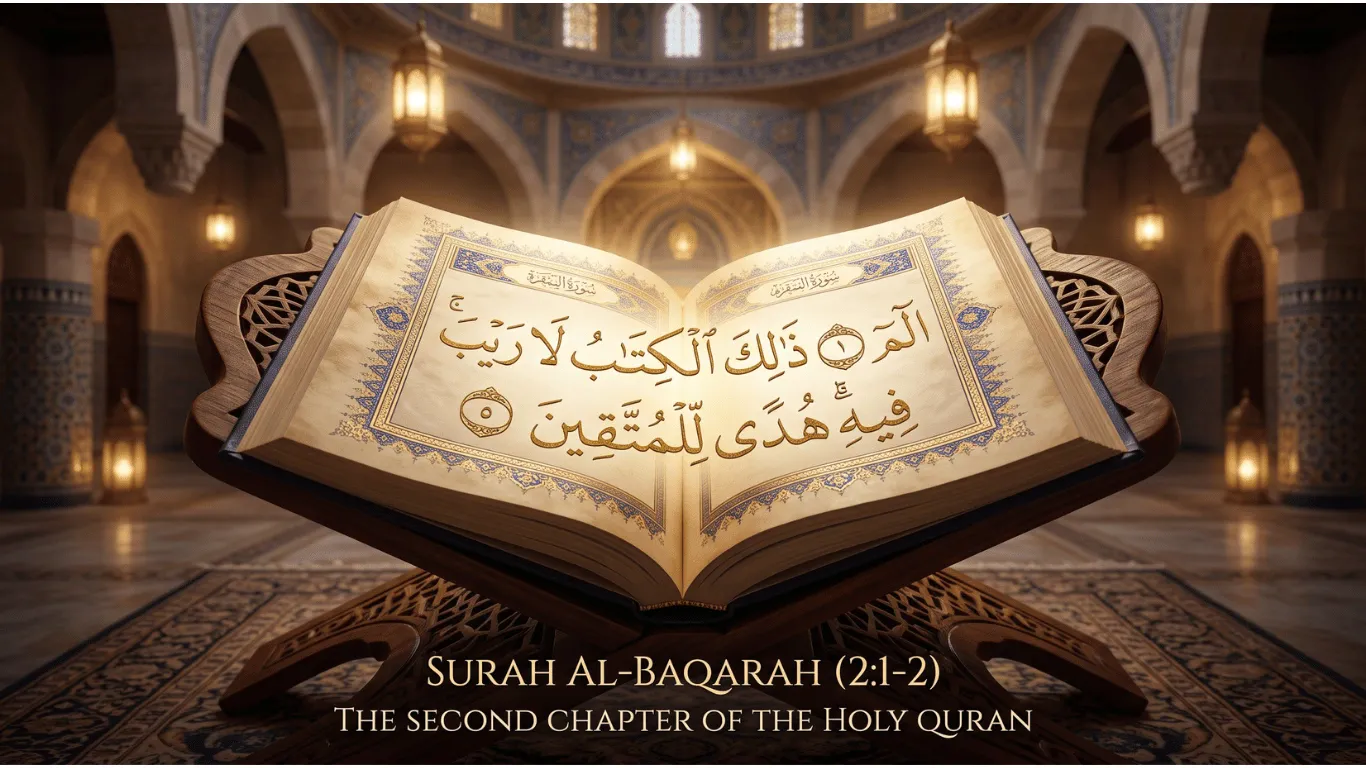
The Intellectual Anchor: Why “Alif Laam Meem Zalikal Kitabu La Raiba Fee” is the Ultimate Cure for Modern Doubt
We consume thousands of opinions, articles, and debates every single day. For college students, working professionals, and diaspora parents raising families, this endless stream of conflicting information creates a quiet but heavy mental burden. It breeds skepticism. We begin to question our purpose, our decisions, and sometimes, even our faith.
The cure for this psychological paralysis is absolute, unshakeable certainty. This is exactly what the opening of Surah Al-Baqarah delivers. By establishing the Quran as the ultimate intellectual anchor, Allah immediately grounds the human mind, wiping away the disease of doubt before you even finish the first line.
Here is exactly how the verse alif laam meem zalikal kitabu la raiba fee serves as the definitive proof of the Holy Quran, and how you can use it to build spiritual resilience.
What is the Meaning of Alif Laam Meem Zalikal Kitabu La Raiba Fee?
The phrase “Alif laam meem zalikal kitabu la raiba fee” translates to “Alif, Lam, Meem. That is the Book in which there is no doubt.” It serves as a divine guarantee, establishing the Quran as the ultimate, error-free guidance for humanity, completely curing intellectual and spiritual uncertainty.
This profound statement forms the first two verses of Surah Al-Baqarah. It is a bold, unmatched declaration. No human author begins a book by claiming it contains absolutely zero errors, yet the Creator of the universe lays down this constitutional fact immediately.
Surah Al-Baqarah (2:1-2)
- Arabic Text: الم ذَٰلِكَ الْكِتَابُ لَا رَيْبَ ۛ فِيهِ ۛ هُدًى لِّلْمُتَّقِينَ
- Transliteration: Alif-Laaam-Meeem. Zaalikal Kitaabu laa rayba feeh; hudal lilmuttaqeen.
- English Translation: Alif, Lam, Meem. This is the Book about which there is no doubt, a guidance for those conscious of Allah.
- Urdu Translation: الف لام میم۔ یہ وہ کتاب ہے جس میں کوئی شک نہیں، ہدایت ہے پرہیزگاروں کے لیے۔
- Hindi Translation: अलिफ़, लाम, मीम। यह वह किताब है जिसमें कोई संदेह नहीं, डर रखने वालों के लिए मार्गदर्शन है।
Understanding this concept is one of the core fundamentals of the Islamic faith. Before seeking guidance, the heart must be free of skepticism.
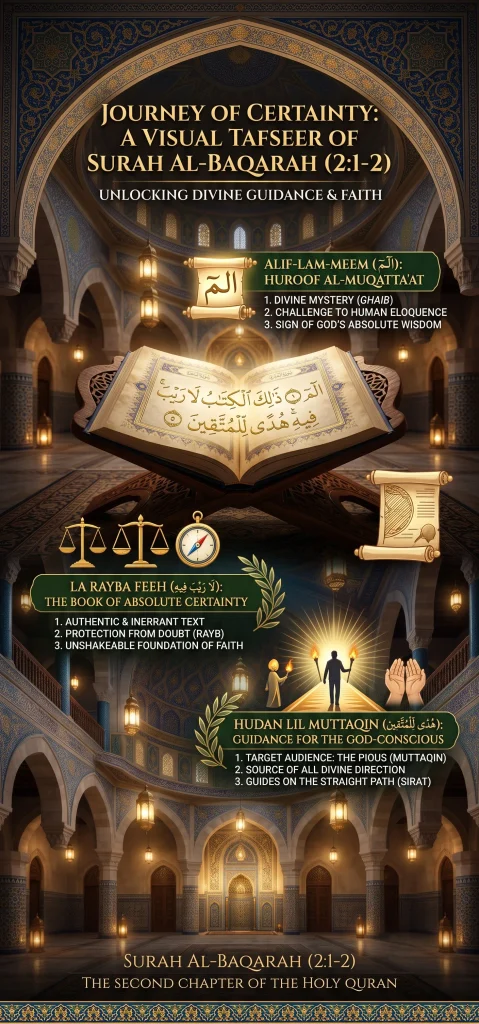
Why “La Raiba Feeh” Eradicates Modern Skepticism
“La raiba feeh” categorically negates the very existence of doubt within the Quran. Classical scholars explain this means the text contains no contradictions. Anyone seeking truth with a sincere heart will find absolute psychological and spiritual certainty within its pages.
Classical Tafseer (exegesis) provides a magnificent framework for this. Imam Ibn Kathir, in his renowned commentary, explains that the word Rayb (رَيْبَ) does not merely mean a simple question. It implies a deep-seated suspicion, unease, and psychological restlessness.
When Allah says La raiba feeh, He is deploying an absolute linguistic negation. He is not saying “Do not doubt this book.” He is stating it as an objective reality: There is no doubt in it. If a person feels doubt, the flaw lies in their own perception, not in the text.
For students and professionals facing anxiety over their future, internalizing this verse acts as an Islamic guide to overcoming anxiety. It shifts your mindset from chaos to absolute reliance on God (Tawakkul).
The Hidden Power of “Zalika” (That) vs. “Hadha” (This)
The Quran uses “Zalika” (That is the Book) instead of “Hadha” (This is the Book) to elevate its status. In classical Arabic, pointing to something distant signifies supreme majesty, indicating the text originates from the highest heavens on the Preserved Tablet.
Even when reading short Quranic ayats, every single letter is mathematically and linguistically precise. If you look at how many surahs in the Quran there are, this unmatched grammatical perfection remains consistent throughout all 114 chapters.
The Intellectual Anchor: Structuring Your Life Around Certainty
We are applying a unique strategy here: The Intellectual Anchor. You cannot build a stable life on unstable principles. Secular philosophies change every decade, but the Quran remains static.
When you pray and recite Ihdinas Siratal Mustaqim (Guide us to the straight path) in Surah Al-Fatiha, Surah Al-Baqarah immediately answers that prayer. It essentially says: You asked for the straight path? Here is the Book with zero doubt. Follow it.
Below is a breakdown of how this verse re-engineers your mindset:
| Arabic Phrase | Literal Translation | The Psychological Anchor (Benefit) |
| Alif, Laam, Meem | Disjointed letters | Induces intellectual humility; we do not know everything. |
| Zalikal Kitabu | That is the Book | Elevates the source of knowledge above human opinion. |
| La Raiba Feeh | In which there is no doubt | Cures existential anxiety, skepticism, and decision fatigue. |
| Hudan lil Muttaqeen | Guidance for the God-conscious | Provides actionable clarity for daily living. |
Those who reject this certainty fall into spiritual blindness, as perfectly described later in Surah Baqarah ayat 18, where they become “deaf, dumb, and blind” to the truth.
The Sunnah of Reciting and Teaching the Quran
Prophet Muhammad (PBUH) emphasized that the best people are those who learn and teach the Quran. Engaging with the text daily removes doubt, builds mental resilience, and connects the believer directly to divine guidance.
To completely crush any lingering doubts about Islam, one must actively engage with the Quran. You cannot resolve spiritual emptiness through logic alone; it requires action. The Prophet (PBUH) established a clear metric for success.
Sahih Al-Bukhari (Hadith 5027)
- Arabic Text: خَيْرُكُمْ مَنْ تَعَلَّمَ الْقُرْآنَ وَعَلَّمَهُ
- Transliteration: Khairukum man ta’allamal-Qur’ana wa ‘allamahu.
- English Translation: The best among you (Muslims) are those who learn the Quran and teach it.
- Urdu Translation: تم میں سے بہترین شخص وہ ہے جو قرآن سیکھے اور سکھائے۔
- Hindi Translation: तुम में से सबसे अच्छा वह है जो कुरान सीखता है और उसे सिखाता है।
You can read a deeper explanation of this specific narration in our post on Khairukum man ta’allamal Qur’ana. When you combine this learning process with reciting the Quran with Tarteel (slow, measured recitation), the words penetrate the heart, leaving absolutely no room for Raiba (doubt).
People Also Ask
These are known as Huroof al-Muqatta’at. According to classical scholars like Ibn Kathir, their exact meaning is known only to Allah. They serve as a linguistic miracle, challenging the Arabs by using the very letters of their alphabet, while establishing human humility before God’s infinite knowledge.
The Quran acts as a psychological anchor. By repeatedly reminding the reader of God’s control and mercy, it lowers cortisol, stops overthinking, and provides clear purpose. You can read a specificHadith about Quran benefitsto understand how revelation directly treats anxiety and depression.
Your Next Step:
Do you know someone struggling with doubts, overthinking, or losing touch with their faith? Do not keep this knowledge to yourself. Share this article on WhatsApp or Facebook to help anchor someone else’s heart to the Book of Allah.
To continue strengthening your daily routine, explore our complete archive of daily supplications and Quranic Tafseer right here on Current Islam.
