- at all, as the count section shows.
- Make them yours with the Rabbana Round: one dua a day for forty days — read it, understand it, say it as your own.
Contents
- What are Rabbana duas?
- How are the forty counted?
- The 40 Rabbana duas — the complete list
- Who said these duas first?
- Which Rabbana should I say for my need?
- The Rabbana Round — how do I make them mine?
- Are these duas answered?
- Honest limits — what the forty are not
- Common mistakes
- Frequently asked questions
The prayer mat is still out. You have asked Allah for the same thing three nights running, and tonight the words feel worn thin — you are no longer sure you are even asking well. The Quran solves that problem from inside its own pages. Again and again it places complete duas on the tongues of prophets, angels and ordinary believers, and almost every one of those duas opens with the same call: Rabbana — “Our Lord.” Forty of them, gathered below, each with its Arabic, transliteration, English and Urdu, so tonight you borrow the exact words Allah preserved.
What are Rabbana duas?
Rabbana duas are the supplications in the Quran that open with the call “Rabbana” — “Our Lord.” Prophets, angels and believers speak them at the hardest moments of their stories, and Allah preserved their exact words so that later believers could take them up as their own.
Every one of them is a quotation. Allah could have described these prayers from outside; instead He quotes them word for word and leaves them standing in the text like doors left open. That is why a Rabbana dua never sounds dated. Adam speaks his after the first mistake (No. 22). The angels who carry the Throne are still speaking two of them for your sake (Nos. 35–36). And the last one is spoken by believers walking in their own light on the Day of Judgment (No. 40) — a scene that has not happened yet, already written for your tongue.
How are the forty counted?
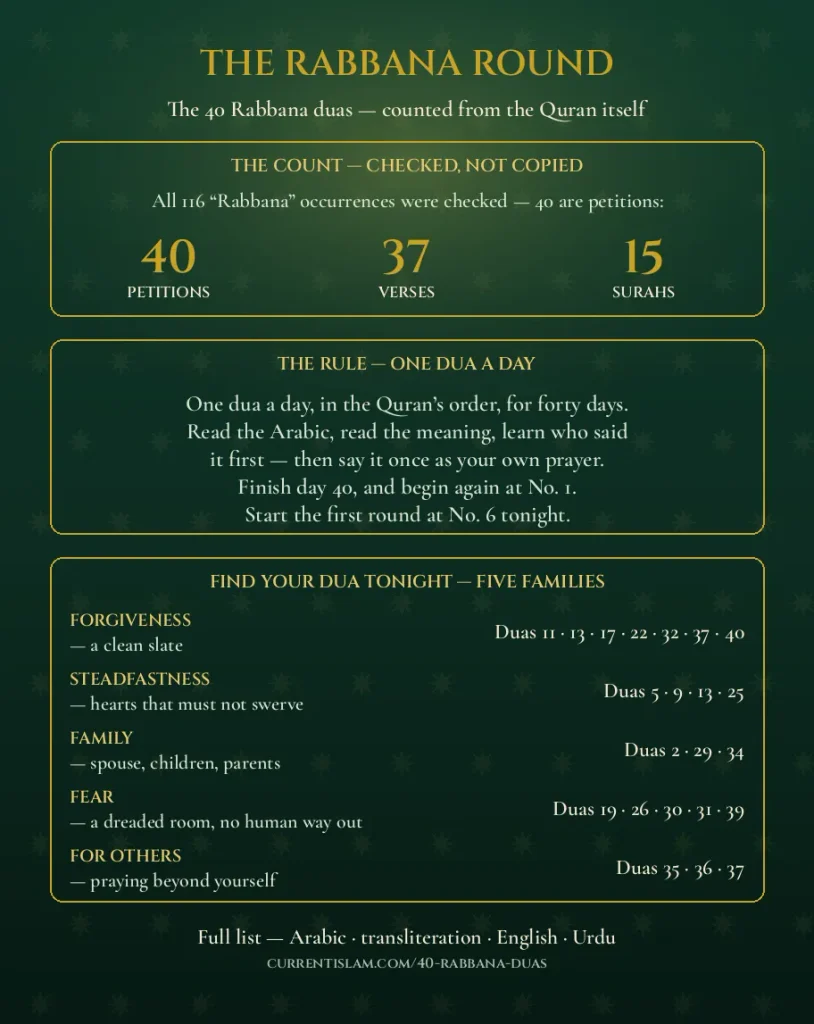
The forty are forty distinct petitions that open with the vocative “Rabbana,” spoken in this world by prophets, believers or angels, counted the way the tradition counts them. They stand in 37 verses of 15 surahs. Three verses carry more than one petition, and each petition counts on its own.
We did not copy this list from another site. We searched the full Arabic text of the Quran — all 6,236 verses — for every occurrence of the word, then checked each by grammar and speaker. The bare word appears in 116 places, and most are not duas at all: “our Lord” sits inside statements (“Our Lord is Allah,” 41:30), oaths, and the speeches of the damned (“Our Lord, let us out,” 35:37) — words nobody is being taught to say. Filtering those away leaves the true addresses, and counted as petitions they come to exactly forty.
Two corrections to the list you may already own came out of that check. The printed collections include 35:34 — “Indeed our Lord is Most Forgiving” — which is not a call but a statement of praise spoken inside Paradise; not a dua, so it does not stand here. In its place stand two real duas the printed lists drop silently: Ibrahim’s prayer for a messenger (No. 3, 2:129) and the cry of the oppressed (No. 19, 4:75). The count stayed forty; every entry now survives the text.
Quantitative Analysis of Rabbana Duas in the Quran
Statistical breakdown of the exhaustive search filtering process used to verify the 40 Rabbana supplicatory verses.
| Analysis Parameter & Criteria | Numerical Data | Detailed Findings & Quranic Scope |
|---|---|---|
| Verses of the Quran searched, one by one | 6,236 | Exhaustive review of every single Ayah (verse) in the entire Quran to find all instances of targeted supplications. |
| Places the word Rabbana appears in the text | 116 | Total occurrences of the word “Rabbana” (Our Lord) detected within the Quranic script. |
| Verses that contain it | 103 | Unique verses containing the invocation “Rabbana” (as some verses contain more than one occurrence). |
| Petitions that survive the filter — the forty | 40 | Surviving verified petitions, spanning 37 verses, extracted across 15 distinct Surahs (chapters) of the Quran. |
Check any entry yourself: every verse in this list is one search away at quran.com — the same text the forty were counted from.
The 40 Rabbana duas — the complete list
Here are the forty, in the Quran’s own order. Each one gives you the Arabic exactly as it stands in the verse, a transliteration for tonight, Khattab’s English, and Jalandhari’s Urdu. Where a dua runs into the next verse, its reference shows both.
Surah Al-Baqarah (2) — Duas 1–8
Dua 1 — 2:127 · First said by: Ibrahim and Ismail, raising the foundations of the Kaaba
رَبَّنَا تَقَبَّلْ مِنَّآ ۖ إِنَّكَ أَنتَ ٱلسَّمِيعُ ٱلْعَلِيمُ
Rabbana taqabbal minna, innaka Antas-Sami’ul-‘Alim.
English (Khattab): “Our Lord! Accept ˹this˺ from us. You are indeed the All-Hearing, All-Knowing.”
Urdu (Jalandhari):
“اے پروردگار، ہم سے یہ خدمت قبول فرما۔ بےشک تو سننے والا (اور) جاننے والا ہے”
Dua 2 — 2:128 · First said by: Ibrahim and Ismail
رَبَّنَا وَٱجْعَلْنَا مُسْلِمَيْنِ لَكَ وَمِن ذُرِّيَّتِنَآ أُمَّةً مُّسْلِمَةً لَّكَ وَأَرِنَا مَنَاسِكَنَا وَتُبْ عَلَيْنَآ ۖ إِنَّكَ أَنتَ ٱلتَّوَّابُ ٱلرَّحِيمُ
Rabbana waj-‘alna muslimayni laka wa min dhurriyyatina ummatam-muslimatal-lak, wa arina manasikana wa tub ‘alayna, innaka Antat-Tawwabur-Rahim.
English (Khattab): “Our Lord! Make us both ˹fully˺ submit to You¹ and from our descendants a nation that will submit to You. Show us our rituals, and turn to us in grace. You are truly the Accepter of Repentance, Most Merciful.”
Urdu (Jalandhari):
“اے پروردگار، ہم کو اپنا فرمانبردار بنائے رکھیو۔ اور ہماری اولاد میں سے بھی ایک گروہ کو اپنا مطیع بنائے رہیو، اور (پروردگار) ہمیں طریق عبادت بتا اور ہمارے حال پر (رحم کے ساتھ) توجہ فرما۔ بے شک تو توجہ فرمانے والا مہربان ہے”
Dua 3 — 2:129 · First said by: Ibrahim and Ismail
رَبَّنَا وَٱبْعَثْ فِيهِمْ رَسُولًا مِّنْهُمْ يَتْلُوا۟ عَلَيْهِمْ ءَايَـٰتِكَ وَيُعَلِّمُهُمُ ٱلْكِتَـٰبَ وَٱلْحِكْمَةَ وَيُزَكِّيهِمْ ۚ إِنَّكَ أَنتَ ٱلْعَزِيزُ ٱلْحَكِيمُ
Rabbana wab-‘ath fihim rasulam-minhum yatlu ‘alayhim ayatika wa yu’allimuhumul-kitaba wal-hikmata wa yuzakkihim, innaka Antal-‘Azizul-Hakim.
English (Khattab): “Our Lord! Raise from among them a messenger who will recite to them Your revelations, teach them the Book and wisdom, and purify them. Indeed, You ˹alone˺ are the Almighty, All-Wise.”
Urdu (Jalandhari):
“اے پروردگار، ان (لوگوں) میں انہیں میں سے ایک پیغمبر مبعوث کیجیو جو ان کو تیری آیتیں پڑھ پڑھ کر سنایا کرے اور کتاب اور دانائی سکھایا کرے اور ان (کے دلوں) کو پاک صاف کیا کرے۔ بےشک تو غالب اور صاحبِ حکمت ہے”
Dua 4 — 2:201 · First said by: The balanced believers — the dua the Prophet ﷺ made most often (Bukhari 6389)
رَبَّنَآ ءَاتِنَا فِى ٱلدُّنْيَا حَسَنَةً وَفِى ٱلْـَٔاخِرَةِ حَسَنَةً وَقِنَا عَذَابَ ٱلنَّارِ
Rabbana atina fid-dunya hasanah, wa fil-akhirati hasanah, wa qina ‘adhaban-nar.
English (Khattab): “Our Lord! Grant us the good of this world and the Hereafter, and protect us from the torment of the Fire.”
Urdu (Jalandhari):
“پروردگار ہم کو دنیا میں بھی نعمت عطا فرما اور آخرت میں بھی نعمت بخشیو اور دوزخ کے عذاب سے محفوظ رکھیو”
Dua 5 — 2:250 · First said by: Talut’s small army, facing Jalut
رَبَّنَآ أَفْرِغْ عَلَيْنَا صَبْرًا وَثَبِّتْ أَقْدَامَنَا وَٱنصُرْنَا عَلَى ٱلْقَوْمِ ٱلْكَـٰفِرِينَ
Rabbana afrigh ‘alayna sabran wa thabbit aqdamana wan-surna ‘alal-qawmil-kafirin.
English (Khattab): “Our Lord! Shower us with perseverance, make our steps firm, and give us victory over the disbelieving people.”
Urdu (Jalandhari):
“اے پروردگار ہم پر صبر کے دہانے کھول دے اور ہمیں (لڑائی میں) ثابت قدم رکھ اور (لشکر) کفار پر فتحیاب کر”
Dua 6 — 2:286 · First said by: The believers, in the closing verse of Al-Baqarah
رَبَّنَا لَا تُؤَاخِذْنَآ إِن نَّسِينَآ أَوْ أَخْطَأْنَا
Rabbana la tu’akhidhna in-nasina aw akhta’na.
English (Khattab): “Our Lord! Do not punish us if we forget or make a mistake.”
Urdu (Jalandhari):
“اے پروردگار اگر ہم سے بھول یا چوک ہوگئی ہو تو ہم سے مؤاخذہ نہ کیجیو”
Dua 7 — 2:286 · First said by: The believers (second petition of 2:286)
رَبَّنَا وَلَا تَحْمِلْ عَلَيْنَآ إِصْرًا كَمَا حَمَلْتَهُۥ عَلَى ٱلَّذِينَ مِن قَبْلِنَا
Rabbana wa la tahmil ‘alayna isran kama hamaltahu ‘alal-ladhina min qablina.
English (Khattab): “Our Lord! Do not place a burden on us like the one you placed on those before us.”
Urdu (Jalandhari):
“اے پروردگار ہم پر ایسا بوجھ نہ ڈالیو جیسا تو نے ہم سے پہلے لوگوں پر ڈالا تھا”
Dua 8 — 2:286 · First said by: The believers (third petition of 2:286)
رَبَّنَا وَلَا تُحَمِّلْنَا مَا لَا طَاقَةَ لَنَا بِهِۦ ۖ وَٱعْفُ عَنَّا وَٱغْفِرْ لَنَا وَٱرْحَمْنَآ ۚ أَنتَ مَوْلَىٰنَا فَٱنصُرْنَا عَلَى ٱلْقَوْمِ ٱلْكَـٰفِرِينَ
Rabbana wa la tuhammilna ma la taqata lana bih, wa’fu ‘anna, waghfir lana, warhamna, Anta mawlana fan-surna ‘alal-qawmil-kafirin.
English (Khattab): “Our Lord! Do not burden us with what we cannot bear. Pardon us, forgive us, and have mercy on us. You are our ˹only˺ Guardian. So grant us victory over the disbelieving people.”
Urdu (Jalandhari):
“اے پروردگار جتنا بوجھ اٹھانے کی ہم میں طاقت نہیں اتنا ہمارے سر پر نہ رکھیو۔ اور (اے پروردگار) ہمارے گناہوں سے درگزر کر اور ہمیں بخش دے۔ اور ہم پر رحم فرما۔ تو ہی ہمارا مالک ہے اور ہم کو کافروں پر غالب فرما”
Go deeper on the close of Al-Baqarah: the site’s Rabbana La Tuakhizna walkthrough of Dua 6, and its companion page on Rabbana Wala Tuhammilna for Duas 7–8.
Surah Aal-e-Imran (3) — Duas 9–18
Dua 9 — 3:8 · First said by: Those firmly grounded in knowledge
رَبَّنَا لَا تُزِغْ قُلُوبَنَا بَعْدَ إِذْ هَدَيْتَنَا وَهَبْ لَنَا مِن لَّدُنكَ رَحْمَةً ۚ إِنَّكَ أَنتَ ٱلْوَهَّابُ
Rabbana la tuzigh qulubana ba’da idh hadaytana, wa hab lana min-ladunka rahmah, innaka Antal-Wahhab.
English (Khattab): “Our Lord! Do not let our hearts deviate after you have guided us. Grant us Your mercy. You are indeed the Giver ˹of all bounties˺.”
Urdu (Jalandhari):
“اے پروردگار جب تو نے ہمیں ہدایت بخشی ہے تو اس کے بعد ہمارے دلوں میں کجی نہ پیدا کر دیجیو اور ہمیں اپنے ہاں سے نعمت عطا فرما تو تو بڑا عطا فرمانے والا ہے”
Dua 10 — 3:9 · First said by: The same believers, facing the promised Day
رَبَّنَآ إِنَّكَ جَامِعُ ٱلنَّاسِ لِيَوْمٍ لَّا رَيْبَ فِيهِ ۚ إِنَّ ٱللَّهَ لَا يُخْلِفُ ٱلْمِيعَادَ
Rabbana innaka jami’un-nasi li-yawmil-la rayba fih, innallaha la yukhliful-mi’ad.
English (Khattab): “Our Lord! You will certainly gather all humanity for the ˹promised˺ Day—about which there is no doubt. Surely Allah does not break His promise.”
Urdu (Jalandhari):
“اے پروردگار! تو اس روز جس (کے آنے) میں کچھ بھی شک نہیں سب لوگوں کو (اپنے حضور میں) جمع کرلے گا بے شک خدا خلاف وعدہ نہیں کرتا”
Dua 11 — 3:16 · First said by: The patient, the truthful, the devoted
رَبَّنَآ إِنَّنَآ ءَامَنَّا فَٱغْفِرْ لَنَا ذُنُوبَنَا وَقِنَا عَذَابَ ٱلنَّارِ
Rabbana innana amanna faghfir lana dhunubana wa qina ‘adhaban-nar.
English (Khattab): “Our Lord! We have believed, so forgive our sins and protect us from the torment of the Fire.”
Urdu (Jalandhari):
“اے پروردگار ہم ایمان لے آئے سو ہم کو ہمارے گناہ معاف فرما اور دوزخ کے عذاب سے محفوظ رکھ”
Dua 12 — 3:53 · First said by: The disciples (Hawariyyun) of Isa
رَبَّنَآ ءَامَنَّا بِمَآ أَنزَلْتَ وَٱتَّبَعْنَا ٱلرَّسُولَ فَٱكْتُبْنَا مَعَ ٱلشَّـٰهِدِينَ
Rabbana amanna bima anzalta wattaba’nar-rasula faktubna ma’ash-shahidin.
English (Khattab): “Our Lord! We believe in Your revelations and follow the messenger, so count us among those who bear witness.”
Urdu (Jalandhari):
“اے پروردگار جو (کتاب) تو نے نازل فرمائی ہے ہم اس پر ایمان لے آئے اور (تیرے) پیغمبر کے متبع ہو چکے تو ہم کو ماننے والوں میں لکھ رکھ”
Dua 13 — 3:147 · First said by: The godly ones who stood with the prophets
رَبَّنَا ٱغْفِرْ لَنَا ذُنُوبَنَا وَإِسْرَافَنَا فِىٓ أَمْرِنَا وَثَبِّتْ أَقْدَامَنَا وَٱنصُرْنَا عَلَى ٱلْقَوْمِ ٱلْكَـٰفِرِينَ
Rabbana-ghfir lana dhunubana wa israfana fi amrina, wa thabbit aqdamana wan-surna ‘alal-qawmil-kafirin.
English (Khattab): “Our Lord! Forgive our sins and excesses, make our steps firm, and grant us victory over the disbelieving people.”
Urdu (Jalandhari):
“اے پروردگار ہمارے گناہ اور زیادتیاں جو ہم اپنے کاموں میں کرتے رہے ہیں معاف فرما اور ہم کو ثابت قدم رکھ اور کافروں پر فتح عنایت فرما”
Dua 14 — 3:191 · First said by: The people of understanding, reflecting on creation
رَبَّنَا مَا خَلَقْتَ هَـٰذَا بَـٰطِلًا سُبْحَـٰنَكَ فَقِنَا عَذَابَ ٱلنَّارِ
Rabbana ma khalaqta hadha batila, subhanaka fa-qina ‘adhaban-nar.
English (Khattab): “Our Lord! You have not created ˹all of˺ this without purpose. Glory be to You! Protect us from the torment of the Fire.”
Urdu (Jalandhari):
“اے پروردگار! تو نے اس (مخلوق) کو بے فائدہ نہیں پیدا کیا تو پاک ہے تو (قیامت کے دن) ہمیں دوزخ کے عذاب سے بچائیو”
Dua 15 — 3:192 · First said by: The people of understanding
رَبَّنَآ إِنَّكَ مَن تُدْخِلِ ٱلنَّارَ فَقَدْ أَخْزَيْتَهُۥ ۖ وَمَا لِلظَّـٰلِمِينَ مِنْ أَنصَارٍ
Rabbana innaka man tudkhilin-nara fa-qad akhzaytah, wa ma liz-zalimina min ansar.
English (Khattab): “Our Lord! Indeed, those You commit to the Fire will be ˹completely˺ disgraced! And the wrongdoers will have no helpers.”
Urdu (Jalandhari):
“اے پروردگار جس کو تو نے دوزخ میں ڈالا اسے رسوا کیا اور ظالموں کا کوئی مددگار نہیں”
Dua 16 — 3:193 · First said by: The people of understanding, answering the call
رَّبَّنَآ إِنَّنَا سَمِعْنَا مُنَادِيًا يُنَادِى لِلْإِيمَـٰنِ أَنْ ءَامِنُوا۟ بِرَبِّكُمْ فَـَٔامَنَّا
Rabbana innana sami’na munadiyan yunadi lil-imani an aminu bi-rabbikum fa-amanna.
English (Khattab): “Our Lord! We have heard the caller¹ to ˹true˺ belief, ˹proclaiming,˺ ‘Believe in your Lord ˹alone˺,’ so we believed.”
Urdu (Jalandhari): “اے پروردگارہم نے ایک ندا کرنے والے کو سنا کہ ایمان کے لیے پکار رہا تھا (یعنی) اپنے پروردگ
ر پر ایمان لاؤ تو ہم ایمان لے آئے”
Dua 17 — 3:193 · First said by: The people of understanding (second petition of 3:193)
رَبَّنَا فَٱغْفِرْ لَنَا ذُنُوبَنَا وَكَفِّرْ عَنَّا سَيِّـَٔاتِنَا وَتَوَفَّنَا مَعَ ٱلْأَبْرَارِ
Rabbana faghfir lana dhunubana wa kaffir ‘anna sayyi’atina wa tawaffana ma’al-abrar.
English (Khattab): “Our Lord! Forgive our sins, absolve us of our misdeeds, and join us with the virtuous when we die.”
Urdu (Jalandhari):
“اے پروردگار ہمارے گناہ معاف فرما اور ہماری برائیوں کو ہم سے محو کر اور ہم کو دنیا سے نیک بندوں کے ساتھ اٹھا”
Dua 18 — 3:194 · First said by: The people of understanding
رَبَّنَا وَءَاتِنَا مَا وَعَدتَّنَا عَلَىٰ رُسُلِكَ وَلَا تُخْزِنَا يَوْمَ ٱلْقِيَـٰمَةِ ۗ إِنَّكَ لَا تُخْلِفُ ٱلْمِيعَادَ
Rabbana wa atina ma wa’adtana ‘ala rusulika wa la tukhzina yawmal-qiyamah, innaka la tukhliful-mi’ad.
English (Khattab): “Our Lord! Grant us what You have promised us through Your messengers and do not put us to shame on Judgment Day—for certainly You never fail in Your promise.”
Urdu (Jalandhari):
“اے پروردگار تو نے جن جن چیزوں کے ہم سے اپنے پیغمبروں کے ذریعے سے وعدے کیے ہیں وہ ہمیں عطا فرما اور قیامت کے دن ہمیں رسوا نہ کیجو کچھ شک نہیں کہ تو خلاف وعدہ نہیں کرتا”
Surah An-Nisa (4) — Dua 19
Dua 19 — 4:75 · First said by: The oppressed men, women and children of Makkah
رَبَّنَآ أَخْرِجْنَا مِنْ هَـٰذِهِ ٱلْقَرْيَةِ ٱلظَّالِمِ أَهْلُهَا وَٱجْعَل لَّنَا مِن لَّدُنكَ وَلِيًّا وَٱجْعَل لَّنَا مِن لَّدُنكَ نَصِيرًا
Rabbana akhrijna min hadhihil-qaryatiz-zalimi ahluha, waj-‘al lana min-ladunka waliyya, waj-‘al lana min-ladunka nasira.
English (Khattab): “Our Lord! Deliver us from this land of oppressors! Appoint for us a saviour; appoint for us a helper—all by Your grace.”
Urdu (Jalandhari):
“اے پروردگار ہم کو اس شہر سے جس کے رہنے والے ظالم ہیں نکال کر کہیں اور لے جا۔ اور اپنی طرف سے کسی کو ہمارا حامی بنا۔ اور اپنی ہی طرف سے کسی کو ہمارا مددگار مقرر فرما”
Surah Al-Ma’idah (5) — Duas 20–21
Dua 20 — 5:83 · First said by: Those whose eyes overflowed on hearing the revelation
رَبَّنَآ ءَامَنَّا فَٱكْتُبْنَا مَعَ ٱلشَّـٰهِدِينَ
Rabbana amanna faktubna ma’ash-shahidin.
English (Khattab): “Our Lord! We believe, so count us among the witnesses.”
Urdu (Jalandhari):
“اے پروردگار ہم ایمان لے آئے تو ہم کو ماننے والوں میں لکھ لے”
Dua 21 — 5:114 · First said by: Isa, son of Maryam, at his people’s request
ٱللَّهُمَّ رَبَّنَآ أَنزِلْ عَلَيْنَا مَآئِدَةً مِّنَ ٱلسَّمَآءِ تَكُونُ لَنَا عِيدًا لِّأَوَّلِنَا وَءَاخِرِنَا وَءَايَةً مِّنكَ ۖ وَٱرْزُقْنَا وَأَنتَ خَيْرُ ٱلرَّٰزِقِينَ
Allahumma rabbana anzil ‘alayna ma’idatam-minas-sama’i takunu lana ‘idal-li-awwalina wa akhirina wa ayatam-minka, warzuqna wa Anta khayrur-raziqin.
English (Khattab): “O Allah, our Lord! Send us from heaven a table spread with food as a feast for us—the first and last of us—and as a sign from You. Provide for us! You are indeed the Best Provider.”
Quick Answer
- The complete list is on this page: all 40 Rabbana duas — the Quran’s supplications that open with Rabbana, “Our Lord” — numbered in Quran order, each with its Arabic, transliteration, English (Khattab) and Urdu (Jalandhari), and the name of who said it first. Jump straight to the list.
“The count is verified, not copied: the forty are 40 petitions standing in 37 verses across 15 surahs, checked against the full Arabic text of the Quran — and one regular entry in the printed lists (35:34) is not a dua at all, as the count section shows.”
Urdu (Jalandhari):
“اے ہمارے پروردگار! ہم پر آسمان سے خوان نازل فرما کہ ہمارے لیے (وہ دن) عید قرار پائے یعنی ہمارے اگلوں اور پچھلوں (سب) کے لیے اور وہ تیری طرف سے نشانی ہو اور ہمیں رزق دے تو بہتر رزق دینے والا ہے”
Surah Al-A’raf (7) — Duas 22–25
Dua 22 — 7:23 · First said by: Adam and Hawwa, after the slip
رَبَّنَا ظَلَمْنَآ أَنفُسَنَا وَإِن لَّمْ تَغْفِرْ لَنَا وَتَرْحَمْنَا لَنَكُونَنَّ مِنَ ٱلْخَـٰسِرِينَ
Rabbana zalamna anfusana, wa il-lam taghfir lana wa tarhamna lanakunanna minal-khasirin.
English (Khattab): “Our Lord! We have wronged ourselves. If You do not forgive us and have mercy on us, we will certainly be losers.”
Urdu (Jalandhari):
“پروردگار ہم نے اپنی جانوں پر ظلم کیا اور اگر تو ہمیں نہیں بخشے گا اور ہم پر رحم نہیں کرے گا تو ہم تباہ ہو جائیں گے”
Dua 23 — 7:47 · First said by: The people of the Heights, seeing the Fire
رَبَّنَا لَا تَجْعَلْنَا مَعَ ٱلْقَوْمِ ٱلظَّـٰلِمِينَ
Rabbana la taj-‘alna ma’al-qawmiz-zalimin.
English (Khattab): “Our Lord! Do not join us with the wrongdoing people.”
Urdu (Jalandhari):
“اے ہمارے پروردگار ہم کو ظالم لوگوں کے ساتھ شامل نہ کیجیو”
Dua 24 — 7:89 · First said by: Shu’ayb, answering his people’s ultimatum
رَبَّنَا ٱفْتَحْ بَيْنَنَا وَبَيْنَ قَوْمِنَا بِٱلْحَقِّ وَأَنتَ خَيْرُ ٱلْفَـٰتِحِينَ
Rabbana-ftah baynana wa bayna qawmina bil-haqqi wa Anta khayrul-fathihin.
English (Khattab): “Our Lord! Judge between us and our people with truth. You are the best of those who judge.”
Urdu (Jalandhari):
“اے پروردگار ہم میں اور ہماری قوم میں انصاف کے ساتھ فیصلہ کردے اور تو سب سے بہتر فیصلہ کرنے والا ہے”
Dua 25 — 7:126 · First said by: The magicians who believed, under Pharaoh’s threat
رَبَّنَآ أَفْرِغْ عَلَيْنَا صَبْرًا وَتَوَفَّنَا مُسْلِمِينَ
Rabbana afrigh ‘alayna sabran wa tawaffana muslimin.
English (Khattab): “Our Lord! Shower us with perseverance, and let us die while submitting ˹to You˺.”
Urdu (Jalandhari):
“اے پروردگار ہم پر صبرواستقامت کے دہانے کھول دے اور ہمیں (ماریو تو) مسلمان ہی ماریو”
Surah Yunus (10) — Dua 26
Dua 26 — 10:85–86 · First said by: Musa’s people, putting their trust in Allah
رَبَّنَا لَا تَجْعَلْنَا فِتْنَةً لِّلْقَوْمِ ٱلظَّـٰلِمِينَ وَنَجِّنَا بِرَحْمَتِكَ مِنَ ٱلْقَوْمِ ٱلْكَـٰفِرِينَ
Rabbana la taj-‘alna fitnatal-lil-qawmiz-zalimin, wa najjina bi-rahmatika minal-qawmil-kafirin.
English (Khattab): “Our Lord! Do not subject us to the persecution of the oppressive people, and deliver us by Your mercy from the disbelieving people.”
Urdu (Jalandhari):
“اے ہمارے پروردگار ہم کو ظالم لوگوں کے ہاتھ سے آزمائش میں نہ ڈال۔ اور اپنی رحمت سے قوم کفار سے نجات بخش”
Surah Ibrahim (14) — Duas 27–29
Dua 27 — 14:38 · First said by: Ibrahim, praying in private
رَبَّنَآ إِنَّكَ تَعْلَمُ مَا نُخْفِى وَمَا نُعْلِنُ ۗ وَمَا يَخْفَىٰ عَلَى ٱللَّهِ مِن شَىْءٍ فِى ٱلْأَرْضِ وَلَا فِى ٱلسَّمَآءِ
Rabbana innaka ta’lamu ma nukhfi wa ma nu’lin, wa ma yakhfa ‘alallahi min shay’in fil-ardi wa la fis-sama’.
English (Khattab): “Our Lord! You certainly know what we conceal and what we reveal. Nothing on earth or in heaven is hidden from Allah.”
Urdu (Jalandhari):
“اے پروردگار جو بات ہم چھپاتے اور جو ظاہر کرتے ہیں تو سب جانتا ہے۔ اور خدا سے کوئی چیز مخفی نہیں (نہ) زمین میں نہ آسمان میں”
Dua 28 — 14:40 · First said by: Ibrahim — the closing words of his prayer (the verse opens with Rabbi, my Lord)
رَبَّنَا وَتَقَبَّلْ دُعَآءِ
Rabbana wa taqabbal du’a’.
English (Khattab): “Our Lord! Accept my prayers.”
Urdu (Jalandhari):
“اے پروردگار میری دعا قبول فرما”
Dua 29 — 14:41 · First said by: Ibrahim
رَبَّنَا ٱغْفِرْ لِى وَلِوَٰلِدَىَّ وَلِلْمُؤْمِنِينَ يَوْمَ يَقُومُ ٱلْحِسَابُ
Rabbana-ghfir li wa li-walidayya wa lil-mu’minina yawma yaqumul-hisab.
English (Khattab): “Our Lord! Forgive me, my parents, and the believers on the Day when the judgment will come to pass.”
Urdu (Jalandhari):
“اے پروردگار حساب (کتاب) کے دن مجھ کو اور میرے ماں باپ کو اور مومنوں کو مغفرت کیجیو”
Dua 29 is the Quran’s great dua for parents; the site’s Allahummaghfirli Waliwalidayya dua page is built on these very words.
Surah Al-Kahf (18) — Dua 30
Dua 30 — 18:10 · First said by: The youths who fled to the Cave
رَبَّنَآ ءَاتِنَا مِن لَّدُنكَ رَحْمَةً وَهَيِّئْ لَنَا مِنْ أَمْرِنَا رَشَدًا
Rabbana atina min-ladunka rahmah, wa hayyi’ lana min amrina rashada.
English (Khattab): “Our Lord! Grant us mercy from Yourself and guide us rightly through our ordeal.”
Urdu (Jalandhari):
“اے ہمارے پروردگار ہم پر اپنے ہاں سے رحمت نازل فرما۔ اور ہمارے کام درستی (کے سامان) مہیا کر”
Dua 30 has a full page of its own: Rabbana Atina Min Ladunka Rahmatan, the Cave youths’ dua explored verse by verse.
Surah Ta-Ha (20) — Dua 31
Dua 31 — 20:45 · First said by: Musa and Harun, sent to Pharaoh
رَبَّنَآ إِنَّنَا نَخَافُ أَن يَفْرُطَ عَلَيْنَآ أَوْ أَن يَطْغَىٰ
Rabbana innana nakhafu an yafruta ‘alayna aw an yatgha.
English (Khattab): “Our Lord! We fear that he may be quick to harm us or act tyrannically.”
Urdu (Jalandhari):
“ہمارے پروردگار ہمیں خوف ہے کہ ہم پر تعدی کرنے لگے یا زیادہ سرکش ہوجائے”
Surah Al-Mu’minun (23) — Dua 32
Dua 32 — 23:109 · First said by: A group of Allah’s servants — the ones the damned used to mock
رَبَّنَآ ءَامَنَّا فَٱغْفِرْ لَنَا وَٱرْحَمْنَا وَأَنتَ خَيْرُ ٱلرَّٰحِمِينَ
Rabbana amanna faghfir lana warhamna wa Anta khayrur-rahimin.
English (Khattab): “Our Lord! We have believed, so forgive us and have mercy on us, for You are the best of those who show mercy.”
Urdu (Jalandhari):
“اے ہمارے پروردگار ہم ایمان لائے تو تُو ہم کو بخش دے اور ہم پر رحم کر اور تو سب سے بہتر رحم کرنے والا ہے”
Surah Al-Furqan (25) — Duas 33–34
Dua 33 — 25:65 · First said by: The servants of the Most Merciful (Ibadur-Rahman)
رَبَّنَا ٱصْرِفْ عَنَّا عَذَابَ جَهَنَّمَ ۖ إِنَّ عَذَابَهَا كَانَ غَرَامًا
Rabbana-srif ‘anna ‘adhaba jahannam, inna ‘adhabaha kana gharama.
English (Khattab): “Our Lord! Keep the punishment of Hell away from us, for its punishment is indeed unrelenting.”
Urdu (Jalandhari):
“اے پروردگار دوزخ کے عذاب کو ہم سے دور رکھیو کہ اس کا عذاب بڑی تکلیف کی چیز ہے”
Dua 34 — 25:74 · First said by: The servants of the Most Merciful
رَبَّنَا هَبْ لَنَا مِنْ أَزْوَٰجِنَا وَذُرِّيَّـٰتِنَا قُرَّةَ أَعْيُنٍ وَٱجْعَلْنَا لِلْمُتَّقِينَ إِمَامًا
Rabbana hab lana min azwajina wa dhurriyyatina qurrata a’yun, waj-‘alna lil-muttaqina imama.
English (Khattab): “Our Lord! Bless us with ˹pious˺ spouses and offspring who will be the joy of our hearts, and make us models for the righteous.”
Urdu (Jalandhari):
“اے پروردگار ہم کو ہماری بیویوں کی طرف سے (دل کا چین) اور اولاد کی طرف سے آنکھ کی ٹھنڈک عطا فرما اور ہمیں پرہیزگاروں کا امام بنا”
Dua 34 is the Quran’s dua for a spouse and family; see also the site’s Surah Furqan ayat 74 page.
Surah Ghafir (40) — Duas 35–36
Dua 35 — 40:7 · First said by: The angels who carry the Throne, praying for the believers
رَبَّنَا وَسِعْتَ كُلَّ شَىْءٍ رَّحْمَةً وَعِلْمًا فَٱغْفِرْ لِلَّذِينَ تَابُوا۟ وَٱتَّبَعُوا۟ سَبِيلَكَ وَقِهِمْ عَذَابَ ٱلْجَحِيمِ
Rabbana wasi’ta kulla shay’in rahmataw-wa ‘ilma, faghfir lilladhina tabu wattaba’u sabilaka wa qihim ‘adhabal-jahim.
English (Khattab): “Our Lord! You encompass everything in ˹Your˺ mercy and knowledge. So forgive those who repent and follow Your Way, and protect them from the torment of the Hellfire.”
Urdu (Jalandhari):
“اے ہمارے پروردگار تیری رحمت اور تیرا علم ہر چیز کو احاطہ کئے ہوئے ہے تو جن لوگوں نے توبہ کی اور تیرے رستے پر چلے ان کو بخش دے اور دوزخ کے عذاب سے بچالے”
Dua 36 — 40:8–9 · First said by: The angels carrying the Throne (the same prayer, continued)
رَبَّنَا وَأَدْخِلْهُمْ جَنَّـٰتِ عَدْنٍ ٱلَّتِى وَعَدتَّهُمْ وَمَن صَلَحَ مِنْ ءَابَآئِهِمْ وَأَزْوَٰجِهِمْ وَذُرِّيَّـٰتِهِمْ ۚ إِنَّكَ أَنتَ ٱلْعَزِيزُ ٱلْحَكِيمُ وَقِهِمُ ٱلسَّيِّـَٔاتِ
Rabbana wa adkhilhum jannati ‘adninillati wa’adtahum wa man salaha min aba’ihim wa azwajihim wa dhurriyyatihim, innaka Antal-‘Azizul-Hakim, wa qihimus-sayyi’at.
English (Khattab): “Our Lord! Admit them into the Gardens of Eternity which You have promised them, along with the righteous among their parents, spouses, and descendants. You ˹alone˺ are truly the Almighty, All-Wise. And protect them from ˹the consequences of their˺ evil deeds.”
Urdu (Jalandhari):
“اے ہمارے پروردگار ان کو ہمیشہ رہنے کے بہشتوں میں داخل کر جن کا تونے ان سے وعدہ کیا ہے اور جو ان کے باپ دادا اور ان کی بیویوں اور ان کی اولاد میں سے نیک ہوں ان کو بھی۔ بےشک تو غالب حکمت والا ہے۔ اور ان کو عذابوں سے بچائے رکھ”
Surah Al-Hashr (59) — Dua 37
Dua 37 — 59:10 · First said by: The believers who came after the first generations
رَبَّنَا ٱغْفِرْ لَنَا وَلِإِخْوَٰنِنَا ٱلَّذِينَ سَبَقُونَا بِٱلْإِيمَـٰنِ وَلَا تَجْعَلْ فِى قُلُوبِنَا غِلًّا لِّلَّذِينَ ءَامَنُوا۟ رَبَّنَآ إِنَّكَ رَءُوفٌ رَّحِيمٌ
Rabbana-ghfir lana wa li-ikhwaninal-ladhina sabaquna bil-iman, wa la taj-‘al fi qulubina ghillal-lilladhina amanu, rabbana innaka Ra’ufur-Rahim.
English (Khattab): “Our Lord! Forgive us and our fellow believers who preceded us in faith, and do not allow bitterness into our hearts towards those who believe. Our Lord! Indeed, You are Ever Gracious, Most Merciful.”
Urdu (Jalandhari):
“اے پروردگار ہمارے اور ہمارے بھائیوں کے جو ہم سے پہلے ایمان لائے ہیں گناہ معاف فرما اور مومنوں کی طرف سے ہمارے دل میں کینہ (وحسد) نہ پیدا ہونے دے۔ اے ہمارے پروردگار تو بڑا شفقت کرنے والا مہربان ہے”
Surah Al-Mumtahanah (60) — Duas 38–39
Dua 38 — 60:4 · First said by: Ibrahim and those with him, breaking with their people
رَّبَّنَا عَلَيْكَ تَوَكَّلْنَا وَإِلَيْكَ أَنَبْنَا وَإِلَيْكَ ٱلْمَصِيرُ
Rabbana ‘alayka tawakkalna wa ilayka anabna wa ilaykal-masir.
English (Khattab): “Our Lord! In You we trust. And to You we ˹always˺ turn. And to You is the final return.”
Urdu (Jalandhari):
“اے ہمارے پروردگار تجھ ہی پر ہمارا بھروسہ ہے اور تیری ہی طرف ہم رجوع کرتے ہیں اور تیرے ہی حضور میں (ہمیں) لوٹ کر آنا ہے”
Dua 39 — 60:5 · First said by: Ibrahim and those with him (continued)
رَبَّنَا لَا تَجْعَلْنَا فِتْنَةً لِّلَّذِينَ كَفَرُوا۟ وَٱغْفِرْ لَنَا رَبَّنَآ ۖ إِنَّكَ أَنتَ ٱلْعَزِيزُ ٱلْحَكِيمُ
Rabbana la taj-‘alna fitnatal-lilladhina kafaru, waghfir lana rabbana, innaka Antal-‘Azizul-Hakim.
English (Khattab): “Our Lord! Do not subject us to the persecution of the disbelievers. Forgive us, our Lord! You ˹alone˺ are truly the Almighty, All-Wise.”
Urdu (Jalandhari):
“اے ہمارے پروردگار ہم کو کافروں کے ہاتھ سے عذاب نہ دلانا اور اے پروردگار ہمارے ہمیں معاف فرما۔ بےشک تو غالب حکمت والا ہے”
Surah At-Tahrim (66) — Dua 40
Dua 40 — 66:8 · First said by: The believers, walking in their light on the Last Day
رَبَّنَآ أَتْمِمْ لَنَا نُورَنَا وَٱغْفِرْ لَنَآ ۖ إِنَّكَ عَلَىٰ كُلِّ شَىْءٍ قَدِيرٌ
Rabbana atmim lana nurana waghfir lana, innaka ‘ala kulli shay’in qadir.
English (Khattab): “Our Lord! Perfect our light for us, and forgive us. ˹For˺ You are truly Most Capable of everything.”
Urdu (Jalandhari):
“اے پروردگار ہمارا نور ہمارے لئے پورا کر اور ہمیں معاف کرنا۔ بےشک خدا ہر چیز پر قادر ہے”
Who said these duas first?
Every Rabbana dua arrives inside a story, and the speaker is half the lesson. Ibrahim says the first three while his hands are on the Kaaba’s walls. Adam says his with nothing left to bargain with. The Cave youths say theirs with soldiers behind them and a cave in front.
Knowing the speaker changes how you borrow the words. When Shu’ayb’s people gave him an ultimatum — return to our religion or be expelled — his answer was No. 24: “Our Lord, judge between us and our people in truth.” When Pharaoh promised the believing magicians crucifixion, their answer was No. 25: patience, and a good death. When Musa told his frightened people to trust Allah under Pharaoh’s oppression, their answer was No. 26 — the Surah Yunus dua of trust spoken before any sea had parted. None of these duas were composed in comfort, and none of them beg. They state who Allah is, state the need plainly, and stop.
Which Rabbana should I say for my need?
Start from the need, not the number. The forty fall into plain families — forgiveness, steadfastness, family, fear, other people’s turns — and the finder table below points you to the duas that match what you are carrying tonight. One honest match beats ten recited at random.
Index of Rabbana Duas by Personal Need
A thematic reference guide matching specific life situations and emotional needs to the corresponding numbered Rabbana supplications from the Quran.
| Your Need Tonight | Rabbana Duas (By Number) |
|---|---|
| Forgiveness, a clean slate | 11 · 13 · 17 · 22 · 32 · 37 · 40 |
| A heart that must not swerve | 9 |
| A feared task, a room you dread entering | 30 · 31 |
| Patience while you are attacked or tested | 5 · 13 · 25 |
| Oppression, and no human way out | 19 · 26 · 39 |
| Spouse, children, the home itself | 2 · 34 |
| Your parents | 29 |
| Both worlds, in one breath | 4 |
| Burdens, and honest mistakes | 6 · 7 · 8 |
| Praying for other people | 35 · 36 · 37 |
| A dispute that needs a just judge | 24 |
| Provision from Allah | 21 |
| Death, and what comes after it | 17 · 25 · 40 |
FINDERINTRO: Read down the left column to your situation, then take the numbers to the list above. Most families need one dua said slowly, not the whole row at speed.
The Rabbana Round — how do I make them mine?
The Rabbana Round is one dua a day, in the Quran’s order, for forty days — read in Arabic, understood in your own language, then said once more as your own prayer. Forty days later the whole collection lives in your memory, and the round simply begins again.
Start tonight, but not at No. 1. Start with Nos. 6–8, the three petitions of 2:286: if you already recite the last two ayat of Surah Baqarah at night, you have been saying them for years without the labels. From tomorrow, take one dua with Fajr — read its Arabic line, read the English and Urdu under it, learn who said it first, then say it once as your own. Keep the Rabbana Round Card beside the mat and tick the day off; the card is the discipline when motivation dips.
Most people find the forgiveness family (Nos. 11, 17, 22, 32, 37, 40) becomes a nightly habit on its own, while the situational ones — No. 24 for a dispute, No. 30 for a decision with no good exit, No. 31 for a room you fear walking into — get pulled out on the days they fit. That is the design: search the collection by need, and let the round keep all forty warm. Children usually start with No. 4 and No. 34 — one balances the two worlds; the other asks for the home itself.
The Rabbana Round Card — save this
> THE RABBANA ROUND — One dua a day, in the Quran’s order, for forty days. Read the Arabic, read the meaning, learn who said it first — then say it once as your own prayer. Finish day 40, and begin again at No. 1. Start the first round at No. 6 tonight.
The 40 Rabbana Duas from the Quran
The complete verified list of 40 supplications (Duas) beginning with “Rabbana” (Our Lord), including their Quranic references and concise meanings.
| No. | Rabbana Dua (Transliteration) | Ref | In One Line |
|---|---|---|---|
| 1 | Rabbana taqabbal minna | 2:127 | Accept this work from us |
| 2 | Rabbana waj-‘alna muslimayni laka wa min dhurriyyatina ummatam-muslimatal-lak | 2:128 | Make us, and our descendants, submit to You |
| 3 | Rabbana wab-‘ath fihim rasulam-minhum yatlu ‘alayhim ayatika wa yu’allimuhumul-kitaba wal-hikmata wa yuzakkihim | 2:129 | Raise a messenger among them |
| 4 | Rabbana atina fid-dunya hasanah | 2:201 | Good in this world and the next |
| 5 | Rabbana afrigh ‘alayna sabran wa thabbit aqdamana wan-surna ‘alal-qawmil-kafirin. | 2:250 | Patience, firm steps, victory |
| 6 | Rabbana la tu’akhidhna in-nasina aw akhta’na. | 2:286 | Do not punish us for forgetting or erring |
| 7 | Rabbana wa la tahmil ‘alayna isran kama hamaltahu ‘alal-ladhina min qablina. | 2:286 | No burden like the ones before us |
| 8 | Rabbana wa la tuhammilna ma la taqata lana bih | 2:286 | Only what we can bear — pardon, forgive, have mercy |
| 9 | Rabbana la tuzigh qulubana ba’da idh hadaytana | 3:8 | Do not let our hearts swerve after guidance |
| 10 | Rabbana innaka jami’un-nasi li-yawmil-la rayba fih | 3:9 | You will gather everyone — and You keep Your promise |
| 11 | Rabbana innana amanna faghfir lana dhunubana wa qina ‘adhaban-nar. | 3:16 | We believed — forgive us, shield us from the Fire |
| 12 | Rabbana amanna bima anzalta wattaba’nar-rasula faktubna ma’ash-shahidin. | 3:53 | Count us among the witnesses |
| 13 | Rabbana-ghfir lana dhunubana wa israfana fi amrina | 3:147 | Forgive our sins and our excesses, make our steps firm |
| 14 | Rabbana ma khalaqta hadha batila | 3:191 | You did not create this without purpose |
| 15 | Rabbana innaka man tudkhilin-nara fa-qad akhzaytah | 3:192 | Whoever enters the Fire is disgraced |
| 16 | Rabbana innana sami’na munadiyan yunadi lil-imani an aminu bi-rabbikum fa-amanna. | 3:193 | We heard the caller to faith — and we believed |
| 17 | Rabbana faghfir lana dhunubana wa kaffir ‘anna sayyi’atina wa tawaffana ma’al-abrar. | 3:193 | Forgive us, wipe our misdeeds, let us die with the virtuous |
| 18 | Rabbana wa atina ma wa’adtana ‘ala rusulika wa la tukhzina yawmal-qiyamah | 3:194 | Give us what You promised — no disgrace on that Day |
| 19 | Rabbana akhrijna min hadhihil-qaryatiz-zalimi ahluha | 4:75 | Deliver us from this town of oppressors |
| 20 | Rabbana amanna faktubna ma’ash-shahidin. | 5:83 | We believe — count us among the witnesses |
| 21 | Allahumma rabbana anzil ‘alayna ma’idatam-minas-sama’i takunu lana ‘idal-li-awwalina wa akhirina wa ayatam-minka | 5:114 | Send us a table from heaven, and provide for us |
| 22 | Rabbana zalamna anfusana | 7:23 | We have wronged ourselves |
| 23 | Rabbana la taj-‘alna ma’al-qawmiz-zalimin. | 7:47 | Do not place us with the wrongdoing people |
| 24 | Rabbana-ftah baynana wa bayna qawmina bil-haqqi wa Anta khayrul-fathihin. | 7:89 | Judge between us and our people in truth |
| 25 | Rabbana afrigh ‘alayna sabran wa tawaffana muslimin. | 7:126 | Pour patience on us, and let us die submitting |
| 26 | Rabbana la taj-‘alna fitnatal-lil-qawmiz-zalimin | 10:85–86 | Not a test through oppressors — deliver us by Your mercy |
| 27 | Rabbana innaka ta’lamu ma nukhfi wa ma nu’lin | 14:38 | You know what we conceal and what we reveal |
| 28 | Rabbana wa taqabbal du’a’. | 14:40 | Accept my dua |
| 29 | Rabbana-ghfir li wa li-walidayya wa lil-mu’minina yawma yaqumul-hisab. | 14:41 | Forgive me, my parents, and the believers |
| 30 | Rabbana atina min-ladunka rahmah | 18:10 | Mercy from You, and a right way out of our affair |
| 31 | Rabbana innana nakhafu an yafruta ‘alayna aw an yatgha. | 20:45 | We fear he may harm us or act tyrannically |
| 32 | Rabbana amanna faghfir lana warhamna wa Anta khayrur-rahimin. | 23:109 | We believed — forgive us and have mercy on us |
| 33 | Rabbana-srif ‘anna ‘adhaba jahannam | 25:65 | Keep Hell’s punishment away from us |
| 34 | Rabbana hab lana min azwajina wa dhurriyyatina qurrata a’yun | 25:74 | Spouses and offspring, the joy of our eyes |
| 35 | Rabbana wasi’ta kulla shay’in rahmataw-wa ‘ilma | 40:7 | Forgive those who repent and follow Your way |
| 36 | Rabbana wa adkhilhum jannati ‘adninillati wa’adtahum wa man salaha min aba’ihim wa azwajihim wa dhurriyyatihim | 40:8–9 | Admit them to the Gardens You promised them |
| 37 | Rabbana-ghfir lana wa li-ikhwaninal-ladhina sabaquna bil-iman | 59:10 | Forgive us and our brothers who believed before us |
| 38 | Rabbana ‘alayka tawakkalna wa ilayka anabna wa ilaykal-masir. | 60:4 | In You we trust, to You we turn |
| 39 | Rabbana la taj-‘alna fitnatal-lilladhina kafaru | 60:5 | Not a test through the disbelievers — forgive us |
| 40 | Rabbana atmim lana nurana waghfir lana | 66:8 | Complete our light for us, and forgive us |
Are these duas answered?
Allah answers the longest Rabbana passage in the Quran on the spot. After the four duas of 3:191–194, the next verse begins, “So their Lord answered them” (3:195) — “I do not let the work of any worker among you be lost, male or female.”
That is the Quran’s own frame for the collection, beside a second one: “Call upon Me; I will answer you” (40:60) — spoken in the same surah as the angels’ two Rabbana duas. One member of the forty is singled out in the Sunnah itself. Anas reported that the most frequent dua of the Prophet ﷺ was No. 4 — “Rabbana, atina fid-dunya hasanah” (2:201) — recorded in Sahih al-Bukhari (6389); read it at sunnah.com/bukhari:6389. No report promises a special reward for completing the set — the honest-limits section is blunt about that. What the sources give is better: words Allah Himself preserved, one of them constantly on the Prophet’s ﷺ tongue, and the longest run of them answered by name.
Honest limits — what the forty are not
No hadith prescribes reciting “the forty Rabbana duas” as a set, fixes a count for them, or attaches a named reward to completing the list. The forty is a reader’s collection gathered from the Quran’s text — a true description of what is there, not a prescription.
Three fences belong around this page. First, the Rabbi line: the Quran also carries duas that open “Rabbi” — “my Lord” — Musa’s prayer for an opened chest (20:25), Musa at Madyan (28:24), Noah for his parents (71:28). They are beautiful and valid, simply a different family; a “Rabbana” list that quietly includes them — as some popular lists do — is miscounting, however good the duas are. Second, the pleas left out: the Quran quotes the damned calling “Rabbana” too (23:107, 33:68, 35:37, 44:12); those are warnings, not models, named here so you can check the filter yourself. Third, outcomes: dua is a request to the Lord who answers as He wills — as the dua for a job from Musa’s story shows, the Quran pairs asking with moving. Recite knowingly, act on your situation, and leave the result to Allah without a deadline.
Common mistakes
Five mistakes recur with this collection. First, racing the round: forty duas at speed, meanings untouched — the round is one a day precisely to prevent that. Second, hunting for “the most powerful Rabbana,” as if the forty were ranked. The Quran ranks none of them; the only one the Sunnah singles out is No. 4, for frequency, not power.
Third, mixing the families — teaching children a list labelled Rabbana that quietly contains Rabbi duas, then wondering why the count never reconciles. Fourth, skipping the duas for other people: the angels spend two of the forty on strangers (Nos. 35–36), and No. 37 exists to clean envy from the heart. Fifth, treating the printed list as a charm — downloading the PDF and never saying the words. Every benefit the sources attach to these duas attaches to saying them, knowingly.
40 rabbana duas pdf
Frequently asked questions
The word Rabbana appears 116 times in the Quran’s Arabic text, but most are statements, not prayers. Count the actual addresses — petitions opening with the vocative “Our Lord,” said by prophets, believers or angels in this world — and they come to exactly forty, in 37 verses.
Rabbana means “Our Lord.” Rabb is the Lord who owns, sustains and raises His creation stage by stage; the ending -na means “our.” The plural is the point: even praying alone, you call on Him with the word the whole community of believers uses — our Lord, not mine only.
No hadith in the collections opened for this page prescribes reciting the forty as a set, a count, or a forty-day course. The set is a collection readers gathered from the Quran’s text. The Sunnah singles out one member: Rabbana Atina (2:201), the Prophet’s ﷺ most frequent dua (Bukhari 6389).
Rabbana Atina — No. 4 on this list, Surah Al-Baqarah, verse 201: “Our Lord, grant us good in this world and good in the Hereafter, and shield us from the punishment of the Fire.” Anas reported it was the most frequent dua of the Prophet ﷺ (Sahih al-Bukhari 6389).
Yes — start there tonight. Read the Arabic as you learn it, use the transliteration for the sounds, and read the English or Urdu so you know what you are asking. Treat translation as a bridge, not the destination: one dua a day, and Arabic becomes familiar within one round.
One letter of address. Rabbana means “our Lord” — the community calling together; Rabbi means “my Lord” — one servant calling alone. Both fill the Quran: Musa’s “Rabbi, open my chest” (20:25) is as valid as any here. This page collects the Rabbana family only, and counts it honestly.
Yes — the Rabbana Round Card on this page. It carries all forty in order, with references and one-line meanings, plus the forty-day Round to follow. Save it, print it for the mat, or keep it on your phone for the daily dua.
Learn No. 4 first — Rabbana Atina (2:201), the dua the Prophet ﷺ made most often; it asks for both worlds in one breath. Then Nos. 6–8, the close of Al-Baqarah, which many already recite at night. After that, let the Rabbana Round carry you: one a day, in order.
Your next step
Start tonight at No. 6 — one dua, read and understood, said as your own. Then widen the habit with the site’s other collections: the Manzil Dua gathers the Quran’s protection verses into one sitting; the morning and evening azkar keep the day’s edges covered; for your parents, the Quran’s own words continue at the dua for parents page; in distress, the cry of Yunus stands ready at Dua Yunus; and for provision, start with Dua for Rizq.
Last reviewed: 9 November 2026 · Author: SHAHAB KHAN · Reviewed by: ATIF KHAN

1 thought on “40 Rabbana Duas — The Full List with English & Urdu”