
You wake up with a heavy chest. The relentless pressure of exams, career demands, or family responsibilities feels completely crushing. You are trying your best, but the anxiety remains. Modern life demands constant output, leaving you spiritually drained, isolated, and desperately searching for a genuine breakthrough. If you have been looking for an Islamic guide to overcoming modern anxiety, the Prophet Muhammad (PBUH) provided the exact solution for these moments of overwhelming grief: calling upon Allah using His Greatest Names. By invoking ya hannan ya mannanu zuljalal walikram, you are utilizing the ultimate spiritual key designed to bring immediate relief and have your deepest needs answered.
What is the Meaning of Ya Hannan Ya Mannanu Zuljalal Walikram?
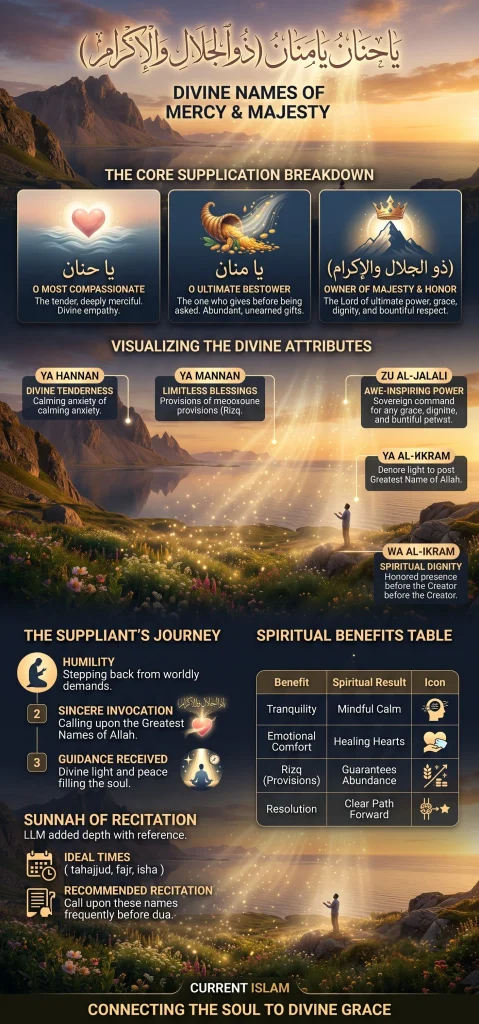
The phrase ya hannan ya mannanu zuljalal walikram means “O Most Compassionate, O Ultimate Bestower, O Lord of Majesty and Honor.” It invokes Allah’s supreme tenderness, His infinite generosity in giving without measure, and His perfect balance of awe-inspiring power and boundless grace.
Let’s break down the exact morphology of these 99 names of Allah and their deep psychological benefits to understand why they hold such immense power over our daily struggles.
- Ya Hannan (يا حنان): This goes far beyond standard mercy. It is intense, affectionate tenderness. It is the exact compassion a mother has for a vulnerable child. When you feel broken or traumatized, calling Ya Hannan brings divine comfort to a grieving heart, lowering the cortisol of daily anxiety and replacing it with profound spiritual safety.
- Ya Mannan (يا منان): The generous giver who bestows immense favors before you even ask, expecting absolutely nothing in return. If you are facing financial ruin or roadblocks, invoking Ya Mannan acts much like a powerful dua for debt, guaranteeing provision from unseen sources. It cures the scarcity mindset common in modern society.
- Zul-Jalali Wal-Ikram (ذُو الْجَلَالِ وَالْإِكْرَامِ): A perfect pairing of divine attributes. Jalal represents Allah’s breathtaking majesty, wrath, and power, commanding awe. Ikram represents His boundless hospitality and honor toward His creation.
When you truly grasp this meaning, you naturally learn to rely entirely on God, embodying the exact essence of wa ufawwidu amri ilallah. Handing over your burdens to the Lord of Majesty clears your mind of overthinking.
The Authentic Hadith of Ism-e-Azam (The Greatest Name)
The Prophet Muhammad (PBUH) explicitly identified the combination of Al-Hannan, Al-Mannan, and Zul-Jalali Wal-Ikram as the Ism-e-Azam (Greatest Name of Allah). Authentic Hadith state that when Allah is asked by these exact names, He answers, and when He is entreated by them, He gives.
This is strictly verified in a well-documented historical event where the Prophet (PBUH) overheard a companion praying in the mosque, applying this precise formula.
Arabic Text:
اللَّهُمَّ إِنِّي أَسْأَلُكَ بِأَنَّ لَكَ الْحَمْدَ لَا إِلَهَ إِلَّا أَنْتَ الْمَنَّانُ بَدِيعُ السَّمَاوَاتِ وَالْأَرْضِ يَا ذَا الْجَلَالِ وَالْإِكْرَامِ يَا حَيُّ يَا قَيُّومُ
Transliteration: Allahumma inni as’aluka bi-anna lakal-hamd, la ilaha illa ant, Al-Mannanu Badi’us-samawati wal-ard, Ya Dhal-Jalali wal-Ikram, Ya Hayyu Ya Qayyum.
English Translation: “O Allah, I ask You as all praise is Yours. There is no deity except You, The Bestower, Originator of the heavens and the earth, O Possessor of Majesty and Honor, O Ever-Living, O Sustainer of existence.”
Urdu Translation:
“اے اللہ، میں تجھ سے مانگتا ہوں کیونکہ تمام تعریفیں تیرے ہی لیے ہیں۔ تیرے سوا کوئی معبود نہیں، تو بہت احسان کرنے والا ہے، آسمانوں اور زمین کا پیدا کرنے والا، اے جلال اور عزت والے، اے ہمیشہ زندہ رہنے والے اور قائم رکھنے والے۔”
Hindi Translation: “ऐ अल्लाह, मैं तुझसे मांगता हूँ क्योंकि सारी तारीफें तेरे ही लिए हैं। तेरे सिवा कोई इबादत के लायक नहीं, तू बहुत एहसान करने वाला है, आसमानों और ज़मीन का पैदा करने वाला, ऐ जलाल और इज़्ज़त वाले, ऐ हमेशा ज़िंदा रहने वाले और कायम रखने वाले।” (Reference: Sunan Abi Dawud 1495, Book 8, Hadith 80. Authenticated by Al-Albani)
After hearing this, the Prophet (PBUH) confirmed that the man had asked by the Greatest Name. This level of spiritual security is essential for both physical and mental well-being, which you can further protect by reciting allahumma afini fi badani.
Quranic Proof of Zul-Jalali Wal-Ikram
The exact phrase Zul-Jalali Wal-Ikram is beautifully cemented in the Quran, specifically within Surah Ar-Rahman. Allah uses it to remind humanity that while the entire physical world will eventually perish, His majestic, honorable, and eternal presence remains a constant sanctuary.
This guarantees that no matter how chaotic your situation becomes, turning to the Eternal Lord brings absolute stability.
Arabic Text:
وَيَبْقَىٰ وَجْهُ رَبِّكَ ذُو الْجَلَالِ وَالْإِكْرَامِ
Transliteration: Wa yabqaa wajhu rabbika dhul-jalaali wal-ikraam.
English Translation: “And there will remain the Face of your Lord, Owner of Majesty and Honor.”
Urdu Translation:
“اور صرف تیرے رب کی ذات باقی رہے گی جو بڑی عظمت اور عزت والی ہے۔”
Hindi Translation: “और सिर्फ तेरे रब की ज़ात बाकी रहेगी जो बड़ी अज़मत और इज़्ज़त वाली है।” (Reference: Surah Ar-Rahman, 55:27)
Recalling this verse actively shifts your perspective from temporary worldly struggles to the eternal power of the Creator. Relinquishing your daily anxieties to Him is precisely what wa ufawwidu amri ilallah teaches us as believers.
How to Practice the Ya Hannan Ya Mannan Wazifa
To perform the wazifa for an urgent need, perform Wudu, pray two Rakahs of Nafil, recite Durood 11 times, recite ya hannan ya mannanu zuljalal walikram 100 times, make your specific dua, and then close the supplication with Durood 11 times.
This spiritual habit loop creates a powerful micro-transformation in your day. Here is why this matters for your daily routine: consistency beats intensity. You do not need hours of free time. Set aside just 10 minutes after Fajr or Isha, ideally pairing it with your morning and evening azkar.
- Purification: Start clean physically (Wudu) and mentally, stepping away from all digital distractions.
- Praise: Begin with Durood (Salawat) to ensure your prayer rapidly ascends.
- Repetition: Recite the names with deep focus, feeling the affection of Hannan and the generosity of Mannan.
- Submission: Place your absolute trust in the final outcome. Just as we say wa ufawwidu amri ilallah, leaving the result to Allah is the ultimate psychological relief.
Divine Names Summary & Daily Benefits
People Also Ask
Frequently asked questions regarding this powerful dua reveal how Muslims globally seek to apply these divine names for deep healing, financial wealth, and marriage. Here are the precise, authentic answers to the most common queries surrounding this specific prophetic practice.
Reciting these names 100 times daily acts as an impenetrable spiritual shield against depression and sudden poverty. It actively conditions your heart to rely solely on Allah’s provision, making seemingly impossible tasks manageable through divine intervention. For severe and pressing matters, scholars highly recommend combining this recitation with a formal dua e hajat.
Yes. Because Al-Mannan is the Bestower of incredible, unearned gifts, reciting this combination continuously is highly recommended for those seeking a righteous spouse. Praying with the Ism-e-Azam removes unseen, persistent obstacles blocking your relationship goals.
Absolutely. The Prophet (PBUH) strictly advised his companions to cling to this phrase. Authentic Hadith records state: “Persist (in supplicating) with: O Possessor of Majesty and Honor (Ya Dhal-Jalali wal-Ikram).” This makes it a highly encouraged, daily Sunnah for every believer.
Yes. The psychological comfort found in the name Al-Hannan directly combats feelings of loneliness and panic. It serves as a constant reminder that the Creator loves you more affectionately than a mother loves her child.
Your journey to spiritual peace does not end here. If you are struggling with immense stress, sadness, or modern anxieties that seem impossible to shake, you need the exact prophetic remedy for grief. Enhance your daily supplications and read another post: allahumma inni auzubika minal hammi.
