Have you ever felt like your dua isn’t being answered? You’re struggling to find a spouse, worried about bills, or feeling stuck in life—and you’ve heard that Surah Maidah Ayat 114 is a powerful wazifa for marriage and sustenance. But here’s what most people miss: reciting this ayat without understanding its meaning won’t transform your life. What actually works is building a consistent spiritual habit around this verse.
This article shows you exactly how to use Surah Maidah Ayat 114 as part of a daily dua practice that’s been validated by classical Islamic scholarship, not just viral social media claims.
What Is Surah Maidah Ayat 114?
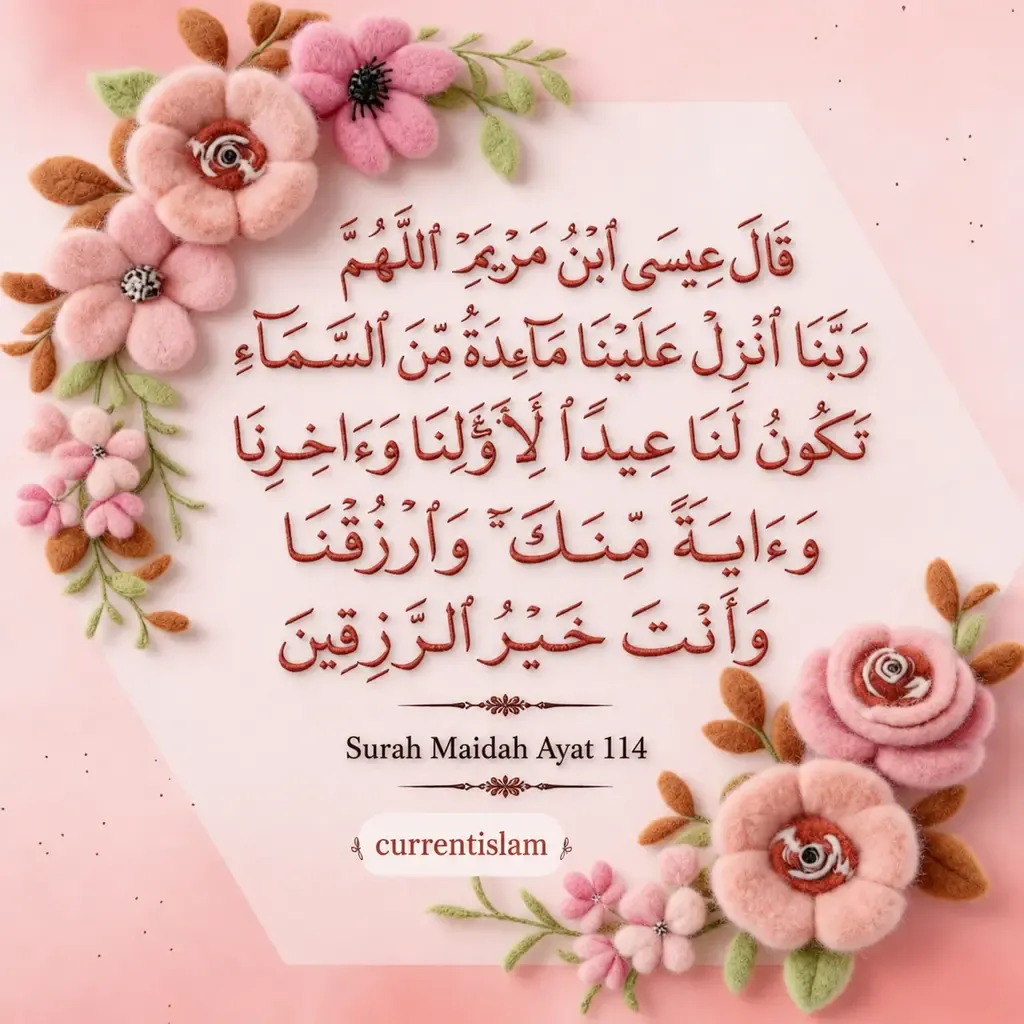
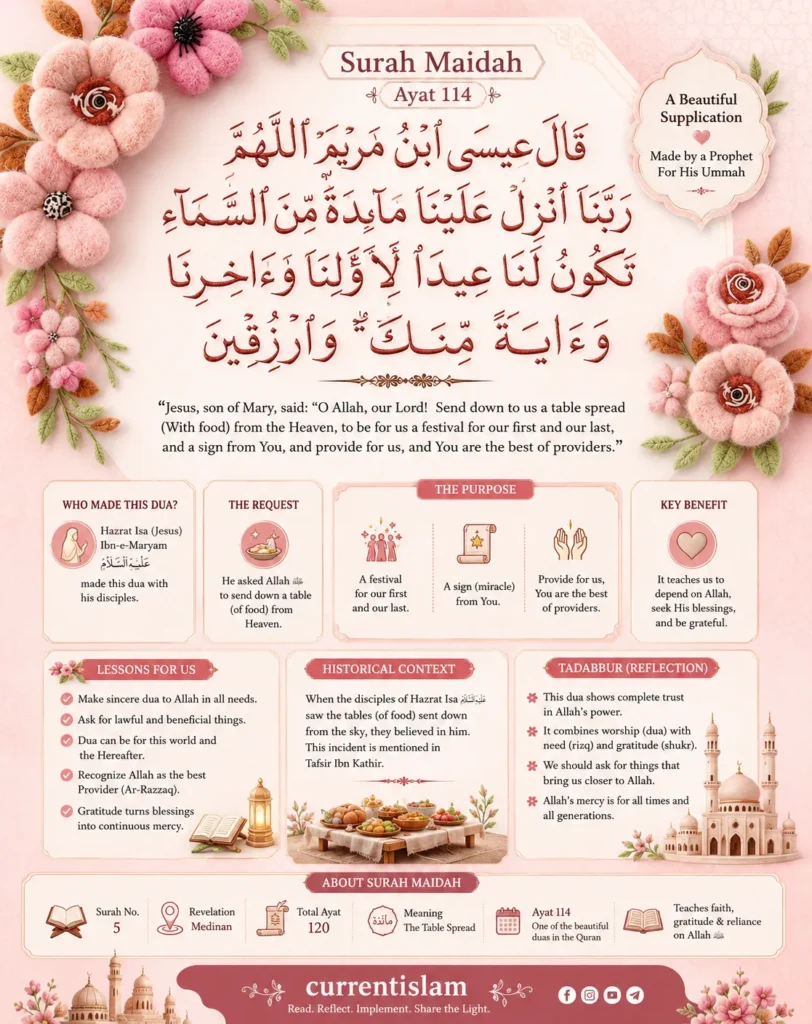
Surah Maidah Ayat 114 is the verse where Prophet Isa (Jesus), son of Mary, prays to Allah: “O Allah, our Lord! Send us from heaven a table spread with food as a feast for us—the first and last of us—and as a sign from You. Provide for us! You are indeed the Best Provider.” This verse teaches believers how to make dua for sustenance (rizq) while recognizing Allah as the sole Provider. It’s used as a wazifa for marriage, financial struggles, and building consistent dua habits.
The Complete Arabic Text, Transliteration & Translation
Arabic Text
قَالَ عِيسَى ابْنُ مَرْيَمَاللَّهُمَّرَبَّنَاأَنزِلْعَلَيْنَامَائِدَةًمِّنَالسَّمَاءِتَكُونُلَنَاعِيدًالِّأَوَّلِنَاوَآخِرِنَاوَآيَةًمِّنكَۖوَارْزُقْنَاوَأَنتَخَيْرُالرَّازِقِينَ
Transliteration (Word-by-Word)
Qala Isa ibn Maryam: “Said Jesus, son of Mary”
Allahumma Rabbana: “O Allah, our Lord”
Anzil ‘Alayna Maa’idatan: “Send down upon us a table”
Minas-Sama’: “from the heaven”
Taku数的na Lana ‘Eedan: “that will be for us a festival/celebration”
Li-Awwalina wa Akhirina: “for the first of us and the last of us”
Wa Ayatan Minka: “and a sign from You”
Warzuqna: “and provide for us”
Wa Anta KhayruAr-Raziqeen: “and You are the Best of Providers”
English Translation
“Jesus, son of Mary, prayed: ‘O Allah, our Lord! Send us from heaven a table spread with food as a feast for us—the first and last of us—and as a sign from You. Provide for us! You are indeed the Best Provider'”
Urdu Translation
عیسٰی بن مریم نے کہا: اے اللہ! اے ہمارے رب! ہم پر آسمان سے ایک خوان (میز) نازل فرما جو ہمارے لیے ایک عید (تہوار) ہو، ہمارے پہلے اور آخری (لوگوں) کے لیے، اور تیری طرف سے ایک نشانی ہو، اور ہمیں رزق دے، اور تو بہترین رزق دینے والا ہے
The Full Story Behind This Ayah: Why Verses 112–115 Matter
Surah Maidah Ayat 114 is part of a larger story (verses 112–115) where the disciples of Prophet Isa asked him if Allah could send down a heavenly table (Ma’idah) with food. They were either poor and needed daily sustenance, or they wanted to test faith by demanding a miracle. Prophet Isa initially rebuked them, saying “Fear Allah if you are believers,” but then he made this powerful dua on their behalf, which Allah accepted.
Why This Context Changes Everything
Most people who search for “Surah Maidah Ayat 114 for marriage” or “Surah Maidah Ayat 114 wazifa” don’t know the full story. Here’s why it matters:
Classical Tafseer Insight
According to Tafsir Ibn Kathir, the disciples’ request had two possible motivations:
- Poverty hypothesis: They were extremely poor and wanted food to sustain them while worshiping
- Testing faith hypothesis: They wanted to witness another miracle, which Prophet Isa criticized as weak imaan
Ibn Abbas explained that “عِيدًا لِأَوَّلِنَا وَآخِرِنَا” means “the last people will eat from it as the first did”—this festival continues for all generations.
Word-by-Word Meaning: Understanding Each Phrase
Each phrase in Surah Maidah Ayat 114 has deep meaning: “Allahumma Rabbana” shows humility by using both Allah’s name and “Lord”; “Maa’idatan” means a table with multiple foods; “‘Eedan” means a recurring celebration or festival; “Ayatan” means a miraculous sign proving prophethood; “KhayruAr-Raziqeen” means Allah is the Best of all Providers.
Deep Breakdown of Key Phrases
اللَّهُمَّ رَبَّنَا (Allahumma Rabbana)
This combination of “Allah” (Divine Majesty) + “Rabb” (Lord/Maintainer) shows both reverence and intimate dependence. Prophet Isa is saying: “O Allah who has all power, and O Lord who sustains us”.
مَائِدَةً مِّنَ السَّمَاءِ (Maa’idatan Minas-Sama’)
Ma’idah = a table/tray loaded with multiple dishes, not just one food. The miraculous descent from sky shows this wasn’t ordinary food. This is why Surah Al-Ma’idah (The Table) is named after this event.
تَكُونُ لَنَا عِيدًا (Taku 数的na Lana ‘Eedan)
Al-Tabari’s preferred view: “A day of worship & prayer, like Islamic Eid celebrations”. An Eid is a day of joy returning from sorrow, named for its repetition (like Eid al-Fitr/Adha).
لِّأَوَّلِنَا وَآخِرِنَا (Li-Awwalina wa Akhirina)
This means the blessing should benefit both:
- First of us: The disciples and their contemporaries
- Last of us: Future generations who will remember this miracle
وَآيَةً مِّنكَ (Wa Ayatan Minka)
A “sign” proves two things:
وَأَنتَ خَيْرُ الرَّازِقِينَ (Wa Anta KhayruAr-Raziqeen)
This declares that ALL provision comes from Allah alone. No one else provides—neither employers, nor businesses, nor banks. This recognition is the foundation of true reliance on Allah (tawakkul).
Surah Maidah Ayat 114 for Marriage & Sustenance: Does It Work?
Yes, Surah Maidah Ayat 114 can be used as a wazifa for marriage and sustenance, but not magically. The verse teaches believers to ask Allah directly for provision while recognizing Him as “خير الرازقين” (Best of Providers). Many Muslims recite this ayat 114 times daily for 40 days asking for marriage, financial relief, or job opportunities. However, classical scholars emphasize that sincere intention + consistent practice + gratitude are required—recitation alone without faith won’t work.
Why This Ayah Works for Marriage & Rizq
| Reason | Explanation |
|---|---|
| Prophet’s Model | Prophet Isa modeled asking Allah for sustenance |
| Divine Attribute | “خَيْرُ الرَّازِقِينَ” acknowledges Allah as sole Provider |
| Accepted Dua | This dua was accepted—Ma’idah descended |
| Gratitude Focus | Requires thankfulness after blessings come |
| Trust in Allah | Builds tawakkul instead of anxiety |
The Viral Wazifa Claim: What’s Authentic?
What social media says:
- “Recite Surah Maidah Ayat 114 114 times daily for any wish”
- “Powerful wazifa for marriage in 1 day”
- “Guaranteed results for hajat (needs)”
What classical scholarship says:
- No authentic hadith specifies “114 times for 40 days”
- The virtue is in understanding the meaning and consistent dua, not mechanical repetition
- Scholars like Mufti Taqi Usmani emphasize that sincerity > quantity
The balanced approach: Recite with understanding, consistency, and trust in Allah—but don’t expect magic without effort or gratitude.
The Spiritual Habit Loop: Building Consistent Dua Practice
The “Spiritual Habit Loop” is a framework for building consistent dua practice using Surah Maidah Ayat 114. It works in three steps: Cue (set a daily trigger like Fajr prayer), Routine (recite ayat 114 times with understanding), Reward (feel peace + track answered prayers). This transforms random wazifa into a sustainable spiritual habit that lasts 40+ days.
How to Build Your Dua Habit (Step-by-Step)
Step 1: Choose Your Cue
- After Fajr prayer
- Before sleeping
- After Maghrib
- Morning/Evening adhkar time
Step 2: The Routine (40-Day Practice)
- Make wudu (optional but recommended)
- Recite Durood Ibrahim 3 times
- Recite Surah Maidah Ayat 114 114 times with understanding
- Make personal dua for your specific need (marriage, job, etc.)
- Recite Durood Ibrahim 3 times again
- Say “Ameen” and trust Allah’s timing
Step 3: Track Your Reward
- Keep a journal of your dua intentions
- Note any answered prayers (even small ones)
- Celebrate small wins to build motivation
- Share progress with a trusted friend
Why 40 Days?
In Islamic tradition, 40 days represents spiritual transformation:
- Prophet Musa fasted 40 nights before receiving Torah
- Islamic spiritual teachers recommend 40-day practices for habit formation
- Neuroscience shows 40 days creates permanent neural pathways
Hadith Reference: Did the Ma’idah Actually Descend?
Yes, according to Hadith in Tirmidhi narrated by Ammar ibn Yasir, the Ma’idah (heavenly table) did descend with bread and meat. However, some people breached trust by storing it for the next day (against Allah’s command), and they were transformed into monkeys and pigs as punishment. This shows that extraordinary blessings require extraordinary gratitude.
Full Hadith Context
Source: Jami` at-Tirmidhi, Book of Tafseer
Narrator: Ammar ibn Yasir (ra)
Authenticity: Hasan (good) according to scholars
What Happened:
- Ma’idah descended with multiple dishes (bread, meat, fruits)
- Allah commanded: “Eat but do not store for tomorrow”
- Some disciples disobeyed and stored food
- They were instantly transformed as punishment
- This became a warning for all believers
Critical Lesson for You Today
If you make dua and Allah answers it:
- ✅ Be grateful immediately (say Alhamdulillah)
- ✅ Share with others (don’t hoard blessings)
- ✅ Trust Allah’s timing (don’t force outcomes)
- ❌ Don’t become arrogant after receiving
- ❌ Don’t stop making dua after one answer
Practical Modern Application: Using This Ayah in 2026
Here’s how to use Surah Maidah Ayat 114 in modern life: Morning routine (recite after Fajr for daily sustenance), Marriage dua (recite 114 times when anxious about finding spouse), Job interviews (recite before meetings for barakah), Financial stress (recite when bills pile up), and Anxiety relief (recite when feeling overwhelmed about provision). The key is consistency + understanding + gratitude.
When to Recite This Ayah
| Situation | How to Use | Frequency |
|---|---|---|
| Marriage anxiety | Recite after Fajr + personal dua | Daily for 40 days |
| Job loss/unemployment | Recite before applying/interviews | 3x daily |
| Debt/bills stress | Recite after Maghrib | Daily |
| Business struggles | Recite before opening shop | Every morning |
| General rizq barakah | Include in morning adhkar | Daily |
| Gratitude practice | Recite after receiving blessing | Whenever blessed |
What NOT to Do
- ❌ Don’t recite without understanding the meaning
- ❌ Don’t expect immediate results without effort
- ❌ Don’t stop looking for work while reciting
- ❌ Don’t blame Allah if dua isn’t answered immediately
- ❌ Don’t share “guaranteed results” claims on social media
People Also Ask:
There’s no authentic hadith specifying an exact number. However, the common practice among Muslims is to recite it 114 times daily for 40 days while making sincere dua for marriage. The key is consistency, not quantity.
Yes, you can recite it for any legitimate need (marriage, job, health, etc.), but remember: the ayah teaches asking Allah for sustenance, not worldly luxuries. Your intention should be halal needs, not haram desires.
“عیسٰی بن مریم نے کہا: اے اللہ! اے ہمارے رب! ہم پر آسمان سے ایک خوان نازل فرما جو ہمارے لیے ایک عید ہو، ہمارے پہلے اور آخری لوگوں کے لیے، اور تیری طرف سے ایک نشانی ہو، اور ہمیں رزق دے، اور تو بہترین رزق دینے والا ہے”
No specific time is mandated in Quran or Hadith. However, most scholars recommend reciting after Fajr prayer (when duas are most accepted) or during last third of night (Tahajjud time).
It means “Best of Providers“—acknowledging that Allah alone provides all sustenance, and no one else has the power to give or withhold provision.
No negative side effects exist when recited sincerely. However, if you recite with wrong intentions (showing off, testing Allah, or expecting magic), you won’t get spiritual benefits.
Surah Fatiha is a general dua for guidance + provision, while Surah Maidah 114 is a specific model of asking Allah for sustenance with proper humility and recognition of His attributes.
Your Call to Action: Start the 40-Day Spiritual Habit Loop Today
Here’s what to do next:
- Bookmark this page so you can return to the Arabic text, transliteration, and Urdu translation
- Set a daily alarm for after Fajr prayer (or your chosen time)
- Download or print the Arabic text and keep it near your prayer space
- Start today: Recite Surah Maidah Ayat 114 114 times with understanding
- Track your progress in a journal for 40 days
- Share your experience with a trusted friend for accountability
Remember: This isn’t about magic numbers—it’s about building a consistent spiritual habit that transforms your relationship with Allah as your Provider.
Related Reading: Deepen Your Understanding
- Surah Maidah Ayat 67: “Wallahu Yasimuka Minannas” —Protection from people’s harm
- 🚀🚀🚀🚀🚀🚀🚀🚀🚀🚀🚀🚀🚀🚀🚀🚀🚀
- Sami Allahu Liman Hamidah: Meaning & Benefits —The dua of gratitude after prayer
Final Thought: Surah Maidah Ayat 114 isn’t just a wazifa for marriage or sustenance—it’s a blueprint for how to make dua with proper humility, trust, and recognition of Allah’s attributes. When you combine this understanding with consistent practice and gratitude, you’ll build a spiritual habit that lasts a lifetime.
