Written in the voice of Shahab Khan, [SCHOLAR CREDENTIALS]. Reviewed by [ATIF KHAN]. Last reviewed: [5, October 2026].
You heard “innal muslimina wal muslimat” in a recitation, or a relative sent you a voice note about it. Now you want to know what it means, and whether it can help with the need weighing on your heart.
[SCHOLAR ANECDOTE: [A Short Real Story:]
This specific interaction is recorded in major foundational texts of Hadith and Tafsir (Quranic exegesis):
Tafsir Ibn Kathir: One of the most authoritative classical commentaries on the Quran cites these exact interactions as the direct catalyst for Surah Al-Ahzab Ayat 35.]
Musnad Ahmad: Imam Ahmad recorded that Umm Salama (the Prophet’s wife) said to him: “I do not hear Allah mentioning women in the Quran regarding migration.” Shortly after, this verse was revealed.
Sunan At-Tirmidhi: Another authentic narration (Hadith 3211) records a similar incident where a female companion named Umm ‘Umarah Al-Ansariyyah came to the Prophet and said: “I see that everything is for men, and I do not see women being mentioned for anything.” This verse was then revealed in response.
Surah al-Ahzab 33:35 is the verse that names ten pairs of qualities, each for men and women, and promises all of them forgiveness and a great reward. A surah is a chapter of the Quran. An ayah is a verse.
Online, this verse is often tied to repetition counts and guaranteed results. We could not find those claims in the tafsir (Quran commentary) works we checked. What the verse does give you is a clear picture of what Allah loves in His servants. This guide explains it, then gives you a one-minute habit: the Ten-Finger Check.
Quick Answer
- It is Surah al-Ahzab (chapter 33), verse 35, revealed in Madinah.
- It lists ten qualities for men and women equally, then promises forgiveness and a great reward.
- No fixed wazifa count appears in the tafsir works we reviewed [VERIFY: scholar to confirm]. Use the Ten-Finger Check instead.
Contents
- Which surah is “innal muslimina wal muslimat”?
- What does 33:35 mean?
- Why was it revealed?
- Is there a wazifa or a repetition count?
- What is the Ten-Finger Check?
- How do you apply it at work or school?
- What mistakes do people make?
- FAQ
Which surah and verse is “Innal Muslimina wal Muslimat”?
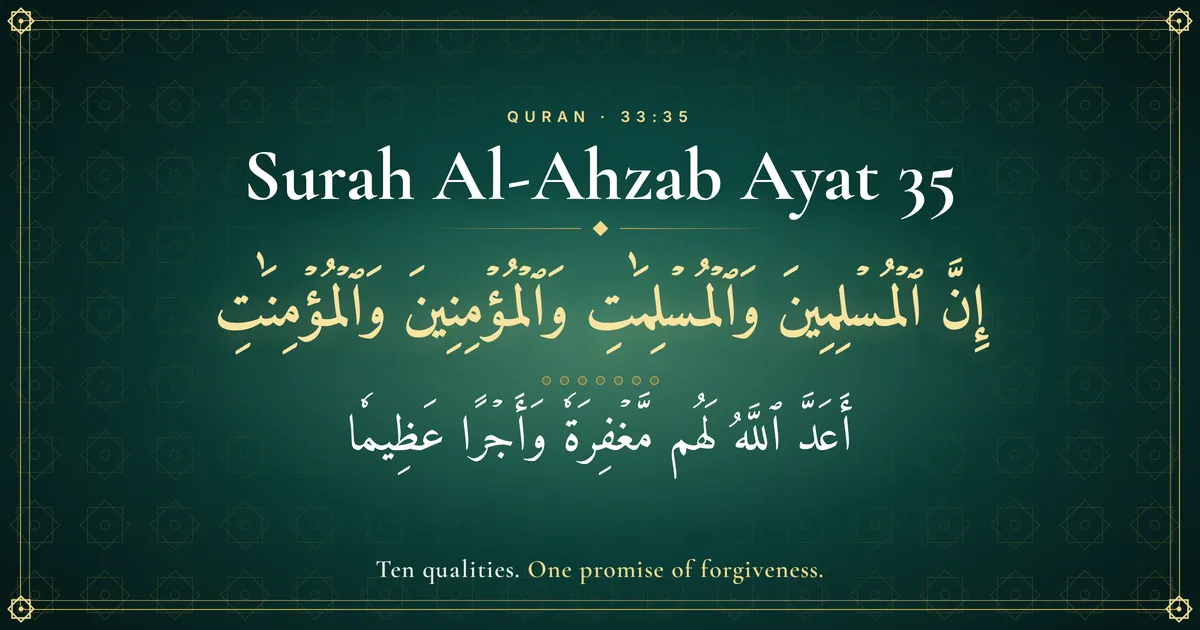
It is Surah al-Ahzab (the Confederates), chapter 33 of the Quran, verse 35. The surah was revealed in Madinah. The verse begins with the words “Inna al-muslimina wal-muslimat”, meaning “Indeed, the Muslim men and Muslim women”, and ends with a promise of forgiveness and reward.
إِنَّ ٱلۡمُسۡلِمِينَ وَٱلۡمُسۡلِمَٰتِ وَٱلۡمُؤۡمِنِينَ وَٱلۡمُؤۡمِنَٰتِ وَٱلۡقَٰنِتِينَ وَٱلۡقَٰنِتَٰتِ وَٱلصَّٰدِقِينَ وَٱلصَّٰدِقَٰتِ وَٱلصَّٰبِرِينَ وَٱلصَّٰبِرَٰتِ وَٱلۡخَٰشِعِينَ وَٱلۡخَٰشِعَٰتِ وَٱلۡمُتَصَدِّقِينَ وَٱلۡمُتَصَدِّقَٰتِ وَٱلصَّٰٓئِمِينَ وَٱلصَّٰٓئِمَٰتِ وَٱلۡحَٰفِظِينَ فُرُوجَهُمۡ وَٱلۡحَٰفِظَٰتِ وَٱلذَّٰكِرِينَ ٱللَّهَ كَثِيرٗا وَٱلذَّٰكِرَٰتِ أَعَدَّ ٱللَّهُ لَهُم مَّغۡفِرَةٗ وَأَجۡرًا عَظِيمٗا
Innal muslimeena wal muslimaati wal mu’mineena wal mu’minaati walqaaniteena walqaanitaati wassaadiqeena wassaadiqaati wassaabireena wassaabiraati walkhaashi’eena walkhaashi’aati walmutasaddiqeena walmutasaddiqaati wassaaa’imeena wassaaa’imaati walhaafizeena furoojahum walhaafizaati waz zaakireenal laaha kaseeranw waz zaakiraati a’addal laahu lahum maghfiratanw wa ajran ‘azeemaa
“Indeed, the Muslim men and Muslim women, the believing men and believing women, the obedient men and obedient women, the truthful men and truthful women, the patient men and patient women, the humble men and humble women, the charitable men and charitable women, the fasting men and fasting women, the men who guard their private parts and the women who do so, and the men who remember Allah often and the women who do so – for them Allah has prepared forgiveness and a great reward.”
Source: Quran 33:35. Translation: Sahih International. Arabic text as shown on Quran.com. [ATIF KHAN: Arabic and transliteration checked by reviewer]
What does Surah al-Ahzab 33:35 mean?
The verse says Allah’s forgiveness and reward depend on faith and conduct, not on being male or female. It names ten qualities, pairs each one for men and women, and promises all who live them forgiveness and a great reward.
Here are the ten qualities, with what each looks like in daily life. The explanations draw on Ibn Kathir and Abul A’la Maududi.
| # | Arabic (men / women) | Meaning | In daily life |
|---|---|---|---|
| 1 | الْمُسْلِمِينَ / الْمُسْلِمَاتِ | Those who submit to Allah | Following Allah’s guidance when it is inconvenient |
| 2 | الْمُؤْمِنِينَ / الْمُؤْمِنَاتِ | Believers | Faith that shows in action, not only in words |
| 3 | الْقَانِتِينَ / الْقَانِتَاتِ | Devout, obedient | Praying on time, including the prayer no one sees |
| 4 | الصَّادِقِينَ / الصَّادِقَاتِ | Truthful | Honest words in emails, exams, and small talk |
| 5 | الصَّابِرِينَ / الصَّابِرَاتِ | Patient | Staying steady when a hard thing first hits |
| 6 | الْخَاشِعِينَ / الْخَاشِعَاتِ | Humble (khushu) | Calm, humble focus before Allah |
| 7 | الْمُتَصَدِّقِينَ / الْمُتَصَدِّقَاتِ | Charitable (sadaqah) | Giving to people in need, even small amounts |
| 8 | الصَّائِمِينَ / الصَّائِمَاتِ | Fasting | Ramadan fasts and voluntary fasts |
| 9 | الْحَافِظِينَ فُرُوجَهُمْ / الْحَافِظَاتِ | Guarding chastity | Staying away from unlawful relationships and guarding modesty |
| 10 | الذَّاكِرِينَ اللَّهَ كَثِيرًا / الذَّاكِرَاتِ | Remembering Allah often | Dhikr (remembrance of Allah) in every state of the day |
[VERIFY: Arabic in the table checked by reviewer. It is shown without full tashkeel for table readability; add full tashkeel if preferred.]
Ibn Kathir describes patience as hardest at the first shock of a trial. He also quotes Sa’id ibn Jubayr: whoever fasts Ramadan and three days of each month is included among the fasting. More on Allah being with the patient.
On dhikr, Ibn Kathir cites a report recorded by Abu Dawud, an-Nasa’i, and Ibn Majah. It says a husband and wife who wake at night and pray two rak’ahs are written that night among those who remember Allah often. [HADITH EDITION: number and grading to confirm.] Mufti Muhammad Shafi writes that dhikr needs no special setting: it can be done with or without wudu, sitting, lying, or walking. Our morning and evening azkar guide gives you a simple start.
Why was Surah al-Ahzab 33:35 revealed?
Reports say Umm Salamah, a wife of the Prophet ﷺ, asked why women were not mentioned in the Quran as men were. Soon after, the Prophet ﷺ recited this verse. Ibn Kathir cites Imam Ahmad, and says al-Nasa’i and Ibn Jarir recorded it too.
In Imam Ahmad’s report, Umm Salamah was combing her hair when she heard the Prophet ﷺ on the minbar (pulpit) say, “O people, Allah says…” and then recite the verse. She tied her hair and went to listen. Similar reports appear in Tirmidhi 3211 [HADITH EDITION: Sunnah.com numbering; grading VERIFY]. Mufti Shafi adds that other women, including Umm Umarah al-Ansariyyah, asked similar questions, and that the Tirmidhi report on her is graded hasan (good).
Wording differs between narrations. See also Surah Al-Ahzab verse 33.
Is there a wazifa for 33:35? How many times should I recite it?
We found no report that sets a repetition count, time, or guaranteed result for this verse in four tafsir works: Ibn Kathir, Maududi, Mufti Shafi Usmani, and Wahiduddin Khan. Treat any fixed number you see online as unsourced until a scholar shows the chain.
A wazifa is a set practice of repeated recitation, often for a specific need. That does not make the verse useless for your need. Reading the Quran with understanding is worship. Asking Allah directly in dua (personal supplication) is also encouraged. Our guide on how to make dua shows the steps, and dua e hajat is a prayer for needs.
The verse teaches the qualities Allah loves, and you can work on those today. Dua complements effort and professional help. It does not replace it. See a financial advisor for money stress and a doctor or counselor for health or emotional strain. No one can promise an outcome. Allah decides.
What is the Ten-Finger Check?
The Ten-Finger Check is a one-minute evening habit built on 33:35. Hold up both hands, fold one finger for each of the ten qualities you practiced today, then ask Allah to help with the fingers still open. It is a reflection tool, not a Sunnah ritual.
Start tonight:
- After Isha, hold up both hands, fingers open.
- Go through the ten qualities in order, quietly. Fold a finger when you did it today, even in a small way.
- For fasting and charity, fold the finger if you did it this week.
- Look at the open fingers. Pick one.
- Ask Allah, in your own words, to help you with that quality.
- Tomorrow, give that one quality one small action.
Looking at your own day honestly is called muhasabah (self-accounting). This check makes it short enough to keep. The verse’s promise is forgiveness and reward, so end by asking Allah to forgive what you missed. Our dua for forgiveness page has words you can use.
Innal muslimina wal muslimat PDF
Save this: [PDF DOWNLOAD LINK: “Ten-Finger Check” printable card]
How do you apply 33:35 at work, at school, or as the only Muslim in the room?
Pick the quality your day tests most. At work, truthfulness shows in honest emails. At school, patience shows under exam stress. When you are the only Muslim in the room, quiet dhikr (remembering Allah) and a polite no to what Allah forbids are good places to start.
On a commute, use the time for dhikr. For charity, set up a small monthly donation so it does not depend on your mood. Related reading: Surah Yunus 10:9 on reward for believers, and Al-Ahzab verse 56 on durood.
What mistakes do people make with this verse?
The most common mistakes are treating the verse as a magic formula, trusting unsourced repetition counts, and skipping the qualities while chasing the result. The verse describes a way of living. The verse promises forgiveness and a great reward, not a specific worldly outcome.
- Using it as a marriage or rizq formula. The verse does not mention marriage or provision. Rizq means the provision Allah gives you.
- Believing a number you cannot trace. Ask for the source and the chain.
- Reading it as only for women, or only for men. Every quality is named for both.
- Reciting without meaning. The qualities are the message.
Frequently asked questions
It is in Surah al-Ahzab, chapter 33, verse 35. The surah was revealed in Madinah and has 73 verses. The verse lists ten pairs of qualities for men and women and ends with Allah’s promise of forgiveness and a great reward for them.
The full Sahih International translation is in the verse block above. In short: Allah has prepared forgiveness and a great reward for Muslim, believing, devout, truthful, patient, humble, charitable, fasting, chaste, and often-remembering men and women. Translations differ slightly in words such as “devout” and “obedient”.
We found no report that sets a number in the tafsir works we reviewed. Any count you see online needs a source. A safer habit is to read it with its meaning, then make dua for your need in your own words. Ask your scholar if you want more guidance.
The verse itself does not mention marriage or provision. It names ten qualities and promises forgiveness and reward. Some people use it as a wazifa, but we found no source for that in the tafsir works we reviewed. You can make dua for marriage or rizq separately.
The verse names men and women side by side for every quality and promises the same forgiveness and reward to both. Maududi adds that roles in life may differ, but equal qualities bring equal standing with Allah. Equality here is about worth in Allah’s sight, not identical duties.
Khashi’in means those who show khushu, a humble, calm awareness of Allah. Ibn Kathir describes khushu as serenity, tranquility, deliberation, dignity, and humility, driven by fear of Allah and knowing He is watching. Maududi reads it as pointing to prayer, given the order of the verse.
Next steps
Sources: Quran.com 33:35; Tafsir Ibn Kathir (abridged); Maududi, Tafhim al-Quran; Mufti Muhammad Shafi, Ma’arif al-Quran; Wahiduddin Khan, Tazkirul Quran. This article is educational. It does not replace advice from a qualified doctor, counselor, or financial professional. Reviewed by ATIF KHAN on [5, October 2026].
